Page 119 of 362
Downloaded from www.Manualslib.com manuals search engine Engine Coolant Temperature Gage
0
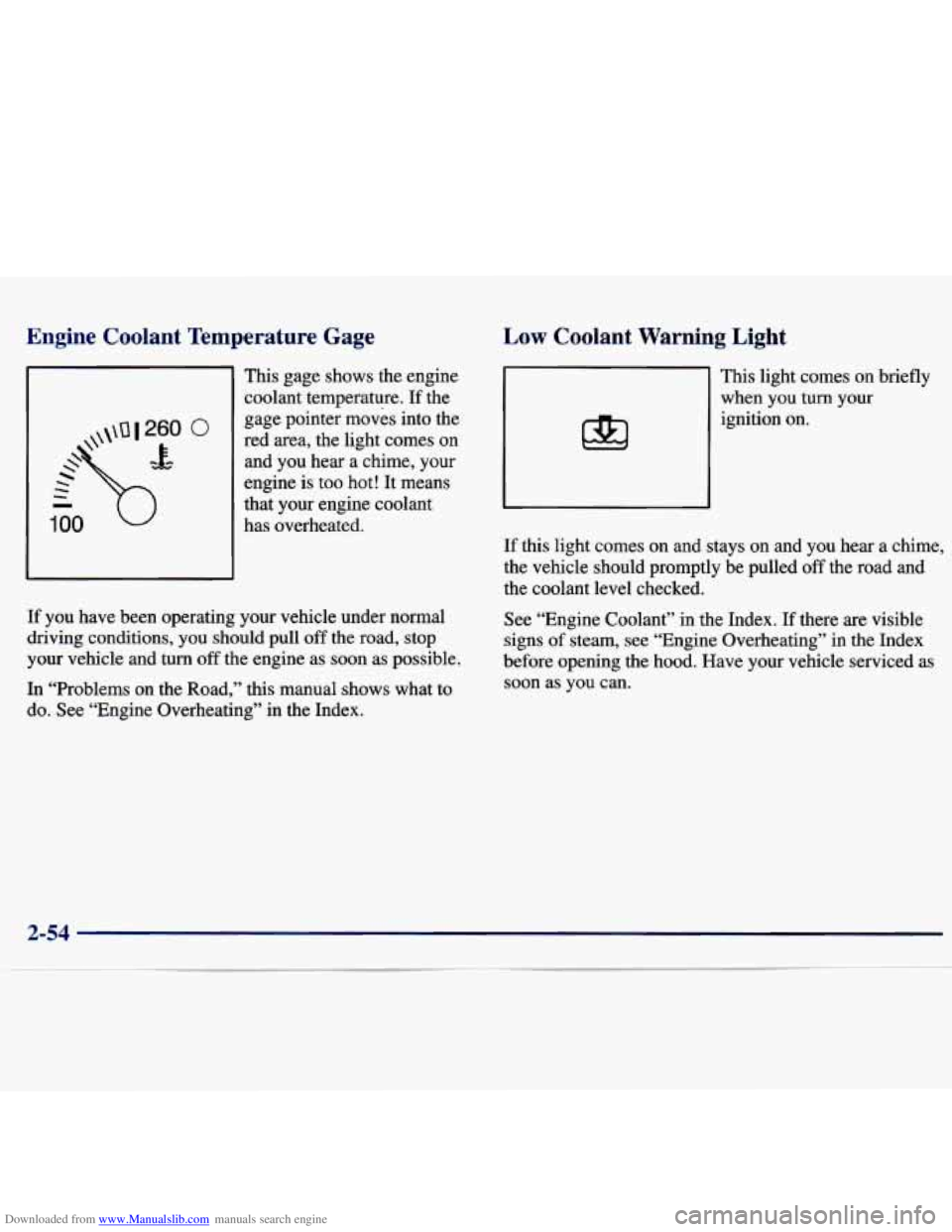
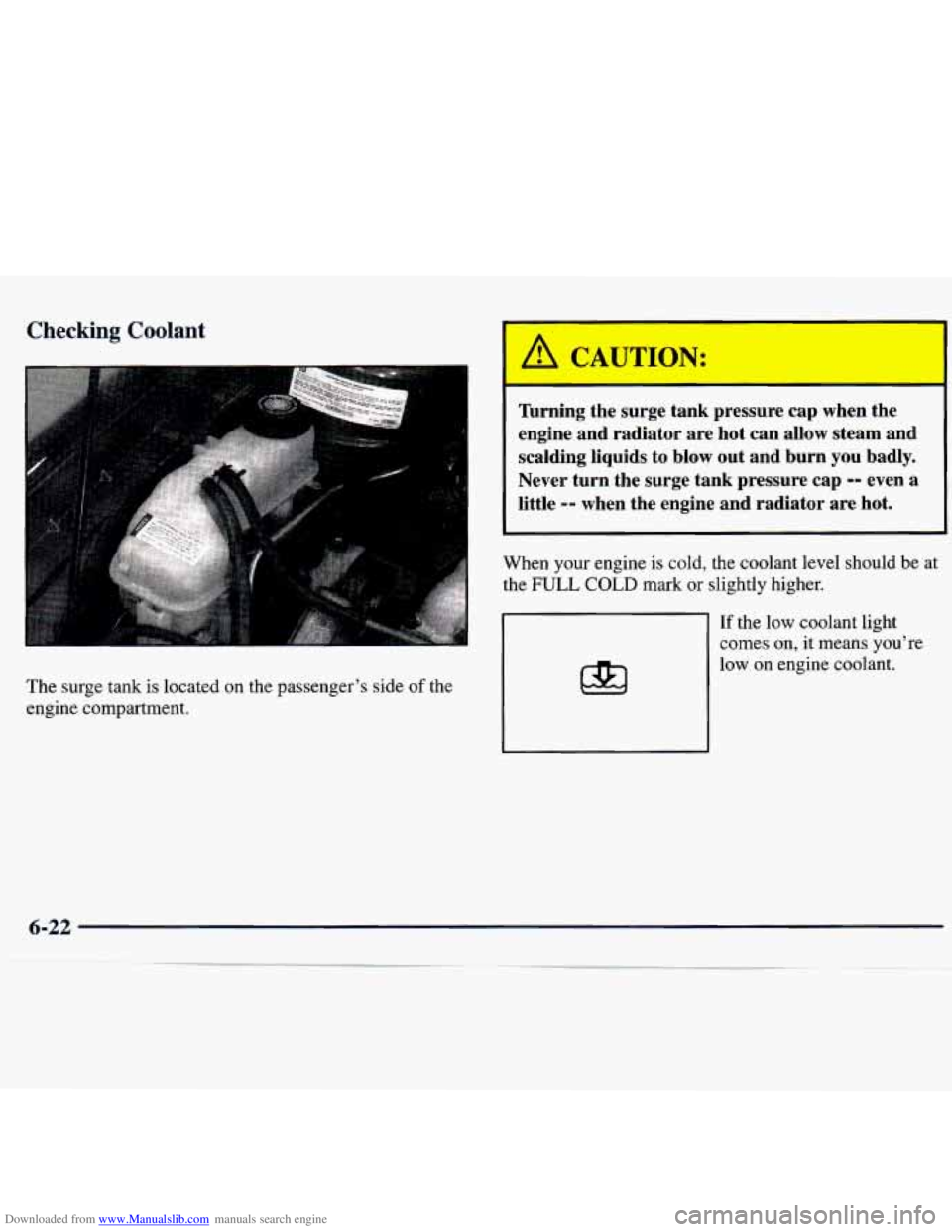
This gage shows the engine
coolant temperature.
If the
gage pointer moves into the
red area, the light comes on
and you hear a chime, your
engine is too hot! It means
that your engine coolant
has overheated.
If you have been operating your vehicle under normal driving conditions, you should pull
off the road, stop
your vehicle
and turn off the engine as soon as possible.
In “Problems on the Road,” this manual shows what to
do. See “Engine Overheating” in the Index.
Low Coolant Warning Light
&I This light comes on briefly
I when you turn your
If this light comes on and stays on and you hear a chime,
the vehicle should promptly be pulled off the road and
the coolant level checked.
See “Engine Coolant” in the Index. If there are visible
signs
of steam, see “Engine Overheating” in the Index
before opening the hood. Have your vehicle serviced as
soon as you can.
Page 131 of 362
Downloaded from www.Manualslib.com manuals search engine For quick cool-down on very hot days, use vent with the
temperature knob
all the way in the blue area and the
NC and recirculation buttons pressed. If this setting is
used for long periods of time, the air in your vehicle
may become too dry.
For normal cooling on hot days, use vent with the
temperature knob
in the blue area and the A/C button
pushed
in. The system will bring in outside air and cool it.
Heating
On cold days, use FLOOR and the outside air button
with the temperature knob all the way in the red area.
The system will bring in outside air, heat it and send it to
the floor outlets.
Your vehicle has heat ducts that are directed toward
the rear seat. Keep the area under the front seats clear
of obstructions
so the heated air can reach the rear
seat passengers.
If your vehicle has an engine coolant heater, you can
use it to help your system provide warm air faster when
it’s cold outside (0°F (-18°C) or lower). An engine
coolant heater wms the coolant your engine and
heating system uses to provide heat. See “Engine
Coolant Heater” in the Index.
Defogging and Defrosting Windows
Your system has two settings for clearing the front and
side windows. For each setting, adjust the temperature
control as desired.
To defrost the front window quickly, rotate the
temperature control knob all the way in the red area.
Use defrost and adjust the fan to the highest speed.
To warm passengers while keeping the front window
clean, use defog.
Your vehicle is equipped with side window defogger
vents. The side window defogger vents are located on
the outside of the side instrument panel vents.
To defrost
the side windows, rotate the temperature control knob
all
the way in the red area. Use FLOOR and adjust the
fan to the highest speed.
To control fogging of the
windows, rotate the temperature control knob all the
way in the red area. Use DEFOG and adjust the fan to
the highest speed.
To defog the side windows while using air conditioning,
use BI-LEVEL and adjust the fan to the highest speed and press the
A/C button. For additional airflow to the
side windows, aim the side vents toward the windows
and close the center vents.
Recirculation will not work in defrost and defog. This is
done to prevent recirculation of humid inside air and
allow the system to work properly.
3-4
Page 203 of 362
Downloaded from www.Manualslib.com manuals search engine Engine Overheating
You will find a coolant temperature gage on your
vehicle’s instrument panel. See “Engine Coolant
Temperature Gage” in the Index.
You will also find a
low coolant level warning light on your vehicle’s
instrument panel. See
“Low Coolant Warning Light” in
the Index.
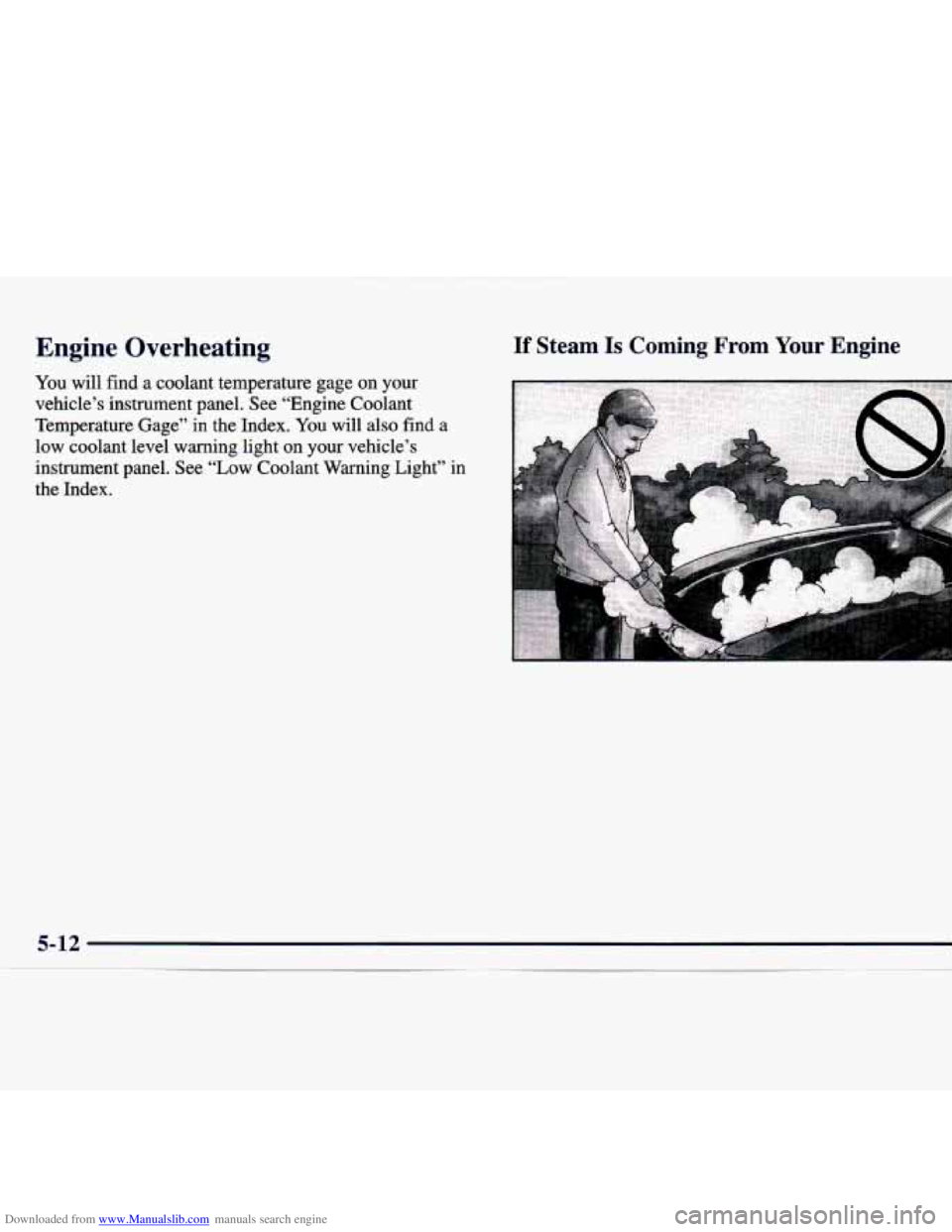
If Steam Is Coming From Your Engine
Page 207 of 362
Downloaded from www.Manualslib.com manuals search engine h ‘JTTION:
An electric engine cooling fan under the hood can
start
up even when the engine is not running and
can injure you. Keep hands, clothing and tools
away
-i from any underhood electric fan.
If the coolant inside the coolant surge tank is boiling,
don’t do anything else until it
cools down.
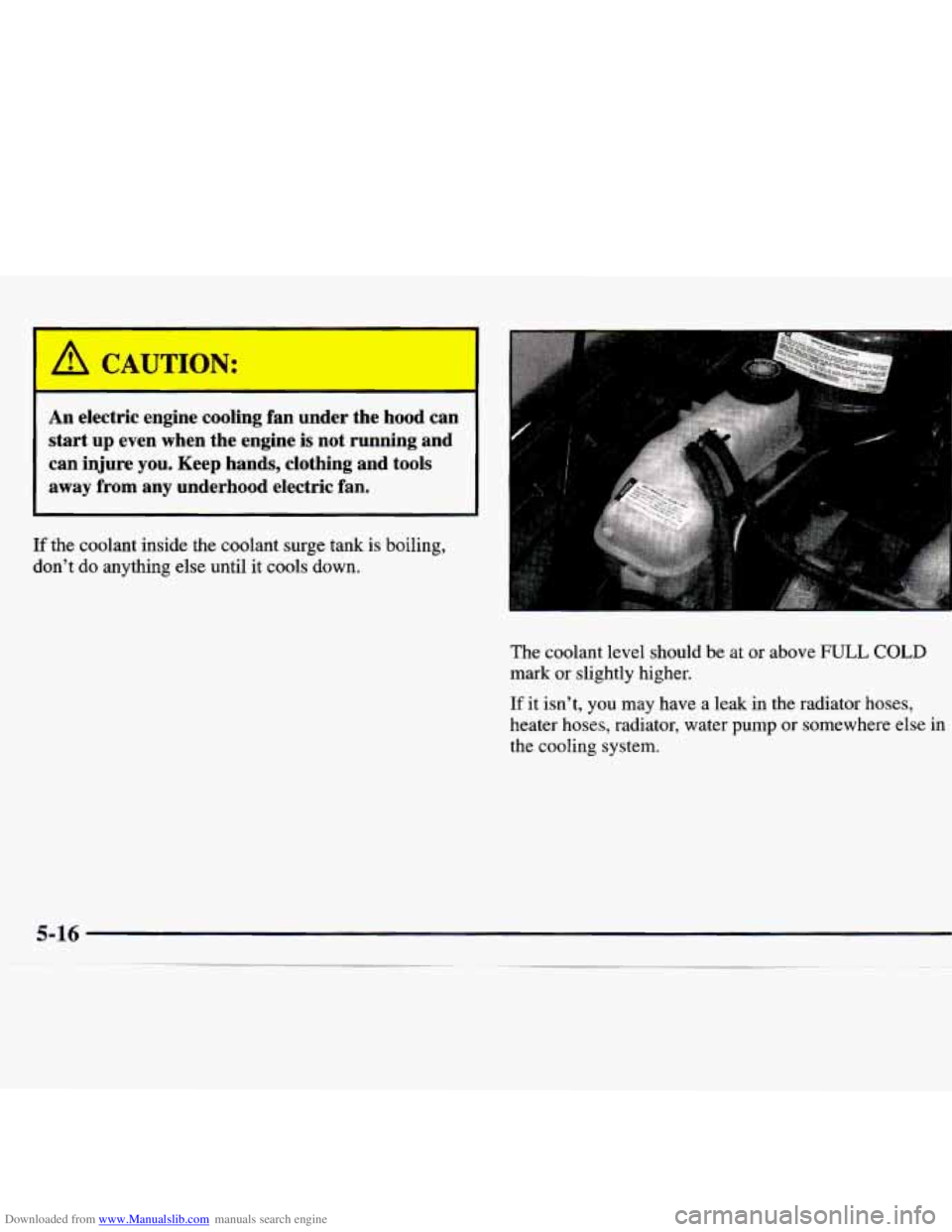
The coolant level should
be at or above FULL COLD
mark or slightly higher.
If it isn’t, you may have a leak in the radiator hoses,
heater hoses, radiator, water
pump or somewhere else in
the cooling system.
Page 208 of 362
Downloaded from www.Manualslib.com manuals search engine Heater and radiator hoses, and other engine
parts, can be
very hot. Don’t touch them. If you
do, you can be burned.
Don’t run the engine
if there is a leak. If you run
the engine, it could lose all coolant. That could
cause an engine fire, and you could be burned.
Get any leak fixed before you drive the vehicle.
NOTICE:
Engine damage from running your engine
without coolant isn’t covered by your warranty.
If there seems to be no leak, with the engine on, check to
see if the electric engine cooling fans are running.
If the
engine is overheating, both fans should be running.
If
they aren’t, your vehicle needs service.
How to Add Coolant to the Coolant
Surge Tank
If you haven’t found a problem yet, but the coolant level
isn’t at FULL COLD mark or slightly higher, add a
50/50 mixture of clean water (preferably distilled) and
DEX-COOL’ coolant at the coolant surge tank, but be
sure the cooling system, including the coolant surge tank
pressure cap, is cool before you do it. (See “Engine
Coolant” in the Index for more information.)
Steam and scalding liquids from a hot cooling
system can blow out and burn you badly. They
are under pressure, and if you turn the coolant
surge tank pressure cap
-- even a little -- they
can come out at high speed. Never turn the cap
when the cooling system, including the coolant
surge tank pressure cap, is hot. Wait for the
cooling system and coolant surge tank pressure
cap to cool if you ever have to turn the
pressure cap.
5-17
Page 212 of 362
Downloaded from www.Manualslib.com manuals search engine .. .
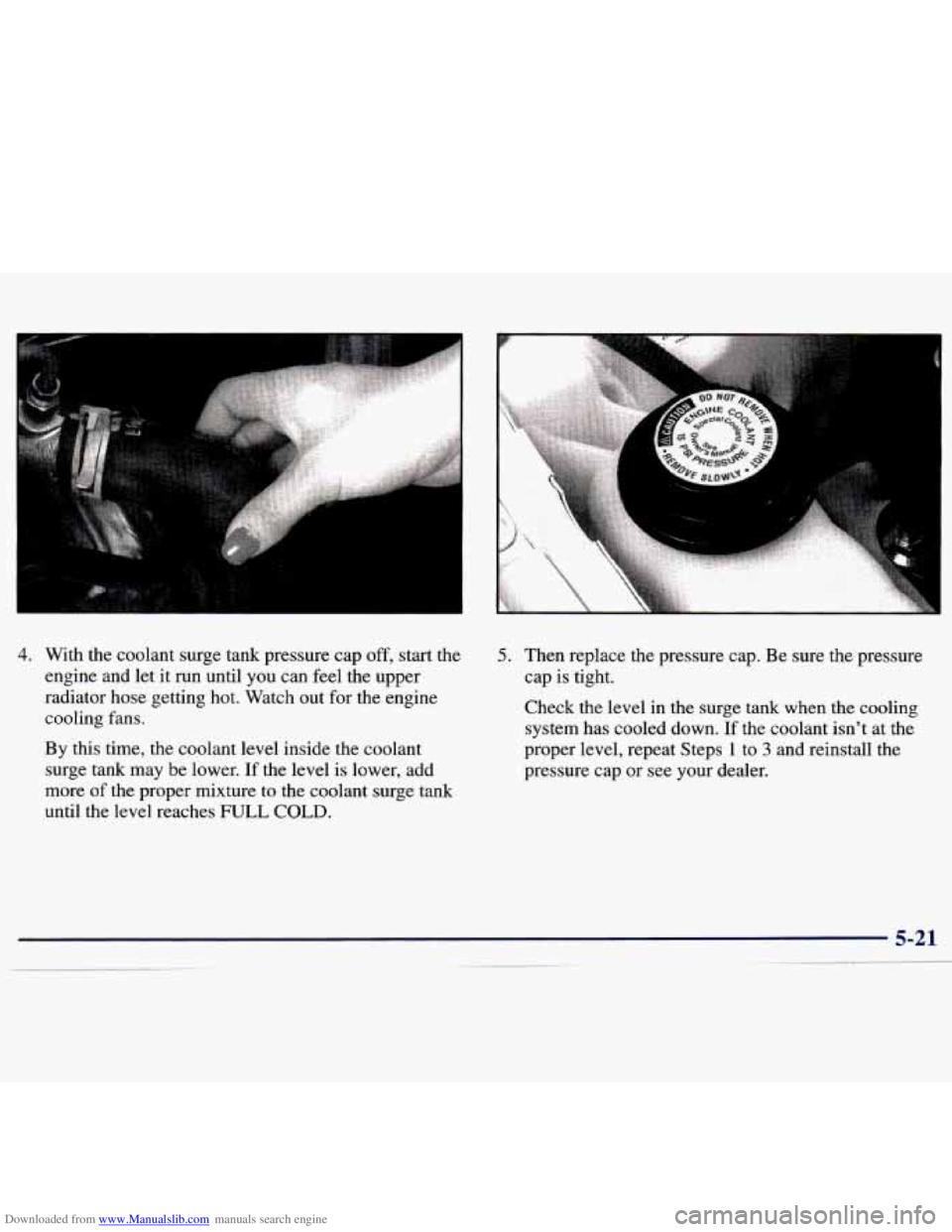
4. With the coolant surge tank pressure cap off, start the
engine and let it run until
you can feel the upper
radiator hose getting hot. Watch out for the engine
cooling fans.
By this time, the coolant level inside the coolant
surge
tank may be lower. If the level is lower, add
more of the proper mixture to the coolant surge tank
until the level reaches
FULL COLD.
5. Then replace the pressure cap. Be sure the pressure
cap
is tight.
Check the level in the surge tank when the
cooling
system has cooled down. If the coolant isn't at the
proper level, repeat Steps
1 to 3 and reinstall the
pressure cap or
see your dealer.
5-21
Page 226 of 362
Downloaded from www.Manualslib.com manuals search engine Section 6 Service and Appearance Care
Here you will find information about the care of your vehicle. This section begins with service and fuel information,
and then it
shows how to check important fluid and lubricant levels. There is also technical information about your
vehicle, and a part devoted to its appearance care.
6-2
6-3
6-5
6- 5
6-7
6- 8
6- 12
6-18 6- 19
6-20
6-23
6-23
6-24
6-25
6- 26
6-30 Service
Fuel
Fuels in Foreign Countries
Filling Your Tank
Filling a Portable Fuel Container
Checking Things Under the Hood
Engine Oil
Air Cleaner
Automatic Transaxle Fluid
Engine Coolant
Surge Tank Pressure Cap
Thermostat
Power Steering Fluid
Windshield Washer Fluid
Brakes
Battery 6-3
1
6-37
6-45
6-46
6-48
6-49
6-50
6-5 1 6-53
6-54
6-55
6-6
1
6-62
6-62
6-63
6-63 Bulb Replacement
Tires Appearance Care
Cleaning the Inside of Your Vehicle
Care of Safety Belts
Cleaning the Outside of Your Vehicle
Cleaning Aluminum Wheels (If Equipped)
Finish Damage Appearance Care Materials Chart
Vehicle Identification Number (VIN)
Electrical System
Replacement Bulbs Capacities and Specifications
Air Conditioning Refrigerants
Normal Maintenance Replacement Parts
Vehicle Dimensions
Page 247 of 362
Downloaded from www.Manualslib.com manuals search engine Checking Coolant
The surge tank is located on the passenger’s side of the
engine compartment.
Thrning the surge tank pressure cap when the
engine and radiator are hot can allow steam and
scalding liquids to blow out and burn you badly.
Never turn the surge tank pressure cap
-- even a
little
-- when the engine and radiator are hot.
When your engine is cold, the coolant level should be at
the
FULL COLD mark or slightly higher.
1
If the low coolant light
comes on, it means you’re
6-22