1998 CHEVROLET MALIBU heating
[x] Cancel search: heatingPage 75 of 362
Downloaded from www.Manualslib.com manuals search engine I’runk Remote Trunk Release
To unlock the trunk from the outside, insert the key and
turn the trunk lock cylinder.
It can be dangerous to drive with the trunk lid
open because carbon monoxide
(CO) gas can
come into your vehicle. You can’t see or smell
CO. It can cause unconsciousness and even death.
If you must drive with the trunk lid open or if
electrical wiring or other cable connections must
pass through the seal between the body and the
trunk lid:
Make sure all windows are shut.
%hrn the fan on your heating or cooling
system to
its highest speed with the setting on
VENT. That will force outside air into your
vehicle.
See ‘6Comfort Controls” in the Index.
instrument panel, open them all the way.
If you have air outlets on or under the
See “Engine Exhaust” in the Index. Press the remote trunk
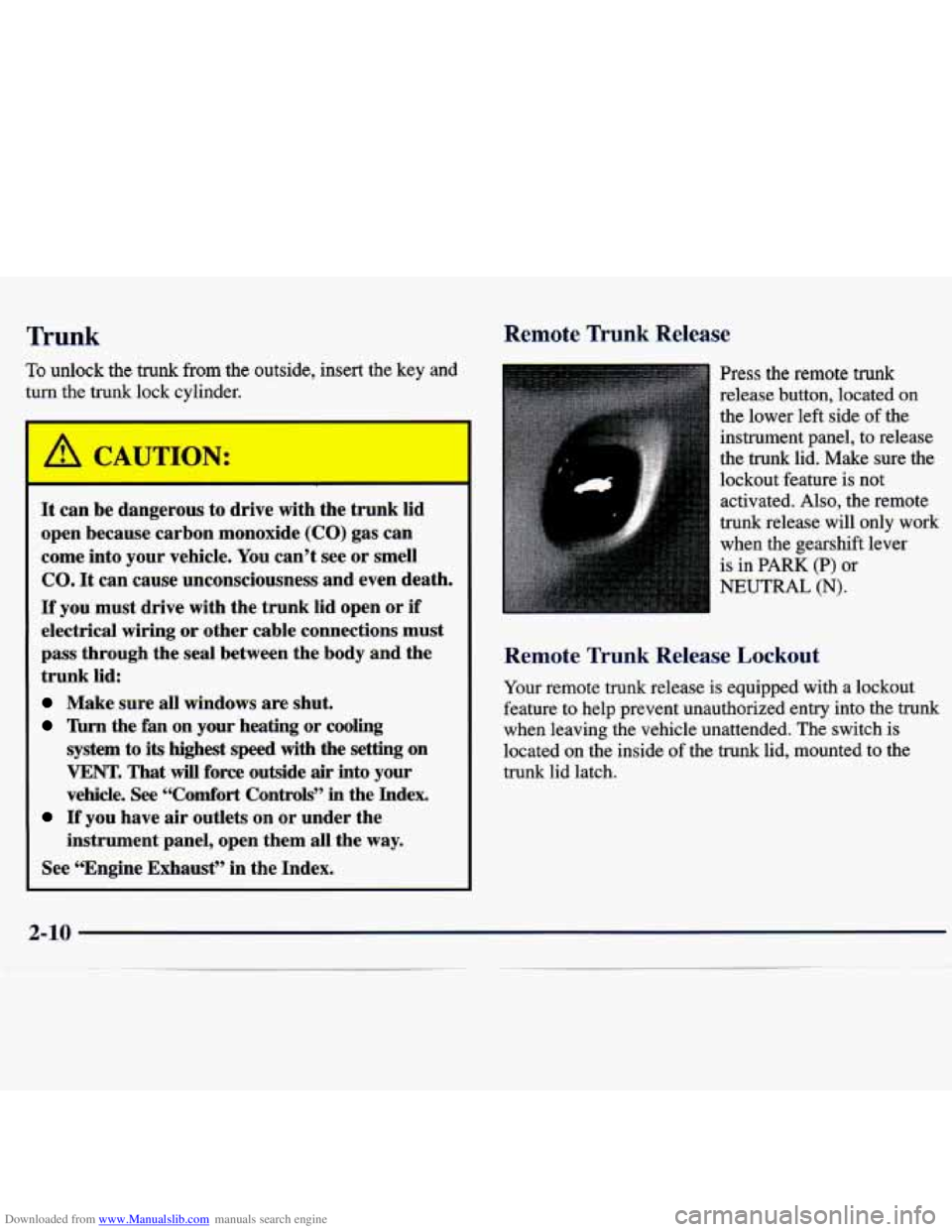
release button, located on
the lower left side of the
instrument panel, to release
the trunk lid. Make sure the
lockout feature is not
activated. Also, the remote
trunk release will only work
when the gearshift lever
is in PARK (P)
or
NEUTRAL (N).
Remote Trunk Release Lockout
Your remote trunk release is equipped with a lockout
feature to help prevent unauthorized entry into the trunk when leaving the vehicle unattended. The switch is
located on the inside of the trunk lid, mounted to the
trunk lid latch.
2-10
Page 108 of 362
Downloaded from www.Manualslib.com manuals search engine Rear Seat Cupholder
Pull down the door on the rear of the center console to
use the rear seat cupholder.
You can use it to a hold cup.
Convenience Net (If Equipped)
Your vehicle may have a convenience net. You’ll see it
just inside the back wall of the trunk.
Put small loads, like grocery bags, in the net. It can help
keep them from falling over during sharp turns or quick
starts and stops.
The net isn’t for larger, heavier loads. Store them in the
trunk as far forward
as you can.
You can
unhook the net so that it will lie flat when
you’re not using
it.
Ashtray and Lighter
The ashtray is located at the lower part of the center of
the instrument panel. To remove the ashtray for
cleaning, pull up on the metal tab and pull the bin out.
NOTICE:
Don’t put papers and other things that burn into
your ashtrays.
If you do, cigarettes or other
smoking materials could set them on fire,
causing damage.
The lighter is located above the ashtray. To use it, just
push it in
all the way and let go. When it’s ready, it will
pop back by itself.
NOTICE:
Don’t hold a cigarette lighter in with your hand
while it is heating.
If you do, it won’t be able to
back away from the heating element when it’s
ready. That can make it overheat, damaging the
lighter and the heating element.
..
Page 119 of 362
Downloaded from www.Manualslib.com manuals search engine Engine Coolant Temperature Gage
0
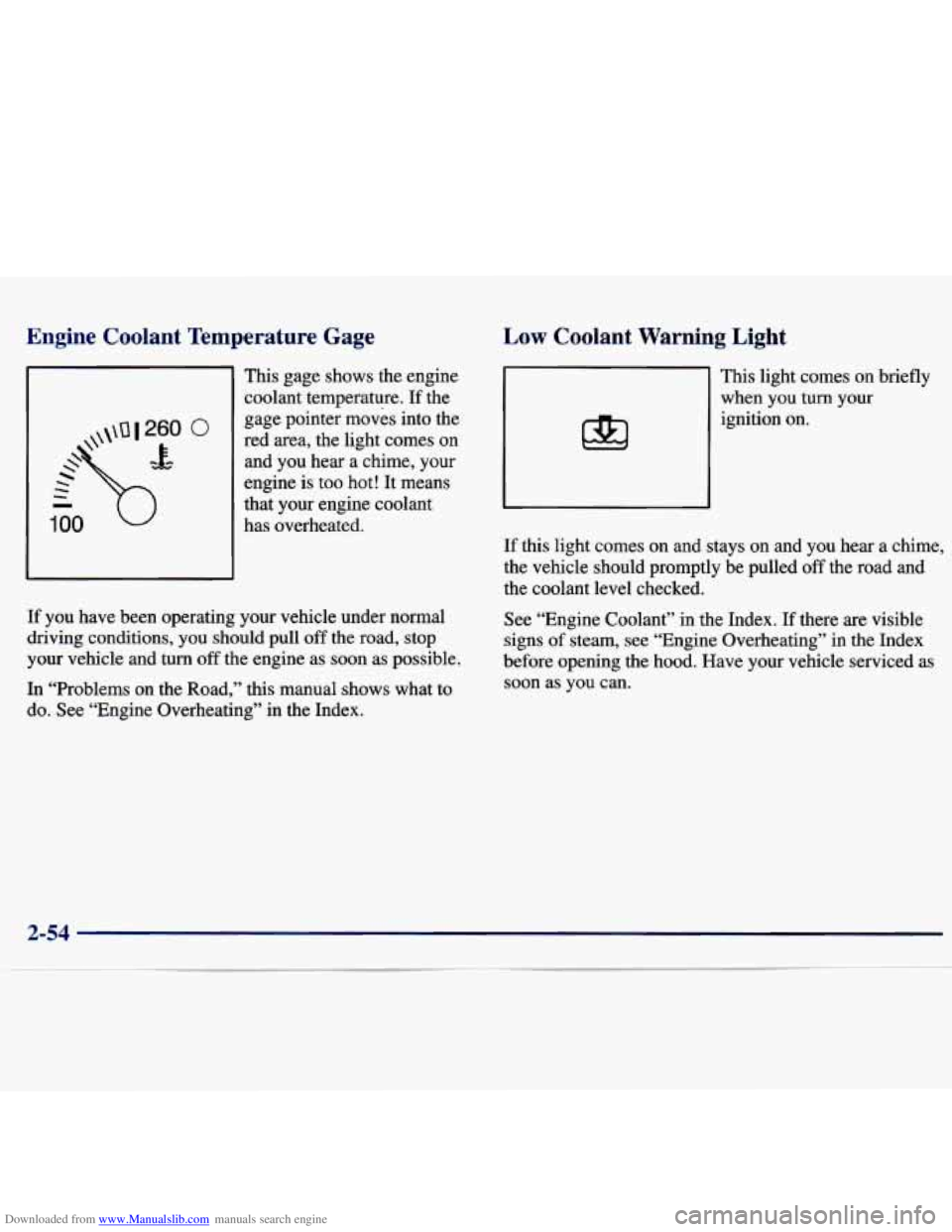
This gage shows the engine
coolant temperature.
If the
gage pointer moves into the
red area, the light comes on
and you hear a chime, your
engine is too hot! It means
that your engine coolant
has overheated.
If you have been operating your vehicle under normal driving conditions, you should pull
off the road, stop
your vehicle
and turn off the engine as soon as possible.
In “Problems on the Road,” this manual shows what to
do. See “Engine Overheating” in the Index.
Low Coolant Warning Light
&I This light comes on briefly
I when you turn your
If this light comes on and stays on and you hear a chime,
the vehicle should promptly be pulled off the road and
the coolant level checked.
See “Engine Coolant” in the Index. If there are visible
signs
of steam, see “Engine Overheating” in the Index
before opening the hood. Have your vehicle serviced as
soon as you can.
Page 128 of 362
Downloaded from www.Manualslib.com manuals search engine Section 3 Cornfort Controls and Audio Systems
In this section, you’ll find out how to operate the comfort control and audio systems offered with your vehicle. Be
sure to read about the particular systems supplied with your vehicle.
3-2 3-2
3-3
3-4
3-4
3-5
3-5
3-6
3-6
3-6 Cornfort Controls
Climate Control System with
Air Conditioning
Air Conditioning
Heating
Defogging and Defrosting Windows
Rear Window Defogger
(If Equipped)
Ventilation System
Audio Systems Setting the Clock for Systems without
Automatic
Tone Control
Setting the Clock for Systems with Automatic
Tone Control 3
-7
3-9
3-14
3-18
3-19
3-21
3-2
1
3-22
3-23
3-23
3-23 AM-FM Stereo
AM-FM Stereo with Cassette Tape Player and
Automatic Tone
Control (If Equipped)
AM-FM Stereo with Compact Disc Player and
Automatic Tone Control
(If Equipped)
Remote Cassette Tape Player
(If Equipped)
Theft-Deterrent Feature
Understanding Radio Reception
Tips About
Your Audio System
Care of
Your Cassette Tape Player
Care of Your Compact Discs
Care of Your Compact Disc Player
Fixed Mast Antenna
3-1
Page 129 of 362
Downloaded from www.Manualslib.com manuals search engine Comfort Controls 3f Fan Knob
This section tells you how to make your air system
work for you. The climate control system with air
conditioning uses ozone-friendly
R- 134a refrigerant.
With this system, you can control the ventilation and heating in your vehicle. Your vehicle also has the
flow-through ventilation system described later in
this section.
Climate Control System with
Air Conditioning
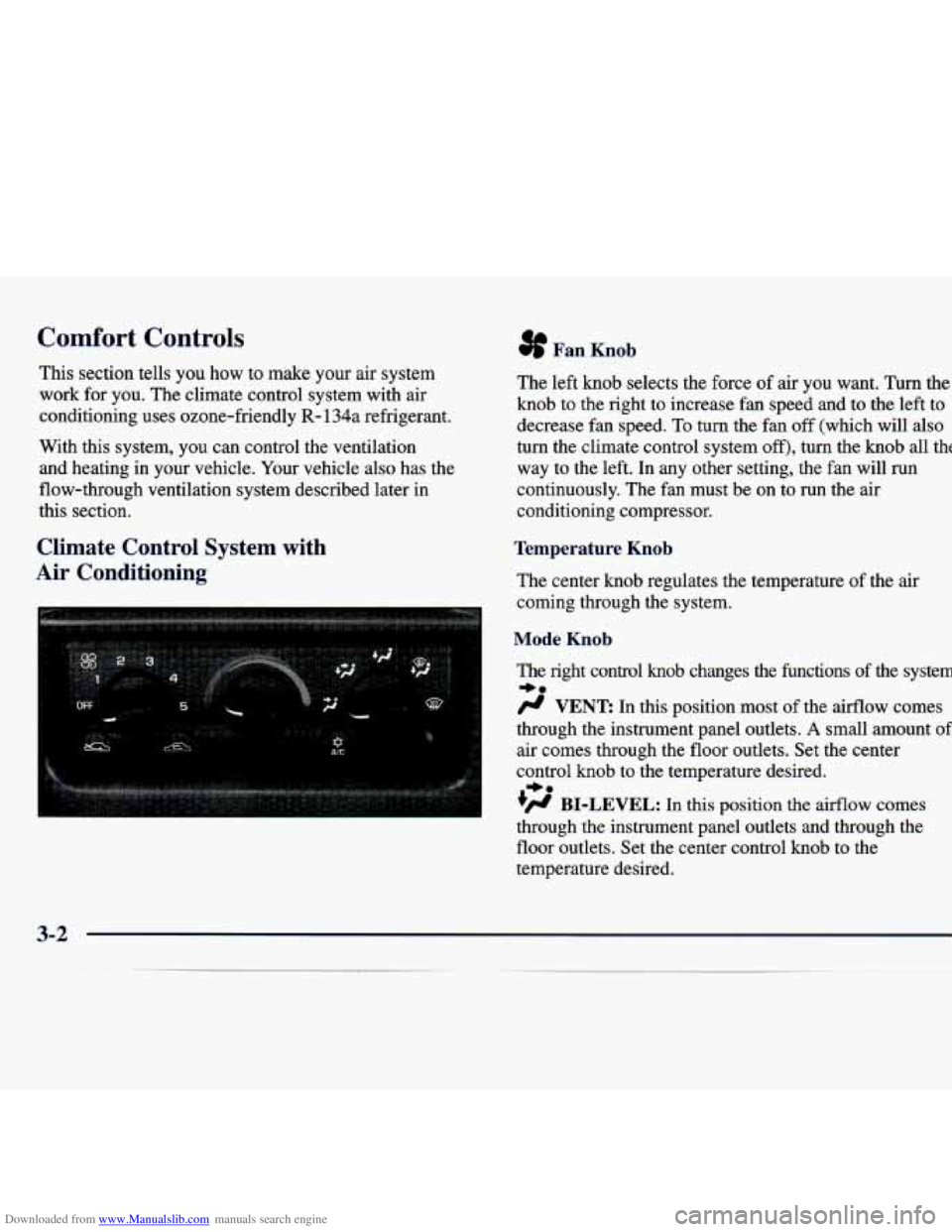
The left knob selects the force of air you want. Turn the
knob to the right to increase fan speed and to the left to
decrease fan speed. To turn the fan
off (which will also
turn the climate control system
off), turn the knob all the
way to
the left. In any other setting, the fan will run
continuously. The fan must be on to run the air
conditioning compressor.
Temperature Knob
The center knob regulates the temperature of the air
coming through the system.
Mode Knob
The right control knob changes the functions of the system.
/J VENT: In this position most of the airflow comes
through the instrument panel outlets.
A small amount of
air comes through the floor outlets. Set the center
control knob to the temperature desired.
+H BI-LEVEL: In this position the airflow comes
through the instrument panel outlets and through the
floor outlets. Set the center control knob to the
temperature desired.
*e
+.
3-2
Page 131 of 362
Downloaded from www.Manualslib.com manuals search engine For quick cool-down on very hot days, use vent with the
temperature knob
all the way in the blue area and the
NC and recirculation buttons pressed. If this setting is
used for long periods of time, the air in your vehicle
may become too dry.
For normal cooling on hot days, use vent with the
temperature knob
in the blue area and the A/C button
pushed
in. The system will bring in outside air and cool it.
Heating
On cold days, use FLOOR and the outside air button
with the temperature knob all the way in the red area.
The system will bring in outside air, heat it and send it to
the floor outlets.
Your vehicle has heat ducts that are directed toward
the rear seat. Keep the area under the front seats clear
of obstructions
so the heated air can reach the rear
seat passengers.
If your vehicle has an engine coolant heater, you can
use it to help your system provide warm air faster when
it’s cold outside (0°F (-18°C) or lower). An engine
coolant heater wms the coolant your engine and
heating system uses to provide heat. See “Engine
Coolant Heater” in the Index.
Defogging and Defrosting Windows
Your system has two settings for clearing the front and
side windows. For each setting, adjust the temperature
control as desired.
To defrost the front window quickly, rotate the
temperature control knob all the way in the red area.
Use defrost and adjust the fan to the highest speed.
To warm passengers while keeping the front window
clean, use defog.
Your vehicle is equipped with side window defogger
vents. The side window defogger vents are located on
the outside of the side instrument panel vents.
To defrost
the side windows, rotate the temperature control knob
all
the way in the red area. Use FLOOR and adjust the
fan to the highest speed.
To control fogging of the
windows, rotate the temperature control knob all the
way in the red area. Use DEFOG and adjust the fan to
the highest speed.
To defog the side windows while using air conditioning,
use BI-LEVEL and adjust the fan to the highest speed and press the
A/C button. For additional airflow to the
side windows, aim the side vents toward the windows
and close the center vents.
Recirculation will not work in defrost and defog. This is
done to prevent recirculation of humid inside air and
allow the system to work properly.
3-4
Page 132 of 362
Downloaded from www.Manualslib.com manuals search engine Rear Window Defogger (If Equipped)
The rear window defogger
uses a warming grid to
remove fog from the
rear window.
Press the defogger switch. The indicator light will glow.
The rear window defogger will turn itself
off after about
10 minutes after the first time the button is pressed, and
after
5 minutes each additional time the button is
pressed. You can turn the defogger
off by pressing the
button again or turning
off the ignition.
Do not attach a temporary vehicle license across the
defogger grid on the rear window.
NOTICE:
Don’t use a razor blade or anything else sharp on
the inside
of the rear window. If you do, you
could cut or damage the warming grid, and the
repairs wouldn’t be covered by your warranty.
Ventilation System
For mild outside temperatures when little heating or
cooling is needed, use VENT to direct outside air
through your vehicle. Your vehicle also has the
flow-through ventilation system.
Your vehicle’s flow-through ventilation system supplies
outside air into
the vehicle when it is moving. Outside
air will also enter the vehicle when the air conditioning
fan is running.
Page 189 of 362
Downloaded from www.Manualslib.com manuals search engine Turn Signals When Towing a Trailer
When you tow a trailer, your vehicle may need
additional wiring. Check with your dealer. The green
arrows on
your instrument panel will flash whenever
you signal a turn or lane change. Properly hooked up,
the trailer lamps will also flash, telling other drivers
you’re about to turn, change lanes
or stop.
When towing a trailer, the green arrows on your
instrument panel will flash for turns even
if the bulbs on
the trailer are burned out. Thus, you may think drivers
behind you are seeing your signal when they are not. It’s
important to check occasionally to be sure the trailer
bulbs are still working.
Driving On Grades
NOTICE:
Do not tow on steep continuous grades exceeding
6 miles (9.6 km). Extended, higher than normal
engine and transaxle temperatures may result and damage your vehicle. Frequent stops are
very important
to allow the engine and transaxle
to
cool.
Reduce speed and shift to a lower gear before you start
down a long
or steep downgrade. If you don’t shift
down, you might have to
use your brakes so much that
they would get hot and no longer work well.
On a long uphill grade, shift down and reduce your
speed to around
45 mph (70 km/h) to reduce the
possibility
of engine and transaxle overheating.
Pay attention to the engine coolant gage.
If the indicator
is in the red area, turn
off the air conditioning to reduce
engine load (see “Engine Overheating” in the Index).