Page 13 of 362
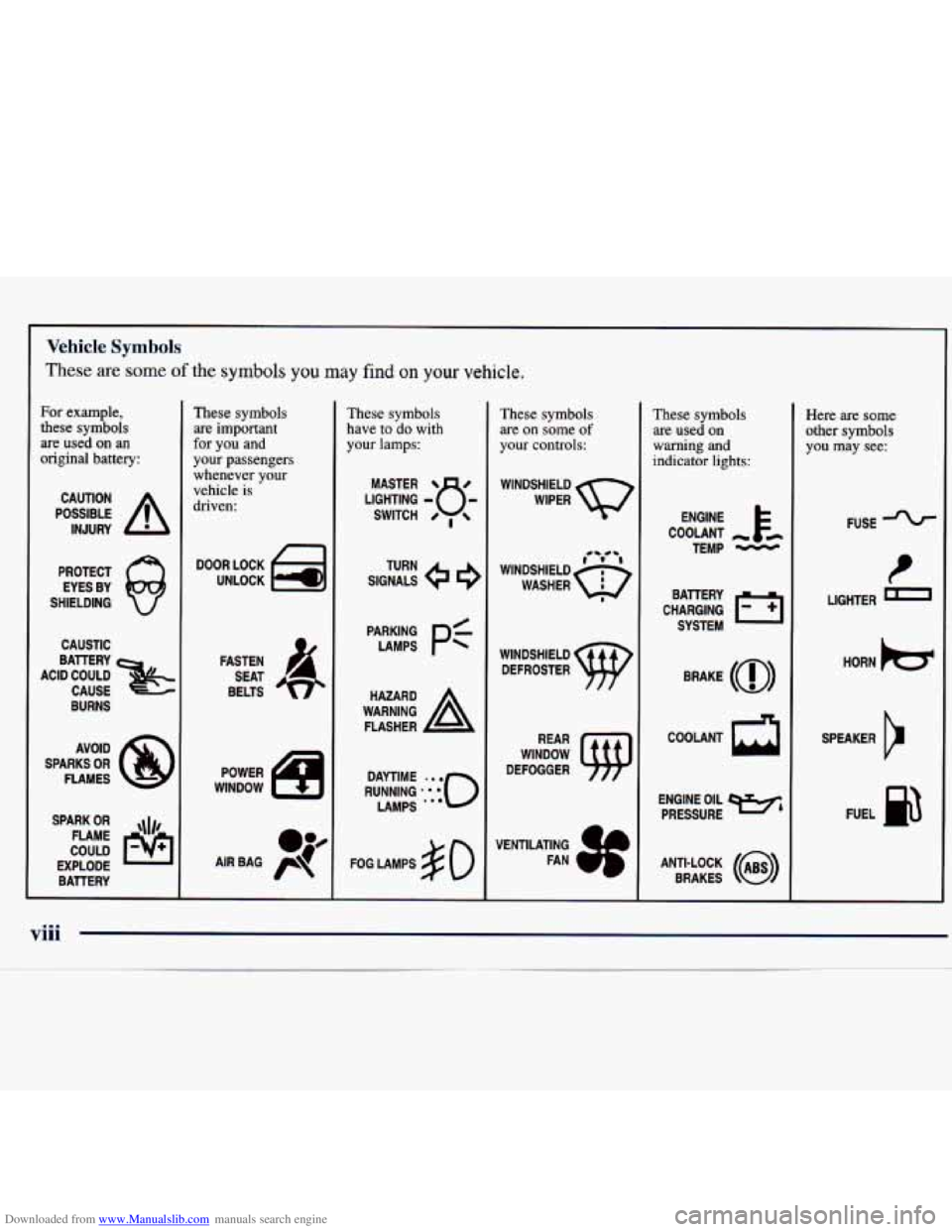
Downloaded from www.Manualslib.com manuals search engine For example,
these symbols
are used
on an
original battery:
POSSIBLE A
CAUTION
INJURY
PROTECT EYES BY
SHIELDING
CAUSTIC
BURNS AVOID
SPARKS
OR
FLAMES
SPARK
OR ,111,
COULD FLAME
EXPLODE BATTERY
These symbols are important
for you and
your passengers
whenever your vehicle is
driven:
n
FASTEN
SEAT
BELTS
These symbols have
to do with
your lamps:
SIGNALS e e
TURN
FOG LAMPS
$0
Vehicle Symbols
These are some of the symbols you may find on your vehicle.
-
These symbols
are
on some of
your controls:
WINDSHIELD
WIPER
WINDOW
DEFOGGER
These symbols are used on
warning and
indicator lights:
CHARGING 1-1
BATTERY
SYSTEM
BRAKE
(0)
R
ENGINE OIL e,
PRESSURE
ANTI-LOCK
(@)
BRAKES
Here are some
other symbols
you may see:
FUSE
LIGHTER
D
HORN )cr
SPEAKER
cr
FUEL p3
viii
Page 66 of 362

Downloaded from www.Manualslib.com manuals search engine 0 Section 2 Features and Controls
Here you can learn about the many standard and optional features on your vehicle, and inform\
ation on starting,
shifting and braking. Also explained are the instrument panel and the warning systems that tell you if everything is
working properly
-- and what to do if you have a problem.
2-2
2-4
2-6
2- 10
2-11
2- 12
2- 13
2- 13
2-
14
2- 17
2-18
2-22
2-23
2-25
2-25
2-26 Keys
Door Locks
Keyless Entry System
TrUnk
Theft
Passlock’
New Vehicle “Break-In”
Ignition Positions
Starting Your Engine
Engine Coolant Heater
(If Equipped)
Automatic Transaxle Operation Parking Brake
Shifting Into PARK (P)
Shifting Out
of PARK (P)
Parking Over Things That Burn
Engine Exhaust 2-26
2-27
2-28
2-29
2-36
2-38
2-39
2-4 1
2-43
2-44
2-44
2-45
2-45
2-46 2-50 Running
Your Engine While You’re Parked
Windows
Tilt Wheel
Turn SignaVMultifunction Lever
Exterior Lamps
Interior Lamps
Mirrors Storage Compartments
Ashtray and Lighter Sunvisors
Accessory Power Outlet
Garment
Hook
Sunroof
Instrument Panel
Warning Lights, Gages and Indicators
Page 79 of 362
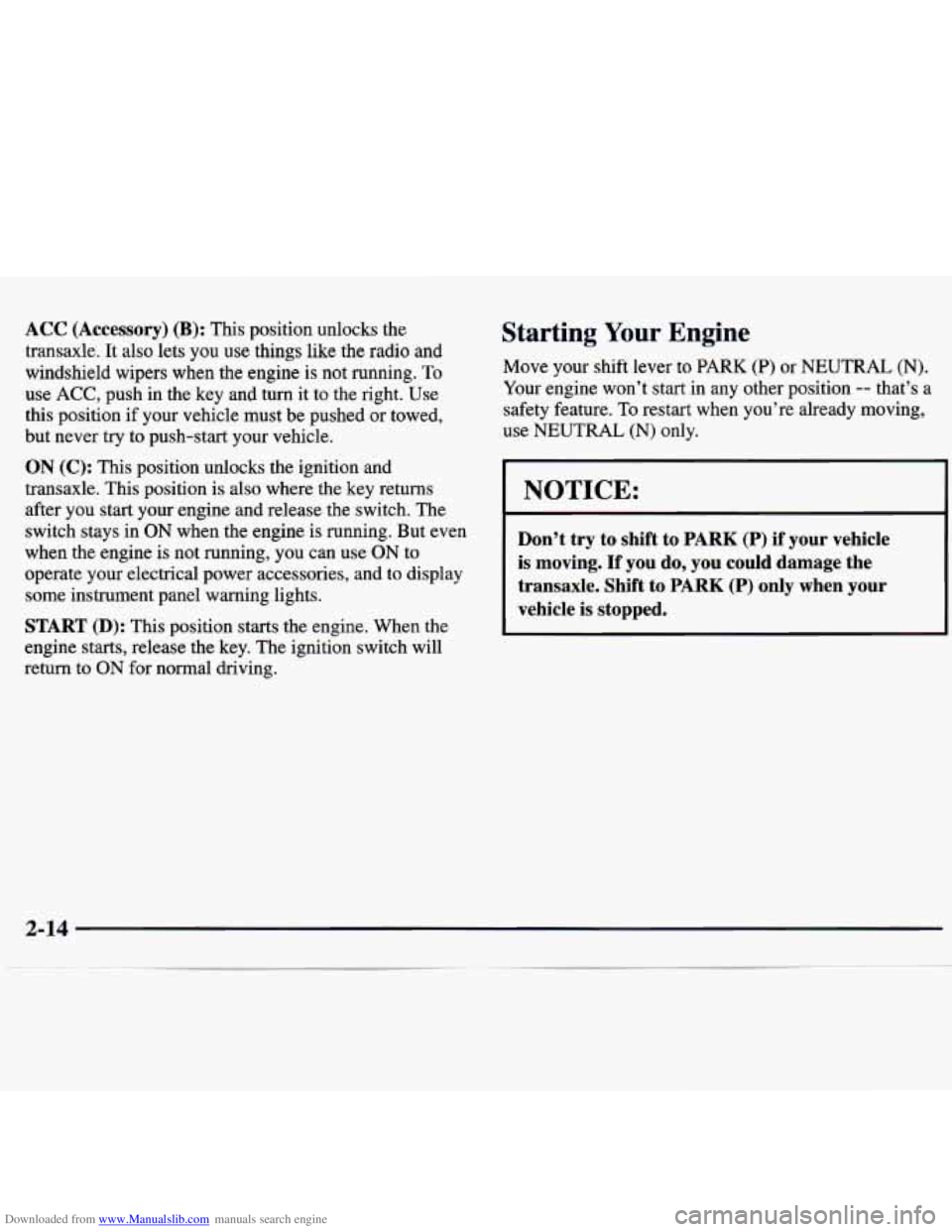
Downloaded from www.Manualslib.com manuals search engine ACC (Accessory) (B): This position unlocks the
transaxle. It also
lets you use things like the radio and
windshield wipers when the engine is not running.
To
use ACC, push in the key and turn it to the right. Use
this position if your vehicle must be pushed or towed,
but never try to push-start your vehicle.
ON (C): This position unlocks the ignition and
transaxle. This position is also where the key returns
after you start your engine and release the switch. The
switch stays in
ON when the engine is running. But even
when the engine is not running, you can use
ON to
operate your electrical power accessories, and to display
some instrument panel warning lights.
START (D): This position starts the engine. When the
engine starts, release the
key. The ignition switch will
return to
ON for normal driving.
Starting Your Engine
Move your shift lever to PARK (P) or NEUTRAL (N).
Your engine won’t start in any other position -- that’s a
safety feature. To restart when you’re already moving,
use
NEUTRAL (N) only.
I 1
I NOTICE:
Don’t try to shift to PARK (P) if your vehicle
is moving. If you do, you could damage the
transaxle. Shift to PARK
(P) only when your
vehicle is stopped.
2-14
Page 101 of 362
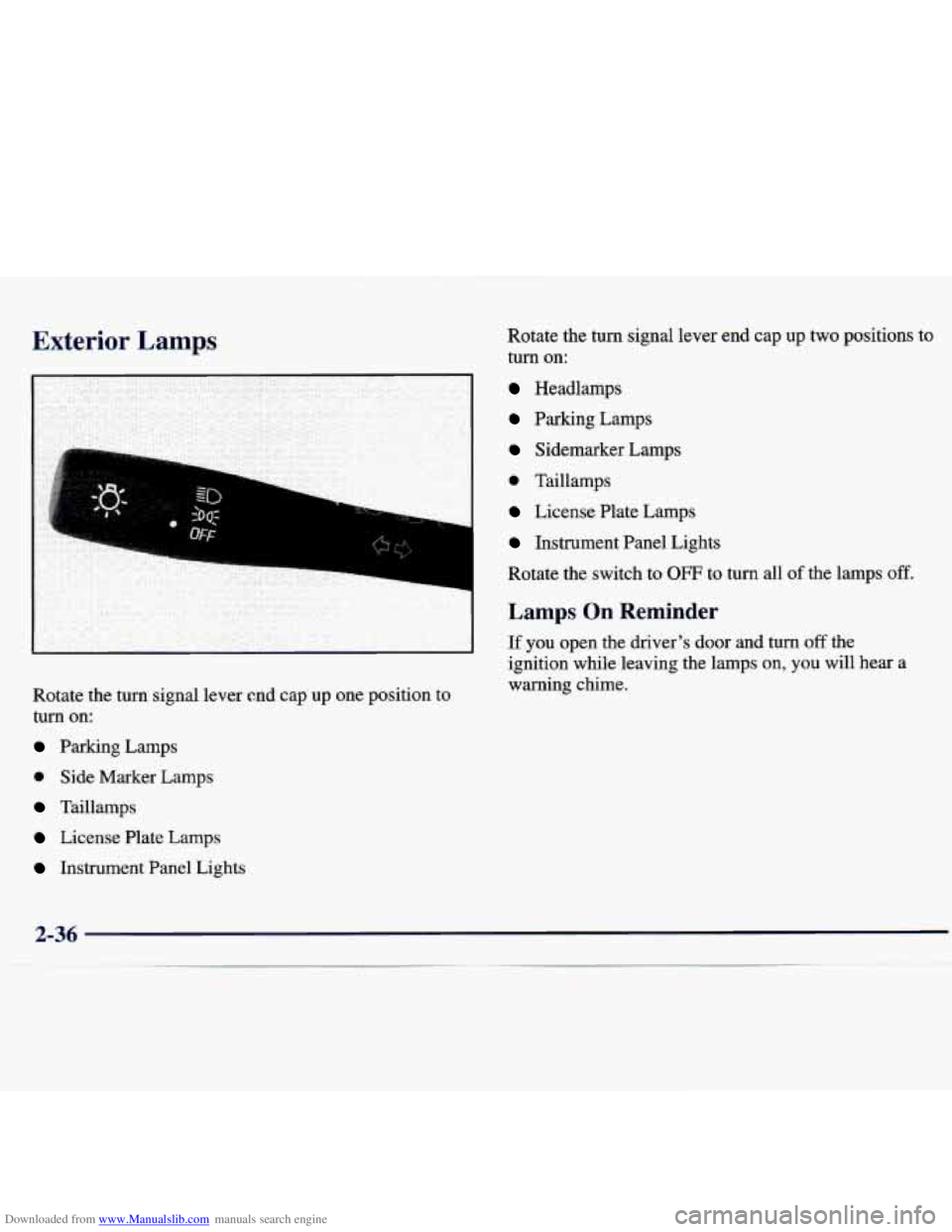
Downloaded from www.Manualslib.com manuals search engine Exterior Lamps
, :: ..j* ,..,.: .. ,:: i-2: . . . .. ..
Rotate the turn signal lever end cap up one position to
turn on:
Parking Lamps
0 Side Marker Lamps
Taillamps
License Plate Lamps Rotate the turn signal
lever end cap up two positions to
turn on:
Headlamps
Parking Lamps
Sidemarker Lamps
0 Taillamps
License Plate Lamps
Instrument Panel Lights
Rotate the switch to
OFF to turn all of the lamps off.
Lamps On Reminder
If you open the driver’s door and turn off the
ignition while leaving the lamps on,
you will hear a
warning chime.
Instrument Panel Lights
2-36
Page 113 of 362
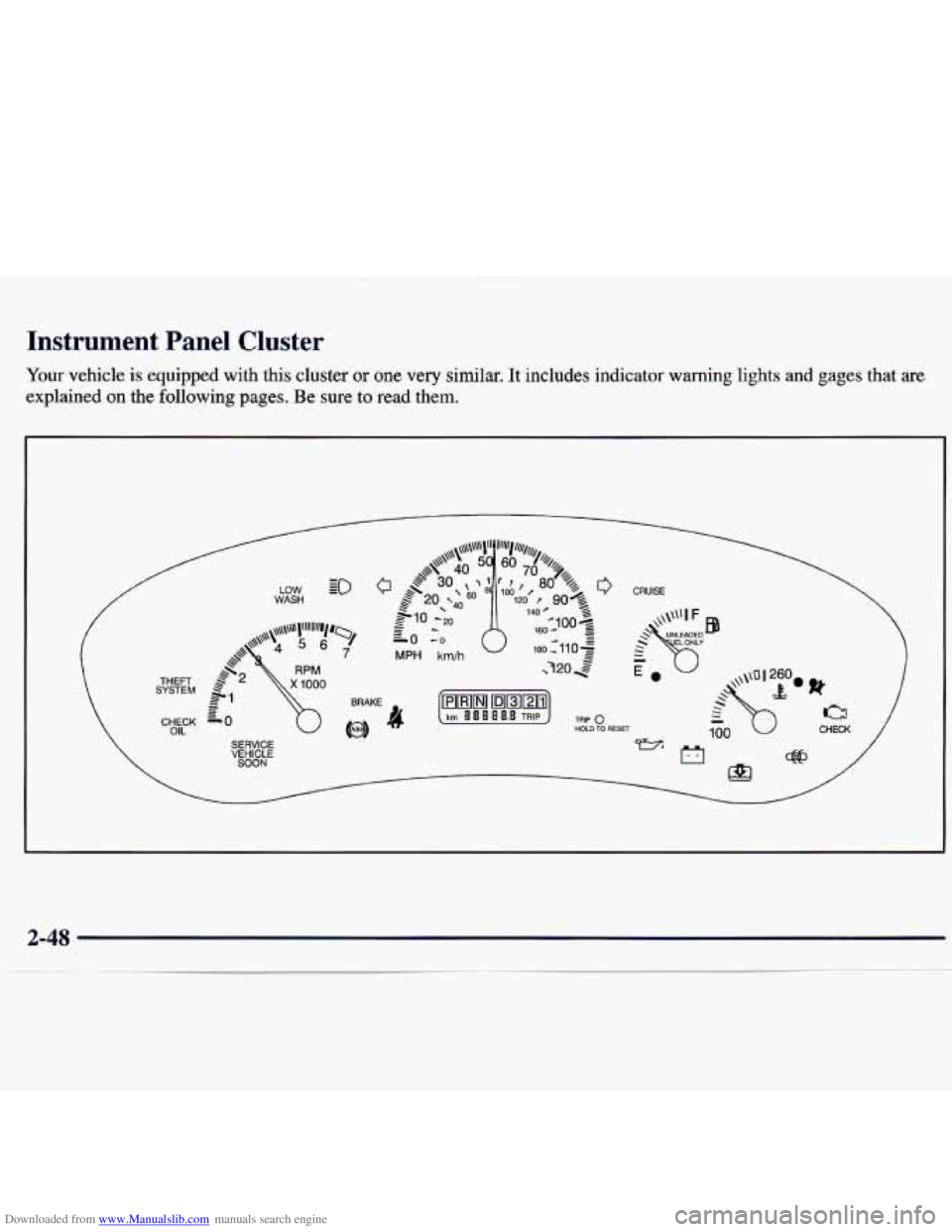
Downloaded from www.Manualslib.com manuals search engine Instrument Panel Cluster
Your vehicle is equipped with this cluster or one very similar. It includes indicator warning lights and gages that are
explained on the following pages. Be sure to read them.
WASH LOW
SYSTEM THEFT
CHECK
OIL
I- +I
IWU - Bu
2-48
--- - ._
Page 115 of 362
Downloaded from www.Manualslib.com manuals search engine Tachon- T I I_-
I
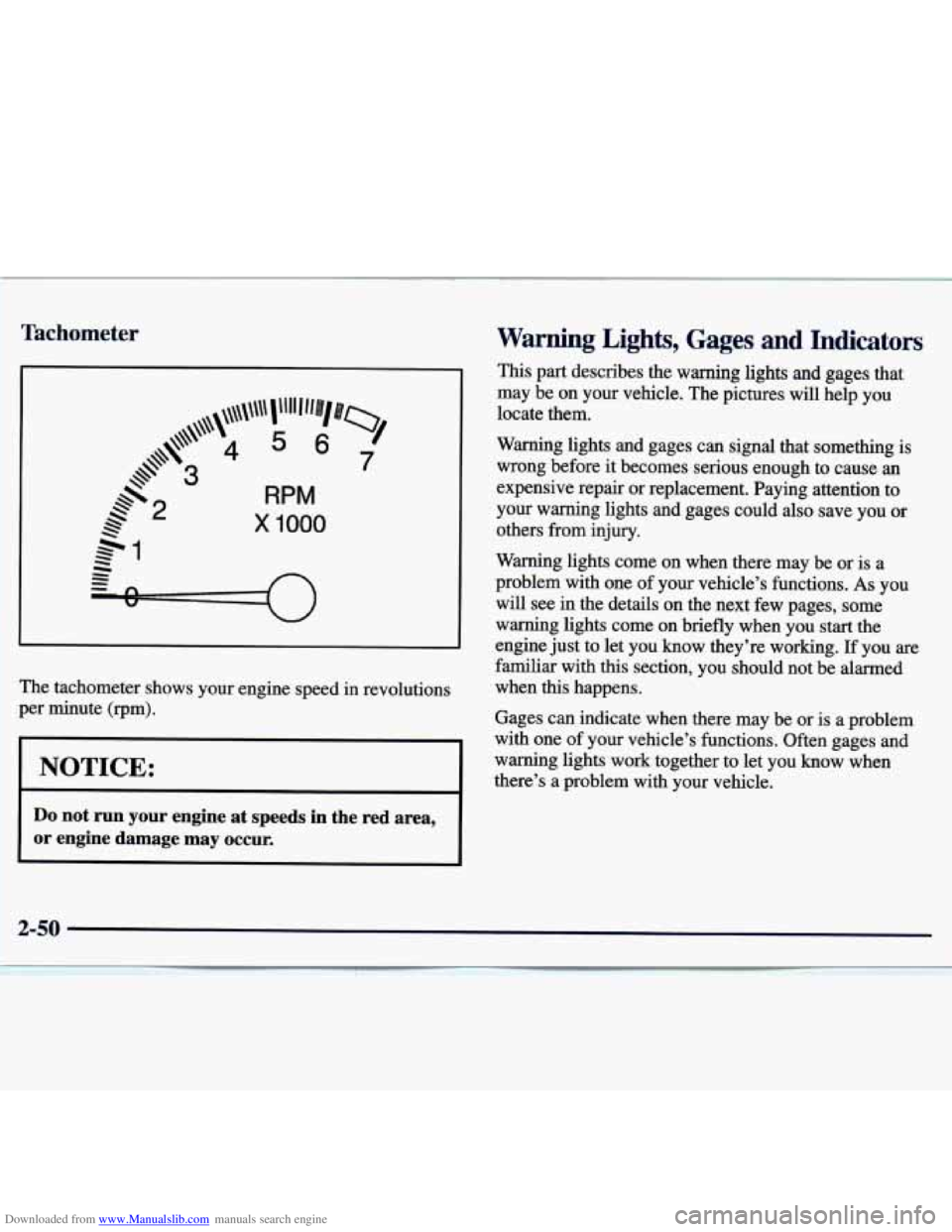
The tachometer shows your engine speed in revolutions
per minute
(rpm).
NOTICE:
Do not run your engine at speeds in the red area,
or engine damage may occur.
Warning Lights, Gages and Indicators
This part describes the warning lights and gages that
may be on your vehicle. The pictures will help you
locate them.
Warning lights and gages can signal that something is
wrong before it becomes serious enough to cause an
expensive repair or replacement. Paying attention to
your warning lights and gages could also save you or
others from injury.
Warning lights come on when there may be or is a
problem with one of your vehicle’s functions. As you
will see in the details on the next few pages, some
warning lights come on briefly when you
start the
engine just to let you know they’re working.
If you are
familiar with
this section, you should not be alarmed
when
this happens.
Gages can indicate when there may be or is a problem
with one
of your vehicle’s functions. Often gages and
warning lights work together to let you know when
there’s a problem with your vehicle.
Page 116 of 362
Downloaded from www.Manualslib.com manuals search engine When one of the warning lights comes on and stays on
when you are driving, or when one of the gages shows
there may be a problem, check
the section that tells you
what to do about it. Please follow this manual’s advice.
Waiting to do repairs can be costly
-- and even
dangerous.
So please get to know your warning lights
and gages. They’re a big help.
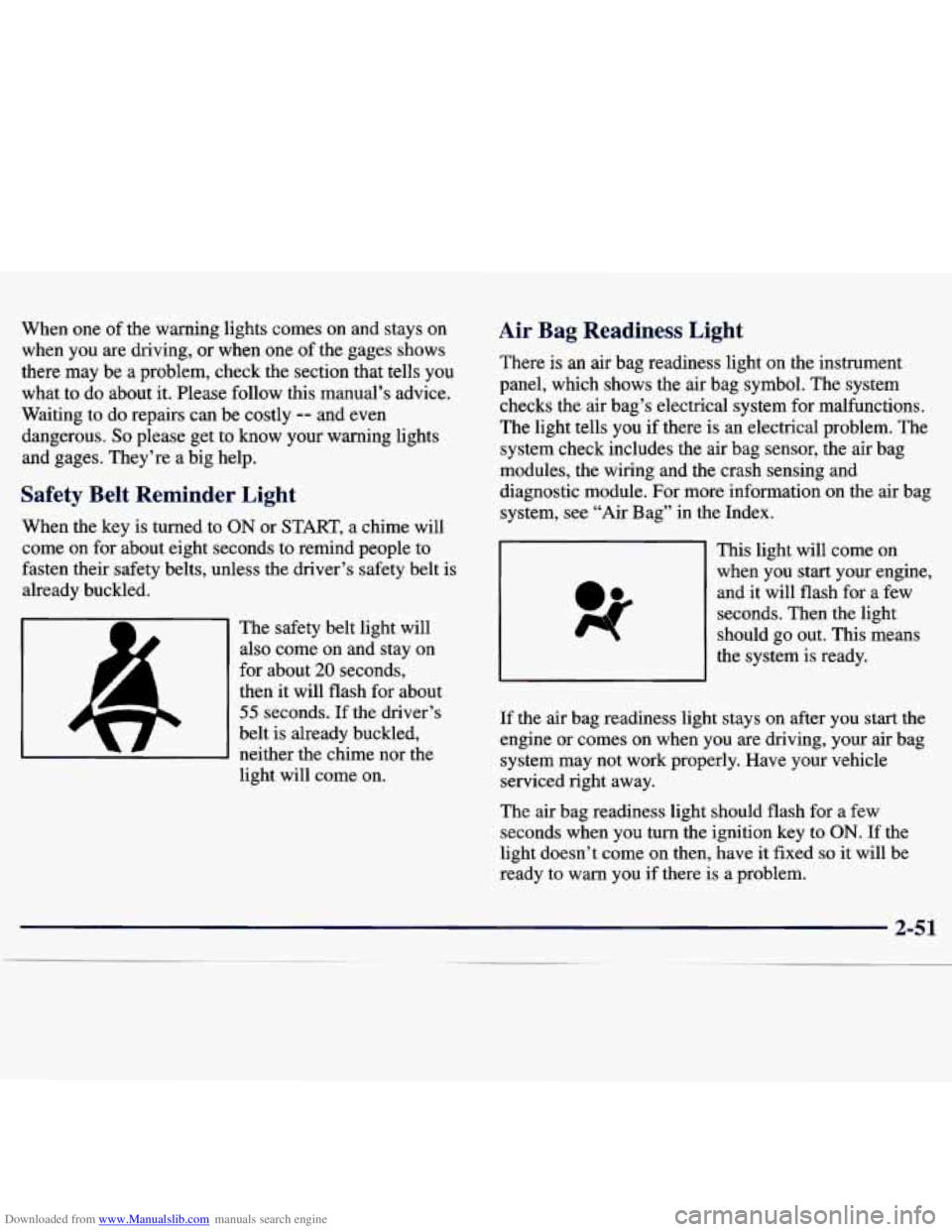
Safety Belt Reminder Light
When the key is turned to ON or START, a chime will
come
on for about eight seconds to remind people to
fasten their safety belts, unless the driver’s safety belt is
already buckled.
The safety belt light will
also come on and stay on
for about
20 seconds,
then it will flash for about
55 seconds. If the driver’s
belt is already buckled,
neither the chime nor the
light will come on.
Air Bag Readiness Light
There is an air bag readiness light on the instrument
panel, which shows the air bag symbol. The system
checks the air bag’s electrical system for malfunctions.
The light tells you
if there is an electrical problem. The
system check includes the air bag sensor, the air bag
modules, the wiring and the crash sensing and
diagnostic module. For more information on the air bag
system, see “Air Bag’’ in the Index.
This light will come on
when you start your engine,
and it will flash for a few
seconds. Then the light
should
go out. This means
the system is ready.
If the air bag readiness light stays on after you start the
engine or comes on when you are driving, your air bag
system may not work properly. Have your vehicle
serviced right away.
The air bag readiness light should flash for a few
seconds when you turn the ignition key to
ON. If the
light doesn’t come on then, have it fixed
so it will be
ready to warn you if there is a problem.
Page 245 of 362
Downloaded from www.Manualslib.com manuals search engine NOTICE:
-
We recommend you use only fluid labeled
DEXRON@-III, because
fluid with that label is
made especially for your automatic transaxle.
Damage caused by fluid other than DEXRON-III
is not covered by your new vehicle warranty.
Engine Coolant
The cooling s stem in your vehicle is filled with
DEX-COOL engine coolant.
This coolant is designed
to remain in your vehicle for 5 years or 150,000 miles
(240 000 km) whichever occurs first, if you add only
DEX-COOL’ extended life coolant.
The following explains your cooling system and how to
add coolant when it is low.
If you have a problem with
engine overheating, see “Engine Overheating” in
the Index.
8
A 50/50 mixture of water and DEX-COOL@ coolant wilk
0 Give freezing protection down to -34°F (-37’C).
0 Give boiling protection up to 265 OF ( 129 O C).
0 Protect against rust and corrosion.
0 Help keep the proper engine temperature.
0 Let the warning lights and gages work as they should.
~~
NOTICE:
When adding coolant, it is important that you
use only DEX-COOL@ (silicate-free) coolant.
If coolant other than DEX-COOL is added. to
the system, premature engine, heater core or
radiator corrosion may result.
In addition, the
engine coolant will require change sooner
-- at
30,000 miles (50 000 km) or 24 months,
whichever
occurs first. Damage caused by the
use of coolant other than DEX-COOL@ is not
covered by
your new vehicle warranty.
6-20 I