1998 CHEVROLET CORVETTE check engine
[x] Cancel search: check enginePage 290 of 378

Downloaded from www.Manualslib.com manuals search engine Tire Rotation
The tires on your Corvette are directional and are
different sizes front to rear. Due to this, your tires should
not be rotated. Each tire and wheel should be used only
in the position it is in.
When It’s Time for New Tires
One way to tell when it’s
time for new tires is to
check the treadwear
indicators, which will
appear when your tires have
only 1/16 inch (1.6
mm) or
less of tread remaining.
You need a new tire if
any of the following statements
are true:
0 You can see the indicators at three or more places
around the tire.
0 You can see cord or fabric showing through the
tire’s rubber.
0 The tread or sidewall is cracked, cut or snagged deep
enough to show cord or fabric.
The tire has a bump, bulge or split.
The tire has a puncture, cut or other damage that
can’t be repaired well because of the size or location
of the damage.
Buying New Tires
To find out what kind and size of tires you need, look at
the Tire-Loading Information label.
The tires installed on your vehicle when it was new had
a Tire Performance Criteria Specification (TPC Spec)
number on each tire’s sidewall. When you get new tires,
get ones with that same TPC Spec number. That way
your vehicle will continue to have tires that are designed
to give proper endurance, handling, speed rating,
traction, ride and other things during normal service on
your vehicle. If your tires have an all-season tread
design, the TPC number will be followed by an
“MS”
(for mud and snow).
If you ever replace your tires with those not having a
TPC Spec number, make sure they are the same size,
load range, speed rating and construction type (bias,
bias-belted or radial) as your original tires.
6-45
Page 300 of 378
Downloaded from www.Manualslib.com manuals search engine Cleaning the Outside of the
Windshield and Wiper Blades
If the windshield is not clear after using the windshield
washer, or if the wiper blade chatters when running,
wax, sap or other material may be on the blade
or windshield.
Clean the outside of the windshield with GM
Windshield Cleaner, Bon Ami@ Powder (non-scratching
glass cleaning powder), GM Part
No. 105001 1. The
windshield is clean
if beads do not form when you rinse
it with water.
If you use a glass treatment or conditioner containing
ethyl alcohol or ethyl sulfate on your glass, be sure
to
remove the acrylic roof panel, if so equipped. These
products may damage the panel.
Grime from the windshield will stick to the wiper blades
and affect their performance. Clean the blade by wiping
vigorously with a cloth soaked in full-strength
windshield washer solvent. Then rinse the blade
with water.
Check the wiper blades and clean them as necessary;
replace blades that look worn.
Weatherstrips
Silicone grease on weatherstrips will make them last
longer, seal better, and not stick or squeak. Apply
silicone grease with a clean cloth at least every
six months. During very cold, damp weather more
frequent application may be required. (See
“Recommended Fluids and Lubricants” in the Index.)
Cleaning a Removable Roof Panel
Special care is necessary when cleaning, removing
and/or storing the roof panel.
Flush with water to remove dust and dirt, then dry
the panel.
Clean the panel with GM Glass Cleaner. Leave the
cleaner
on the panel for one minute, then wipe the
panel with a soft, lint-free cloth.
Don’t use abrasive cleaning materials.
If water drops are frequently allowed to dry on the roof
panel, impurities in the water will adhere to the top.
These impurities may etch or mar the finish. When the
panel gets wet, you should dry it off.
6-55
Page 301 of 378
Downloaded from www.Manualslib.com manuals search engine NOTICE:
Do not use a glass treatment or conditioner
containing ethyl alcohol or ethyl sulfate on the
roof panel. These products may damage the panel.
Cleaning the Outside of Your Vehicle
The paint finish on your vehicle provides beauty, depth
of color, gloss retention and durability.
Washing Your Vehicle
The best way to preserve your vehicle’s finish is to keep it
clean by washing it often with lukewarm or cold water.
Don’t wash your vehicle in the direct rays of the sun.
Don’t use strong soaps or chemical detergents. Use
liquid hand, dish or car washing (mild detergent) soaps.
You can get GM-approved cleaning products from your
dealer. (See “Appearance Care and Materials” in the
Index.) Don’t use cleaning agents that
are petroleum
based, or that contain acid or abrasives. All cleaning
agents should be flushed promptly and not allowed to
dry on the surface, or they could stain. Dry the finish
with a soft, clean chamois or an all-cotton towel to
avoid surface scratches and water spotting. High pressure car washes
may cause water to enter
your vehicle.
NOTICE:
Conveyor systems on some automatic car washes
may damage a Corvette. They may not have enough clearance for the undercarriage or for the wide rear tires.
Check with the manager before using a car wash.
Cleaning Exterior LampsLenses
Use lukewarm or cold water, a soft cloth and a liquid
hand, dish or car washing (mild detergent) soap to clean
exterior lamps and lenses. Follow instructions under
“Washing Your Vehicle.”
Finish Care
Occasional waxing or mild polishing of your vehicle by
hand may be necessary to remove residue from the paint
finish. You can get GM-approved cleaning products
from your dealer. (See “Appearance Care and Materials”
in the Index.)
Page 307 of 378
Downloaded from www.Manualslib.com manuals search engine Vehicle Identification Number (VIN)
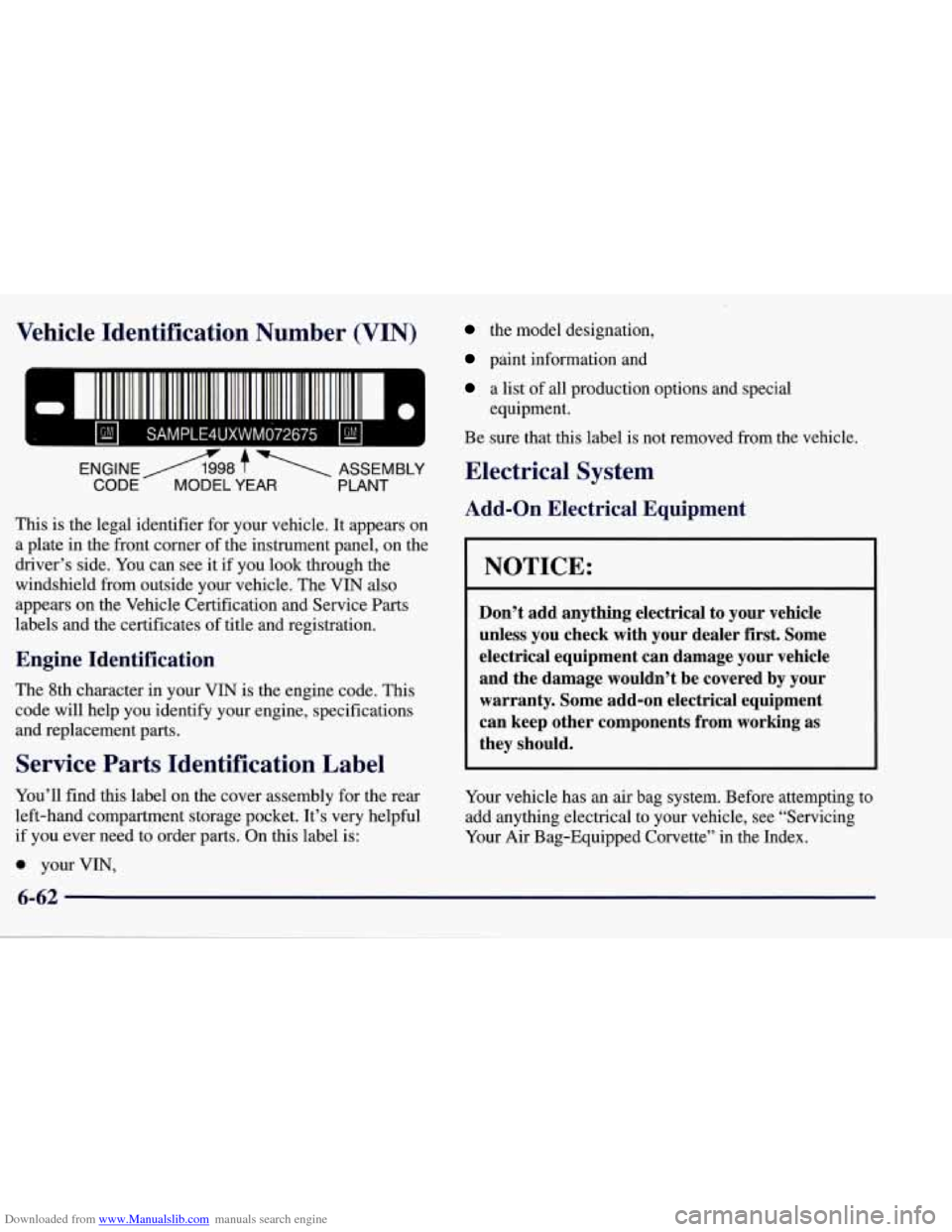
This is the legal identifier for your vehicle. It appears on
a plate in the front comer of the instrument panel, on the
driver’s side. You can see it
if you look through the
windshield from outside your vehicle. The VIN also
appears on the Vehicle Certification and Service
Parts
labels and the certificates of title and registration.
Engine Identification
The 8th character in your VIN is the engine code. This
code will help you identify your engine, specifications
and replacement parts.
Service Parts Identification Label
You’ll find this label on the cover assembly for the rear
left-hand compartment storage pocket. It’s very helpful
if you ever need to order parts. On this label is:
0 your VIN,
the model designation,
paint information and
a list of all production options and special
Be sure that this label is not removed from the vehicle.
equipment.
Electrical System
Add-on
Electrical Equipment
NOTICE:
Don’t add anything electrical to your vehicle
unless you check with your dealer first. Some
electrical equipment can damage your vehicle
and the damage wouldn’t be covered by your
warranty. Some add-on electrical equipment
can keep other components from working as
they should.
Your vehicle has an air bag system. Before attempting to
add anything electrical to your vehicle, see “Servicing
Your
Air Bag-Equipped Corvette” in the Index.
Page 309 of 378
Downloaded from www.Manualslib.com manuals search engine Headlamps
The headlamp wiring is protected by a circuit breaker.
An electrical overload will cause the lamps to go on and
off, or in some cases to remain off. If this happens, have
your headlamp wiring checked right away.
Windshield Wipers
The windshield wiper motor is protected by a fuse and
an internal circuit breaker. If the motor overheats due to
heavy snow, etc., the wiper will stop until the motor
cools. If the overload is caused by some electrical
problem and not snow, etc., be sure to get it fixed.
Power Windows and Other Power Options
Circuit breakers protect the power seats and other power
accessories. When the current load is too heavy, the
circuit breaker opens and closes, protecting the circuit
until the problem is fixed or goes away.
Fuses and Circuit Breakers
The wiring circuits in your vehicle are protected from
short circuits by a combination of maxi-fuses,
mini-fuses and circuit breakers. This greatly reduces the
chance of fires caused by electrical problems. replace
a bad fuse with a new one of the identical size
and rating.
If you ever have a problem on the road and don’t have a
spare fuse, you can borrow one that has the same
amperage. Just pick some feature of your vehicle that
you can get along without
-- like the radio or cigarette
lighter
-- and use its fuse, if it is the correct amperage.
Replace it as soon as you can.
Instrument Panel Fuse Block
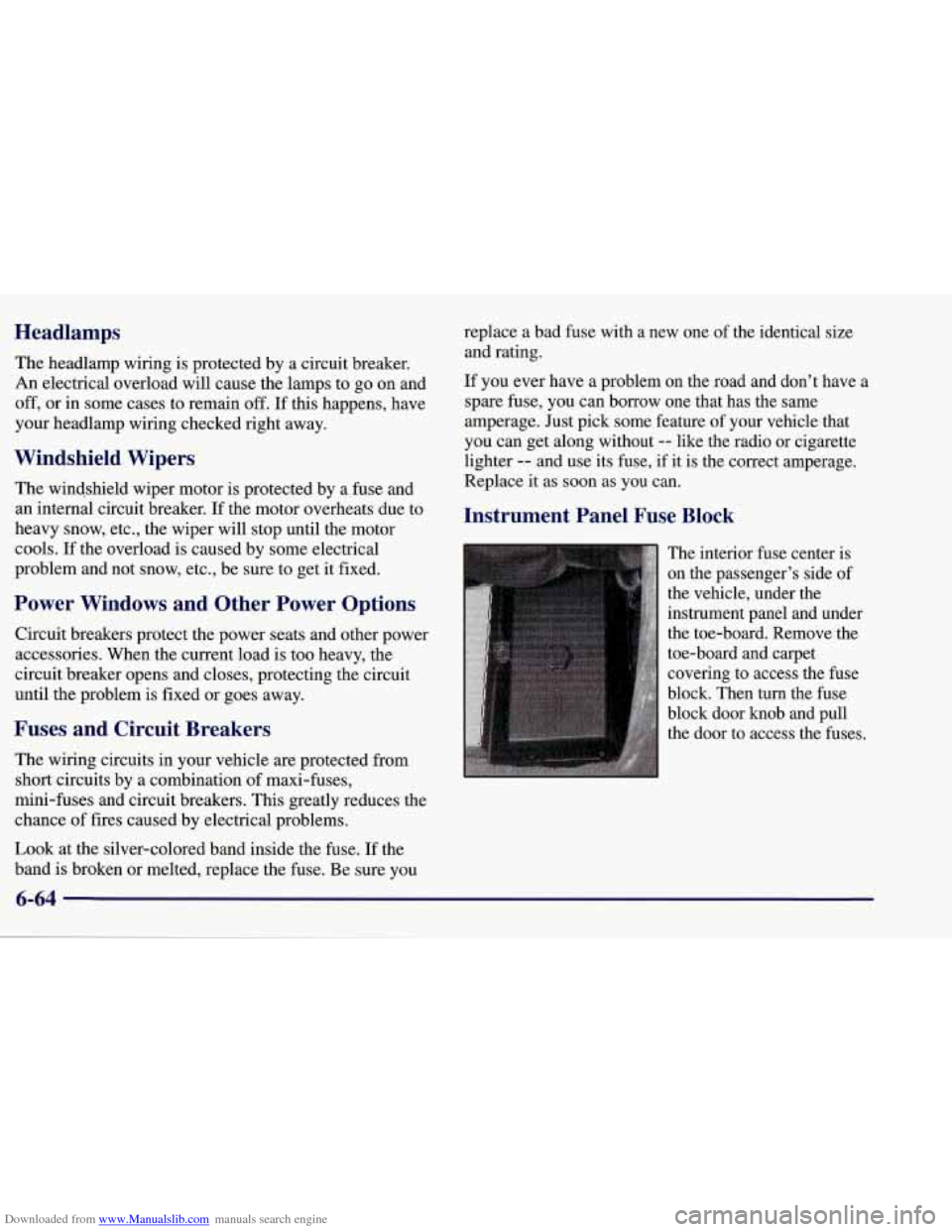
The interior fuse center is
on the passenger’s side of
the vehicle, under the
instrument panel and under
the toe-board. Remove the
toe-board and carpet
covering to access the fuse
block. Then turn the fuse
block door knob and pull
the door
to access the fuses.
Look at the silver-colored band inside the fuse. If the
band is broken or melted, replace the fuse. Be sure you
Page 316 of 378
Downloaded from www.Manualslib.com manuals search engine Wheel Nuts
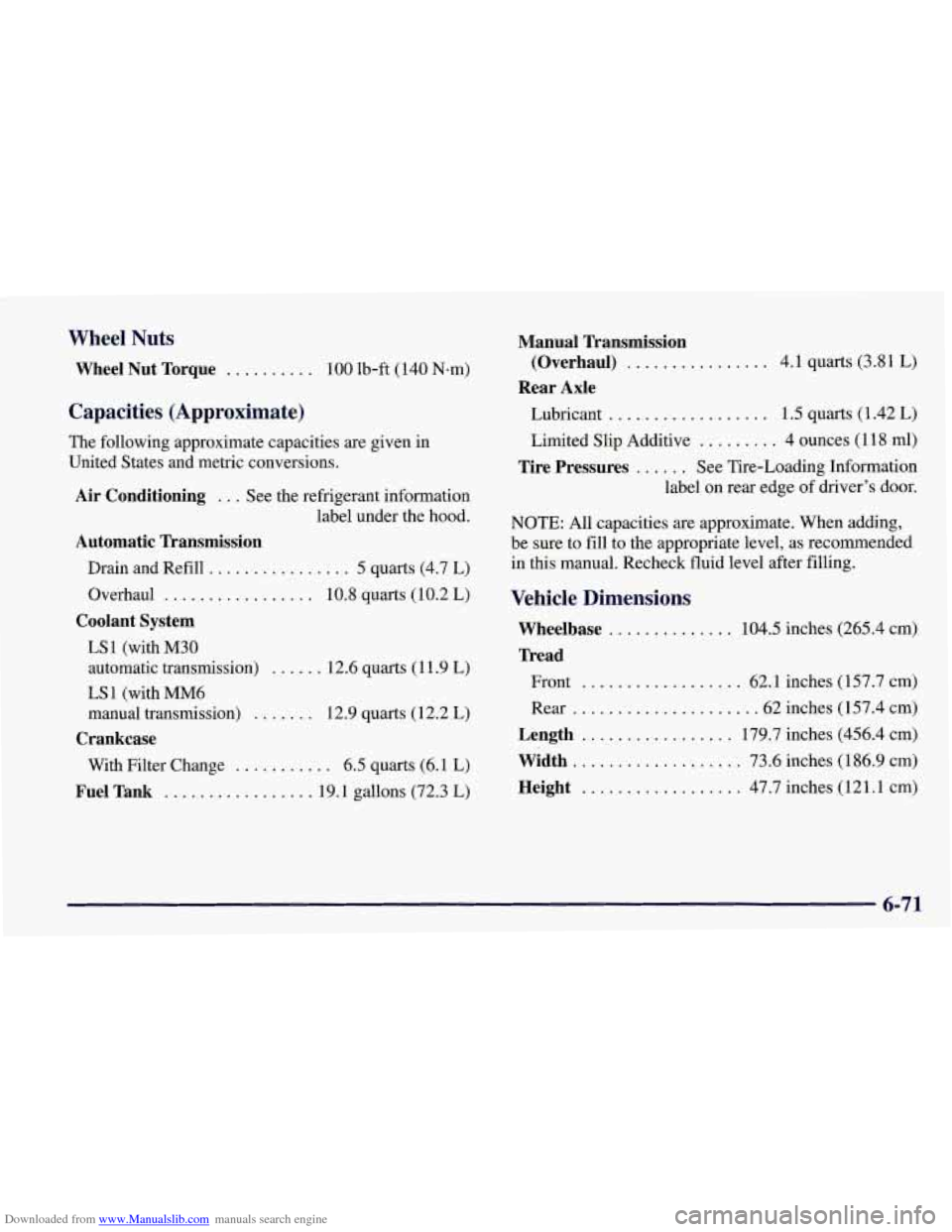
Wheel Nut Torque .......... 100 lb-ft (140 N-m)
Capacities (Approximate)
The following approximate capacities are given in
United States and metric conversions.
Air Conditioning ... See the refrigerant information
label under the hood.
Automatic Transmission
Drain and Refill ................ 5 quarts (4.7 L)
Overhaul
................. 10.8 quarts (10.2 L)
Coolant System
LS 1 (with M30
automatic transmission)
...... 12.6 quarts (1 1.9 L)
LS 1 (with "6
manual transmission)
....... 12.9 quarts ( 12.2 L)
Crankcase
With Filter Change ........... 6.5 quarts (6.1 L)
Fuel Tank ................. 19.1 gallons (72.3 L)
Manual Transmission
Rear Axle (Overhaul)
................ 4.1
quarts (3.8 1 L)
Lubricant
.................. 1.5 quarts (1 -42 L)
Limited Slip Additive ......... 4 ounces (1 18 ml)
Tire Pressures ...... See Tire-Loading Information
label on rear edge of driver's door.
NOTE: All capacities are approximate. When adding,
be sure to fill to the appropriate level, as recommended
in this manual. Recheck fluid level after filling.
Vehicle Dimensions
Wheelbase .............. 104.5 inches (265.4 cm)
Tread
Front .................. 62.1 inches (157.7 cm)
Rear
.................... .62 inches (157.4 cm)
Length ................. 179.7 inches (456.4 cm)
Width ................... 73.6 inches (1 86.9 cm)
Height .................. 47.7 inches (1 21.1 cm)
6-71
Page 320 of 378
Downloaded from www.Manualslib.com manuals search engine Section 7 Maintenance Schedule
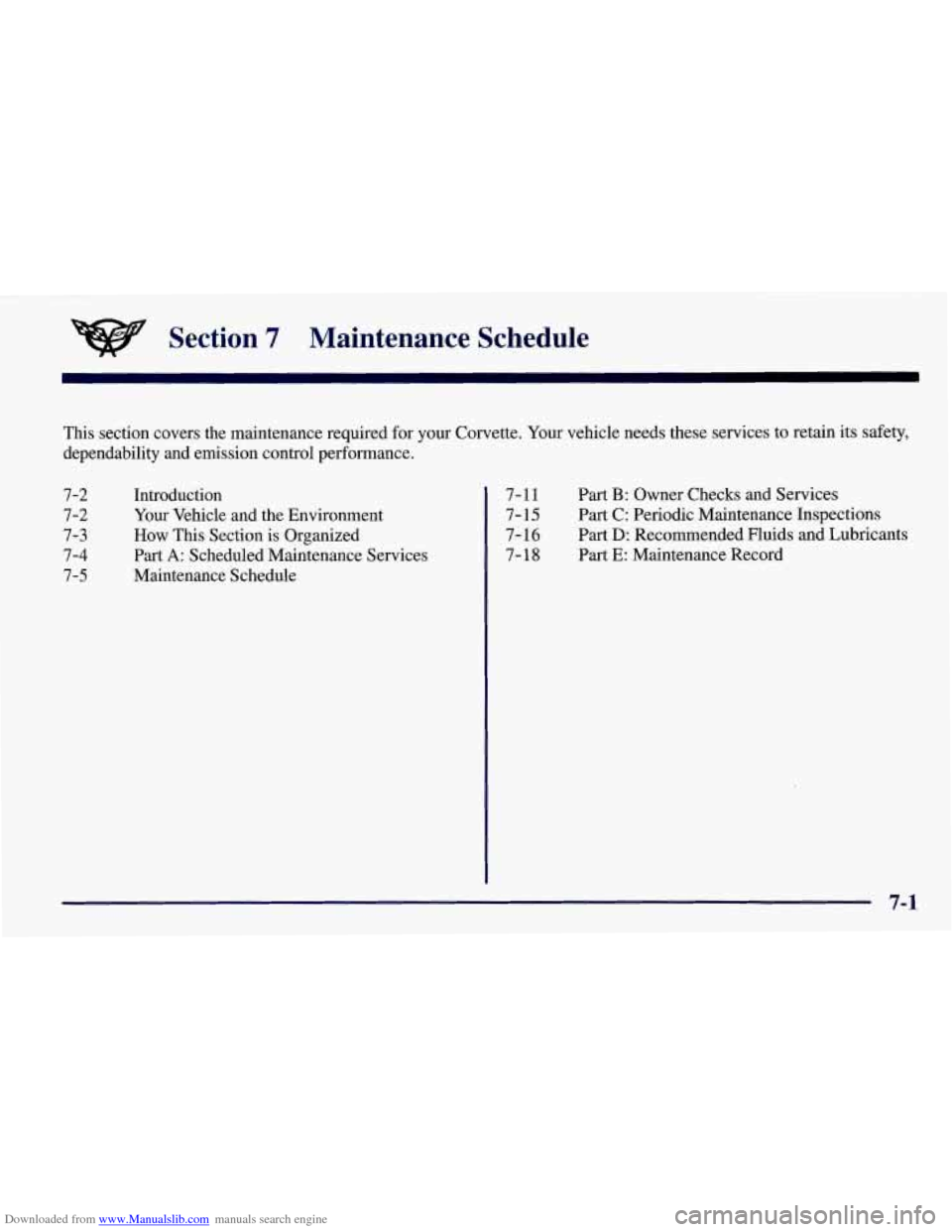
This section covers the maintenance required for your Corvette. Your vehicle needs these services to retain its safety,
dependability and emission control performance.
7-2
7-2
7-3
7-4
7-5 Introduction
Your Vehicle
and the Environment
How This Section is Organized
Part
A: Scheduled Maintenance Services
Maintenance Schedule 7-11
7-15
7- 16 7-18
Part B: Owner Checks and Services
Part C: Periodic Maintenance Inspections
Part
D: Recommended Fluids and Lubricants
Part
E: Maintenance Record
7-1
Page 322 of 378
Downloaded from www.Manualslib.com manuals search engine How This Section is Organized
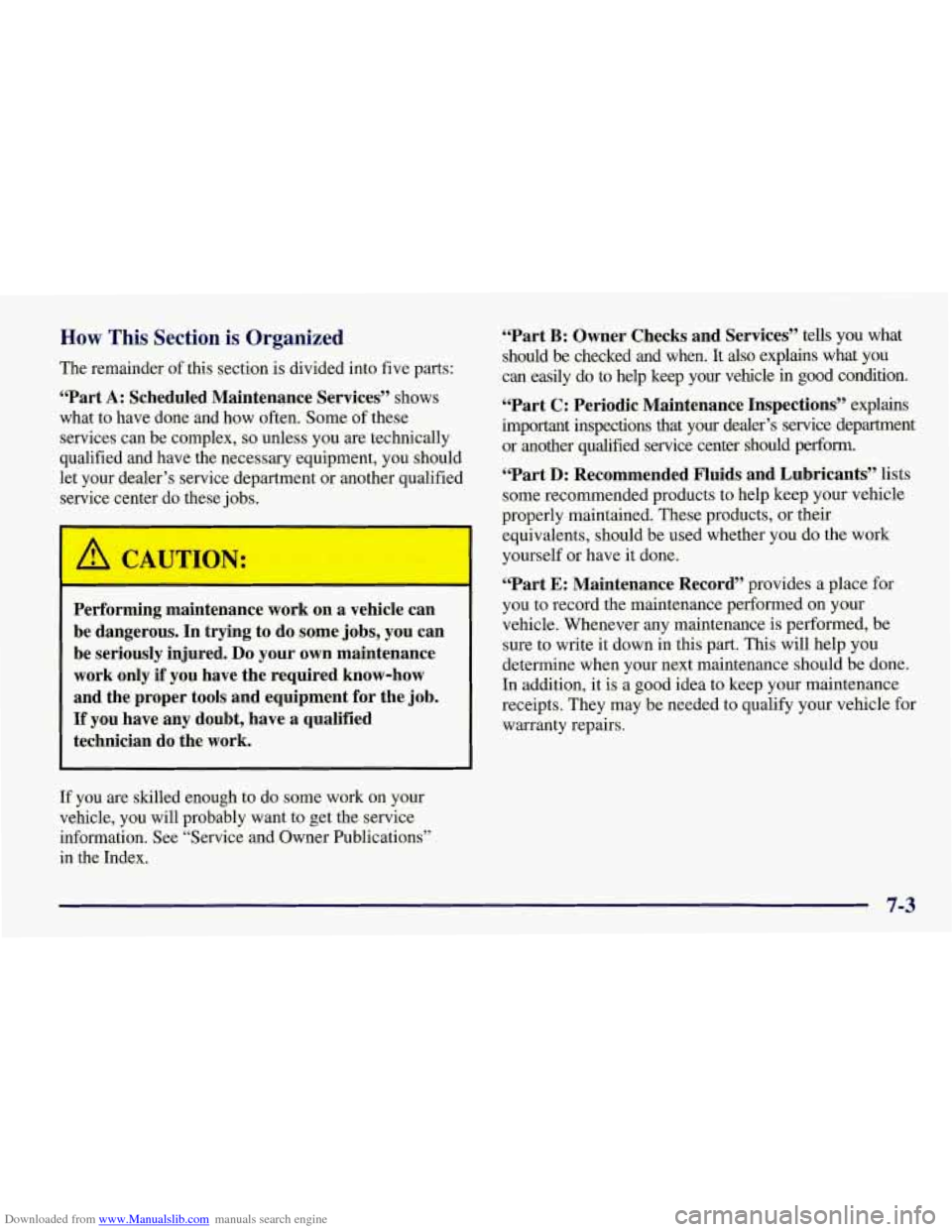
The remainder of this section is divided into five parts:
“Part
A: Scheduled Maintenance Services” shows
what to have done and how often. Some
of these
services can be complex,
so unless you are technically
qualified and have the necessary equipment, you should
let your dealer’s service department or another qualified
service center do these jobs.
Performing maintenance work on a vehicle can
be dangerous. In trying to do some
jobs, you can
be seriously injured.
Do your own maintenance
work only if
you have the required know-how
and the proper tools and equipment for the job.
If you have any doubt, have a qualified
technician do the work.
If you are skilled enough to do some work on your
vehicle, you will probably want to get the service
information. See “Service and Owner Publications”
in the Index. “Part
B: Owner Checks and Services”
tells you what
should be checked and when. It also explains what you
can easily do to help keep your vehicle
in good condition.
“Part C: Periodic Maintenance Inspections” explains
important inspections that your dealer’s service department
or another quaMied service center should perform.
“Part
D: Recommended Fluids and Lubricants” lists
some recommended products to help keep your vehicle
properly maintained. These products,
or their
equivalents, should be used whether you do the work
yourself or have it done.
“Part
E: Maintenance Record” provides a place for
you to record the maintenance performed on your
vehicle. Whenever any maintenance is performed, be
sure to write it down in this part. This will help you
determine when your next maintenance should be done.
In addition, it is a good idea to keep your maintenance
receipts. They may be needed to qualify your vehicle for
warranty repairs.
7-3