1998 CHEVROLET CORVETTE check engine
[x] Cancel search: check enginePage 271 of 378
Downloaded from www.Manualslib.com manuals search engine Surge Tank Pressure Cap
NOTICE:
The surge tank pressure cap is a 15 psi (105 kPa)
pressure-type cap and must be tightly installed to prevent coolant
loss and possible engine damage
from overheating.
When you replace the surge tank pressure cap, a GM cap
is recommended.
Thermostat
Engine coolant temperature is controlled by a thermostat
in the engine coolant system. The thermostat stops the
flow of coolant through the radiator until the coolant
reaches a pre-set temperature.
When you replace the thermostat, a GM thermostat
is recommended.
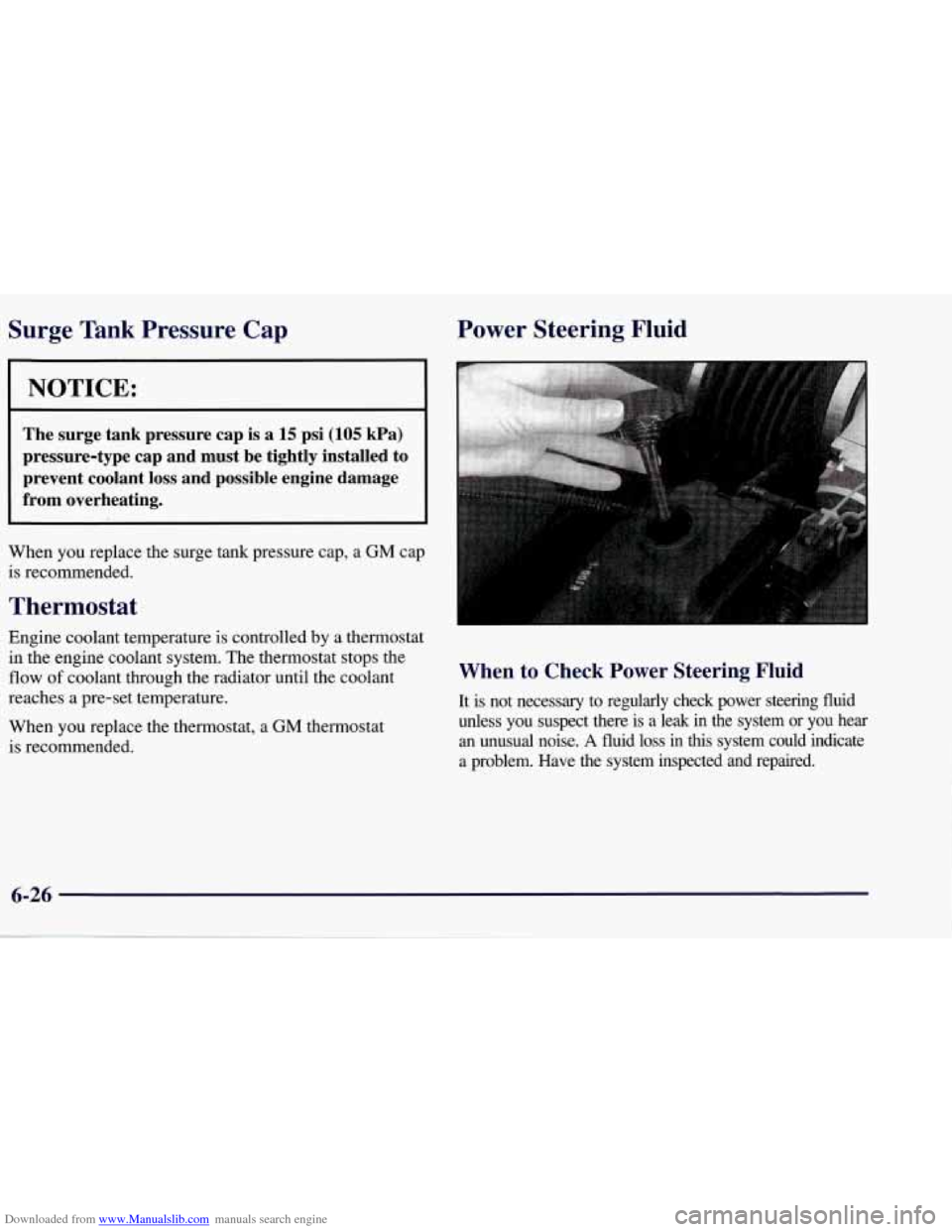
Power Steering Fluid
When to Check Power Steering Fluid
It is not necessary to regularly check power steering fluid
unless you suspect there is a leak
in the system or you hear
an unusual noise. A fluid loss in this system could indicate
a problem. Have the system inspected
and repaired.
Page 272 of 378
Downloaded from www.Manualslib.com manuals search engine How To Check Power Steering Fluid
When the engine compartment is cool, wipe the cap and
the top of the reservoir clean, then unscrew the cap and
wipe the dipstick with a clean rag. Replace the cap and
completely tighten it. Then remove the cap again and
look at the fluid level on the dipstick.
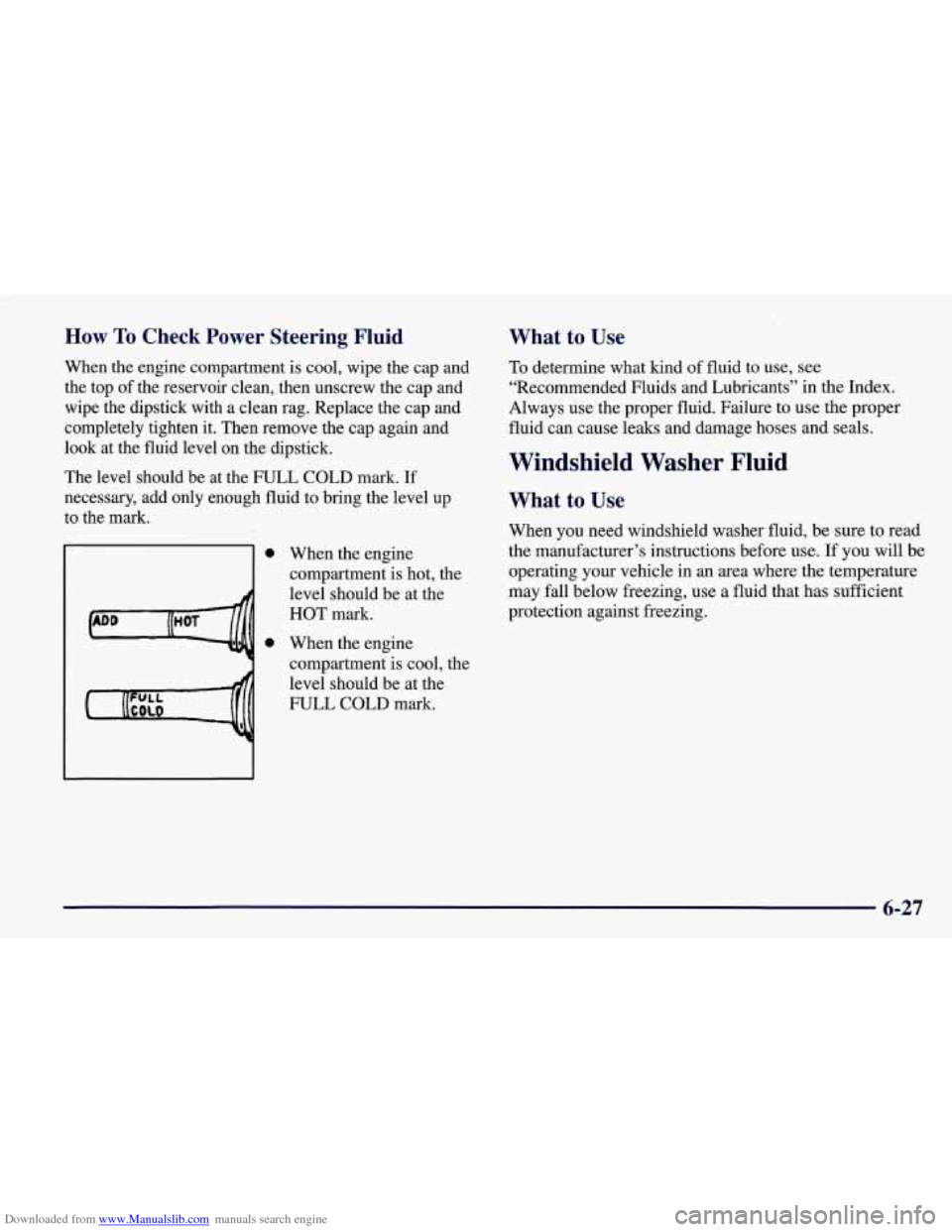
The level should be at the FULL COLD mark. If
necessary, add only enough fluid to bring the level up
to the mark.
0 When the engine
compartment is hot, the
level should be at the
HOT mark.
When the engine compartment is cool, the
level should be at the
FULL COLD mark.
What to Use
To determine what kind of fluid to use, see
“Recommended Fluids and Lubricants” in the Index.
Always use the proper fluid. Failure to use the proper
fluid can cause leaks and damage hoses and seals.
Windshield Washer Fluid
What to Use
When you need windshield washer fluid, be sure to read
the manufacturer’s instructions before use. If you will be
operating your vehicle in
an area where the temperature
may fall below freezing, use a fluid that has sufficient
protection against freezing.
6-27
Page 274 of 378
Downloaded from www.Manualslib.com manuals search engine Brakes
Brake Fluid
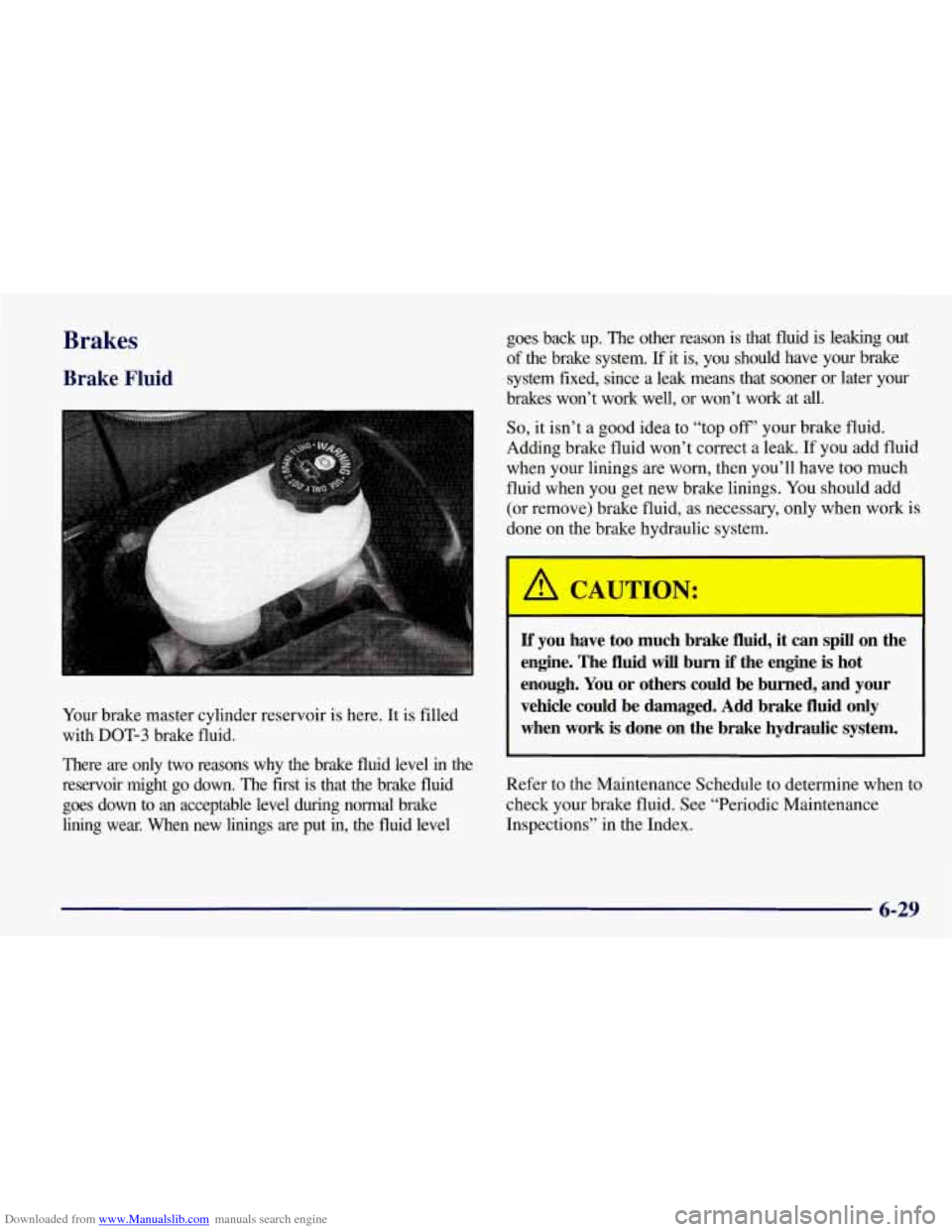
Your brake master cylinder reservoir is here. It is filled
with
DOT-3 brake fluid.
There are only two reasons why the brake fluid level
in the
reservoir might go down. The first is that
the brake fluid
goes down to an acceptable level during normal brake
lining wear. When new linings are put in, the fluid level goes back
up. The
other reason is that fluid is leaking out
of the brake system.
If it is, you should have your brake
system fixed, since a leak means that sooner or later your
brakes won’t work well, or won’t work at
all.
So, it isn’t a good idea to “top off’ your brake fluid.
Adding brake fluid won’t correct a leak. If you add fluid
when your linings are worn, then you’ll have too much
fluid when you get new brake linings.
You should add
(or remove) brake fluid, as necessary, only when work is
done on the brake hydraulic system.
If you have too much brake fluid, it can spill on the
engine. The fluid
will burn if the engine is hot
enough.
You or others could be burned, and your
vehicle could be damaged. Add brake fluid
only
when work is done on the brake hydraulic system.
Refer to the Maintenance Schedule to determine when to
check your brake fluid. See “Periodic Maintenance
Inspections” in the Index.
6-29
Page 275 of 378
Downloaded from www.Manualslib.com manuals search engine Checking Brake Fluid
You can check the brake fluid without taking off the cap.
Just look at the brake fluid reservoir. The
fluid level should
be above the
MIN mark on the reservoir. If it isn’t, have
your brake system checked
to see if there is a leak.
After work is done on the brake hydraulic system, make
sure the level is between the
MIN and MAX marks.
What to Add
When you do need brake fluid, use only DOT-3 brake
fluid
-- such as Delco Supreme 11 @ (GM Part
No. 12377967). Use new brake fluid from a sealed
container only.
Always clean the brake fluid reservoir cap and the area around the cap before removing it.
This will help keep
dirt from entering the reservoir.
With the wrong kind of fluid in your brake
system, your brakes may not work well, or they
may not even work at all. This could cause a
crash. Always use the proper brake fluid.
NOTICE:
Using the wrong fluid can badly damage
brake system parts. For example, just a few
drops
of mineral-based oil, such as engine
oil, in your brake system can damage brake
system parts
so badly that they’ll have to be
replaced. Don’t let someone put
in the
wrong kind of fluid.
If you spill brake fluid on your vehicle’s
painted surfaces, the paint finish can be
damaged. Be careful not to spill brake fluid
on your vehicle.
If you do, wash it off
immediately. See “Appearance Care” in
the Index.
Page 285 of 378
Downloaded from www.Manualslib.com manuals search engine 3. Put the blade assembly pivot in the wiper arm
hook. Pull up until the pivot locking tab locks
in the hook slot.
4. Carefully lower the wiper arm and blade assembly
into the windshield.
Tires
Your new vehicle comes with high-quality tires made by
a leading tire manufacturer. If you ever have questions
about your tire warranty and where to obtain service, see
your Corvette Warranty booklet for details.
A CAUTION:
Poorly maintained and improperly used tires
are dangerous.
0
0
0
Overloading your tires can cause overheating
as a result of too much friction. You could
have an airout and a serious accident.
See
‘Zoading Your Vehicle” in the Index.
Underinflated tires pose the same danger as
overloaded tires. The resulting accident
could cause serious injury. Check all tires
frequently to maintain the recommended
pressure. Tire pressure should be checked
when your tires are cold.
Overinflated tires are more likely to be
cut, punctured or broken by a sudden
impact
-- such as when you hit a pothole.
Keep tires at the recommended pressure.
Worn, old tires can cause accidents.
If your
tread is badly worn, or if your tires have
been damaged, replace them.
Page 286 of 378
Downloaded from www.Manualslib.com manuals search engine Extended Mobility Tires
Your vehicle, when new, had Goodyear Extended
Mobility Tires (EMT). There’s no spare tire, no tire
changing equipment and no place to store a tire in the
vehicle. Extended Mobility Tires perform
so well
without any air that a Tire Pressure Monitor (TPM) is
used to alert you if a tire has lost pressure.
The Tire Pressure Monitor (TPM) has a sensor on
each road wheel that transmits to a receiver on the
instrument panel.
The system operates on a radio frequency subject to
Federal Communications Commission (FCC) Rules and
with Industry and Science Canada.
This device complies with Part 15 of the FCC Rules.
Operation is subject to the following two conditions: (1) this device may not cause harmful interference, and
(2)
this device must accept any interference received,
including interference that may cause undesired operation.
This device complies with RSS-210 of Industry and
Science Canada. Operation is subject to the following
two conditions: (1) this device may not cause
interference, and (2) this device must accept any
interference received, including interference that may
cause undesired operation of the device. Changes or modifications
to this system
by other than an
authorized service facility could void authorization to
use this equipment.
If a tire’s inflation pressure is between
5 psi (35 kPa)
and 25 psi (170 kPa), you will see a message on the
Driver Information Center. This message will show
which tire is underinflated and two chimes will sound.
An example would
be LOW TIRE PRESSURE-LR.
This would mean that the inflation pressure in your left
rear tire is between 5 psi (35 Pa) and 25 psi (170 Pa).
If the inflation pressure in the tire drops below
5 psi
(35 Ea), the message would read FLAT TIRE-LR and
four chimes will sound.
See “Driver Information
Center” in the Index.
The TPM will also alert you if a tire’s pressure is higher
than
42 psi (290 Wa). The message will show which tire
is overinflated and two chimes will sound. An example
would be HIGH PRESSURE-LR. This would mean that
the inflation pressure in your left rear tire is higher than
42 psi (290 kPa). See “Driver Information Center” in
the Index.
If a tire pressure message appears on the Driver
Information Center, stop as soon as you can. Have
the
tire pressures checked and set to those shown on your
Tire Loading Information label. See “Inflation
-- Tire
Pressure” in the Index.
Page 287 of 378
Downloaded from www.Manualslib.com manuals search engine i ,h, CAUTION:
When the LOW TIRE PRESSURE or FLAT TIRE message is displayed on the Driver
Information Center, your vehicle’s handling
capabilities will be reduced during severe
maneuvers.
If you drive too fast, you could lose
control of your vehicle.
You or others could be
injured, Don’t drive over
55 mph (90 km/h) when
the
LOW TIRE PRESSURE or FLAT TIRE
message is displayed. Drive cautiously, and check
your tire pressures as soon as you can.
I
I
If a tire goes flat, you won’t need to stop on the side of
the road to change the tire. You can just keep on driving.
The shorter the distance you drive and the slower the
speed, the greater the chance that the tire will not have
to be replaced.
If you drive on a deflated EMT for
50 miles (80 km) or less and at speeds of 55 mph
(90 km/h) or less, there is a good chance that the tire can
be repaired. The tire can operate effectively with no air
pressure for up to 200 miles (320
km) at speeds up to
55 mph (90 km/h), but the tire would then have to be
replaced. When a tire is filled with air, it provides a cushion between the
road and the wheel. Because you
won’t have this cushion when driving on a deflated tire,
try to avoid potholes that could damage your wheel and
require replacement of it.
Some road hazards can damage a tire beyond repair.
This damage could occur even before you’ve driven on
the tire in
a deflated condition. When a tire has been
damaged, or
if you’ve driven any distance on a deflated
EMT, check with an authorized Goodyear EMT Service
Center to determine whether the tire can be repaired or
should be replaced. To maintain your vehicle’s extended
mobility feature, all replacement tires must be Extended
Mobility Tires. As soon as possible, contact the nearest
authorized Chevrolet or Goodyear EMT servicing
facility for inspection and repair or replacement. Call
Chevrolet at 1-800-CHEV-USA (1-800-243-8872) or
Goodyear at 1-800-789-9878 24-hours a day for
information on the location of the nearest EMT
servicing facility. In Canada, contact the Customer
Communication Center at 1-800-263-3777, or Canadian
Roadside Assistance at 1-800-268-6800. You can also
use the Goodyear number listed above to locate an
authorized EMT servicing facility.
Page 289 of 378
Downloaded from www.Manualslib.com manuals search engine Inflation -- Tire Pressure
The Tire-Loading Information label, which is on the
rear edge of the driver’s door shows the correct inflation
pressures for your tires when they’re cold. “Cold”
means your vehicle has been sitting for at least three
hours or driven no more than
1 mile (1.6 km).
NOTICE:
Don’t let anyone tell you that underinflation or
overinflation is all right. It’s not.
If your tires
don’t have enough
air (underinflation), you can
get the following:
0 Too much flexing
0 Too much heat
0 Tire overloading
0 Bad wear
Bad handling
0 Bad fuel economy.
NOTICE: (Continued) NOTICE: (Continued)
If your tires
have too much air (overinflation).
you can get the following:
Unusual wear
Bad handling
0 Rough ride
0 Needless damage from road hazards.
When to Check
Check your tires once a month or more.
How to Check
With the Tire Pressure Monitor, you can check tire
inflation pressures while driving. After you’ve reached a
speed
of 15 mph (24 kmh) or more, press and release the
GAGES button on the Driver Information Center (DIC)
until the front tire pressures are displayed. Then, press
and release the GAGES button for the rear tire
pressures.
If the display doesn’t show tire pressure, or if
the SERVICE TIRE
MON SYS message appears, see
your dealer for service.