1998 CHEVROLET CORVETTE key
[x] Cancel search: keyPage 159 of 378
Downloaded from www.Manualslib.com manuals search engine Other Messages
Here are more messages that you can receive on your
Driver Information Center. To acknowledge a message
and read another message that may have come on at the
same time, press the RESET button.
0
0
0
0
0
0
0
0
BRAKE BEFORE SHIFT
(Automatic Transmissions Only)
CHANGE
OIL NOW
CHANGE OIL SOON
CRUISE DISENGAGED
CRUISE SET
- MPH (- ktn/h)
DOOR AJAR
ENGINE PROTECTION REDUCE ENGINE
RPM
HATCH AJAR (Coupe)
TRUNK AJAR (Convertible)
HIGH VOLTAGE
0 LOW BRAKE F‘LUID (See “Brake Fluid” in
the Index)
0 LOW COOLANT (See “Engine Overheating” in
0 LOW FUEL (fuel range is less than 50 miles (80 km))
the Index)
0 LOW VOLTAGE
LOW WASHER FLUID
0 PULL KEY - WAIT 10 SEC
RESERVE FUEL
UPSHIFTNOW
2-106
. ..
Page 194 of 378

Downloaded from www.Manualslib.com manuals search engine Police records show that almost half of all motor
vehicle-related deaths involve alcohol.
In most cases,
these deaths are the result of someone who was drinking
and driving.
In recent years, over 17,000 annual motor
vehicle-related deaths have been associated with the use
of alcohol, with more than
300,000 people injured.
Many adults
-- by some estimates, nearly half the adult
population
-- choose never to drink alcohol, so they
never drive after drinking. For persons under
21, it’s
against the law in every
U.S. state to drink alcohol.
There
are good medical, psychological and
developmental reasons for these laws.
The obvious way to solve this highway safety problem
is for people never to drink alcohol and then drive. But
what if people do? How much is “too much” if the
hver plans to drive? It’s a lot less than many might
think. Although it depends on each person and situation,
here is some general information on the problem.
The Blood Alcohol Concentration (BAC)
of someone
who is drinking depends upon four things:
0 The amount of alcohol consumed
0 The drinker’s body weight
0 The amount of food that is consumed before and
during drinking
The length of time it has taken the drinker to
consume the alcohol.
According to the American Medical Association, a
180-lb.
(82 kg) person who drinks three 12-ounce
(355 ml) bottles of beer in an hour will end up with a
BAC of about
0.06 percent. The person would reach the
same BAC by drinking three 4-ounce (120
ml) glasses
of wine or three mixed drinks
if each had 1- 1/2 ounces
(45
ml) of a liquor like whiskey, gin or vodka.
4-3
Page 223 of 378
Downloaded from www.Manualslib.com manuals search engine Hazard Warning Flashers
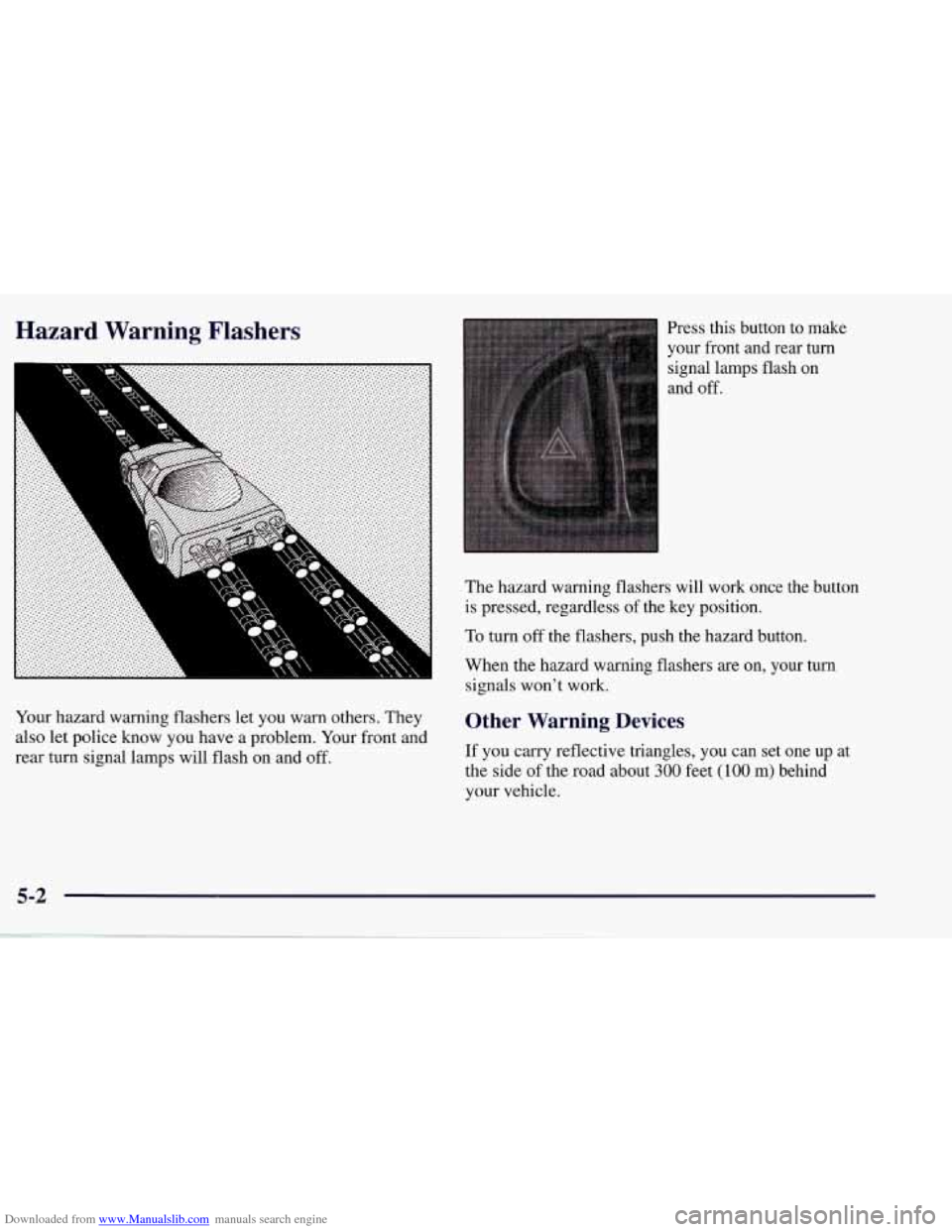
Your hazard warning flashers let you warn others. They
also let police know you have a problem. Your front and
rear
turn signal lamps will flash on and off.
Press this button to make
your front and rear turn
signal lamps flash on
and
off.
The hazard warning flashers will work once the button
is pressed, regardless of the key position.
To turn off the flashers, push the hazard button.
When the hazard warning flashers are on, your turn
signals won't work.
Other Warning Devices
If you carry reflective triangles, you can set one up at
the side of the road about
300 feet (100 m) behind
your vehicle.
Page 230 of 378
Downloaded from www.Manualslib.com manuals search engine To help avoid injury to you or others:
Never let passengers ride in a vehicle that is
Never tow faster than safe or posted speeds.
Never tow with damaged parts not
0 Never get under your vehicle after it has
Always secure the vehicle on each side with
0 Use only R-hooks. being towed.
fully secured.
been lifted by the tow truck.
separate safety chains when towing it.
A vehicle can fall from a car carrier if it isn’t
adequately secured. This can cause a collision,
serious personal injury and vehicle damage. The
vehicle should be tightly secured with chains or
steel cables before
it is transported.
Don’t use substitutes (ropes, leather straps,
canvas webbing, etc.) that can be cut by sharp
edges underneath the towed vehicle. Always use
R-hooks inserted in the front and rear R-hook
slots. Never use J-hooks. They will damage
drivetrain and suspension components.
When your vehicle is being towed, have the ignition
key in the
OFF position. The steering wheel should
be clamped in a straight-ahead position, with a
clamping device designed for towing service.
Do not
use the vehicle’s steering column lock for this. The
transmission should be in
NEUTRAL (N) and the
parking brake released.
5-9
Page 295 of 378
Downloaded from www.Manualslib.com manuals search engine I~~rrect wheel nuts or improperly tightened
wheel nuts can cause the wheel to become loose
and even come
off. This could lead to an accident.
Be sure to use the correct wheel nuts.
If you have
to replace them, be sure to get new
GM original
equipment wheel nuts.
NOTICE:
Improperly tightened wheel nuts can lead to
brake pulsation and rotor damage. To avoid
expensive brake repairs, evenly tighten the wheel
nuts in the proper sequence and to the proper
torque specification. Used Replacement Wheels
Putting a used wheel
on your vehicle is
dangerous.
You can’t know how it’s been used or
how far it’s been driven. It could fail suddenly
and cause an accident.
If you have to replace a
wheel, use
a new GM original equipment wheel.
Using the Wheel Lock Key
The wheel lock key sits in a small depression in
the
trunk rail directly under the left-hand rear
compartment cover.
Your vehicle’s wheel lock key has a unique registration
number. The registration number is printed on a card
included in your lock nut package.
Also, on this card, is
lost key replacement information. This number is not
recorded by
GM or your dealer, so be sure not to lose
this card.
You will need the information if you ever lose
your wheel lock key.
Page 296 of 378
Downloaded from www.Manualslib.com manuals search engine If you or someone else is going to remove the wheels on
your vehicle, make sure that the special wheel nut socket
and wheel lock key
are being used.
NOTICE:
Your wheels could be damaged if the wheel nut
socket
is not used to remove your vehicle’s wheels.
The wheel nut socket can be used with an air wrench or
a torque wrench. The wheel lock key can be used with a
torque wrench, but not with an air or impact wrench.
I NOTICE:
Your wheel lock key or lock nuts could be
damaged if an
air or impact wrench is used with
this key.
Tire Chains
NOTICE:
Don’t use tire chains. They can damage your
vehicle because there’s not enough clearance.
Use another type of traction device only
if its
manufacturer recommends it for use on your
vehicle and tire size combination and road
conditions. Follow that manufacturer’s
instructions.
To help avoid damage to your
vehicle, drive slowly, readjust or remove the
device
if it’s contacting your vehicle, and don’t
spin your wheels.
If you do find traction devices that will fit, install
them on the rear tires.
6-51
Page 331 of 378
Downloaded from www.Manualslib.com manuals search engine At Least Twice a Year Automatic Transmission Inspection
Restraint System Check
Make sure the safety belt reminder light and all your
belts, buckles, latch plates, retractors and anchorages are
working properly. Look for any other loose or damaged
safety belt system parts. If you see anything that might
keep a safety belt system from doing its job, have it
repaired. Have any torn or frayed safety belts replaced.
Also look for any opened or broken
air bag coverings,
and have them repaired or’replaced. (The air bag system
does not need regular maintenance.)
Wiper Blade Check
Inspect wiper blades for wear or cracking. Replace blade
inserts that appear
worn or damaged or that streak or
miss areas of the windshield. Also see “Wiper Blades.
Cleaning” in the Index.
Manual Transmission Check
Check the transmission fluid level; add if needed. See
“Manual Transmission” in the Index. Check for leaks.
A fluid loss may indicate a problem. Have the system
inspected and repaired
if needed. It is
not necessary to check the transmission fluid level.
A transmission fluid leak is the only reason for fluid
loss. Check for leaks.
If a leak occurs, take the vehicle to
your
GM dealership Service Department and have it
repaired as
soon as possible.
At Least Once a Year
Key Lock Cylinders Service
Lubricate the key lock cylinders with the lubricant
specified in Part D.
Body Lubrication Service
Lubricate all body door hinges. Also lubricate all hinges
and latches, including those for the hood, rear
compartment, console door and any folding seat
hardware.
Part D tells you what to use. More frequent
lubrication may be required when exposed to a
corrosive environment.
Page 332 of 378
Downloaded from www.Manualslib.com manuals search engine Starter Switch Check
-
I A CAUTION:
Brake-Transmission Shift Interlock (BTSI) Check (Automatic Transmission)
When you are doing this check, the vehicle could
move suddenly.
If it does, you or others could be
injured. Follow the steps below.
1. Before you start, be sure you have enough room
2. Firmly apply both the parking brake (see “Parking
around the vehicle.
Brake” in the Index if necessary) and the
regular brake.
NOTE:
Do not use the accelerator pedal, and be
ready to turn off the engine immediately if it starts.
3. On automatic transmission vehicles, try to start the
engine in each gear. The starter should work only in
PARK (P) or NEUTRAL (N). If the starter works in
any other position, your vehicle needs service.
On manual transmission vehicles, put the shift lever
in NEUTRAL (N), push the clutch down halfway
and try to start the engine. The starter should work
only when the clutch is pushed down all the way to
the floor.
If the starter works when the clutch isn’t
pushed all the way down, your vehicle needs service.
I A CAUTION:
I
When you are doing this check, the vehicle could
move suddenly.
If it does, you or others could be
injured. Follow the steps below.
1. Before you start, be sure you have enough
room around the vehicle. It should be parked
on a level surface.
2. Firmly apply the parking brake (see “Parking Brake”
in the Index if necessary).
NOTE: Be ready to apply the regular brake
immediately if the vehicle begins to move.
3. With the engine off, turn the key to the ON position,
but don’t start the engine. Without applying the
regular brake, try to move the shift lever out of
PARK (P) with normal
effort. If the shift lever
moves out of PARK (P), your vehicle’s BTSI
needs service.
7-13