1998 CHEVROLET CORVETTE lock
[x] Cancel search: lockPage 54 of 378
Downloaded from www.Manualslib.com manuals search engine Section 2 Features and Controls
Here you can learn about the many standard and optional features on your vehicle, and information on starting,
shifting and braking. Also explained are the instrument panel and the warning systems that tell you
if everything is
working properly
-- and what to do if you have a problem.
2-4
2-5
2-6
2-
14
2- 17 2-18
2-20
2-2 1
2-22
2-24
2-26
2-29
2-32
2-34
2-36
2-36 Door Locks
Memory (Option)
Remote Function Actuation
System
Remote Hatch/Trunk Lid Release
Universal Theft-Deterrent System
PASS-Key@
New Vehicle “Break-In”
Ignition Switch Starting Your Engine
Engine Coolant Heater (Canada Only)
Automatic Transmission Operation
Manual Transmission Operation
Parking Brake Shifting Into PARK (P)
(Automatic Transmission Models Only)
Shifting Out of PARK (P)
(Automatic Transmission)
Parking Your Vehicle (Manual Transmission) 2-37
2-37
2-38
2-39 2-39
2-40
2-42
2-50
2-52
2-53
2-54
2-60
2-68
2-74
2-77
2-87 Parking Over
Things That Burn
Engine Exhaust
Running Your Engine While You’re Parked
(Automatic Transmission)
Limited-Slip Rear Axle
Selective Real Time Damping (Option)
Windows
Turn SignalMultifunction Lever
Exterior Lamps
Interior Lamps
Mirrors
Storage Compartments
Roof Panel (Coupe)
Convertible Top (Option)
Instrument Panel
Warning Lights, Gages and Messages
Driver Information Center (DIC)
2-1
Page 56 of 378
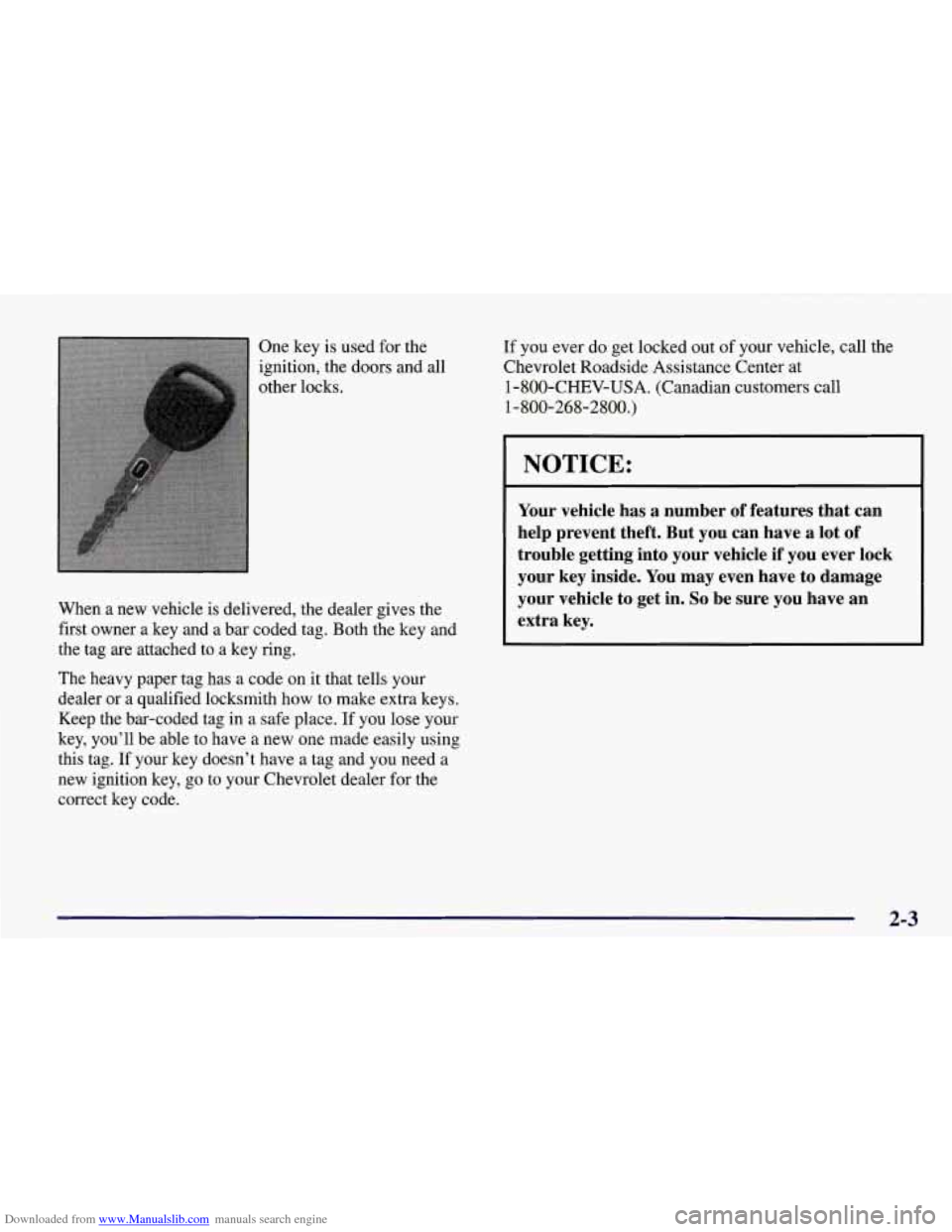
Downloaded from www.Manualslib.com manuals search engine One key is used for the
ignition, the doors and
all
other locks.
When a new vehicle is delivered, the dealer gives the
first owner a key and a bar coded tag. Both the key and
the tag are attached to
a key ring.
The heavy paper tag has a code on it that tells your
dealer
or a qualified locksmith how to make extra keys.
Keep the bar-coded tag in a safe place. If you lose your
key, you’ll be able to have a new one made easily using
this tag. If your key doesn’t have a tag and
you need a
new ignition key, go to your Chevrolet dealer for the
correct key code. If you
ever do get locked out
of your vehicle, call the
Chevrolet Roadside Assistance Center at
1-800-CHEV-USA. (Canadian customers call
1-800-268-2800.)
NOTICE:
Your vehicle has a number of features that can
help prevent theft. But you can have a lot of
trouble getting into your vehicle if you ever lock
your key inside. You may even have to damage
your vehicle to get in.
So be sure you have an
extra key.
2-3
Page 57 of 378
Downloaded from www.Manualslib.com manuals search engine Door Locks
Unlocked doors can be dangerous.
Passengers
-- especially children -- can easily
open the doors and fall out. When a door
is
locked, the inside handle won’t open it.
Outsiders can easily enter through an unlocked
door when you
slow down or stop your vehicle.
This may not be
so obvious: You increase the
chance
of being thrown out of the vehicle in a
crash
if the doors aren’t locked. Wear safety belts
properly, lock your doors, and you will be
far
better off whenever you drive your vehicle.
There are several ways to lock and unlock your vehicle.
From the outside, use your door key or the key
fob transmitter.
If your theft-deterrent system is armed, unlock the doors
only with the key or the transmitter to avoid setting off
the alarm. See “Universal Theft-Deterrent” in the Index. To
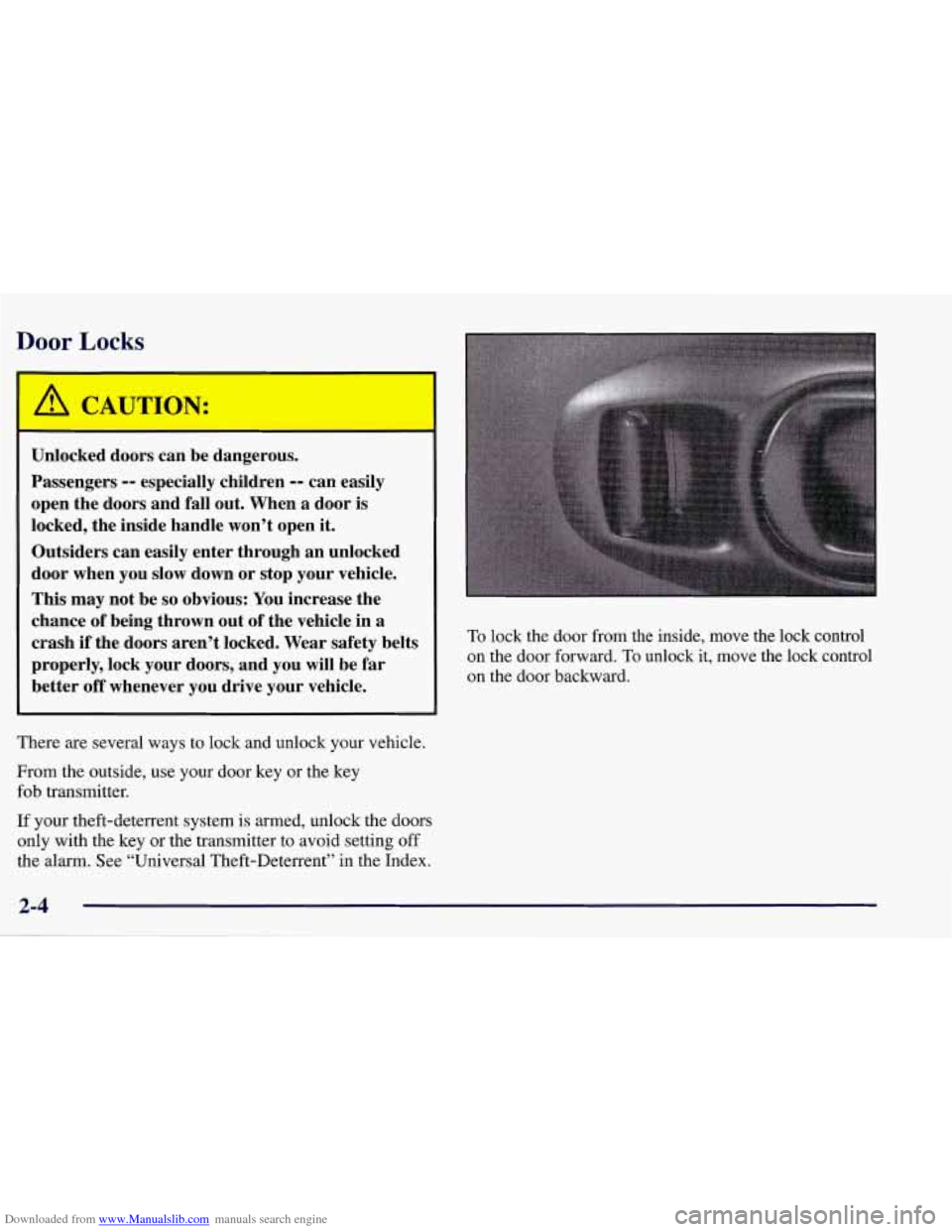
lock the door from the inside, move the lock control
on the door forward. To unlock it, move the lock control
on the door backward.
Page 58 of 378
Downloaded from www.Manualslib.com manuals search engine Power Door Locks
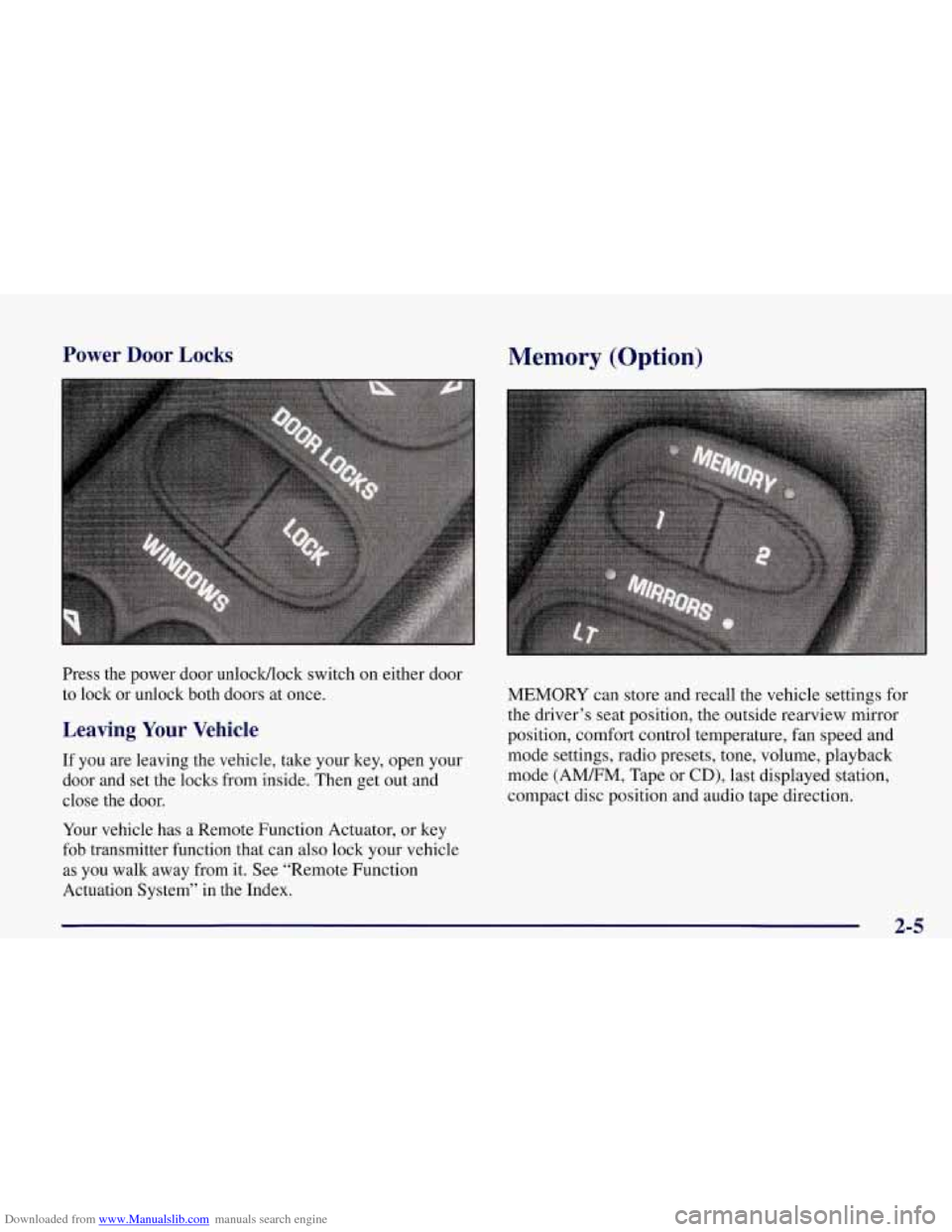
Press the power door unlocWlock switch on either door
to lock or unlock both doors at once.
Leaving Your Vehicle
If you are leaving the vehicle, take your key, open your
door and set the locks from inside. Then get out and
close the door.
Your vehicle has a Remote Function Actuator, or key
fob transmitter function that can also lock your vehicle
as you walk away from it. See “Remote Function
Actuation System’’ in
the Index.
Memory (Option)
MEMORY can store and recall the vehicle settings for
the driver’s seat position, the outside rearview mirror
position, comfort control temperature, fan speed and
mode settings, radio presets, tone, volume, playback
mode (AMEM, Tape or
CD), last displayed station,
compact disc position and audio tape direction.
2-5
Page 59 of 378
Downloaded from www.Manualslib.com manuals search engine The MEMORY buttons are located on the driver’s side
door, above the power mirror buttons. The MEMORY
buttons can store and recall the vehicle settings for up to
three drivers. Use button
“1” to store the vehicle settings
for the first driver, button
“2” for a second driver or
press buttons
1 and 2 simultaneously for a third driver.
To store your vehicle settings, press and hold a
MEMORY button. The light will glow steady for one
second and then flash once when the settings
are completed.
To recall your settings, press your MEMORY button.
The light above the button will flash until the correct
vehicle settings are achieved, then glow for three
seconds when completed.
Your memory settings will also be recalled when you
press the active door
UNLOCK button on the key
fob transmitter.
Drivers 1,2 and
3 correspond to the order in which your
key fob transmitters were programmed. (See “Fob
Training” in the Index.)
Memory recall
will not work if the vehicle is moving,
the ignition key is removed or a power seat, mirror or
memory switch is being used. Memory recall will be
temporarily interrupted during engine crank.
Remote Function Actuation System
Your vehicle has a passive/active Remote Function
Actuation (RFA) system that allows you to lock and
unlock your doors, unlock your hatch/trunk lid, turn the
panic alarm on and off and disarm or
arm your
theft-deterrent system. When using one of the key fob
transmitters supplied with your vehicle, the passive
range distance is as much as
30 feet (9 m) away from the
vehicle on the driver’s side and 20 feet
(6 m) away on
the passenger’s side. The active range distance is as
much as
100 feet (30 m) away.
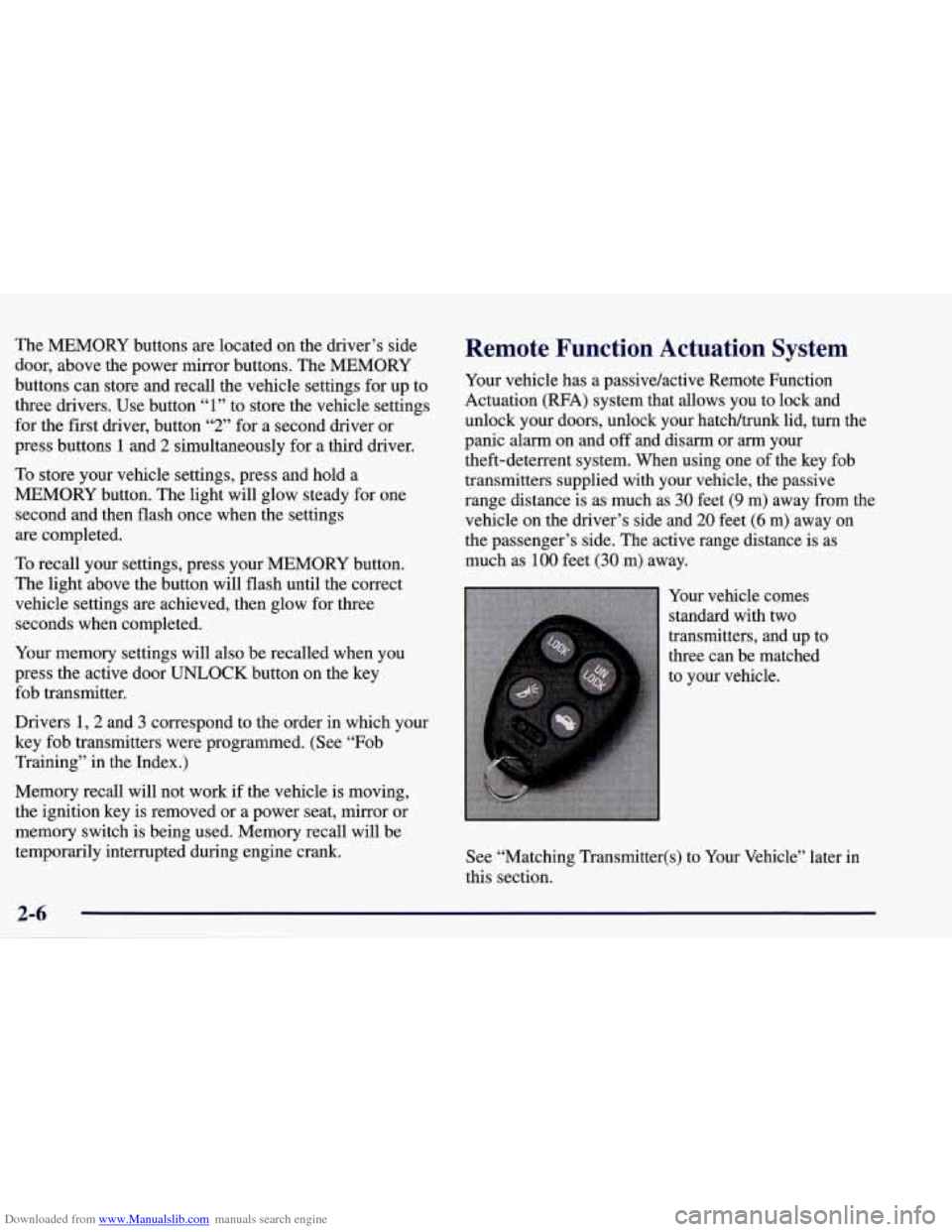
Your vehicle comes
standard with two
transmitters, and up to
three can be matched
to your vehlcle.
See “Matching Transmitter(s) to Your Vehicle” later in
this section.
Page 60 of 378
Downloaded from www.Manualslib.com manuals search engine Your RFA system operates on a radio frequency subject
to Federal Communications Commission (FCC) Rules
and with Industry Canada.
This device complies with Part
15 of the FCC Rules.
Operation is subject to the following two conditions:
(1) this device may not cause harmful interference,
and
(2) this device must accept any interference
received, including interference that may cause
undesired operation.
This device complies with RSS-210 of Industry Canada.
Operation is subject to the following two conditions:
(1) this device may not cause interference, and (2) this
device must accept
any interference received, including
interference that may cause undesired operation of
the device.
Changes or modifications to this system by other than an
authorized service facility could void authorization to
use this equipment. If
you ever notice a decrease in the key fob transmitter
range, try doing one of the following:
0
0
0
0
0
0
Check to determine if battery replacement is
necessary. See the instructions that follow.
Check the distance. You may be too far from your
vehicle. You may need to stand closer during rainy
or snowy weather.
Check the location. Other vehicles or objects may be
blocking the signal. Take a few steps to the left or
right, hold the transmitter higher, and
try again.
Check to make sure that an electronic device
such as a cellular phone or lap top computer is not
causing interference.
Try to resynchronize the transmitter by pressing
and holding the LOCK and UNLOCK buttons for
seven seconds when standing next to the vehicle.
If you’re still having trouble, see your dealer or a
qualified technician for service.
2-7
Page 61 of 378
Downloaded from www.Manualslib.com manuals search engine Operation
You don’t have to do anything for the RFA to work
when the passive feature is on.
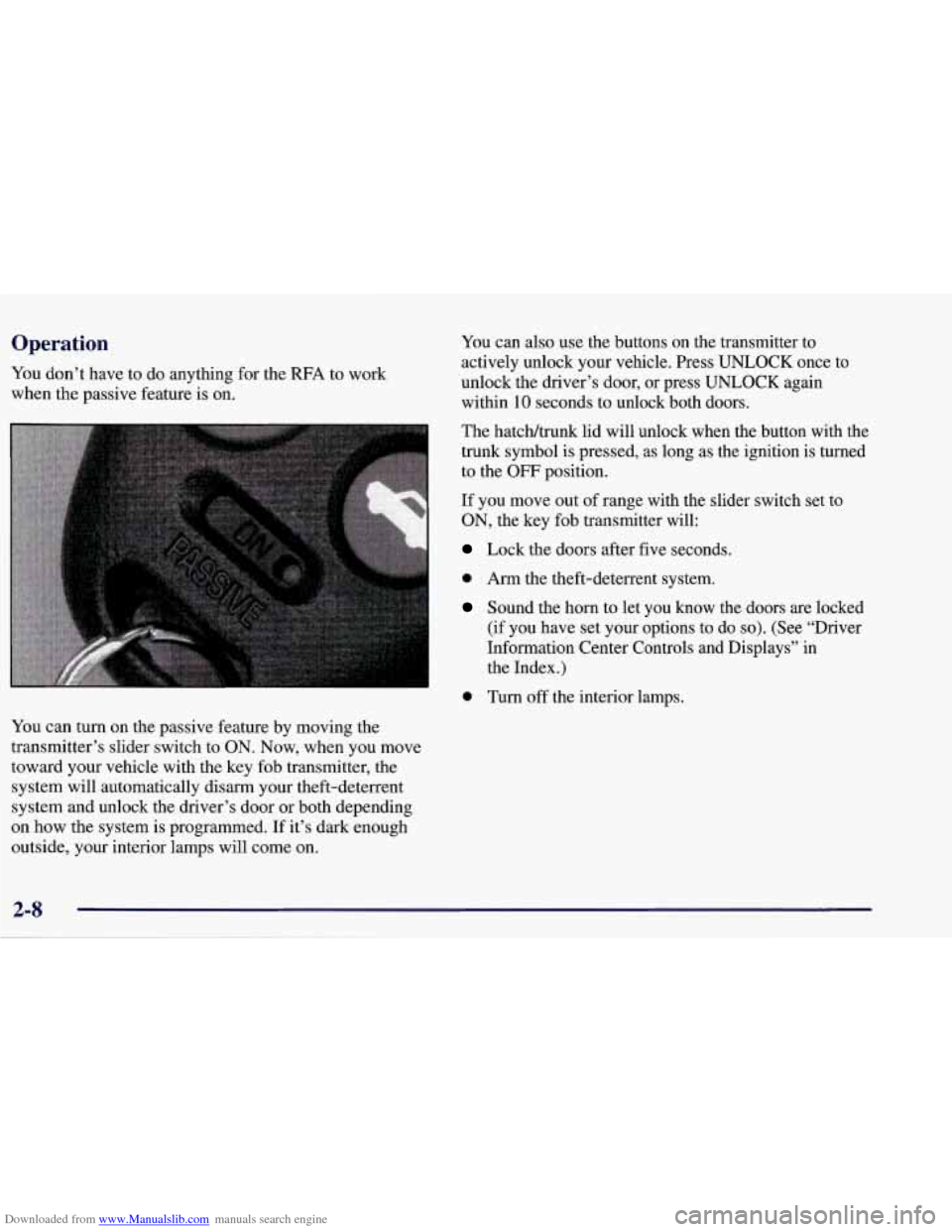
You can turn on the passive feature by moving the
transmitter’s slider switch to
ON. Now, when you move
toward your vehicle with the key fob transmitter, the
system will automatically disarm your theft-deterrent
system and unlock the driver’s door or both depending
on how the system is programmed. If it’s dark enough
outside,
your interior lamps will come on.
You can also use the buttons on the transmitter to
actively unlock your vehicle. Press UNLOCK once to
unlock the driver’s door, or press UNLOCK again
within 10 seconds to unlock both doors.
The hatchltrunk lid will unlock when the button with the
trunk symbol is pressed, as long as the ignition is turned
to the
OFF position.
If you move out of range with the slider switch set to
ON, the key fob transmitter will:
Lock the doors after five seconds.
0 Arm the theft-deterrent system.
Sound the horn to let you know the doors are locked
(if you have set your options to
do so). (See “Driver
Information Center Controls and Displays” in
the Index.)
0 Turn off the interior lamps.
Page 62 of 378
Downloaded from www.Manualslib.com manuals search engine The system has a feature that makes it difficult for you
to lock your keys in your vehicle.
If you leave your keys
in the ignition and attempt to lock the doors, the vehicle
will not lock and a chime will sound to remind you that
the keys are in the ignition.
If the door lock is pressed
again, within five seconds, the doors will lock and the
keys can be locked in the car. If you leave the keys
in
the ignition and move away with the key fob transmitter,
the doors still will not lock. You should notice that the
horn doesn’t sound and return to get your keys out of
the ignition.
The system will allow you to lock your keys in the
vehicle if you didn’t leave them in the ignition. You
should, however, be able to use the key fob transmitter
to get them out as long as the passive slide switch
is in
the
ON position. After 15 seconds of no motion, the key
fob transmitter shuts down to save the battery. Wait
about
30 seconds, then rock the vehicle. The key fob
transmitter should “wake up” and unlock the doors.
This system can’t guarantee that you will never be
locked out of your vehicle. If the battery is low or if the
key fob transmitter is in a place where the signal can’t
get to the antenna,
it won’t unlock the doors. Always
remember to take your keys with you.
Panic Alarm Button
When you press the special horn button on the key
fob transmitter, your vehicle’s horn will sound. This
panic alarm button will allow you to attract attention,
if needed.
If the horn alarm sounds, there are three ways to turn
it off:
Push the panic alarm button on the key fob
Wait 90 seconds, and the horn will turn off by
transmitter again.
itself
or
0 Turn the key to any position in the ignition switch,
except
OFT.
RF’A Settings
You can adjust the settings on the system through the
Driver Information Center (DIC). You can have just the
driver’s or both door locks passively unlock, change the
type of alarm used by the theft-deterrent, or have lamps
come on when you approach the vehicle. See “Driver
Information Center Controls and Displays” in the Index.
2-9