Page 271 of 400
Downloaded from www.Manualslib.com manuals search engine Checking Engine Oil
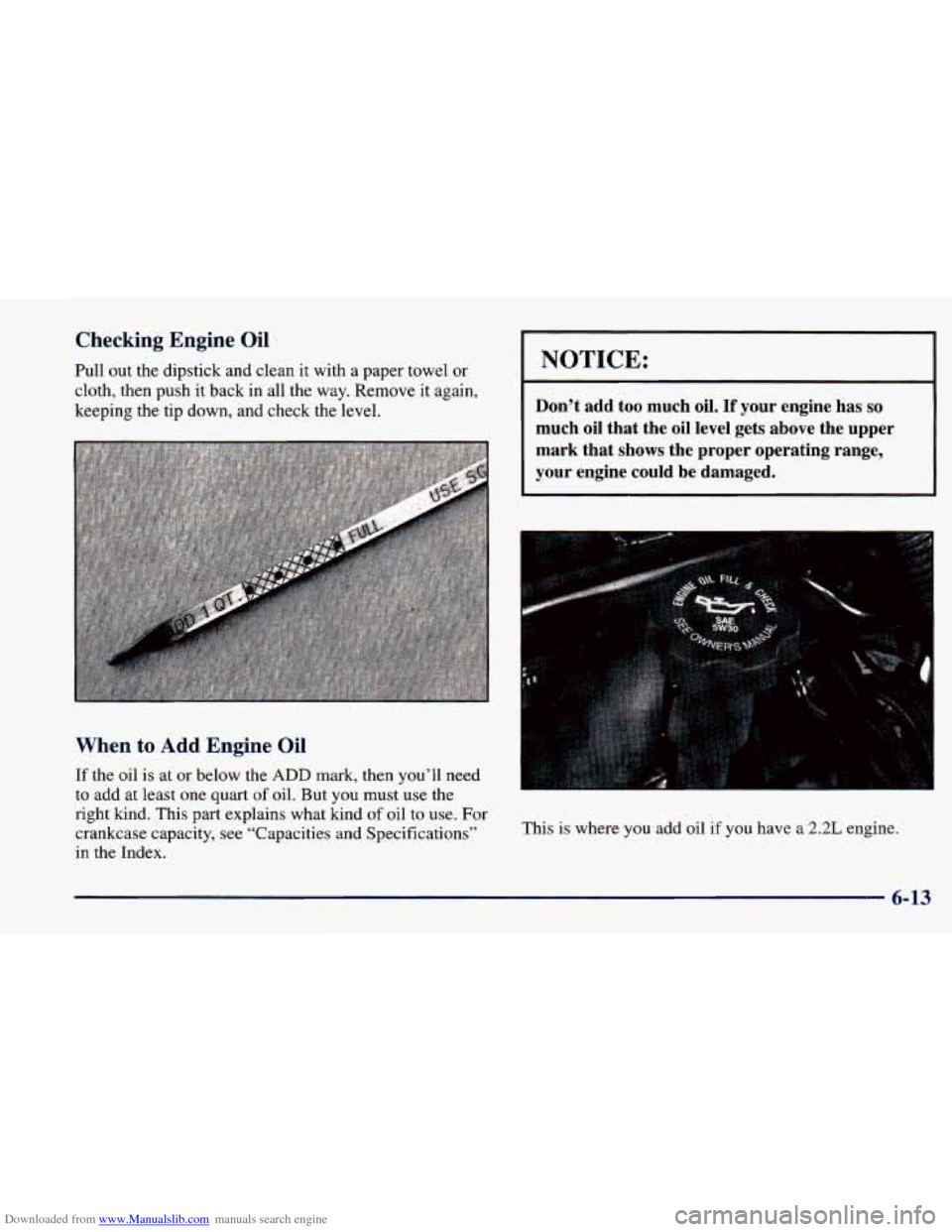
Pull out the dipstick and clean it with a paper towel or
cloth, then push it back in all the way. Remove it again.
keeping the tip down, and check the level.
When to Add Engine Oil
If the oil is at or below the ADD mark, then you’ll need
to add at least one quart of oil. But you must use the
right kind. This part explains what kind
of oil to use. For
crankcase capacity, see “Capacities and Specifications”
in the Index.
I NOTICE:
Don’t add too much oil. If your engine has so
much oil that the oil level gets above the upper
mark that shows the proper operating range,
your engine could be damaged.
This is where you add oil if you have a 2.2L engine.
6-13
Page 274 of 400
Downloaded from www.Manualslib.com manuals search engine Engine Oil Additives
Don’t add anything to your oil. Your dealer is ready to
advise
if you think something should be added.
When to Change Engine Oil
If any one of these is true for you, use the short tripkity
maintenance schedule:
e
e
0
0
e
Most trips are less than 5 to 10 miles (8 to 16 km).
This
is particularly important when outside
temperatures are below freezing.
Most trips include extensive idling (such as frequent
driving in stop-and-go traffic).
Most trips
are through dusty areas.
You frequently tow a trailer
or use a carrier on top of
your vehicle.
The vehicle is used for delivery service, police, taxi
or other commercial application.
Driving under these conditions causes engine oil
to
break down sooner. If any one of these is true for your
vehicle, then you need
to change your oil and filter
every
3,000 miles (5 000 km) or 3 months -- whichever
occurs first.
If none of them is true, use the long triphighway
maintenance schedule. Change the oil and filter every
7,500 miles (12 500 km) or 12 months -- whichever
occurs first. Driving a vehicle with a fully warmed
engine under highway conditions causes engine oil to
break down slower.
Wh .~: 1 I Do with Used Oil
Did you know that used engine oil contains certain
elements that may be unhealthy for your skin and could
even cause cancer? Don’t let used
oil stay on your skin
for very long. Clean your
skin and nails with soap and
water, or a good hand cleaner. Wash
or properly throw
away clothing
or rags containing used engine oil. (See
the manufacturer’s warnings about the use and disposal
of oil products.)
Used oil can be a real threat to the environment. If you
change your own oil, be sure
to drain all free-flowing oil
from the filter before disposal. Don’t ever dispose of
oil
by putting it in the trash, pouring it on the ground, into
sewers, or into streams or bodies of water. Instead,
recycle it by taking
it to a place that collects used oil. If
you have a problem properly disposing of your used oil,
ask your dealer, a service station or a local recycling
center for help.
6-16
Page 276 of 400
Downloaded from www.Manualslib.com manuals search engine Operating the engine with the air cleaner off can
cause you or others to be burned. The air cleaner
not only cleans the air, it stops flame
if the engine
backfires.
If it isn’t there, and the engine
backfires, you could be burned. Don’t drive with
it
off, and be careful working on the engine with
the air cleaner
off.
NOTICE:
If the air cleaner is off, a backfire can cause a
damaging engine fire. And, dirt can easily get
into your engine, which will damage it.
Always
have the air cleaner in place when you’re driving.
Automatic Transaxle Fluid
(Three-Speed Only)
When to Check and Change
A good time to check your automatic transaxle fluid
level is when the engine oil is changed.
Change both the fluid and filter every
50,000 miles
(83 000 km) if the vehicle is mainly driven under one or
more of these conditions:
In heavy city traffic where the outside temperature
In hilly or mountainous terrain.
When doing frequent trailer towing.
0 Uses such as found in taxi, police or delivery service.
If you do not use your vehicle under any of these
conditions, the fluid and filter do not require changing.
See “Scheduled Maintenance Services’’ in the Index. regularly reaches
90°F (32°C)
or higher.
6-18
Page 278 of 400
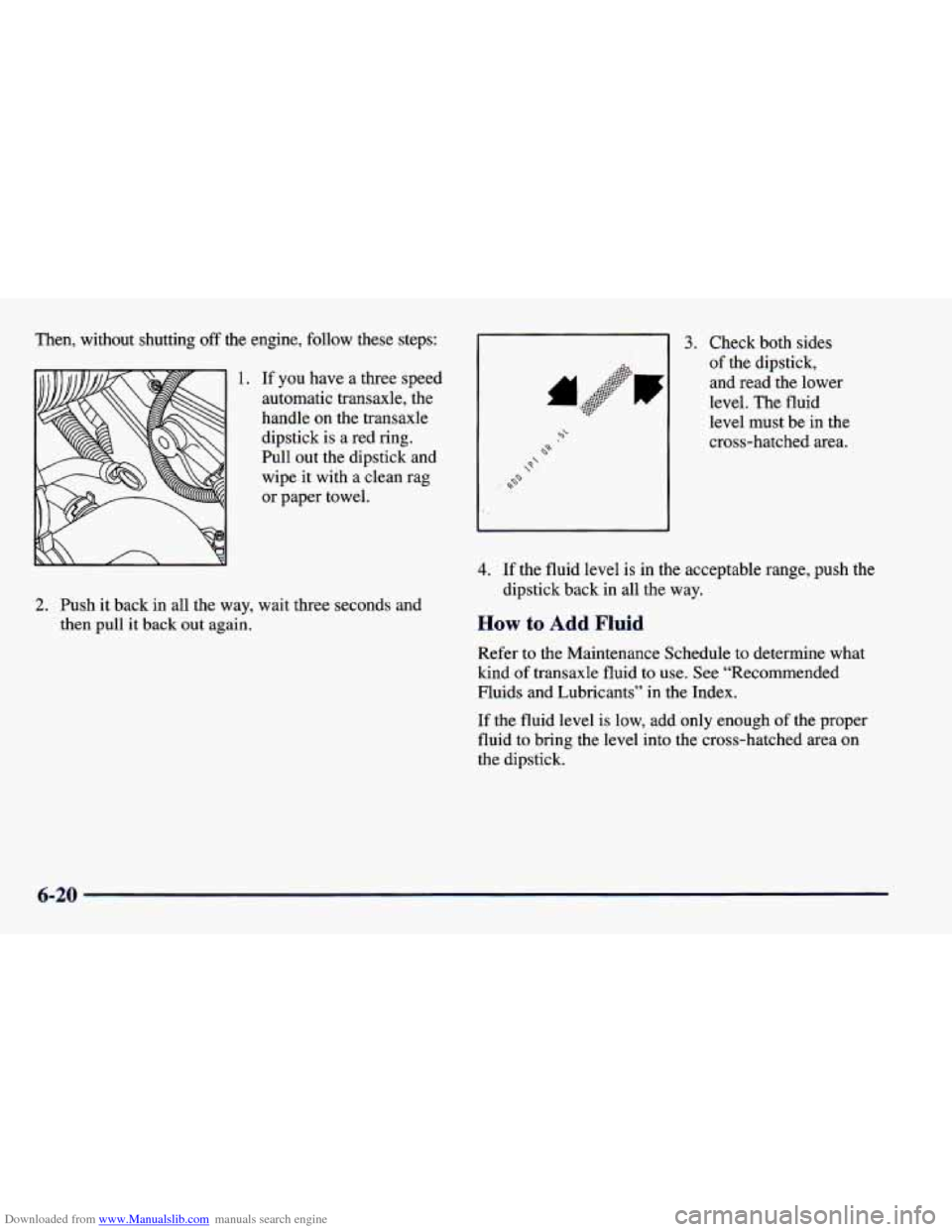
Downloaded from www.Manualslib.com manuals search engine Then, without shutting off the engine, follow these steps:
1. If you have a three speed
automatic transaxle, the
handle on the transaxle
dipstick is a red ring.
Pull out the dipstick and
wipe it with a clean rag
or paper towel.
2. Push it back in all the way, wait three seconds and
then pull it
back out again.
-1 3. Check both sides
of the dipstick,
and read the lower
level. The fluid
level must be in the
cross-hatched area.
4. If the fluid level is in the acceptable range, push the
dipstick back in all the way.
How to Add Fluid
Refer to the Maintenance Schedule to determine what
kind
of transaxle fluid to use. See “Recommended
Fluids and Lubricants” in the Index.
If the fluid level is low, add only enough of the proper
fluid to bring the level into the cross-hatched area
on
the dipstick.
6-20
Page 279 of 400
Downloaded from www.Manualslib.com manuals search engine 1. Pull out the dipstick. Automatic Transaxle Fluid
2. Using a long-neck funnel, add enough fluid at the (Four-Speed Only) dipstick hole to bring it to the proper level.
It doesn’t take much fluid, generally less than A transaxle \
fluid leak
is the only reason for fluid loss.
one pint
(0.5 L). Don’t ove$ZZ. If a leak occurs, take the vehicle to your Chevrolet
dealership Service Department and have it repaired as
soon as possible. You may also have your fluid level
checked by your dealer or service center when you have your oil changed.
Change both the fluid and filter every
50,000 miles
(83 000 km) if the vehicle is mainly driven under one or
more of these conditions:
0 In heavy city traffic where the outside temperature
In hilly or mountainous terrain.
It
is not necessary
to check the transaxle fluid level.
NOTICE:
We recommend you use only fluid labeled
DEXRON@-III, because fluid with that label is
made especially for your automatic transaxle.
Damage caused by fluid other than DEXRON-I11
is not covered by your new vehicle warranty. regularly reaches 90 OF (32 O C) or higher.
3. After adding fluid, recheck the fluid level as described under “How to Check.”
0 When doing frequent trailer towing.
4. When the correct fluid level is obtained, push the dipstick back in all the way. 0 Uses such as found in taxi, police or delivery service.
6-21
Page 281 of 400
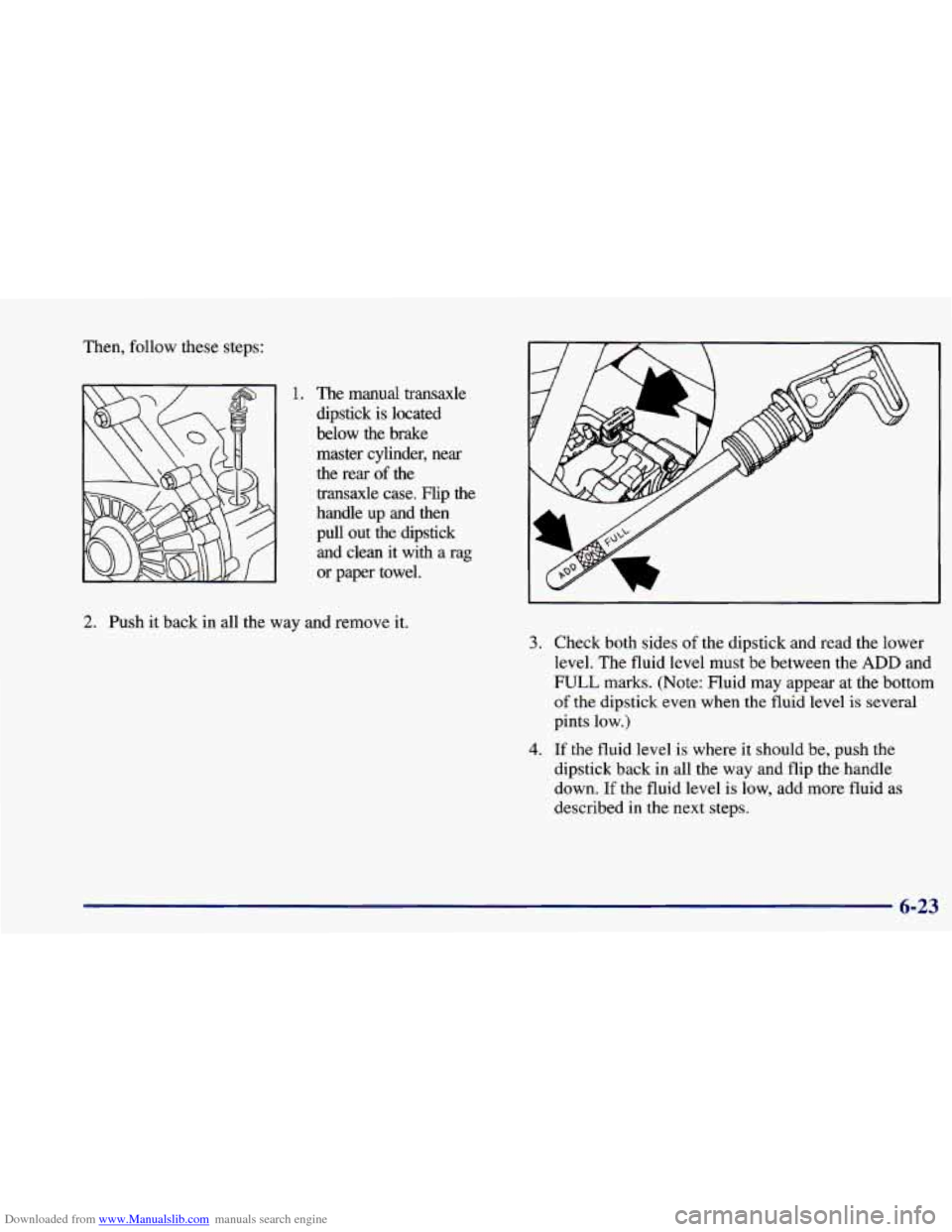
Downloaded from www.Manualslib.com manuals search engine Then, follow these steps:
1. The manual transaxle
dipstick is located
below the brake
master cylinder,
near
the rear of the
transaxle case. Flip the
handle up and then
pull out the dipstick and clean
it with a rag
or paper towel.
2. Push it back in all the way and remove it.
3. Check both sides of the dipstick and read the lower
level. The fluid level must be between the
ADD and
FULL marks. (Note: Fluid may appear at the bottom
of the dipstick even when the fluid level is several
pints low.)
4. If the fluid level is where it should be, push the
dipstick back
in all the way and flip the handle
down. If the fluid level is low, add more fluid
as
described in the next steps.
6-23
Page 294 of 400
Downloaded from www.Manualslib.com manuals search engine Front Exterior
Headlamps
For the type of bulb to use, see “Replacement Bulbs” in
the Index.
To replace one of your headlamp bulbs, do
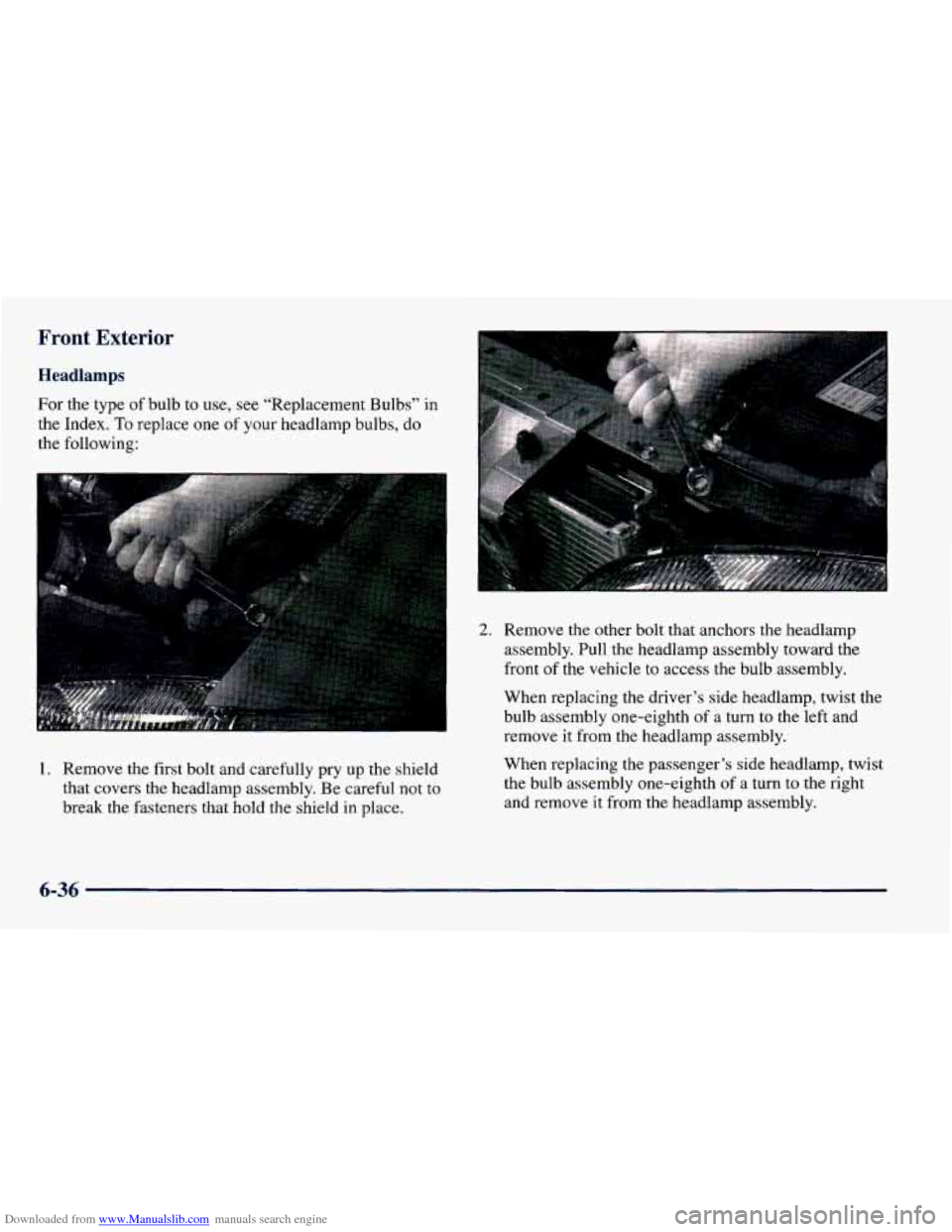
the following:
1. Remove the first bolt and carefully pry up the shield
that covers the headlamp assembly, Be careful not to
break the fasteners that hold the shield in place.
2. Remove the other bolt that anchors the headlamp
assembly. Pull the headlamp assembly toward the
front of the vehicle to access the bulb assembly.
When replacing the driver’s side headlamp, twist the
bulb assembly one-eighth of a turn to the left and
remove it from the headlamp assembly.
When replacing the passenger’s side headlamp, twist
the bulb assembly one-eighth of a turn to the right
and remove it from the headlamp assembly.
6-36
Page 298 of 400
Downloaded from www.Manualslib.com manuals search engine Windshield Wiper Blade Replacement Tires
Your new vehicle comes with high-quality tires made by
a leading tire manufacturer. If you ever have questions
about your tire warranty and where to obtain service, see
your Chevrolet Warranty booklet for details.
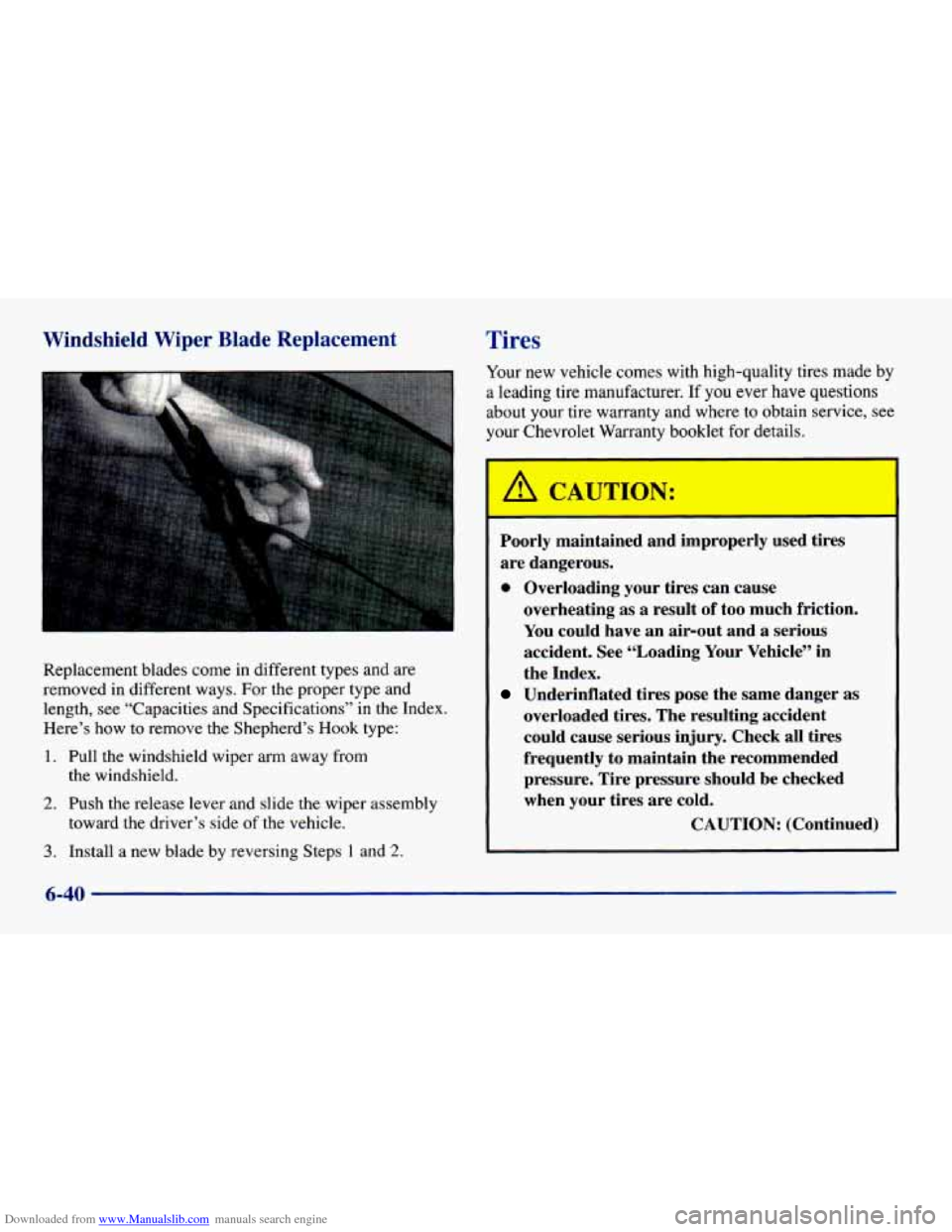
Replacement blades come in different types and are
removed in different ways. For the proper type and
length, see “Capacities and Specifications” in the Index.
Here’s how to remove the Shepherd’s
Hook type:
1. Pull the windshield wiper arm away from
2. Push the release lever and slide the wiper assembly
the
windshield.
toward the driver’s side
of the vehicle.
3. Install a new blade by reversing Steps 1 and 2.
Poorly maintained and improperly used tires
are dangerous.
0 Overloading your tires can cause
overheating as a result
of too much friction.
You could have an air-out and a serious
accident. See (‘Loading Your Vehicle” in
the Index.
Underinflated tires pose the same danger as
overloaded tires. The resulting accident
could cause serious injury. Check all tires
frequently to maintain the recommended
pressure. Tire pressure should be checked
when your tires are cold.
CAUTION: (Continued)
6-40