1998 CHEVROLET CAVALIER tow
[x] Cancel search: towPage 159 of 400
Downloaded from www.Manualslib.com manuals search engine Heating
On cold days, use FLOOR with the temperature knob all
the way in the red area. The system will bring in outside
air, heat it and send it to the floor ducts.
Your vehicle has heat ducts that are directed toward
the rear seat. Keep the area under the front seats clear
of obstructions
so the heated air can reach the rear
seat passengers.
If your vehicle has an engine coolant heater, you can use
it to help your system provide warm air faster when it’s
cold outside
(0°F (-18°C) or lower). An engine coolant
heater warms the coolant your engine and heating
system use to provide heat. See “Engine Coolant
Heater” in the Index.
Ventilation System
For mild outside temperatures when little heating or
cooling
is needed, use VENT to direct outside air
through your vehicle. Your vehicle also has
the
flow-through ventilation system described later in
this section.
Your vehicle’s flow-through ventilation system supplies
outside
air into the vehicle when it is moving. Outside
air will also enter the vehicle when the air conditioning
fan is running. Ventilation
Tips
Keep the hood and
front air inlet free of ice, snow or
any other obstruction, such as leaves. The heater and
defroster will work far better, reducing the chance of
fogging the inside of your windows.
When you enter a vehicle in cold weather, adjust the
mode knob to
FLOOR and the fan to the highest
speed for a few moments before driving
off. This
helps clear the intake ducts of snow and moisture
and reduces the chance
of fogging the inside of
your windows.
Keep the air path under the front seats clear of
objects. This helps air circulate throughout
your vehicle.
3-5
Page 160 of 400
Downloaded from www.Manualslib.com manuals search engine Defogging and Defrosting
Your system has two settings for clearing the front and
side windows.
To defrost the windows quickly, use
DEFROST with the temperature knob all
the way in the
red area.
To warm passengers while keeping the
windows clean, use DEFOG.
To defog the side windows, set the right control to
BI-LEVEL and the fan control to the highest setting.
To defog the side windows while using the air
conditioner, set the right control to BI-LEVEL, the fan
control to the highest setting, and press the
A/C button.
For both systems, aim the side vents toward the side
windows. For increased airflow to the side vents, close
the center
vents.
Rear Window Defogger (If Equipped)
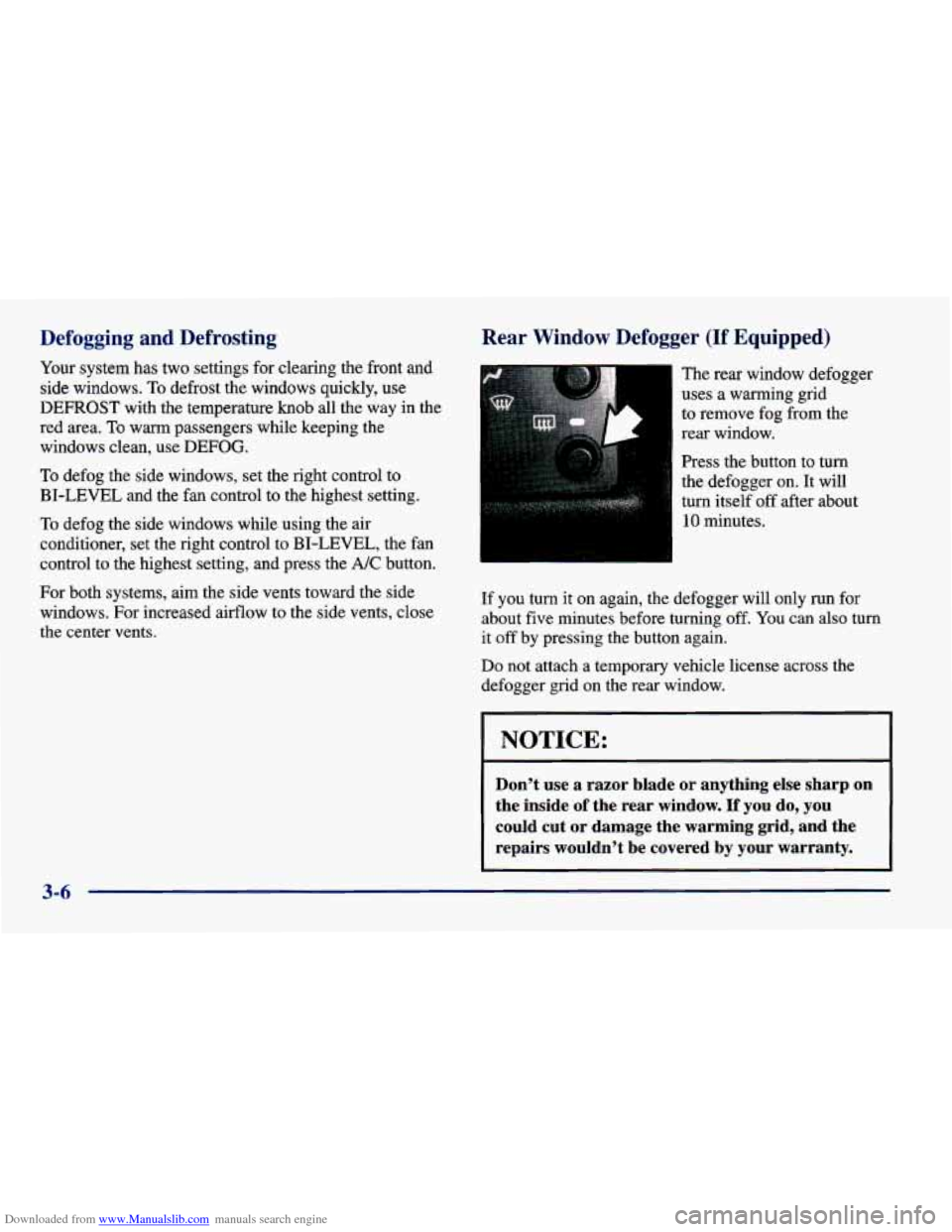
The rear window defogger
uses a warming grid
to remove fog from the
rear window.
Press the button
to turn
the defogger on. It will
turn itself off after about
10 minutes.
If you turn it on again, the defogger will only run for
about five minutes before turning off.
You can also turn
it off by pressing the button again.
Do not attach a temporary vehicle license across the
defogger grid on the rear window.
I NOTICE:
Don’t use a razor blade or anything else sharp on
the inside
of the rear window. If you do, you
could cut or damage the warming grid, and the
repairs wouldn’t be covered by
your warranty.
3-6
Page 181 of 400

Downloaded from www.Manualslib.com manuals search engine a Section 4 Your Driving and the Road
Here you’ll find information about driving on different kinds\
of roads and in varying weather conditions. We’ve also
included many other useful tips on driving.
4-2
4-3
4-5 4-6
4- 10
4-12
4- 12
4-
14
4-15
4- 16
4- 19
4-20 Defensive Driving
Drunken Driving
Control
of a Vehicle
Braking Steering
Off-Road Recovery
Passing
Loss of Control
Driving at Night Driving in Rain and on Wet Roads
City Driving
Freeway Driving 4-2 1
4-22
4-22
4-24
4-28
4-3
1
4-33
4-40 Before Leaving on
a Long Trip
Highway Hypnosis
Hill and Mountain Roads
Winter Driving
Recreational Vehicle Towing
Loading Your Vehicle
Towing a Trailer (Models with 2.4L Engine
and 4-Speed Automatic Transaxle)
Towing a Trailer (Except Models
with 2.4L Engine and 4-Speed
Automatic Transaxle)
Page 208 of 400
Downloaded from www.Manualslib.com manuals search engine Run your engine only as long as you must. This saves
fuel. When you run the engine, make it
go a little faster
than just idle. That is, push the accelerator slightly.
This
uses less fuel for the heat that you get and it keeps the
battery charged. You will need a well-charged battery to
restart the vehicle, and possibly for signaling later on with your headlamps. Let
the heater run for a while.
Then, shut the engine
off and close the window almost
all the way to preserve the heat. Start the engine again
and repeat this only when you feel really uncomfortable
from the cold. But do it as little as possible. Preserve the
fuel as long as you can. To help keep warm, you can get
out
of the vehicle and do some fairly vigorous exercises
every half hour or
so until help comes.
Recreational Vehicle Towing
You can tow your vehicle behind another vehicle for use
at your destination. Be sure to use the proper towing
equipment designed for recreational towing. Follow the instructions for the towing equipment.
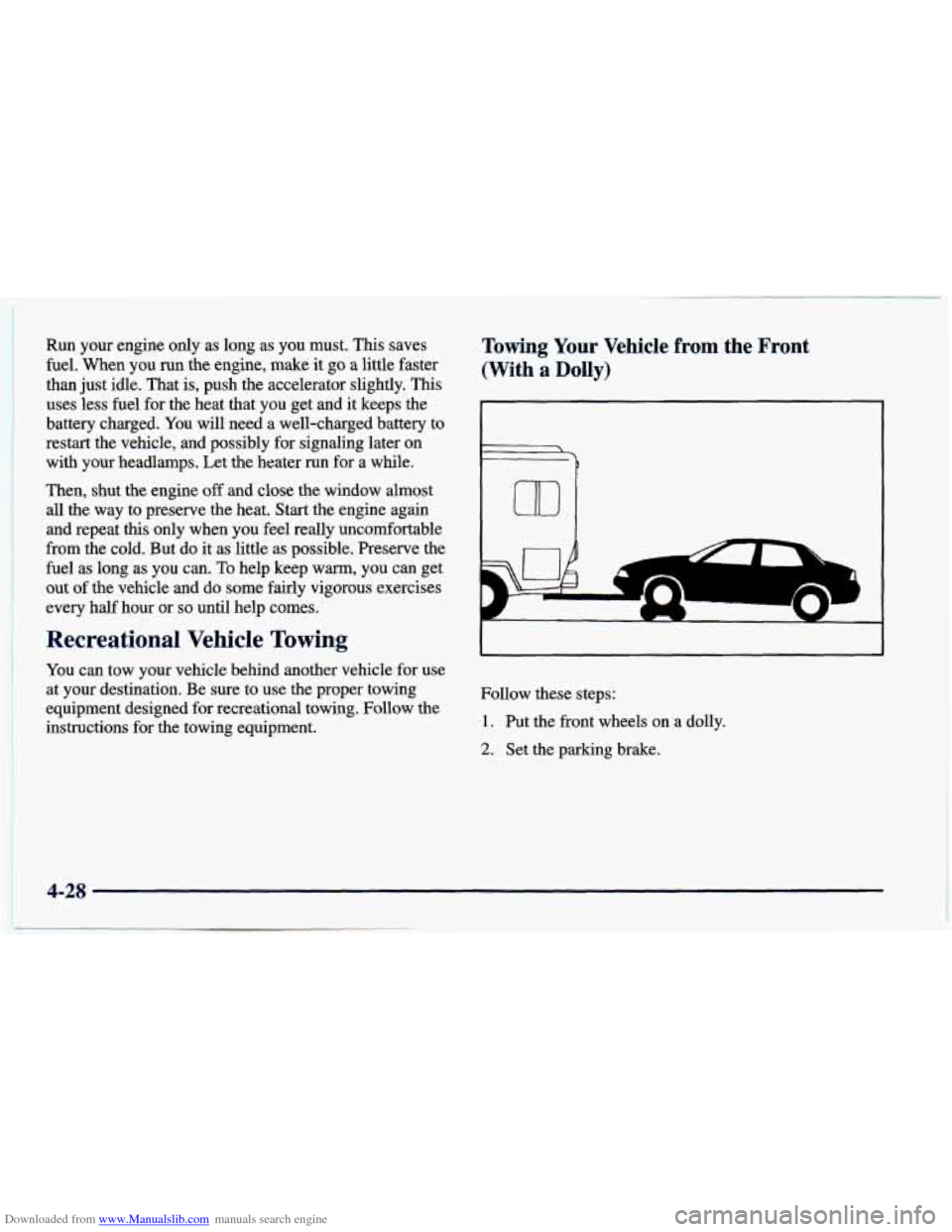
Towing Your Vehicle fr--m the Front
(With
a Dolly)
Follow these steps:
1. Put the front wheels on a dolly.
2. Set the parking brake.
4-28
Page 209 of 400
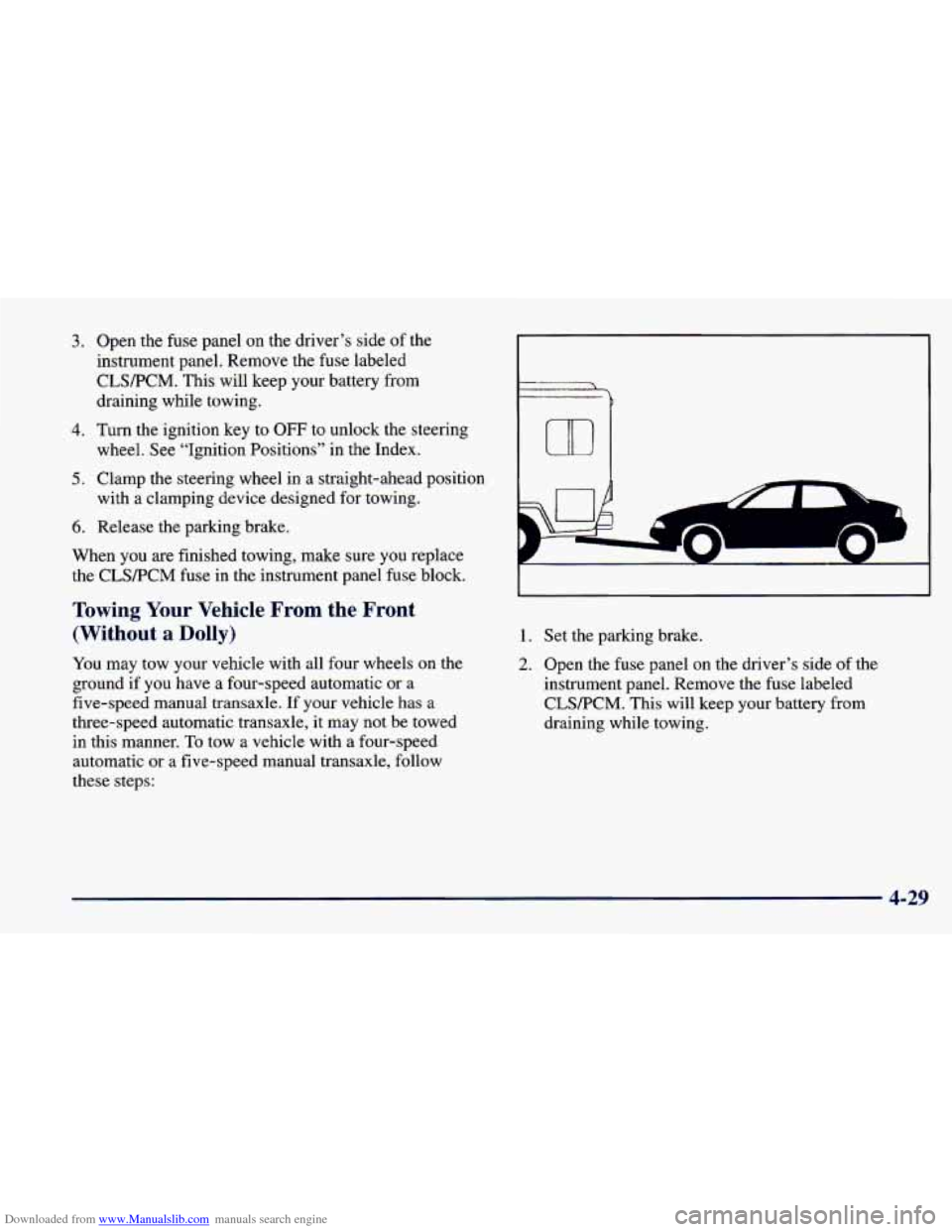
Downloaded from www.Manualslib.com manuals search engine 3. Open the fuse panel on the driver’s side of the
instrument panel. Remove the fuse labeled
CLSPCM. This will keep your battery from
draining while towing.
4. Turn the ignition key to OFF to unlock the steering
5. Clamp the steering wheel in a straight-ahead position
6. Release the parking brake.
When
you are finished towing, make sure you replace
the
CLSPCM fuse in the instrument panel fuse block.
wheel.
See “Ignition Positions” in the Index.
with a clamping device designed for towing.
an
Towing Your Vehicle From the Front
(Without
a Dolly)
You may tow your vehicle with all four wheels on the
ground if you have a four-speed automatic or a
five-speed manual transaxle.
If your vehicle has a
three-speed automatic transaxle, it may not be towed
in this manner.
To tow a vehicle with a four-speed
automatic
or a five-speed manual transaxle, follow
these steps:
1. Set the parking brake.
2. Open the fuse panel on the driver’s side of the
instrument panel. Remove the fuse labeled
CLSPCM. This will keep your battery from
draining while towing.
4-29
Page 210 of 400
Downloaded from www.Manualslib.com manuals search engine 3. Turn me ignition key to OFF to unlock the
4. Shift your transaxle to NEUTRAL (N).
5. Release the parking brake.
When you are finished towing, make sure you replace
the CLWPCM fuse in the instrument panel fuse block.
steering wheel.
NOTICE:
Make sure that the towing speed does not exceed
65 mph (110 km/h), or your vehicle could be
badly damaged.
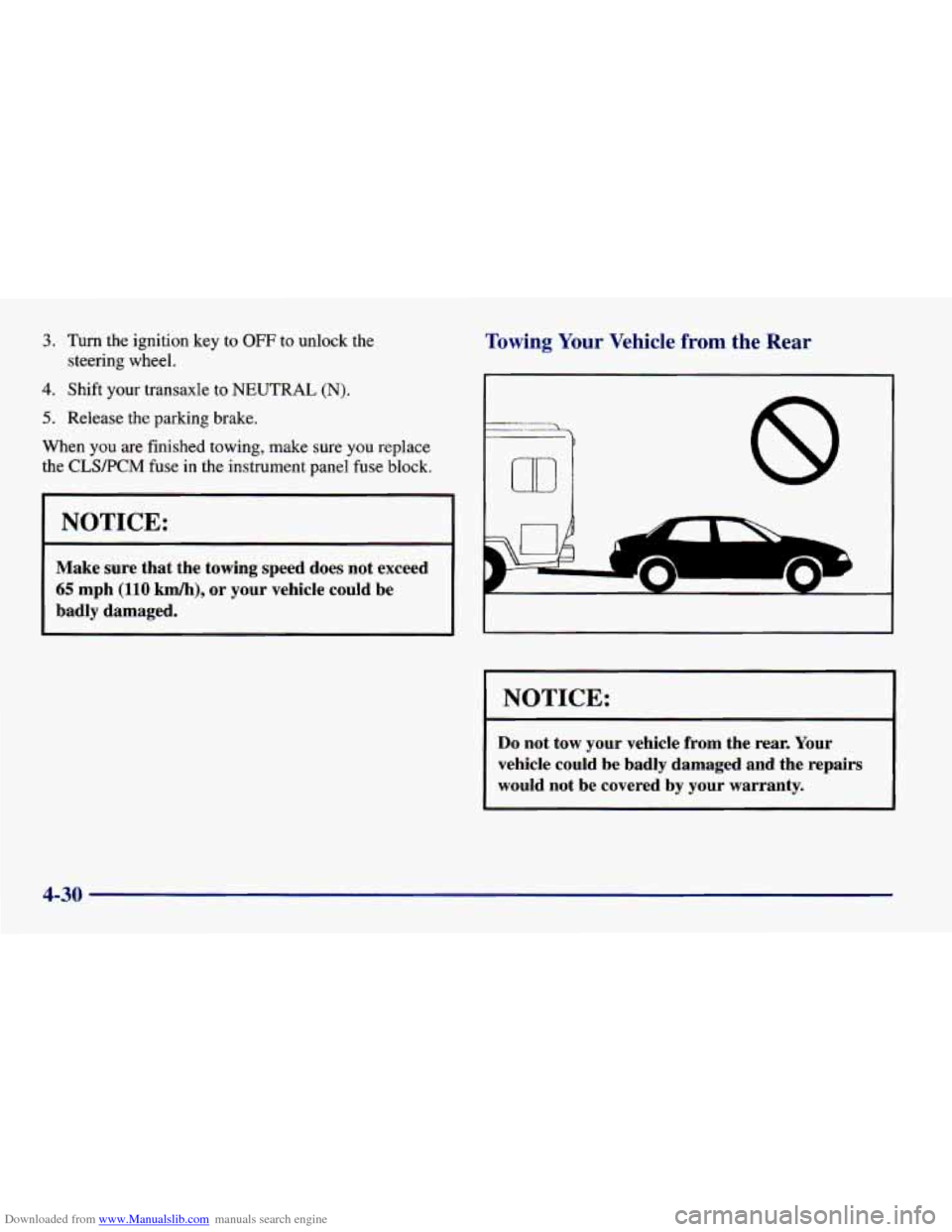
Towing Your Vehicle from the Rear
r
'b
UD 8
I NOTICE:
Do not tow your vehicle from the rear. Your
vehicle could be badly damaged and the repairs
would not be covered by your warranty.
4-30
Page 213 of 400
Downloaded from www.Manualslib.com manuals search engine Towing a Trailer (Models with
2.4L Engine and 4-Speed
Automatic Transaxle)
I--
If you don’t use the correct equipment and drive
properly, you can lose control when you pull a
trailer. For example,
if the trailer is too heavy, the
brakes may not work well
-- or even at all. You
and your passengers could be seriously injured.
You may also damage your vehicle; the resulting
repairs would not be covered by your warranty.
Pull
a trailer only if you have followed all the
steps in this section. Ask your dealer for advice
and information about towing a trailer with
your vehicle.
Do not tow a trailer if your vehicle is equipped with a
2.2L (Code 4) engine. You also cannot tow a trailer if
your vehicle is equipped with a manual or a three-speed
automatic transaxle, or is a convertible model. Your
vehicle can tow a trailer if it is equipped with a
2.4L engine and 4 speed automatic transaxle and the
proper trailer towing equipment.
To identify what the
vehicle trailering capacity is for your vehicle, you
should read the information
in “Weight of the Trailer”
that appears later in this section. But trailering is
different than just driving your vehicle by itself.
Trailering means changes in handling, durability and
fuel economy. Successful, safe trailering takes correct
equipment, and
it has to be used properly.
That’s the reason for this part. In it
are many
time-tested, important trailering tips and safety rules.
Many of these are important for your safety and that of
your passengers.
So please read this section carefully
before you pull a trailer.
Load-pulling components such as the engine, transaxle,
wheel assemblies and tires are forced to work harder
against the drag of the added weight. The engine is
required to operate at relatively higher speeds and under
greater loads, generating extra heat. What’s more, the
trailer adds considerably to wind resistance, increasing
the pulling requirements.
4-33
Page 214 of 400
Downloaded from www.Manualslib.com manuals search engine If You Do Decide To Pull A Trailer
If you do, here are some important points:
0
0
0
0
0
0
0
There are many different laws, including speed limit
restrictions, having to do with trailering. Make sure
your rig will be legal, not only where you live but also where you’ll be driving.
A good source for this
information can be state or provincial police.
Consider using a sway control.
You can ask a hitch
dealer about sway controls.
Don’t tow
a trailer at all during the first 1,000 miles
(1 600 km) your new vehicle is driven. Your engine,
axle or other parts could be damaged.
Then, during the first 500 miles (800 km) that you tow
a trailer, don’t drive over
50 mph (80 km/h) and don’t
make
starts at full throttle. This helps your engine and
other parts
of your vehicle wear in at the heavier loads.
Obey speed limit restrictions when towing a trailer.
Don’t drive faster than the maximum posted speed
for trailers (or no more than
55 mph (90 km/h)) to
save wear on your vehicle’s parts.
Do not tow when the ambient temperature is above
100°F (38°C).
Do not tow more
than 1,000 miles (1 600 km) per year. Three important considerations have to
do with weight:
0 the weight of the trailer,
the weight of the
trailer tongue
0 and the total weight on your vehicle’s tires.
Weight of the Trailer
How heavy can a trailer safely be?
It should never weigh more than
1,000 lbs. (450 kg). But
even
that can be too heavy.
It depends on how
you plan to use your rig. For
example, speed, altitude, road grades, outside temperature and how much your vehicle is used to pull a
trailer are all important. And, it can also depend
on any
special equipment that you have on your vehicle.
You can ask your dealer for our trailering information or
advice,
or you can write us at:
Chevrolet Motor Division
Customer Assistance Center
P.O. Box 7047
Troy,
MI 48007-7047
4-34