1998 CHEVROLET CAVALIER parking brake
[x] Cancel search: parking brakePage 145 of 400
Downloaded from www.Manualslib.com manuals search engine Enhanced Traction System Warning Light
(If Equipped)
ETS
OFF
With the Enhanced Traction
System (ETS), this warning
light should come on briefly
as you start the engine.
If the warning light doesn’t come on then, have it fixed
so it will be ready to warn you if there’s a problem.
If the warning light stays on, or comes on when you’re
driving, there may be a problem with your Enhanced
Traction System and your vehicle may need service.
When this warning light is on, the system will not limit
wheel spin. Adjust your driving accordingly. The
Enhanced Traction System warning light may come
on for the following reasons:
0
a
0
If you turn the system off by moving the shift lever
to FIRST (1) or
SECOND (2), the warning light will
come on and stay on. To turn the system back on,
move the shift lever back to a position other than
FIRST
(1) or SECOND (2). The warning light
should
go off. (See “Enhanced Traction System” in
the Index for more information.)
The warning light will come on when you set your
parking brake with the engine running, and it will
stay
on if your parking brake doesn’t release fully.
If the transaxle shift lever is in any position other
than FIRST
(1) or SECOND (2) and the warning
light stays on after your parking brake is fully
released, it means there’s a problem with the system.
If the traction control system is affected by an
engine-related problem, the system will turn
off and
the warning light will come on.
If the Enhanced Traction System warning light comes
on and stays on for an extended period of time when
the transaxle shift lever is in any position other than
FIRST
(1) or SECOND (2) your vehicle needs service.
2-69
Page 189 of 400
Downloaded from www.Manualslib.com manuals search engine LOW
TRAC
This light will come on when your Enhanced
Traction System is limiting
wheel spin. See “Enhanced
Traction System Active Light” in the Index.
You may feel or hear the system working, but this
is normal.
7- 1 When the transaxle shift
I
lever is in any position
ETS other than FIRST (1) or
OFF
SECOND (2) and the
parking brake is fully
released, this warning light will come on to let you
know if there’s a problem
with the system.
See “Enhanced Traction System Warning Light” in the
Index. When this warning light is on, the system will not
limit wheel spin. Adjust your driving accordingly. The
Enhanced Traction System can operate when the
transaxle shift lever is in any position other than
FIRST (1) or SECOND
(2). To limit wheel spin,
especially in slippery road conditions, you should use
the other shift lever positions only when necessary. See
“Automatic Transaxle” in the Index.
(If your vehicle
ever gets stuck in sand, mud, ice or snow, see “Rocking
Your Vehicle” in the Index.)
When you move the shift lever to FIRST
(1) or
SECOND
(2), the system will turn off. The Enhanced
Traction System warning light will come
on and stay on.
If the Enhanced Traction System is limiting wheel spin
when you move the shift lever to another position, the system won’t turn
off right away. It will wait until
there’s no longer a current need to limit wheel spin.
You can turn the system back on at any time by moving
the shift lever to any position other than FIRST
(1) or
SECOND (2). The Enhanced Traction System warning
light should go off.
4-9
Page 208 of 400
Downloaded from www.Manualslib.com manuals search engine Run your engine only as long as you must. This saves
fuel. When you run the engine, make it
go a little faster
than just idle. That is, push the accelerator slightly.
This
uses less fuel for the heat that you get and it keeps the
battery charged. You will need a well-charged battery to
restart the vehicle, and possibly for signaling later on with your headlamps. Let
the heater run for a while.
Then, shut the engine
off and close the window almost
all the way to preserve the heat. Start the engine again
and repeat this only when you feel really uncomfortable
from the cold. But do it as little as possible. Preserve the
fuel as long as you can. To help keep warm, you can get
out
of the vehicle and do some fairly vigorous exercises
every half hour or
so until help comes.
Recreational Vehicle Towing
You can tow your vehicle behind another vehicle for use
at your destination. Be sure to use the proper towing
equipment designed for recreational towing. Follow the instructions for the towing equipment.
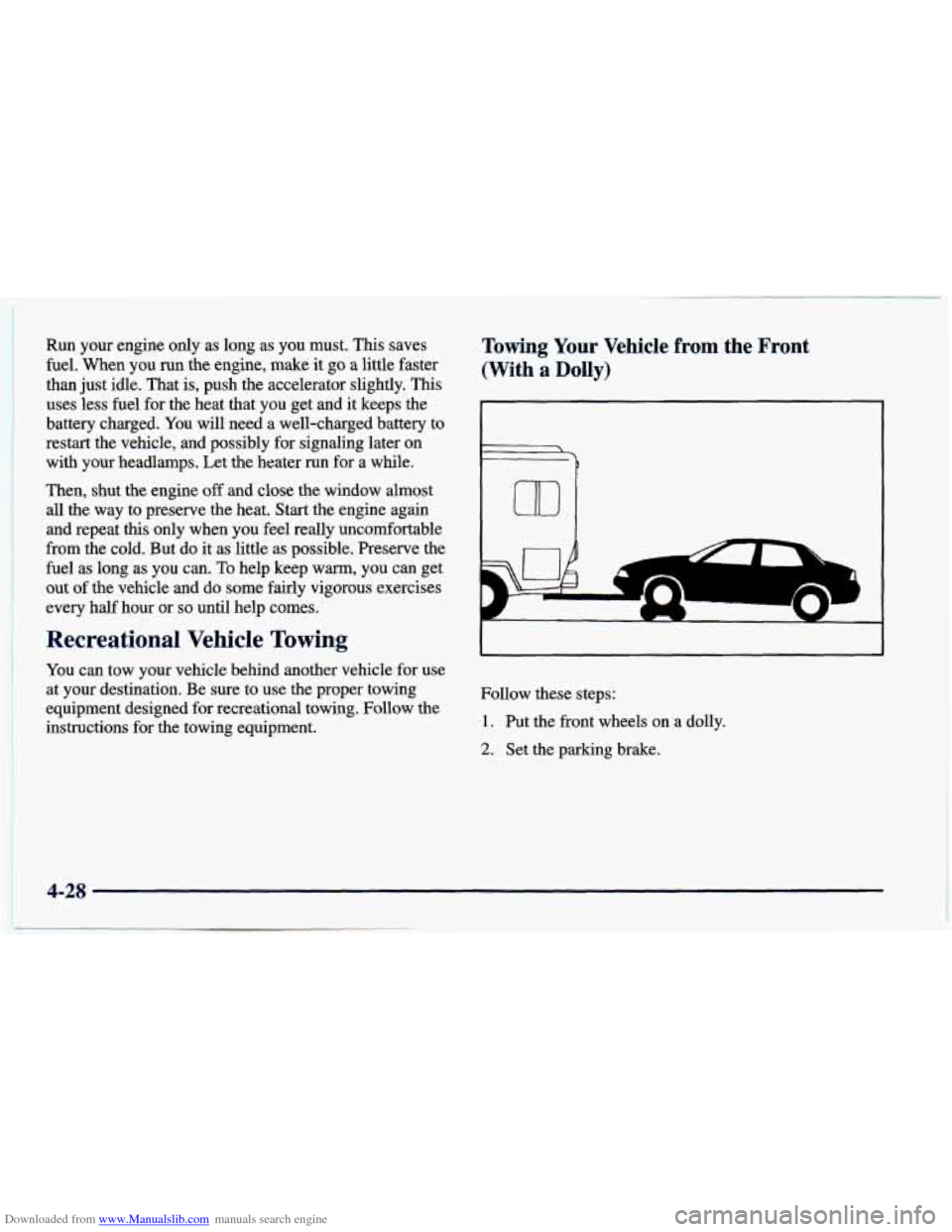
Towing Your Vehicle fr--m the Front
(With
a Dolly)
Follow these steps:
1. Put the front wheels on a dolly.
2. Set the parking brake.
4-28
Page 209 of 400
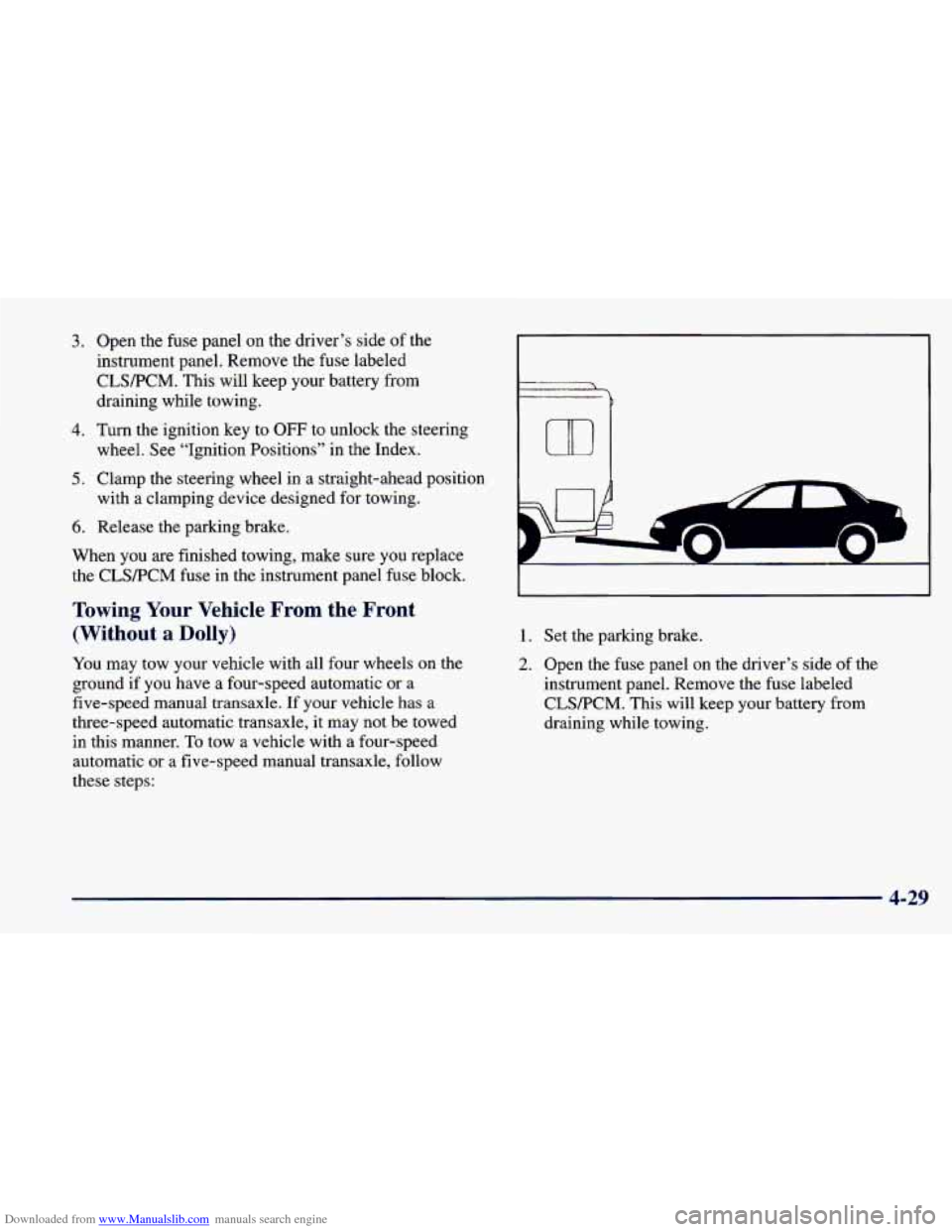
Downloaded from www.Manualslib.com manuals search engine 3. Open the fuse panel on the driver’s side of the
instrument panel. Remove the fuse labeled
CLSPCM. This will keep your battery from
draining while towing.
4. Turn the ignition key to OFF to unlock the steering
5. Clamp the steering wheel in a straight-ahead position
6. Release the parking brake.
When
you are finished towing, make sure you replace
the
CLSPCM fuse in the instrument panel fuse block.
wheel.
See “Ignition Positions” in the Index.
with a clamping device designed for towing.
an
Towing Your Vehicle From the Front
(Without
a Dolly)
You may tow your vehicle with all four wheels on the
ground if you have a four-speed automatic or a
five-speed manual transaxle.
If your vehicle has a
three-speed automatic transaxle, it may not be towed
in this manner.
To tow a vehicle with a four-speed
automatic
or a five-speed manual transaxle, follow
these steps:
1. Set the parking brake.
2. Open the fuse panel on the driver’s side of the
instrument panel. Remove the fuse labeled
CLSPCM. This will keep your battery from
draining while towing.
4-29
Page 210 of 400
Downloaded from www.Manualslib.com manuals search engine 3. Turn me ignition key to OFF to unlock the
4. Shift your transaxle to NEUTRAL (N).
5. Release the parking brake.
When you are finished towing, make sure you replace
the CLWPCM fuse in the instrument panel fuse block.
steering wheel.
NOTICE:
Make sure that the towing speed does not exceed
65 mph (110 km/h), or your vehicle could be
badly damaged.
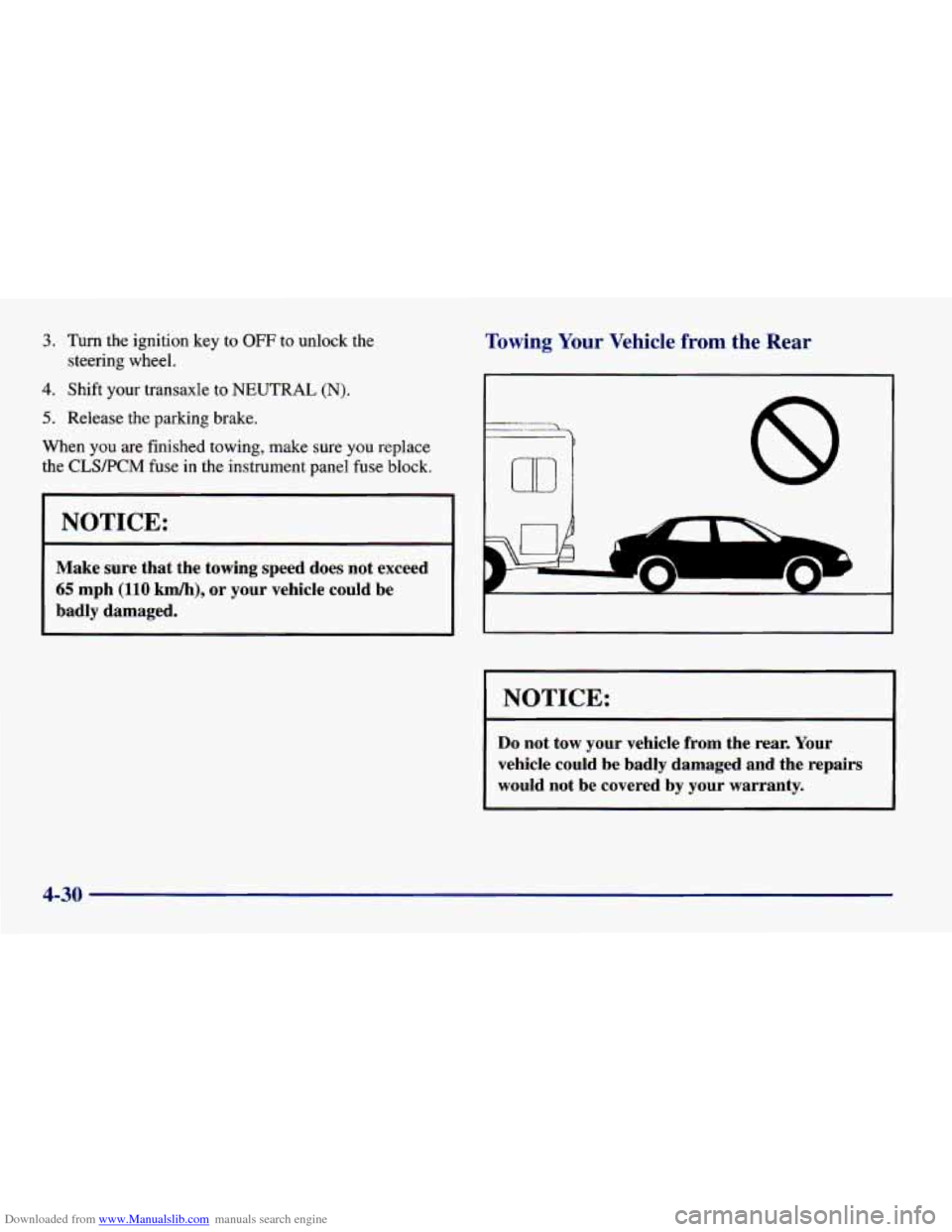
Towing Your Vehicle from the Rear
r
'b
UD 8
I NOTICE:
Do not tow your vehicle from the rear. Your
vehicle could be badly damaged and the repairs
would not be covered by your warranty.
4-30
Page 219 of 400
Downloaded from www.Manualslib.com manuals search engine Parking on Hills
You really should not park your vehicle, with a trailer
attached, on a hill.
If something goes wrong, your rig
could start to move. People can be injured, and both
your vehicle and the trailer can be damaged.
But
if you ever have to park your rig on a hill, here’s
how to do it:
1.
2.
3.
4.
5.
Apply your regular brakes, but don’t shift into
PARK (P) yet.
Have someone place chocks under the trailer wheels.
When the wheel chocks are in place, release the
regular brakes until the chocks absorb the load.
Reapply the regular brakes. Then apply your parking
brake, and then shift to PARK
(P).
Release the regular brakes.
When You Are Ready to Leave After
Parking on a
Hill
1. Apply your regular brakes and hold the pedal down
while you:
Start your engine;
Shift into a gear; and
Release the parking brake.
2. Let up on the brake pedal.
3. Drive slowly until the trailer is clear of the chocks.
4. Stop and have someone pick up and store the chocks.
4-39
Page 226 of 400
Downloaded from www.Manualslib.com manuals search engine 2. Get the vehicles close enough so the jumper cables
can reach, but be sure the vehicles aren’t touching
each other. If they are, it could cause a ground
connection
you don’t want. You wouldn’t be able to
start your vehicle, and the bad grounding could
damage the electrical systems.
To avoid the possibility
of the vehicles rolling, set
the parking brake firmly on both vehicles involved
in the jump start procedure. Put an automatic
transaxle in
PARK (P) or a manual transaxle in
NEUTRAL (N) before setting the parking brake.
unnecessary accessories plugged into the cigarette lighter. Turn
off all lamps that aren’t needed as well
as radios.
This will avoid sparks and help save both
batteries. In addition, it could save your radio.
3. Turn off the ignition on both vehicles. Unplug
I 1
NOTICE:
If you leave your radio on, it could be badly
damaged. The repairs wouldn’t be covered by
your warranty.
4. Open the hoods and locate the batteries.
I
An electric fan can start up even when me engine is not running and can injure you. Keep hands,
clothing and tools away from any underhood
electric fan.
5. Find the positive (+) and negative (-) terminals on
each battery.
5-4
Page 231 of 400
Downloaded from www.Manualslib.com manuals search engine A CAUTION:
To help avoid injury to you or others:
0 Never let passengers ride in a vehicle that is
0 Never tow faster than safe or posted speeds.
0 Never tow with damaged parts not
fully secured.
0 Never get under your vehicle after it has
been lifted by the tow truck.
0 Always secure the vehicle on each side with
separate safety chains when towing it.
0 Never use J-hooks. Use T-hooks instead.
being towed.
When your vehicle is
being towed, have the ignition key
turned
to OFF. The steering wheel should be clamped in
a straight-ahead position, with a clamping device
designed
for towing service. Do not use the vehicle’s
steering column lock for this. The transaxle should be in
NEUTRAL (N) and the parking brake released.
’ A CAUTION:
A vehicle can fall from a car carrier if it isn’t
adequately secured. This can cause a collision,
serious personal injury and vehicle damage. The
vehicle should be tightly secured with chains or
steel cables before it
is transported.
Don’t use substitutes (ropes, leather straps,
canvas webbing, etc.) that can be cut by sharp
edges underneath the towed vehicle. Always use
T-hooks inserted in the T-hook slots. Never use
J-hooks. They will damage drivetrain and
suspension components.
5-9