Page 107 of 400

It’s better not to park with the engine running. But if yo\
u")
Downloaded from www.Manualslib.com manuals search engine Running Your Engine While You’re
Parked (Automatic Transaxle)
It’s better not to park with the engine running. But if yo\
u
ever have to, here are
some things to know.
I
Idling the engine with the climate control
system
off could allow dangerous exhaust into
your vehicle (see the earlier Caution under
“Engine Exhaust”).
Also, idling in
a closed-in place can let deadly
carbon monoxide
(CO) into your vehicle even if
the fan switch is at the highest setting. One place
this can happen
is a garage. Exhaust -- with
CO -- can come in easily. NEVER park in a
garage with the engine running.
Another closed-in place can be
a blizzard.
(See “Blizzard” in the Index.)
It can be dangerous to get out of your vehicle if
the shift lever is not fully in PARK (P) with the
parking brake firmly
set. Your vehicle can roll.
Don’t leave your vehicle when the engine is
running unless you have to.
If you’ve left the
engine running, the vehicle can move suddenly.
You or others could be injured.
To be sure your
vehicle won’t move, even when you’re on fairly
level ground, always set your parking brake and
move the shift lever to PARK
(P).
Follow the proper steps to be sure your vehicle won’t
move. See “Shifting Into
PARK (P)” in the Index.
If you are parking on a hill and if you’re pulling a
trailer,
also see “Towing a Trailer” in the Index.
2-31
Page 117 of 400
Downloaded from www.Manualslib.com manuals search engine The DRL system will make your high-beam headlamps
come on at reduced brightness in daylight when:
0 The ignition is on with the engine running,
The headlamp switch is OFF,
0 The parking brake is released and
0 The transaxle is not in PARK (P) on models with an
automatic transaxle.
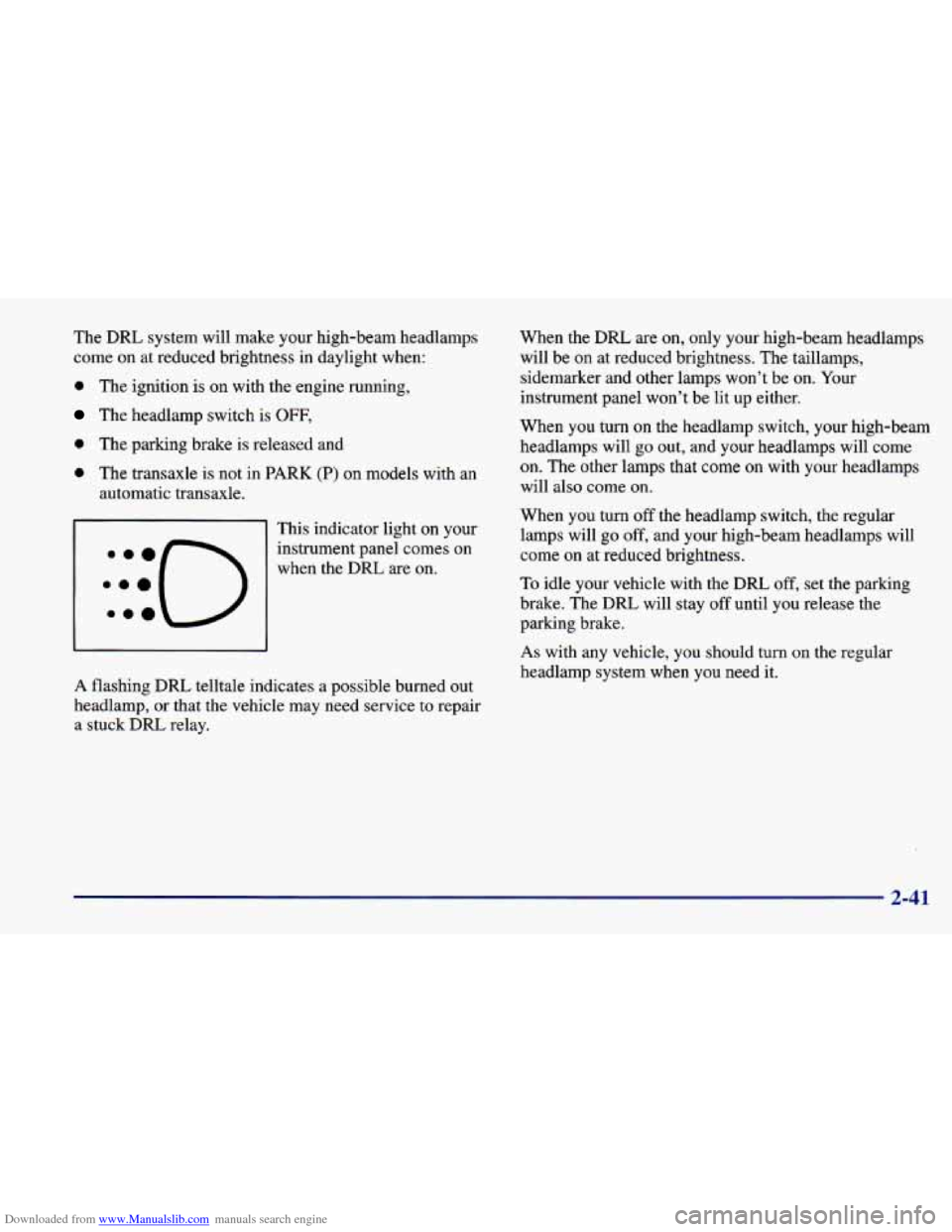
This indicator light on your
instrument panel comes on when the DRL are on.
A flashing DRL telltale indicates a possible burned out
headlamp, or that the vehicle may need service
to repair
a stuck DRL relay. When the DRL
are on,
only your high-beam headlamps
will be on at reduced brightness. The taillamps,
sidemarker
and other lamps won’t be on. Your
instrument panel won’t be lit up either.
When you
turn on the headlamp switch, your high-beam
headlamps will
go out, and your headlamps will come
on. The other lamps that come on with your headlamps
will also come on.
When you turn
off the headlamp switch, the regular
lamps will
go off, and your high-beam headlamps will
come on at reduced brightness.
To idle your vehicle with the DRL
off, set the parking
brake. The
DRL will stay off until you release the
parking brake.
As with any vehicle, you should turn on the regular
headlamp system when you need it.
2-41
Page 126 of 400
Downloaded from www.Manualslib.com manuals search engine Lowering Your Convertible Top
1. Set the parking brake and shift your automatic
transaxle to
PARK (P) or your manual transaxle to
NEUTRAL (N).
2. Turn the ignition to RUN.
3. Lower the side door windows to avoid wear to
the weatherstrips.
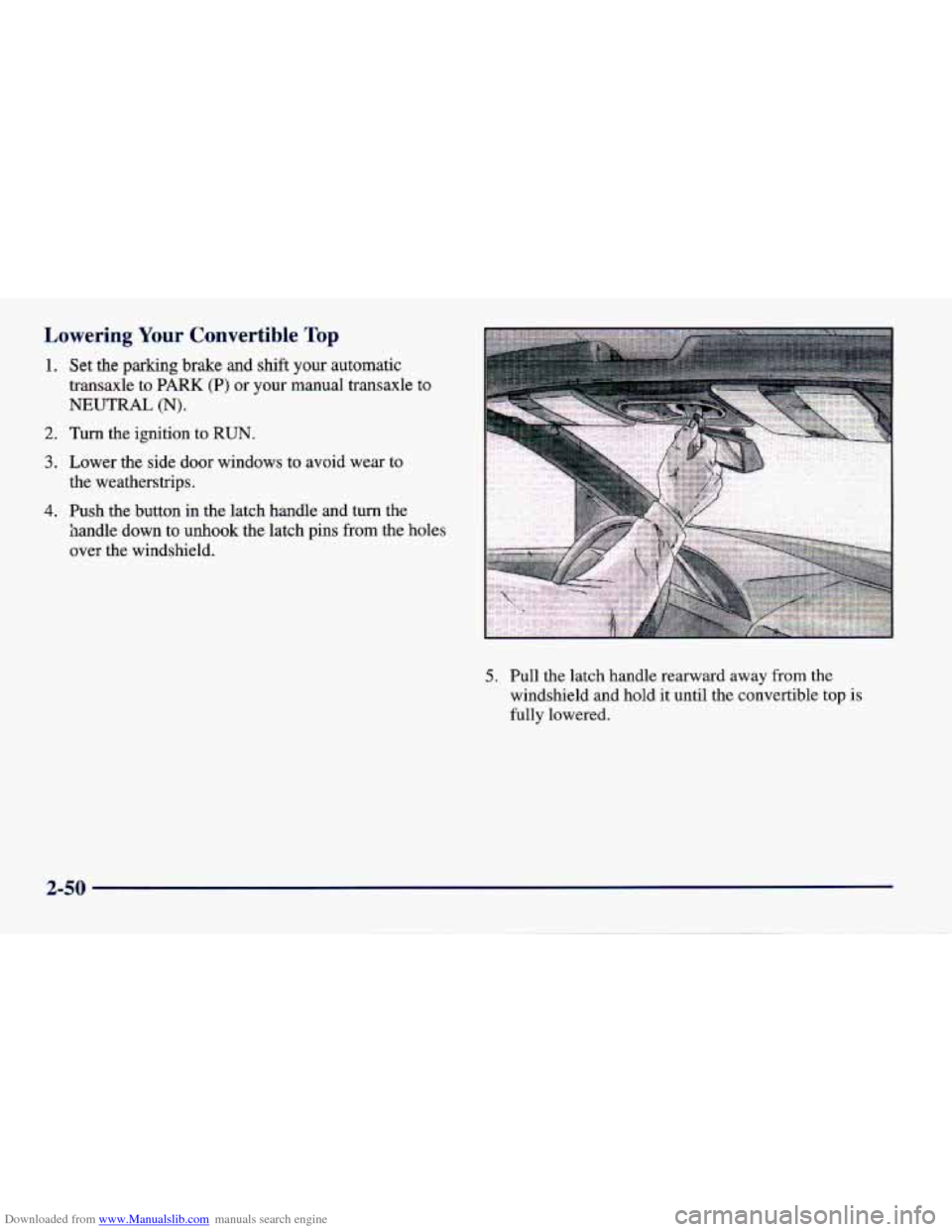
4. Push the button in the latch handle and turn the
handle down to unhook the latch pins from the holes
over the windshield.
5. Pull the latch handle rearward away from the
windshield and hold it until the convertible
top is
fully lowered.
2-50
Page 130 of 400
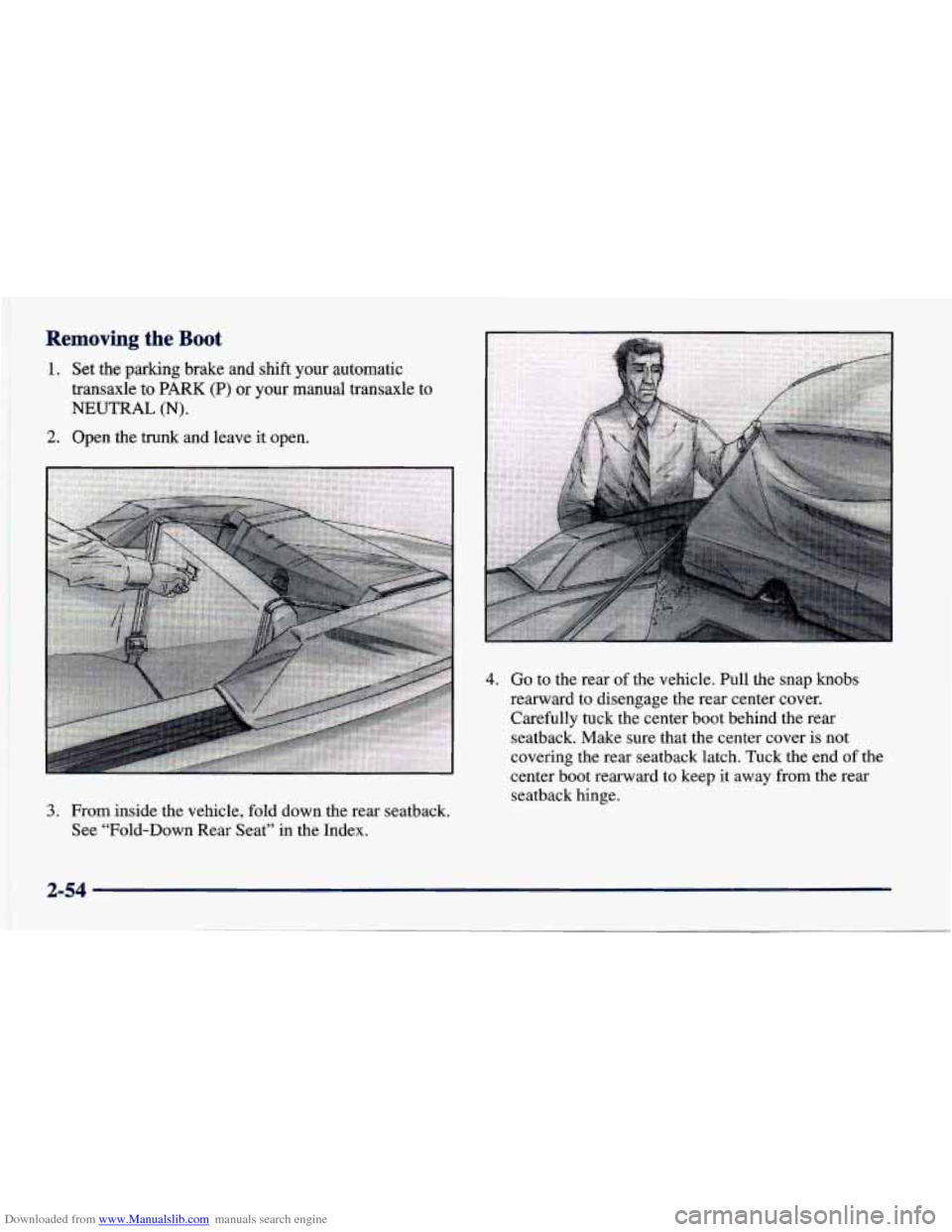
Downloaded from www.Manualslib.com manuals search engine Removing the Boot
1. Set the parking brake and shift your automatic
transaxle to
PARK (P) or your manual transaxle to
NEUTRAL (N).
2. Open the trunk and leave it open.
3. From inside the vehicle, fold down the rear seatback.
See “Fold-Down Rear Seat” in the Index. seatback hinge.
Page 132 of 400
Downloaded from www.Manualslib.com manuals search engine Raising the Convertible Top
1. Set the parking brake and shift your automatic
transaxle to
PARK (P) or your manual transaxle to
NEUTRAL (N).
2. Turn the ignition to RUN.
3. Lower the door windows to avoid wear to
the weatherstrips.
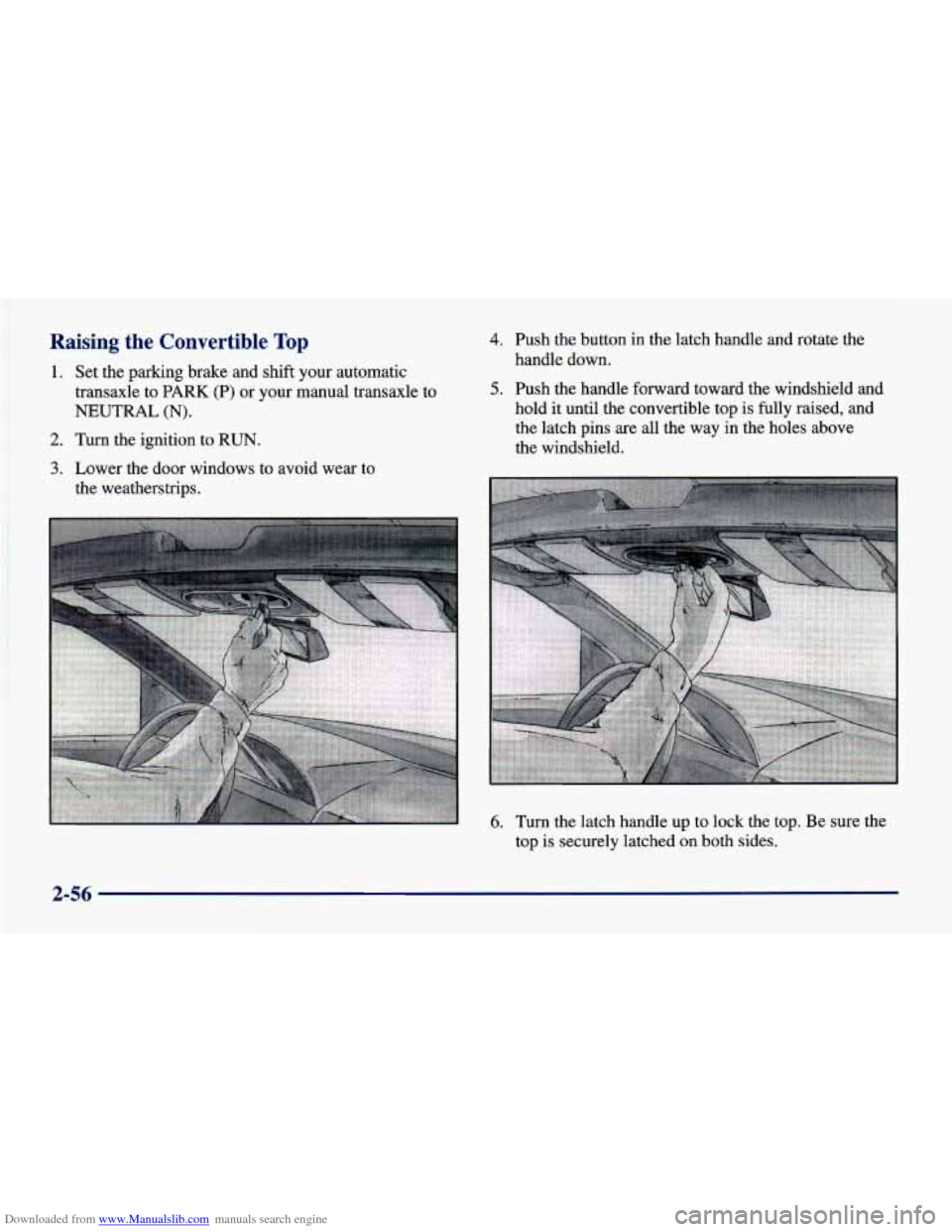
4. Push the button in the latch handle and rotate the
handle down.
5. Push the handle forward toward the windshield and
hold it until the convertible top is fully raised, and
the latch pins
are all the way in the holes above
the windshield.
6. Turn the latch handle up to lock the top. Be sure the
top is securely latched
on both sides.
2-56
Page 133 of 400
Downloaded from www.Manualslib.com manuals search engine Lowering the Top Manually
NOTICE:
Do not attempt to lower the top manually as
damage to the vehicle will occur.
If the top fails to
raise or lower completely, see “Raising the Top
Manually” following.
Raising the Top Manually
1. Set the parking brake and shift your automatic
transaxle to PARK (P) or your manual transaxle to
NEUTRAL (N). Turn the engine off.
2. Push the button in the latch handle and rotate the
handle down.
3. Open the trunk.
If your vehicle loses power, or something else happens
that prevents you from raising the top electrically, you
may need to raise the top manually.
This will allow you
to safely drive the vehicle until you can get the top
repaired. Raising the convertible top manually should only be done in an emergency and requires two people.
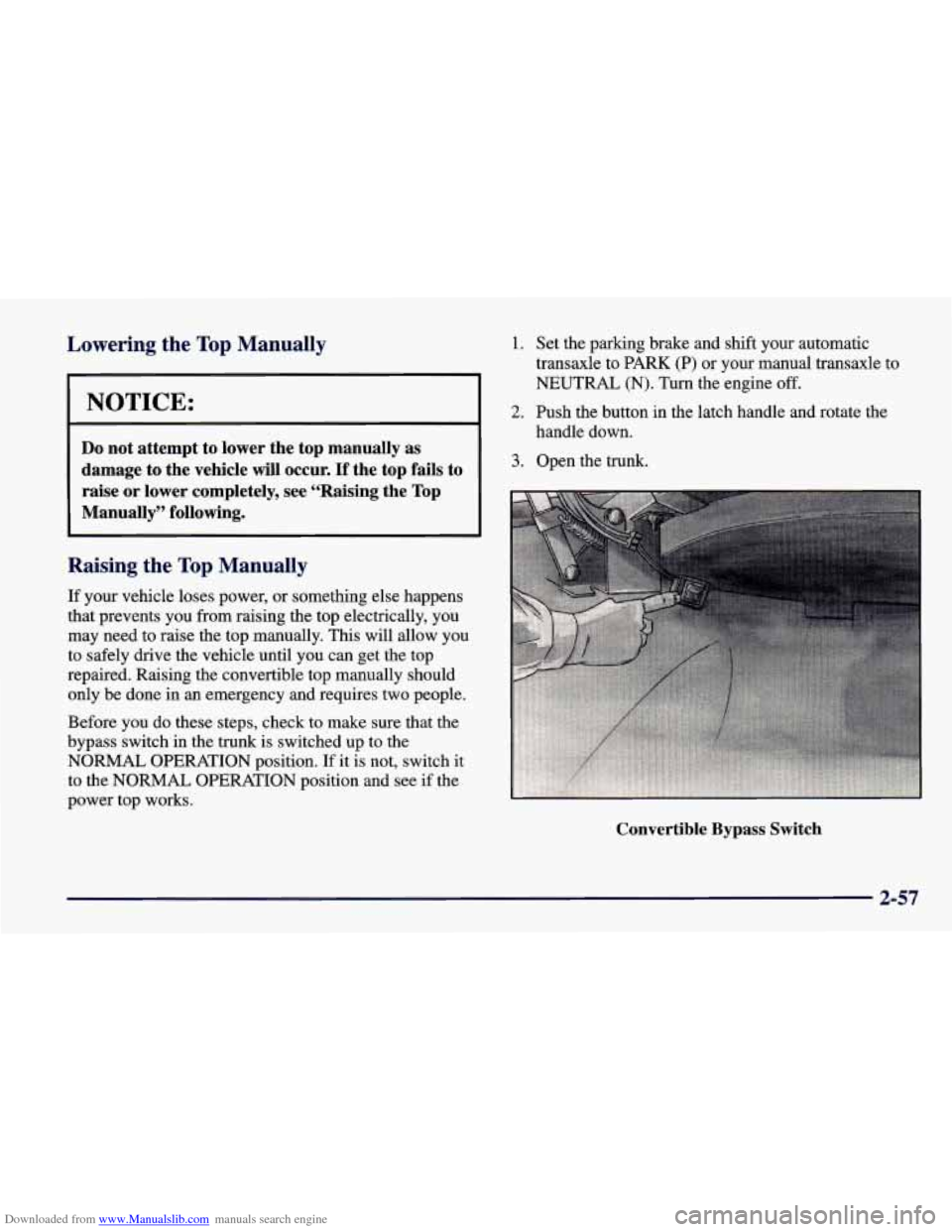
Before you do these steps, check to make sure that the
bypass switch in the trunk is switched up to the
NORMAL OPERATION position.
If it is not, switch it
to the NORMAL OPERATION position and see
if the
power top works.
Convertible Bypass Switch
2-57
Page 137 of 400
Downloaded from www.Manualslib.com manuals search engine Your instrument panel is designed to let you know at a glance how your vehicle is running. You’ll know how fast
you’re going, how much fuel is left in the tank, and many other things you’ll need to drive sa\
fely and economically,
The main components
of your instrument panel are:
1. Instrument Panel Intensity Control
2. Turn SignaVMultifunction Lever
3. Hazard Warning Flashers Switch
4. Ignition Switch
5. Windshield Wiperwasher Controls
6. Audio System
7. Climate Controls and Rear Window Defogger
8. Ashtray
9. Parking Brake Lever
10. Tilt Steering Wheel Lever (If Equipped)
11. Hood Release Lever
12. Fuse Panel
2-61
Page 144 of 400
Downloaded from www.Manualslib.com manuals search engine Your brake system may not be working properly
if the brake system warning light is on. Driving
with the brake system warning light
on can lead
to an accident. If the light is still on after you’ve
pulled
off the road and stopped carefully, have
the vehicle towed for service.
When the ignition is on, the brake system warning light
will also come on when you set your parking brake. The
light will stay on if your parking brake doesn’t release
fully. If it stays on after your parking brake is fully
released, it means you have
a brake problem.
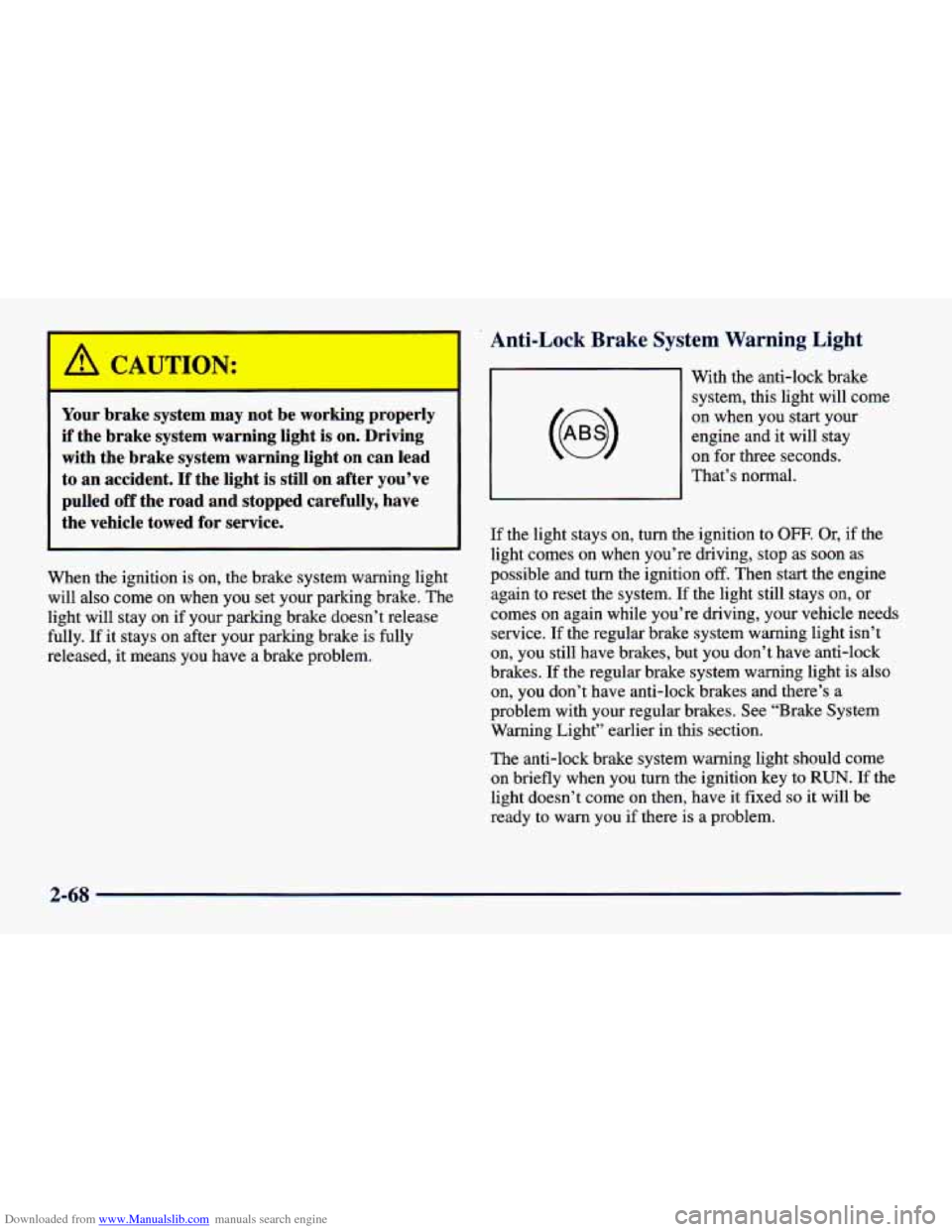
Anti-Lock Brake System Warning Light
I With the anti-lock brake
system, this light will
come
on when you start your
engine and it will stay
on for three seconds.
That’s normal.
If the light stays
on, turn the ignition to OFF. Or, if the
light comes on when you’re driving, stop as
soon as
possible and
turn the ignition off. Then start the engine
again to reset the system. If the light still stays on, or
comes on again while you’re driving, your vehicle needs
service.
If the regular brake system warning light isn’t
on, you still have brakes, but you don’t have anti-lock
brakes. If the regular brake system warning light is also
on, you don’t have anti-lock brakes and there’s a
problem with your regular brakes. See “Brake System
Warning Light’’ earlier in this section.
The anti-lock brake system warning light should come
on briefly when you turn the ignition key to
RUN. If the
light doesn’t come on then, have it fixed
so it will be
ready to warn you if there is a problem.
2-68