Page 196 of 400
Downloaded from www.Manualslib.com manuals search engine You can be temporarily blinded by approaching
headlamps. It can take a second or two, or even several
seconds, for your eyes to readjust to the dark. When you
are faced with severe glare (as from a driver who
doesn't lower the high beams, or a vehicle with
misaimed headlamps), slow down a little. Avoid staring
directly into the approaching headlamps.
Keep your windshield and all the glass on your vehicle
clean
-- inside and out. Glare at night is made much
worse by dirt on the glass. Even the inside
of the glass
can build up a film caused by dust. Dirty glass makes
lights dazzle and flash more than clean glass would,
making the pupils
of your eyes contract repeatedly.
Remember that your headlamps light up far less of a
roadway when you are in a turn or curve. Keep your
eyes moving; that way, it's easier to pick out dimly
lighted objects. Just as your headlamps should be
checked regularly for proper aim,
so should your eyes
be examined regularly. Some drivers suffer from night
blindness
-- the inability to see in dim light -- and aren't
even aware of it.
Driving in Rain and on Wet Roads
1
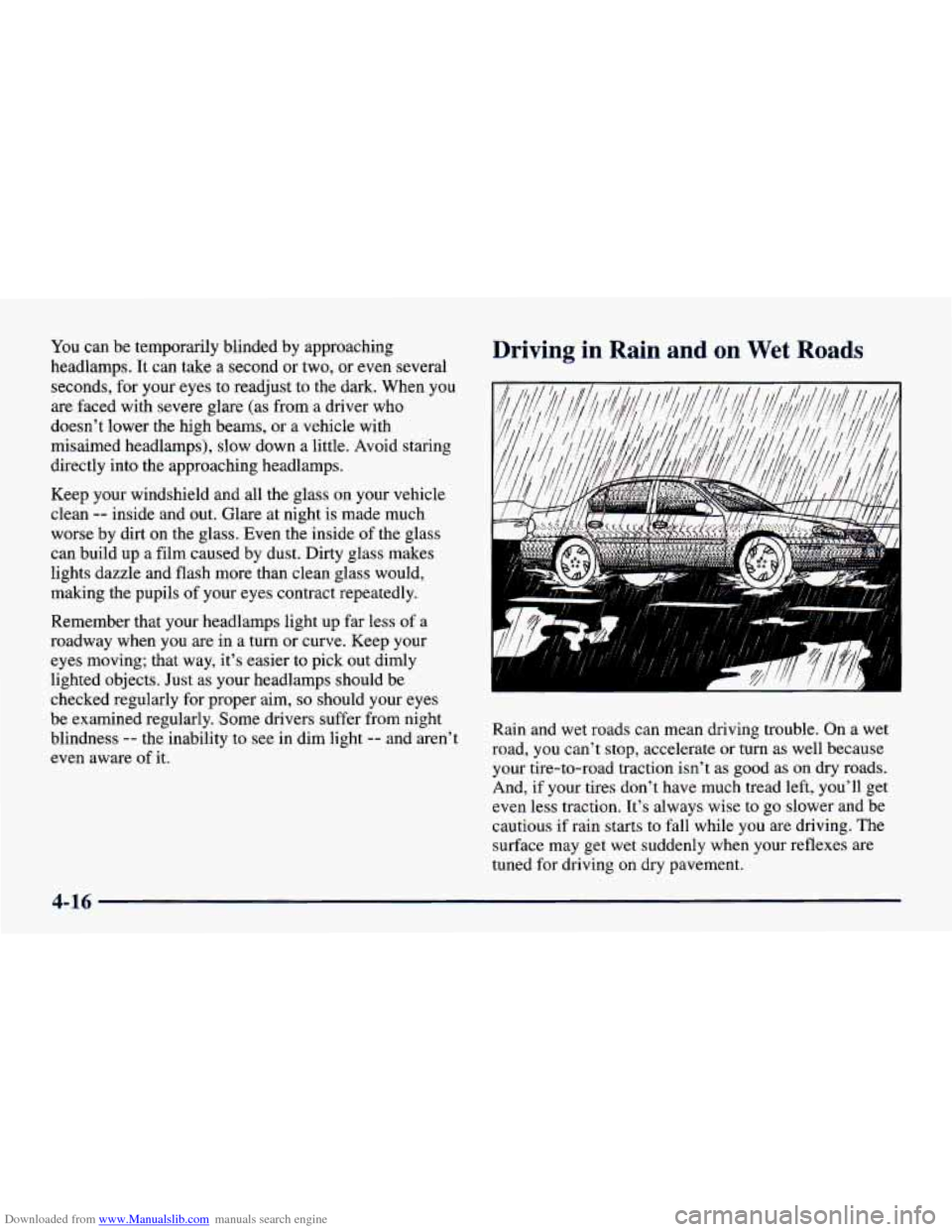
Rain and wet roads can mean driving trouble. On a wet
road, you can't stop, accelerate or turn as well because
your tire-to-road traction isn't
as good as on dry roads.
And, if your tires don't have much tread left, you'll get
even less traction. It's always wise to go slower and be
cautious if rain starts to fall while you are driving. The
surface may get wet suddenly when your reflexes
are
tuned for driving on dry pavement.
4-16
Page 208 of 400
Downloaded from www.Manualslib.com manuals search engine Run your engine only as long as you must. This saves
fuel. When you run the engine, make it
go a little faster
than just idle. That is, push the accelerator slightly.
This
uses less fuel for the heat that you get and it keeps the
battery charged. You will need a well-charged battery to
restart the vehicle, and possibly for signaling later on with your headlamps. Let
the heater run for a while.
Then, shut the engine
off and close the window almost
all the way to preserve the heat. Start the engine again
and repeat this only when you feel really uncomfortable
from the cold. But do it as little as possible. Preserve the
fuel as long as you can. To help keep warm, you can get
out
of the vehicle and do some fairly vigorous exercises
every half hour or
so until help comes.
Recreational Vehicle Towing
You can tow your vehicle behind another vehicle for use
at your destination. Be sure to use the proper towing
equipment designed for recreational towing. Follow the instructions for the towing equipment.
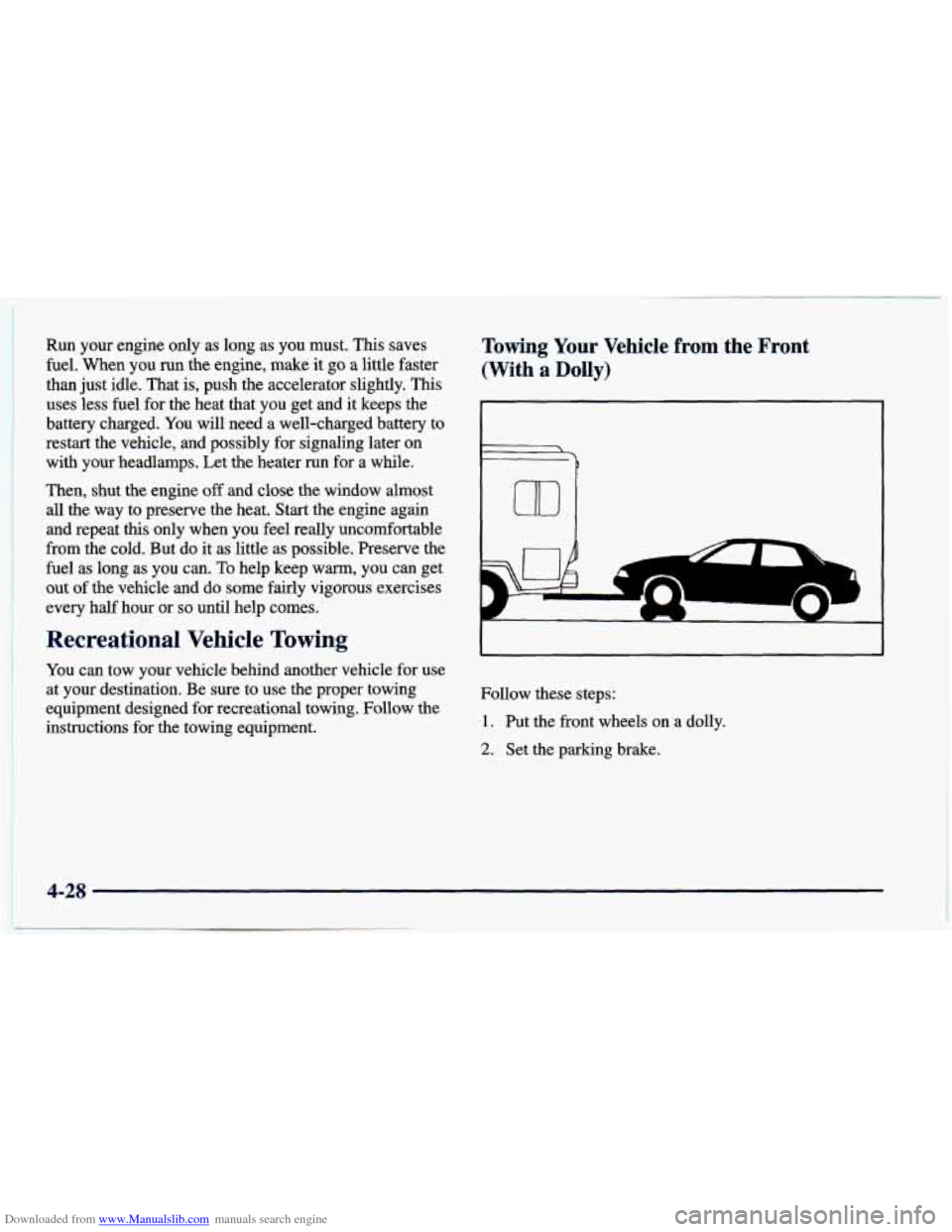
Towing Your Vehicle fr--m the Front
(With
a Dolly)
Follow these steps:
1. Put the front wheels on a dolly.
2. Set the parking brake.
4-28
Page 294 of 400
Downloaded from www.Manualslib.com manuals search engine Front Exterior
Headlamps
For the type of bulb to use, see “Replacement Bulbs” in
the Index.
To replace one of your headlamp bulbs, do
the following:
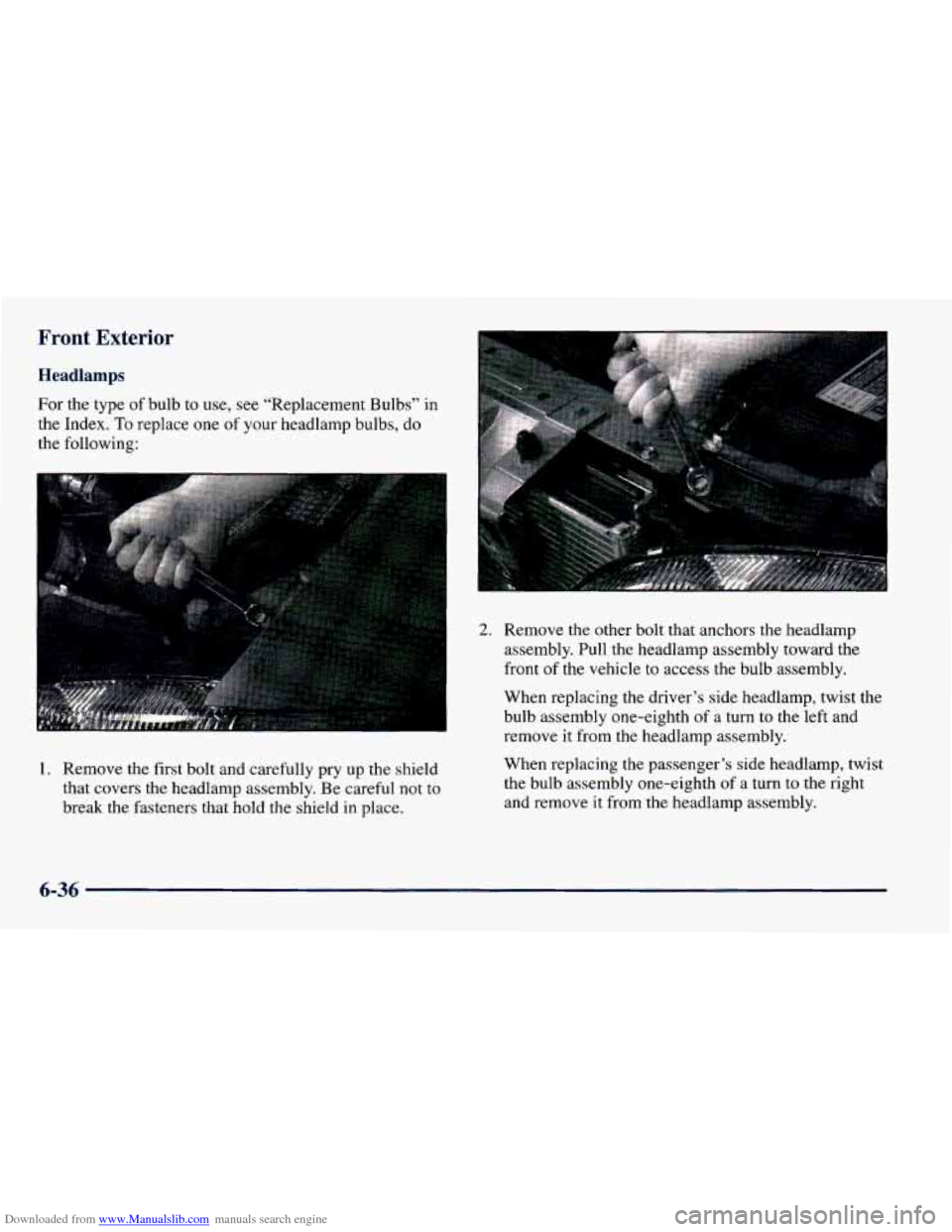
1. Remove the first bolt and carefully pry up the shield
that covers the headlamp assembly, Be careful not to
break the fasteners that hold the shield in place.
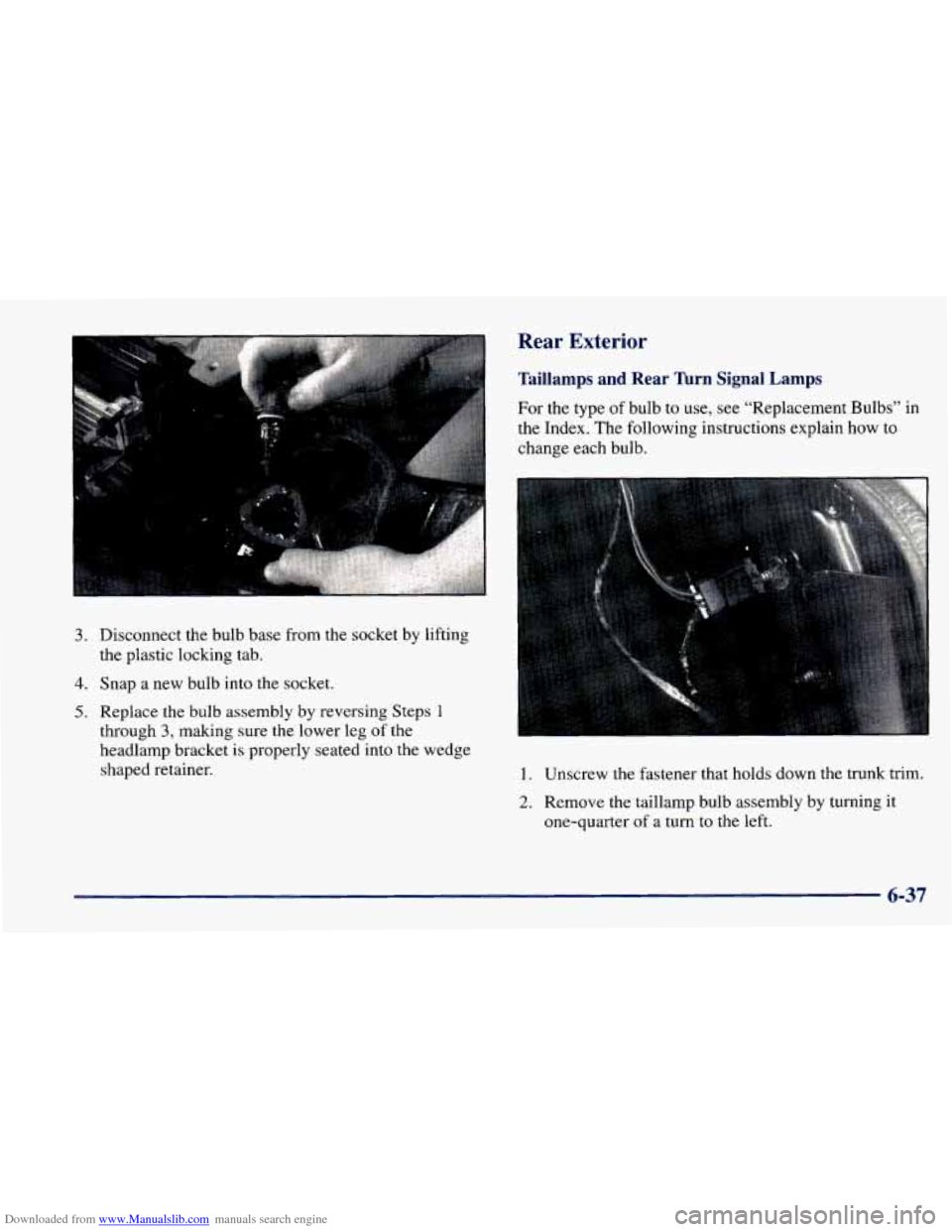
2. Remove the other bolt that anchors the headlamp
assembly. Pull the headlamp assembly toward the
front of the vehicle to access the bulb assembly.
When replacing the driver’s side headlamp, twist the
bulb assembly one-eighth of a turn to the left and
remove it from the headlamp assembly.
When replacing the passenger’s side headlamp, twist
the bulb assembly one-eighth of a turn to the right
and remove it from the headlamp assembly.
6-36
Page 295 of 400
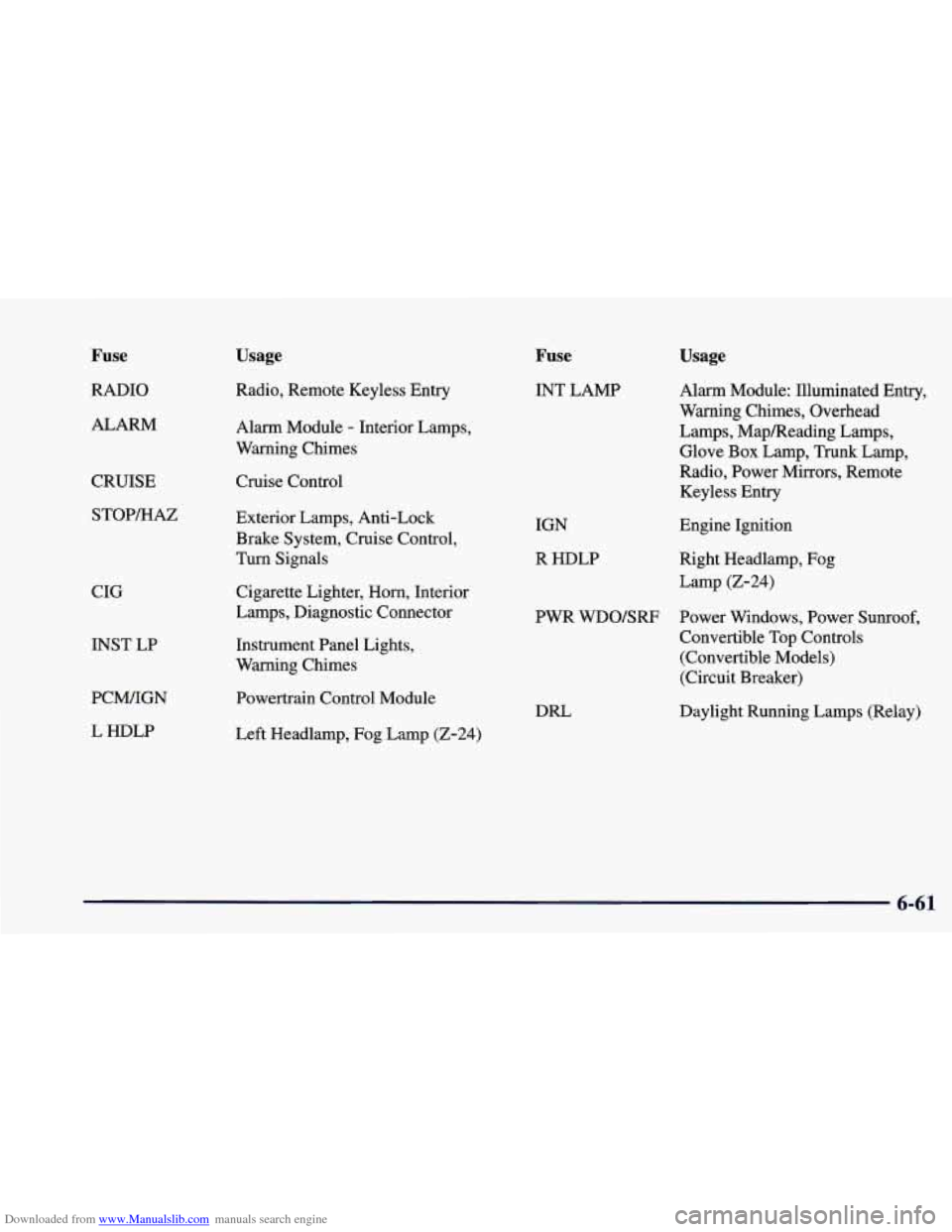
Downloaded from www.Manualslib.com manuals search engine 3. Disconnect the bulb base from me socket by lifting
4. Snap a new bulb into the socket.
5. Replace the bulb assembly by reversing Steps 1
through 3, making sure the lower leg of the
headlamp bracket is properly seated into the wedge
shaped retainer.
the
plastic locking tab.
Rear Exterior
Taillamps and Rear Turn Signal Lamps
For the type of bulb to use, see “Replacement Bulbs” in
the Index. The following instructions explain
how to
change each bulb.
1. Unscrew the fastener that holds down the trunk trim.
2. Remove the taillamp bulb assembly by turning it
one-quarter of a turn to the left.
6-37
Page 305 of 400
Downloaded from www.Manualslib.com manuals search engine NOTICE:
The wrong wheel can also cause problems with
bearing life, brake cooling, speedometer or
odometer calibration, headlamp aim, bumper
height, vehicle ground clearance and tire or tire
chain clearance to the body and chassis.
See “Changing a Flat Tire” in the Index for more
information.
Used Replacement Wheels
~~~
Putting a used wheel on your vehicle is
dangerous. You can’t know how it’s been used or
how far it’s been driven. It could fail suddenly
and cause an accident.
If you have to replace a
wheel, use a new
GM original equipment wheel.
’ire Chains
NOTICE:
If your vehicle has P195165R15 or P205/55R16
size tires, don’t use tire chains. They can damage
your vehicle because there’s not enough clearance.
Use another type
of traction device only if its
manufacturer recommends
it for use on your
vehicle and tire size combination and road
conditions. Follow that manufacturer’s
instructions.
To help avoid damage to your
vehicle, drive slowly, readjust or remove the
device if it’s contacting your vehicle, and don’t
spin your wheels.
If you do find traction devices that will fit, install
them on the front tires.
NOTICE: (Continued)
6-47
Page 316 of 400
Downloaded from www.Manualslib.com manuals search engine Electrical System
Add-on Electrical Equipment
NOTICE:
Don’t add anything electrical to your vehicle unless
you check
with your dealer first. Some electrical
equipment can damage your vehicle and the
damage wouldn’t be covered
by your warranty.
Some add-on electrical equipment
can keep other
components
from working as they should.
Your vehicle has an air bag system. Before attempting to
add anything electrical to your vehicle, see “Servicing
Your Air Bag-Equipped Vehicle” in the Index.
Headlamp Wiring
The headlamp wiring is protected by fuses. Should your
headlamps fail
to function, have your headlamp system
checked right away.
Windshield Wiper Fuse
The windshield wiper motor is protected by a circuit
breaker and a fuse. If the motor overheats due
to heavy
snow, etc., the wiper will stop until the motor cools. If
the overload is caused by some electrical problem, have
it fixed.
Power Windows and Other Power Options
Circuit breakers in the fuse panel protect the power
windows and other power accessories. When the current
load is too heavy, the circuit breaker opens and closes,
protecting the circuit until the problem is fixed.
6-58
Page 319 of 400
Downloaded from www.Manualslib.com manuals search engine Fuse
RADIO
ALARM CRUISE STOP/HAZ
CIG
INST LP
PCM/IGN
L HDLP
Usage
Radio, Remote Keyless Entry
Alarm Module
- Interior Lamps,
Warning Chimes
Cruise Control
Exterior Lamps, Anti-Lock
Brake System, Cruise Control,
Turn Signals Cigarette Lighter,
Horn, Interior
Lamps, Diagnostic Connector
Instrument Panel Lights,
Warning Chimes
Powertrain Control Module
Left Headlamp, Fog Lamp
(2-24)
Fuse
INT LAMP
IGN
R HDLP
Usage
Alarm Module: Illuminated Entry,
Warning Chimes, Overhead
Lamps, MapReading Lamps,
Glove Box Lamp, Trunk Lamp,
Radio, Power Mirrors, Remote Keyless
Entry
Engine Ignition
Right Headlamp, Fog
Lamp
(2-24)
PWR WDO/SRF Power Windows, Power Sunroof,
Convertible Top Controls
(Convertible Models)
(Circuit Breaker)
DRL Daylight Running Lamps (Relay)
6-61
Page 321 of 400
Downloaded from www.Manualslib.com manuals search engine Replacement Bulbs
OUTSIDE LAMPS BULB
Back-up Lamps ......................... 3057
Front ParkingRurn Signal Lamps
BaseModel
........................... 3357
2-24Model
......................... 3357NA
Center High-Mounted Stoplamp Inside
................................ 1141
Outside
............................... 912
Halogen Headlamps HigWLow Beam
...................... 9005/6
Tail/Turn Signal Lamps .................. 3057
Turn Signal Lamps (Rear Sedan)
.......... 3057
INSIDE LAMPS BULB
Domemeading Lamp (If Equipped)
Front
................................. 168
Rear
.................................. 194
Capacities and Specifications
The following approximate capacities are given in English and metric conversions. Please refer to “Recommended
Fluids and Lubricants” in the Index for more information.
Engine Crankcase ............ 4.0 quarts (3.8 L)
Automatic Transaxle
(3-Speed Automatic Transaxle)*
Pan Removal and Replacement ... 4.0 quarts (3.8 L)
After Complete Overhaul
........ 7.0 quarts (6.6 L)
*4-Speed Automatic Transaxle Not Owner Serviceable.
When draining or replacing torque convertec more
fluid may
be needed.
Manual Transaxle
Complete Drain and Refill ....... 2.0 quarts (1.9 L)
Cooling System
2.2L ....................... 10.3 quarts (9.8 L)
2.4L ...................... 10.7 quarts (10.1 L)
6-63