1998 CADILLAC SEVILLE height
[x] Cancel search: heightPage 17 of 378
Downloaded from www.Manualslib.com manuals search engine Head Restraints
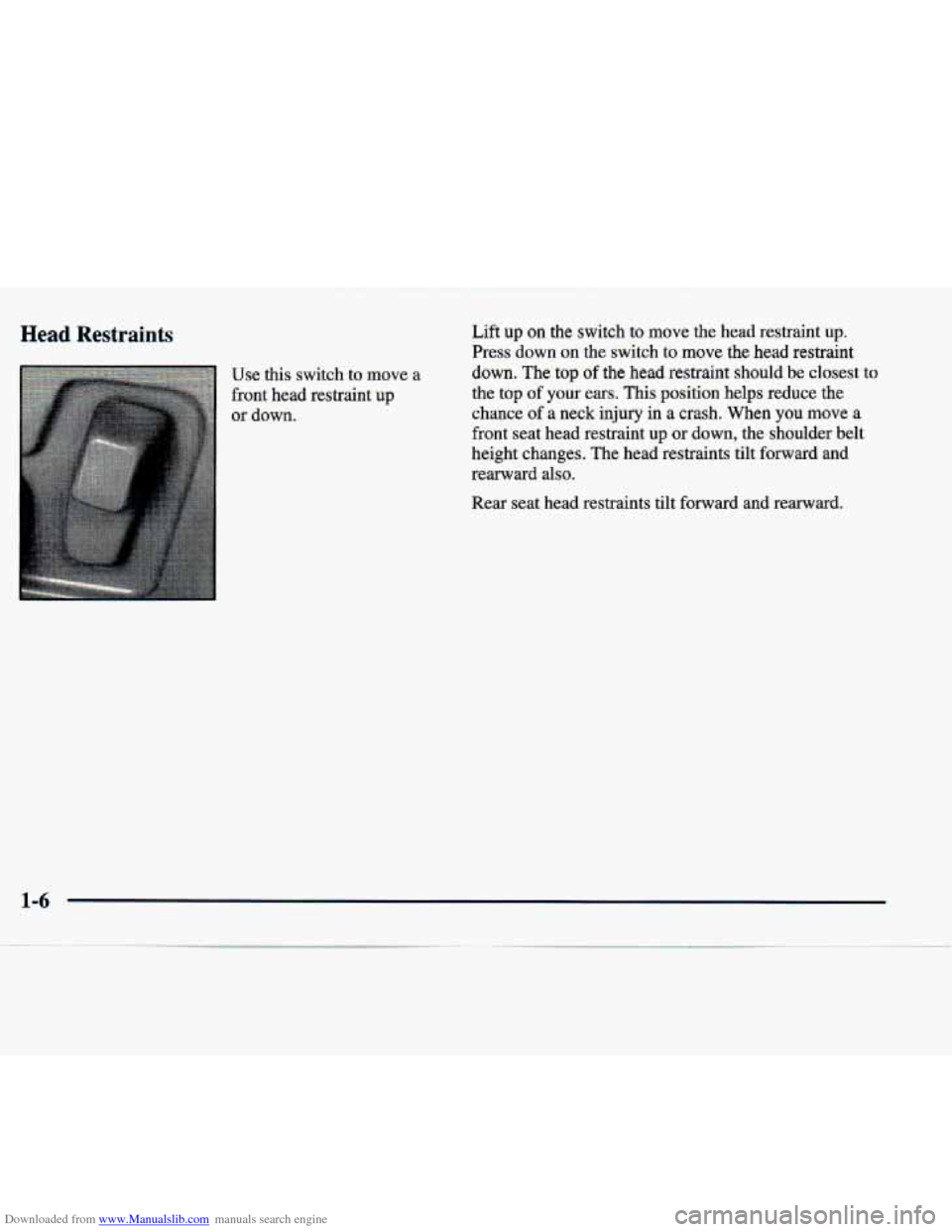
Use this switch to move a
front head restraint up
or down. Lift
up on the switch to move the head restraint up.
Press down on the switch to move the head restraint
down. The top of the head restraint should be closest to
the top of your ears. This position helps reduce the
chance
of a neck injury in a crash. When you move a
front seat head restraint up or down, the shoulder belt
height changes. The head restraints tilt forward and
rearward also.
Rear seat head restraints tilt forward and rearward.
1-6
Page 25 of 378
Downloaded from www.Manualslib.com manuals search engine Shoulder Belt Height Adjuster
When you move a front seat head restraint, the shoulder
belt height changes. See “Head Restraints’’ in the Index.
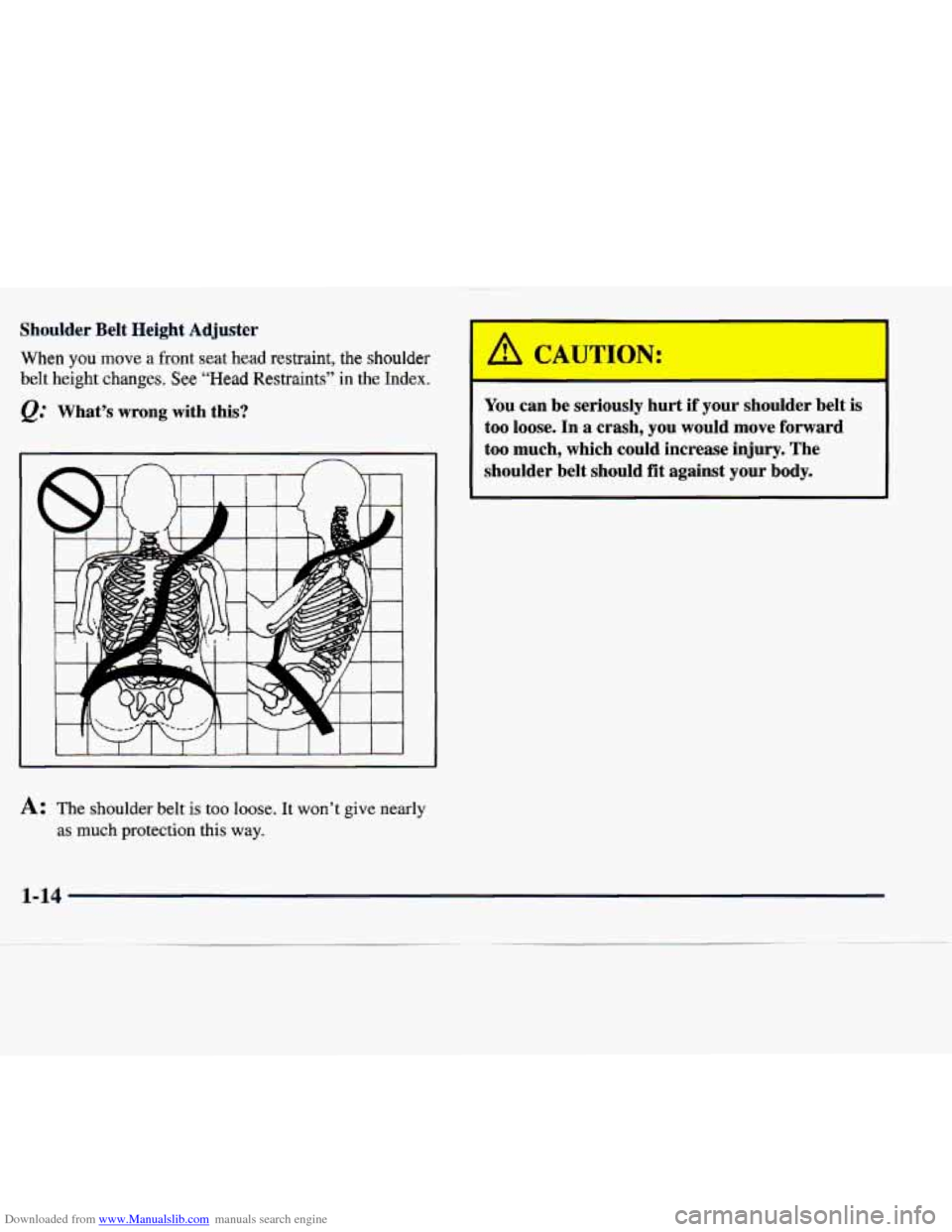
@ What’s wrong with this?
A: The shoulder belt is too loose. It won’t give nearly
as much protection this way.
uu
You can be seriously hurt if your shoulder belt is
too loose. In a crash, you would move forward
too much, which could increase injury. The
shoulder belt should
fit against your body.
1-14
Page 47 of 378
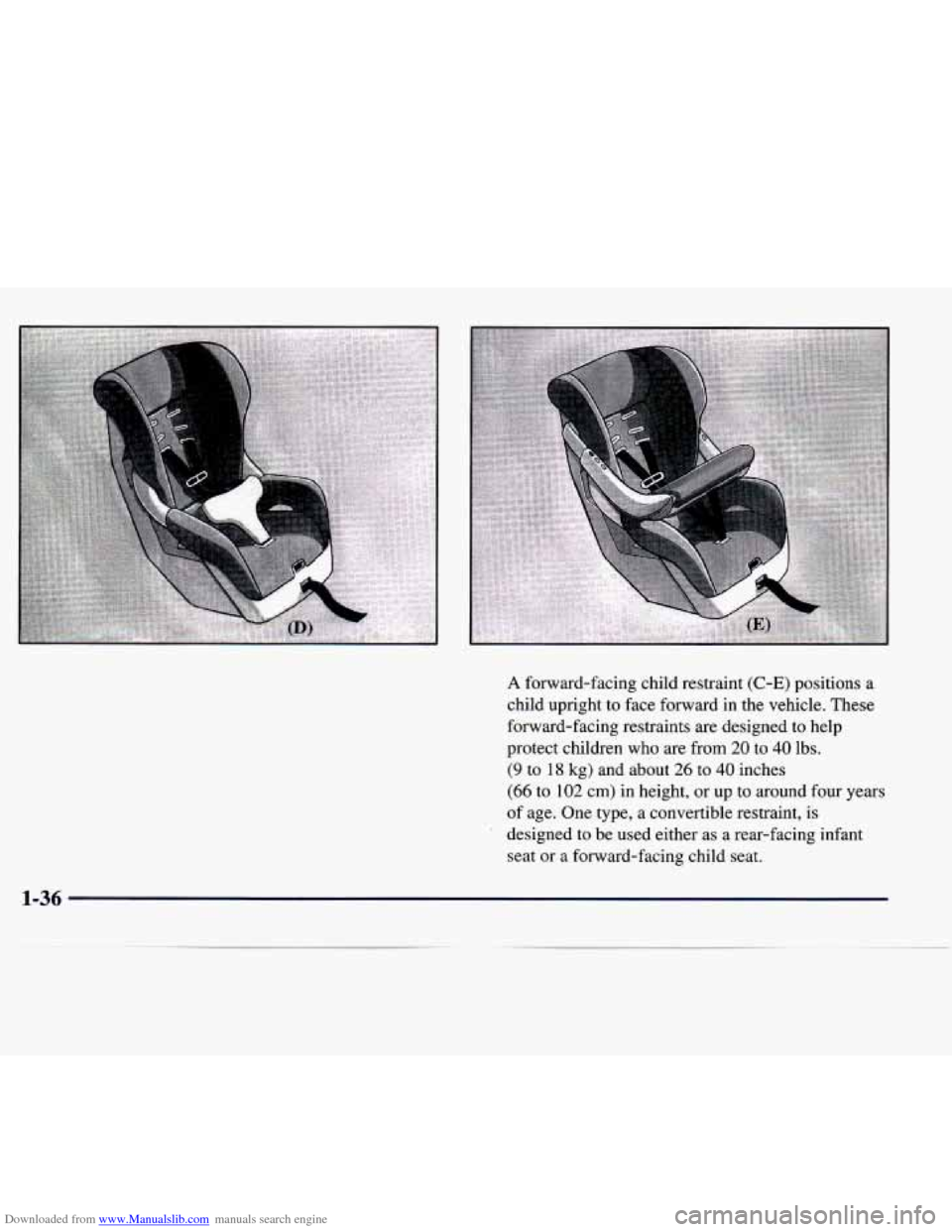
Downloaded from www.Manualslib.com manuals search engine A forward-facing child restraint (C-E) positions a
child upright to face forward in the vehicle. These
forward-facing restraints are designed
to help
protect children
who are from 20 to 40 lbs.
(9 to 18 kg) and about 26 to 40 inches
(66 to 102 cm) in height, or up to around four years
of age. One type, a convertible restraint, is
designed to be used either as a rear-facing infant
seat
or a forward-facing child seat.
1-36
Page 306 of 378
Downloaded from www.Manualslib.com manuals search engine NOTICE:
Brake Adjustment
Every time you apply the brakes, with or without the vehicle moving, your brakes adjust for wear.
Continuing to drive with worn-out brake pads
could result in costly brake repair.
Replacing Brake System Parts
The braking system on a modern vehicle is complex. Its
Some driving conditions or climates may cause a brake
squeal when the brakes are first applied or lightly
applied. This does not mean something is wrong with
your brakes.
Properly torqued wheel nuts are necessary to help
prevent brake pulsation. When tires are rotated, inspect
brake pads for wear and evenly torque wheel nuts in the
proper sequence to GM specifications.
Brake linings should always be replaced as complete
axle sets.
See “Brake System Inspection’’ in the Maintenance
Schedule booklet under Part
C “Periodic Maintenance
Inspections.”
Brake Pedal navel
See your dealer if the brake pedal does not return to
normal height, or if there is a rapid increase in pedal
travel.
This could be a sign of brake trouble. many parts have to be
of top quality and work well
together if the vehicle is to have really good braking.
Your vehicle was designed and tested with top-quality
GM brake parts. When you replace parts
of your braking
system
-- for example, when your brake linings wear
down and you have to have new ones put in
-- be sure
you get new approved GM replacement parts. If you
don’t, your brakes may no longer work properly. For
example, if someone puts in brake linings that are wrong
for your vehicle, the balance between your front and
rear brakes can change
-- for the worse. The braking
performance you’ve come to expect can change in many other ways
if someone puts in the wrong replacement
brake parts.
6-31
Page 324 of 378
Downloaded from www.Manualslib.com manuals search engine NOTICE:
The wrong wheel can also cause problems with
bearing life, brake cooling, speedometer or
odometer calibration, headlamp aim, bumper
height, vehicle ground clearance and tire or tire
chain clearance to the body and chassis.
See “Changing a Flat Tire” in the Index for
more information.
Used Reti ----Yt Wheels
Putting a used wheel on your vehicle is
dangerous. You can’t know how it’s been used or
how far
it’s been driven. It could fail suddenly
and cause an accident.
If you have to replace a
wheel, use a new
GM original equipment wheel.
Tire Cha’ s
NOTICE:
Use tire chains only where legal and only when
you must. Use only
SAE Class “S” type chains
that are the proper size for your tires. Install
them on the front tires and tighten them
as
tightly as possible with the ends securely
fastened. Drive slowly and follow the chain
manufacturer’s instructions.
If you can hear the
chains contacting your vehicle, stop and retighten
them.
If the contact continues, slow down until it
stops. Driving too fast or spinning the wheels
with chains on will damage your vehicle.
Page 341 of 378
Downloaded from www.Manualslib.com manuals search engine Replacement Bulbs
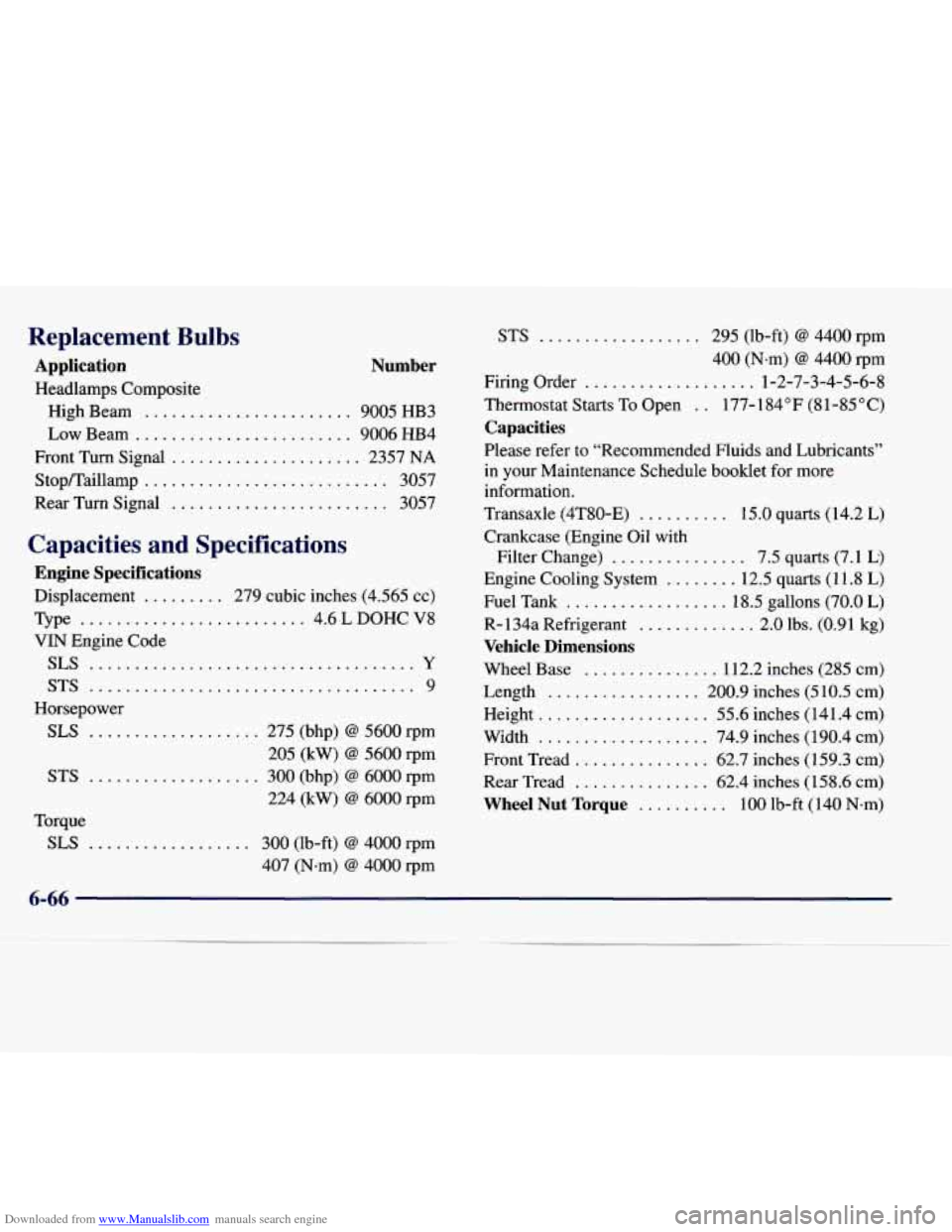
Application Number
Headlamps Composite High Beam
....................... 9005 HB3
Low Beam ........................ 9006 HB4
Front Turn Signal ..................... 2357 NA
Stop/Taillamp ........................... 3057
Rear Turn Signal
........................ 3057
Capacities and Specifications
Engine Specifications
Displacement ......... 279 cubic inches (4.565 cc)
Type
......................... 4.6 L DOHC V8
VIN Engine Code
SLS .................................... Y
STS .................................... 9
Horsepower
SLS ................... 275 (bhp) @ 5600 rpm
STS
................... 300 (bhp) @ 6000 rpm
205 (kW)
@ 5600 rpm
224 (kW)
@ 6000 rpm
Torque
SLS .................. 300 (lb-ft) @ 4000 rpm
407 (N-m)
@ 4000 rpm STS
.................. 295 (lb-ft) 63 4400 rpm
Firing Order
................... 1-2-7-3-4-5-6-8
400
(N-m)
@ 4400 rpm
Thermostat Starts To Open
, , 177- 184°F (8 1-85 “C)
Capacities
Please refer to “Recommended Fluids and Lubricants”
in your Maintenance Schedule booklet for more
information.
Transaxle
(4T80-E) .......... 15.0 quarts (14.2 L)
Crankcase (Engine Oil with Filter Change)
............... 7.5 quarts (7.1 L)
Engine Cooling System ........ 12.5 quarts (1 1.8 L)
R- 134a Refrigerant ............. 2.0 lbs. (0.9 1 kg)
Vehicle Dimensions
Wheel Base ............... 112.2 inches (285 cm)
Length
................. 200.9 inches (510.5 cm)
Height
................... 55.6 inches (141.4 cm)
Width
................... 74.9 inches (190.4 cm)
Front Tread
............... 62.7 inches (1 59.3 cm)
Rear Tread
............... 62.4 inches (158.6 cm)
Wheel Nut Torque .......... 100 lb-ft (140 N-m)
Fuel Tank
.................. 18.5 gallons (70.0 L)
6-66
Page 370 of 378
Downloaded from www.Manualslib.com manuals search engine Reminder Light .......................... 1.7. 2.65
Replacing After
a Crash ........................ 1-48
Right Front Passenger Position
.................. 1- 19
Shoulder Belt Height Adjuster
................... 1-14
Smaller Children and Babies
.................... 1-3 1
UseDuring Pregnancy ......................... 1-18
WhyTheyWork
............................... 1-8
Safety Chains .................................. 4-35
Safety Defects. Reporting
................... 7- 12. 7. 13
Safety Warnings and Symbols
....................... 111
Seatback Reclining Front
............................... 1-4
Seats Adaptive
..................................... 1-3
Heated
...................................... 1-4
Lumbar Control
............................... 1-2
Memory Function
.............................. 1-3
Power
....................................... 1-2
Rearcushion
................................ 6-67
SeatControls
................................. 1-2
Securing a Child Restraint
................. 1.40. 1-42
Second Gear. Automatic Transaxle
................. 2-24
SecurityLight
.................................. 2-73
Security System
........................... 2.14. 2.16
Service
........................................ 6-2
A/C System Message
.......................... 2-86
AirBagMessage
............................. 2-86
Bulletins. Ordering
.................. 7.13.7.14. 7-15
Charging System Message
...................... 2-86
Electrical System Message
...................... 2-86
Engine Soon Light
............................ 2-70
Fuel System Message
.......................... 2-86
Idle Control System Message ................... 2-86
...
Restraint Systems .............................. 1 . 1 Manuals. Ordering
.................. 7.13. 7. 14. 7.15
Parts Identification Label
....................... 6-58
Stability System Message
...................... 2-86
Steering System Message
....................... 2-86
Suspension System Message
.................... 2-86
Theft System Message
......................... 2-87
Vehicle Soon Message
......................... 2-87
Work. Doing Your Own ......................... 6-2
Service and Appearance Care
...................... 6-1
Service and Owner Publications
......... 7- 13. 7. 14. 7.15
Sheet Metal Damage
............................ 6-56
Shift Lever Positions
............................ 2-21
Shifting Automatic Transaxle
.......................... 2-21
IntoPARK(P)
............................... 2-26
Out
of PARK (P) ............................. 2-28
Shoulder Belt Height Adjuster
..................... 1-14
Signaling
Turns ................................ 2-33
SIR .......................................... 1-19
Skidding
...................................... 4-14
Solar Sensor. Electronic
........................... 3-4
Sound Equipment. Adding
........................ 3-43
Spare Tire. Compact
............................. 5-35
Speaker Covers. Cleaning
........................ 6-52
Specifications and Capacities
...................... 6-66
Speed Limited to
90 mph Message ................. 2-87
Stability System Engaged Message
................. 2-87
Stains. Cleaning
................................ 6-51
Starting Your Engine
............................ 2-19
Publications. Ordering
............... 7-
13. 7. 14. 7. 15
Servicing Your Air Bag-Equipped Cadillac
.......... 1-27
Speech Impaired. Customer Assistance
............... 7-4
Speedometer
................................... 2-63
Starting Disabled Remove Key Message
............. 2-87
8-9
..