Page 272 of 378
Downloaded from www.Manualslib.com manuals search engine Compact Span re
Although the compact spare tire was fully inflated
when your vehicle was new, it can lose air after a time.
Check the inflation pressure regularly. It should be
60 psi (420 Wa).
After installing the compact spare on your vehicle, you should stop as soon as possible and make sure your
spare tire
is correctly inflated. The compact spare is
made to perform well at speeds up to
65 mph
(105 kndh) for distances up to 3,000 miles (5 000 km),
so you can finish your trip and have your full-size tire
repaired or replaced where you want. Of course, it’s best
to replace your spare with a full-size
tire as soon as you
can. Your spare will last longer and be in good shape in
case
you need it again.
NOTICE:
When the compact spare is installed, don’t take
your vehicle through an automatic car wash with
guide rails. The compact spare can get caught on
the rails. That can damage the tire and wheel,
and maybe other parts
of your vehicle.
Don’t use your compact spare on other vehicles.
And don’t
mix your compact spare tire or wheel with
other wheels or tires. They won’t fit. Keep your spare tire and its wheel together.
NOTICE:
Tire chains won’t fit your compact spare. Using
them can damage your vehicle and can damage
the chains too. Don’t use tire chains on your
compact spare.
Page 321 of 378
Downloaded from www.Manualslib.com manuals search engine A CAUTIL I:
Mixing tires could cause you to lose control while
driving.
If you mix tires of different sizes or types
(radial and bias-belted tires), the vehicle may not
handle properly, and you could have
a crash.
Using tires of different sizes may also cause
damage to your vehicle. Be sure to use the same
size and type tires on all wheels.
It’s all right to drive with your compact spare,
though.
It was developed for use on your vehicle.
I A CAUTION:
If you use bias-ply tires on your vehicle, the
wheel rim flanges could develop cracks after
many miles
of driving. A tire and/or wheel could
fail suddenly, causing
a crash. Use only radial-ply
tires with the wheels on your vehicle.
Uniform Tire Quality Grading
The following information relates to the system
developed by the United States National Highway
Traffic Safety Administration, which grades tires by
treadwear, traction and temperature performance. (This applies only to vehicles sold in the United States.) The
grades are molded on
the sidewalls of most passenger
car tires. The Uniform Tire Quality Grading system does
not apply to deep tread, winter-type snow tires,
space-saver or temporary use spare tires, tires with
nominal rim diameters of
10 to 12 inches (25 to 30 cm),
or to some limited-production tires.
While the tires available on General Motors passenger
cars and light trucks may vary with respect to these
grades, they must also conform to Federal safety
requirements and additional General Motors Tire
Performance Criteria (TPC) standards.
6-46
Page 324 of 378
Downloaded from www.Manualslib.com manuals search engine NOTICE:
The wrong wheel can also cause problems with
bearing life, brake cooling, speedometer or
odometer calibration, headlamp aim, bumper
height, vehicle ground clearance and tire or tire
chain clearance to the body and chassis.
See “Changing a Flat Tire” in the Index for
more information.
Used Reti ----Yt Wheels
Putting a used wheel on your vehicle is
dangerous. You can’t know how it’s been used or
how far
it’s been driven. It could fail suddenly
and cause an accident.
If you have to replace a
wheel, use a new
GM original equipment wheel.
Tire Cha’ s
NOTICE:
Use tire chains only where legal and only when
you must. Use only
SAE Class “S” type chains
that are the proper size for your tires. Install
them on the front tires and tighten them
as
tightly as possible with the ends securely
fastened. Drive slowly and follow the chain
manufacturer’s instructions.
If you can hear the
chains contacting your vehicle, stop and retighten
them.
If the contact continues, slow down until it
stops. Driving too fast or spinning the wheels
with chains on will damage your vehicle.
Page 332 of 378
Downloaded from www.Manualslib.com manuals search engine Appearance Care Materials Chart
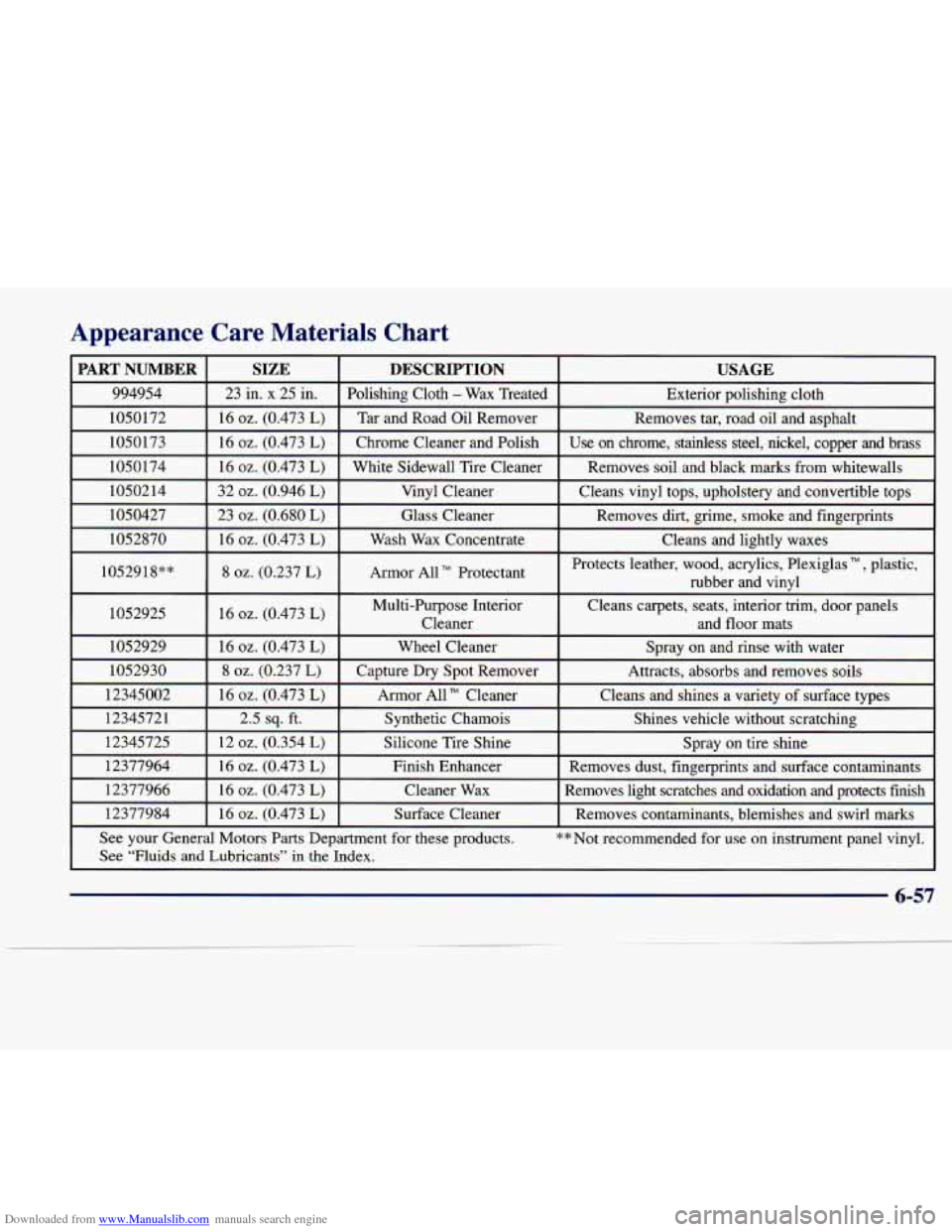
PART NUMBER USAGE
DESCRIPTION SIZE
994954
Exterior polishing cloth
Polishing Cloth - Wax Treated
23 in. x 25 in.
1050172 Removes tar, road oil and asphalt
Tar
and Road Oil Remover 16
oz. (0.473 L)
1050173
Cleans and lightly waxes
Wash Wax
Concentrate
16 oz. (0.473
L) 1052870 Removes dirt, grime, smoke
and fingerprints
Glass Cleaner 23
oz. (0.680 L) 1050427 Cleans
vinyl tops, upholstery and convertible tops Vinyl
Cleaner
32
oz. (0.946 L) 10502 14
Removes soil
and black marks from whitewalls
White Sidewall Tire Cleaner
16 oz. (0.473 L) 1050174 Use on chrome, stainless steel, nickel, copper
and brass
Chrome
Cleaner and Polish
16 oz. (0.473 L)
I 1052918"" I 8 oz. (0.237 L) I Armor
All" Protectant
1 1052925 I 16 02. (0.473 L) I
Multi-Purpose Interior
Cleaner
1052929
Synthetic Chamois
2.5
sq. ft. 12345721 Armor All
TM Cleaner
16 oz. (0.473 L) 12345002 Capture
Dry Spot Remover
8
oz. (0.237 L) 1052930 Wheel
Cleaner
16
oz. (0.473 L)
12345725
Surface Cleaner
16
oz. (0.473 L) 12377984 Cleaner
Wax
16
oz. (0.473 L) 12377966 Finish Enhancer
16
oz. (0.473 L) 12377964 Silicone
Tire Shine
12
oz. (0.354 L)
See your General Motors Parts Department
for these products.
See "Fluids and Lubricants" in the Index. Protects
leather, wood, acrylics, Plexiglas
TM , plastic,
rubber and vinyl
I
and floor mats
Cleans and shines a variety
of surface types
Shines vehicle without scratching
~ ~~
~
Spray on tire shine
Removes dust, fingerprints and surface contaminants
Removes light scratches and oxidation and protects finish
Removes contaminants, blemishes and swirl marks
k*Not recommended for use on instrument panel vinyl.
6-57