1998 CADILLAC SEVILLE ECU
[x] Cancel search: ECUPage 75 of 378
Downloaded from www.Manualslib.com manuals search engine Theft Parking Lots
If you park in a lot where someone will be watching
your vehicle, it’s best to lock it up and take your keys.
But what
if you have to leave your ignition key?
Vehicle theft is big business, especially in some cities.
Although your vehicle has a number of theft-deterrent
features, we know that nothing we put on it can make it
impossible to steal. However, there
are ways you
can help.
Key in the Ignition
If you leave your vehicle with the keys inside, it’s an
easy target for joy riders or professional thieves -- so
don’t do it.
When you park your vehicle and open the driver’s door,
you’ll hear a chime reminding you to remove your key from the ignition and take
it with you. Always do this.
Your ignition and transaxle will be locked. And
remember to lock the doors.
Parking at Night
Park in a lighted spot, close all windows and lock your
vehicle. Remember to keep your valuables out of sight.
Put them in a storage area, or take them with you.
0
0
0
0
0
0
If possible, park in a busy, well lit area.
Put your valuables in
a storage area, like your
trunk or glove
box. Be sure to close and lock the
storage area.
Close all windows.
Lock the glove box.
Lock all the doors except the driver’s.
Then take the door key and remote keyless entry
transmitter with you.
SECURITY
If the ignition is off and
any door is open, the
SECURITY light will
flash, reminding you to
arm the system.
2-14
Page 76 of 378
Downloaded from www.Manualslib.com manuals search engine To arm the system, do the following:
1. Open the door.
2. Lock the door using the power door lock switch or
the RKE system with the door open. The
SECURITY light should come on and stay on.
off within approximately
30 seconds.
3. Close all the doors. The SECURITY light should go
When the theft system activates, the horn will sound and
the lamps will flash for about
30 seconds when the door
or trunk is opened without the key or RISE system.
Remember, the theft-deterrent system won’t arm if you
lock the doors with a key or use the manual door lock. It
activates only if you use a power door lock switch with
the door open or the
RKE system.
To avoid activating the alarm by accident:
The vehicle should be locked with the door key or
the manual door lock switch
after the doors are
closed
if you don’t want to arm the theft-deterrent
system.
0 Always unlock a door with a key or use the RKE
system. (Pressing the unlock button on the RKE
transmitter disables the theft-deterrent system.)
Unlocking a door any other way will activate the
alarm when a door or the trunk is opened. If you
activate the alarm by accident, unlock the driver’s
door with your key. You can also turn off the alarm by
using the unlock button
of the RKE system, or by
starting the car with
a valid key.
Changes or modifications made to this system by other than an authorized service facility could void
authorization to use the theft system.
Testing the Alarm
1. From inside the vehicle, roll down the window, then
get out of the vehicle, keeping the door open.
2. From outside of the vehicle, with the door open, lock
the vehicle using the power door lock or the RKE
system and close the door. Wait
30 seconds until the
SECURITY lamp goes
off.
3. Reach in and unlock the door using the manual lock
and open the door. The horn will sound and the
hazard lights will flash.
If the alarm does not sound when it should, check to see
if the horn works. The horn fuse may be blown. To
replace the fuse, see “Fuses and Circuit Breakers” in the
Index. If the fuse does not need to be replaced, you may
need to have your vehicle serviced.
To reduce the possibility of theft, always
arm the optional
theft-deterrent system when leaving your vehicle.
Page 77 of 378
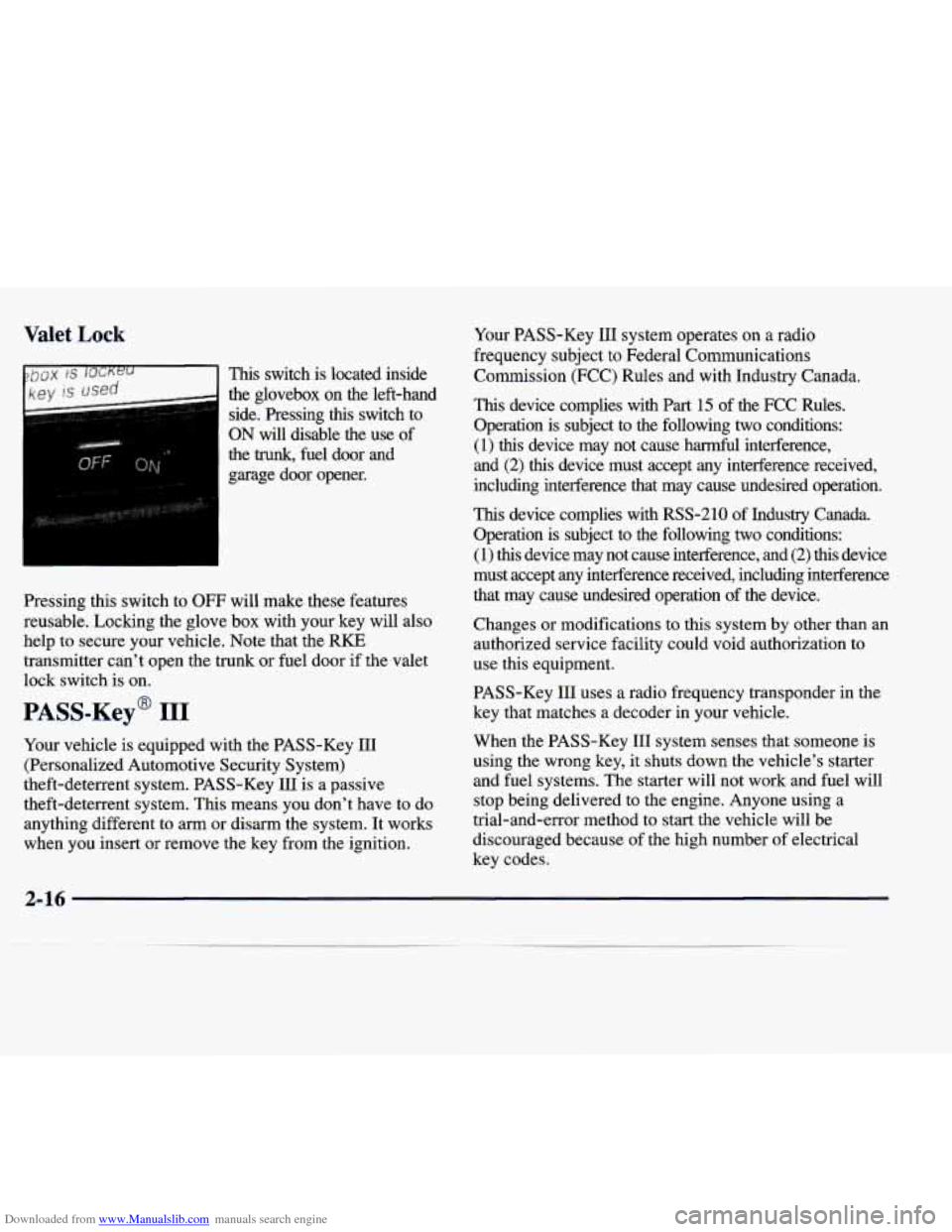
Downloaded from www.Manualslib.com manuals search engine Valet Lock
the glovebox on the left-hand side. Pressing this switch to
ON will disable the use of
the trunk, fuel door and
garage door opener.
Pressing this switch to OFF will make these features
reusable. Locking the glove
box with your key will also
help to secure your vehicle. Note that the RKE
transmitter can't open the
trunk or fuel door if the valet
lock switch is on.
PASS-Key' 111
Your vehicle is equipped with the PASS-Key I11
(Personalized Automotive Security System)
theft-deterrent system. PASS-Key
111 is a passive
theft-deterrent system. This means you don't have to do
anything different to arm or disarm the system. It works
when you insert
or remove the key from the ignition. Your PASS-Key
I11 system operates on a radio
frequency subject
to Federal Communications
Commission (FCC) Rules and with Industry Canada.
This device complies with Part 15 of the FCC Rules.
Operation is subject to the following two conditions:
(1) this device may not cause harmful interference,
and
(2) this device must accept any interference received,
including interference that may cause undesired operation.
This device complies with RSS-210 of Industry Canada.
Operation is subject to
the following two conditions:
(1) this device may not cause interference, and (2) this device
must accept any interference received, including interference
that may cause undesired operation
of the device.
Changes or modifications to this system by other than an authorized service facility could void authorization to
use this equipment.
PASS-Key
111 uses a radio frequency transponder in the
key that matches a decoder in your vehicle.
When the PASS-Key
111 system senses that someone is
using
the wrong key, it shuts down the vehicle's starter
and fuel systems. The starter will not work and fuel will
stop being delivered to the engine. Anyone using a
trial-and-error method
to start the vehicle will be
discouraged because of the high number of electrical
key codes.
2-16
Page 78 of 378
Downloaded from www.Manualslib.com manuals search engine If when trying to start the vehicle, the engine does not
start and the STARTING DISABLED REMOVE KEY
message is displayed in the Driver Information Center,
your key should be checked for damage.
Turn the
ignition
off and try again.
If the engine still does not start, and the key appears to
be undamaged, try another ignition key. At this time, you may also want to check the fuse (see “Fuses and
Circuit Breakers’’ in the Index). If the engine still does
not start with the other key, your vehicle needs service.
If your vehicle does start, the first key may be faulty.
See your dealer or a locksmith who can service the
PASS-Key
I11 to have a new key made.
If you are ever driving and the SERVICE
THEFT
SYSTEM message is displayed in the Driver
Information Center or the
SECURITY light comes on
and stays on, you will be able to restart your engine if
you
turn it off. Your vehicle is not protected by the
PASS-Key@
111 system at this time. Your PASS-Key@
I11 system is not working properly and must be serviced
by your dealer.
If you lose or damage a PASS-Key I11 key, see your
dealer or a locksmith who can service PASS-Key
111 to
have a new key made.
New Vehicle 66Break-In”
NOTICE:
Your vehicle doesn’t need an elaborate
“break-in.” But it will perform better in the long
run
if you follow these guidelines:
Don’t drive at any one speed -- fast or
slow
-- for the first 500 miles (805 km).
Don’t make full-throttle starts.
200 miles (322 km) or so. During this time
your new brake linings aren’t yet broken
in. Hard stops with new linings can mean
premature wear and earlier replacement.
Follow this breaking-in guideline every
time you get new brake linings.
See “Towing a Trailer” in the Index
for
more information.
0 Avoid making hard stops for the first
Don’t tow a trailer during break-in.
Page 113 of 378
Downloaded from www.Manualslib.com manuals search engine Center Console Storage Area Rear Storage Armrest
Your vehicle is equipped with a rear seat armrest which
includes an open storage compartment and a dual
cupholder that unfolds for use.
To open, lift the
front edge.
Convenience Net
The convenience net is inside the back wall of the trunk.
Put small loads, like grocery bags, behind the net.
It can
help keep them from falling over during sharp turns
or
quick starts and stops.
The
net is not for larger, heavier loads. Store them in the
trunk
as far forward as you can. When not using the net,
hook the net to the tabs securing it
to the sill plate.
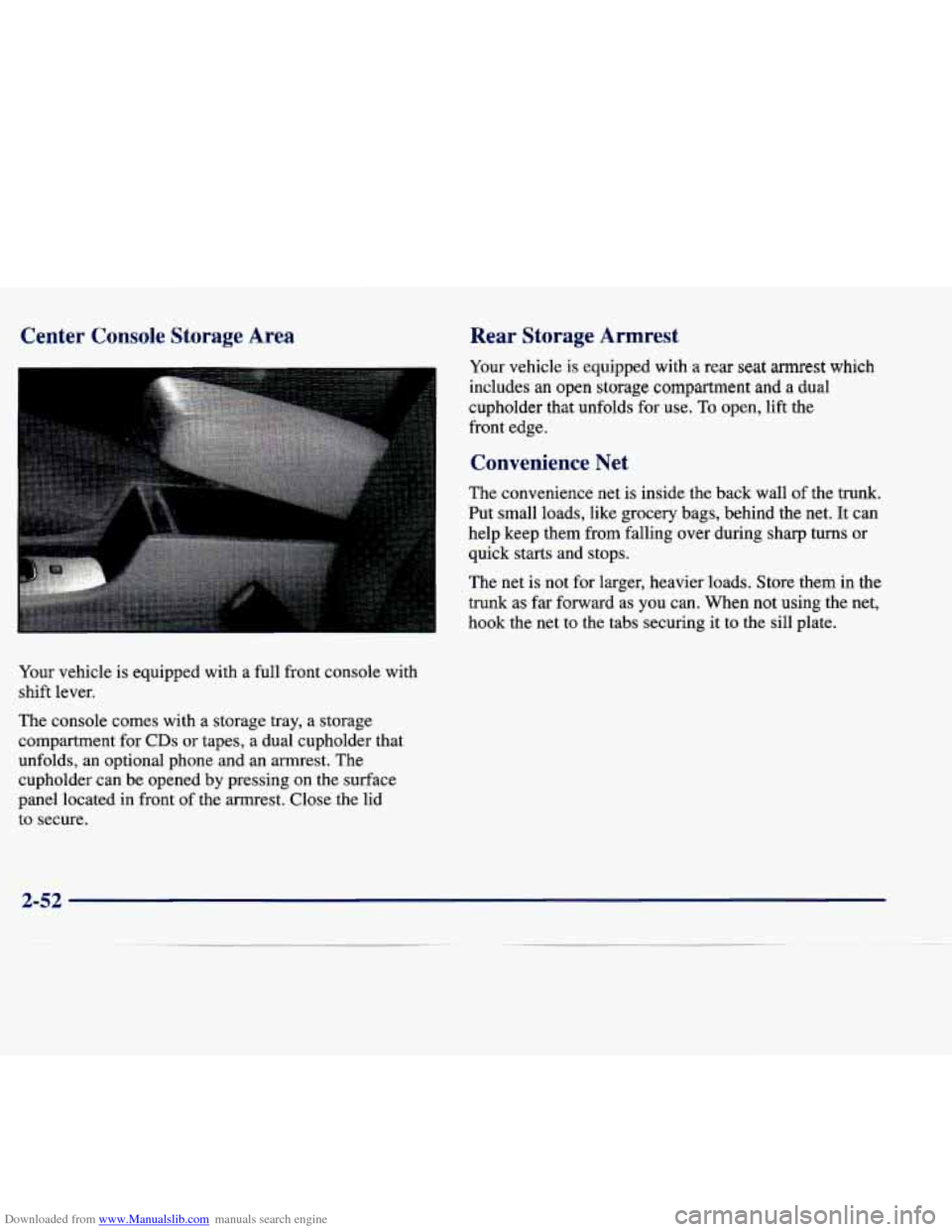
Your vehicle is equipped with a full front console with
shift lever.
The console comes with a storage tray, a storage
compartment for
CDs or tapes, a dual cupholder that
unfolds, an optional phone and an armrest. The
cupholder can be opened
by pressing on the surface
panel located in front of the armrest. Close the lid
to secure.
2-52
Page 123 of 378
Downloaded from www.Manualslib.com manuals search engine Cluster
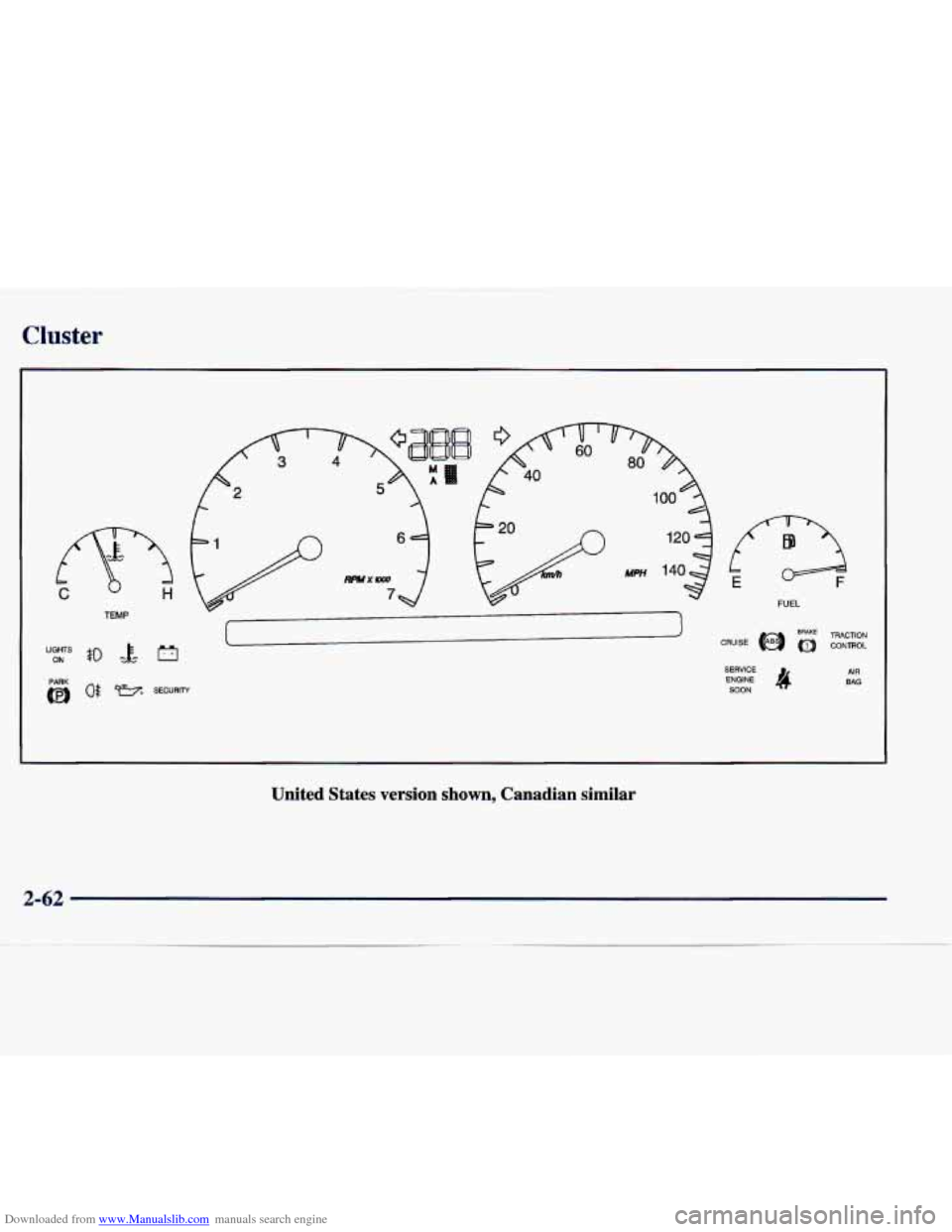
TEMP
ON $0 -$- a
6 o( SECURITY
CRUISE TRACTION a CONTROL
6 SOON BAG AIR
United States version shown, Canadian similar
2-62
Page 134 of 378
Downloaded from www.Manualslib.com manuals search engine A CAUTION:
Don’t keep driving if the oil pressure is low. If
you do, your engine can become so hot that it
catches fire. You or others could be burned.
Check your oil as soon as possible and have your
vehicle serviced.
I NOTICE:
Damage to your engine from neglected oil
problems can be costly and
is not covered by
your warranty.
Security Light
SECURITY
For information regarding this light, see
“Theft-Deterrent System”
in the Index.
Fog Lamp Light (STS Only)
This light will come on
when the fog lamp button
is pressed. For more
information about the fog
lamps, see “Fog
Lamps” in
the Index.
2-73
Page 148 of 378
Downloaded from www.Manualslib.com manuals search engine SERVICE THEFT SYSTEM - 34: This message
means there is a problem in the Personalized
Automotive Security System (PASS-Key
111). A fault
has been detected in the system which means that the
PASS-Key I11 system is disabled and is not protecting
the vehicle. The vehicle usually restarts, however, you
may want to take your vehicle to a proper service center
before turning off the engine.
SERVICE TRANSMISSION - 100: See your dealer
for repair.
SERVICE VEHICLE SOON - 3: This message is
displayed when a non-emissions related powertrain
malfunction occurs. Have your vehicle serviced by
a
technician as soon as possible.
SPEED LIMITED TO 90 - 113: A failure in the
suspension control system has occurred when this
message appears. The PCM determines the speed to
which your vehicle is limited. Have your vehicle serviced if this message appears.
STABILITY SYS ENGAGED - 55 : You may see the
STABILITY
SYS ENGAGED message on the Driver
Information Center. It means that an advanced,
computer-controlled system has come on to help your
vehicle continue
to go in the direction in which you’re
steering. This stability enhancement system activates
when the computer senses that your vehicle is just
starting to spin, as it might
if you hit a patch of ice or
other slippery spot on the road. When the system is on,
you may hear a noise or feel
a vibration in the brake
pedal. This is normal.
When the STABILITY SYS ENGAGED message is on,
you should continue to steer in the direction you want to
go. The system is designed to help you in bad weather or
other difficult driving situations by making the most of
whatever road conditions will permit. If the STABILITY
SYS ENGAGED message comes on, you’ll know that
something has caused your vehicle to start to spin,
so
you should consider slowing down.
STARTING DISABLED REMOVE KEY - 33: This
message will appear when the Personalized Automotive Security System (PASS-Key
111) senses that an improper
ignition key
is being used to try to start the vehicle.
Check the ignition key for damage. If
it is damaged, it
may need
to be replaced. If you see no damage, remove
the key and
try to start the vehicle again. If it still does
not start,
try another ignition key.
2-87