Page 288 of 380
Downloaded from www.Manualslib.com manuals search engine Filling a Portable Fuel Container
A CAUTION:
Never fill a portable fuel container while it is in
your vehicle. Static electricity discharge from the
container can ignite the gasoline vapor. You can
be badly burned and your vehicle damaged if this
occurs.
To help avoid injury to you and others:
Dispense gasoline only into approved
containers.
Do not fill a container while it is inside a
vehicle, in a vehicle’s trunk, pickup bed or
on any surface other than the ground.
inside of the
fill opening before operating
the nozzle. Contact should be maintained
until the filling is complete.
Bring the fill nozzle in contact with the
Don’t smoke while pumping gasoline.
Checking Things Under the Hood
A CAUTION:
An electric fan under the hood can start up and
injure you even when the engine is not running.
Keep hands, clothing and tools away from
any
underhood electric fan.
A CAUTION:
Things that burn can get on hot engine parts and
start a fire. These include liquids like gasoline,
oil, coolant, brake fluid, windshield washer and
other fluids, and plastic or rubber. You or others
could be burned. Be careful not to drop or spill
things that will burn onto a hot engine.
6-8
Page 291 of 380
Downloaded from www.Manualslib.com manuals search engine Underhood Lamp
Turn the parking lamps on to operate the underhood
lamp.
The underhood lamp will come on when the
hood is opened.
Engine Oil
1
iMlUM UNLEADED
FUEL ONLY TRIP fl fl.
@BMaBUD
.......................... .............. ....... ............ ....... .... ..... ........... ... ....... :;if i i.. *: :-i.. : i : ......................................... .".......
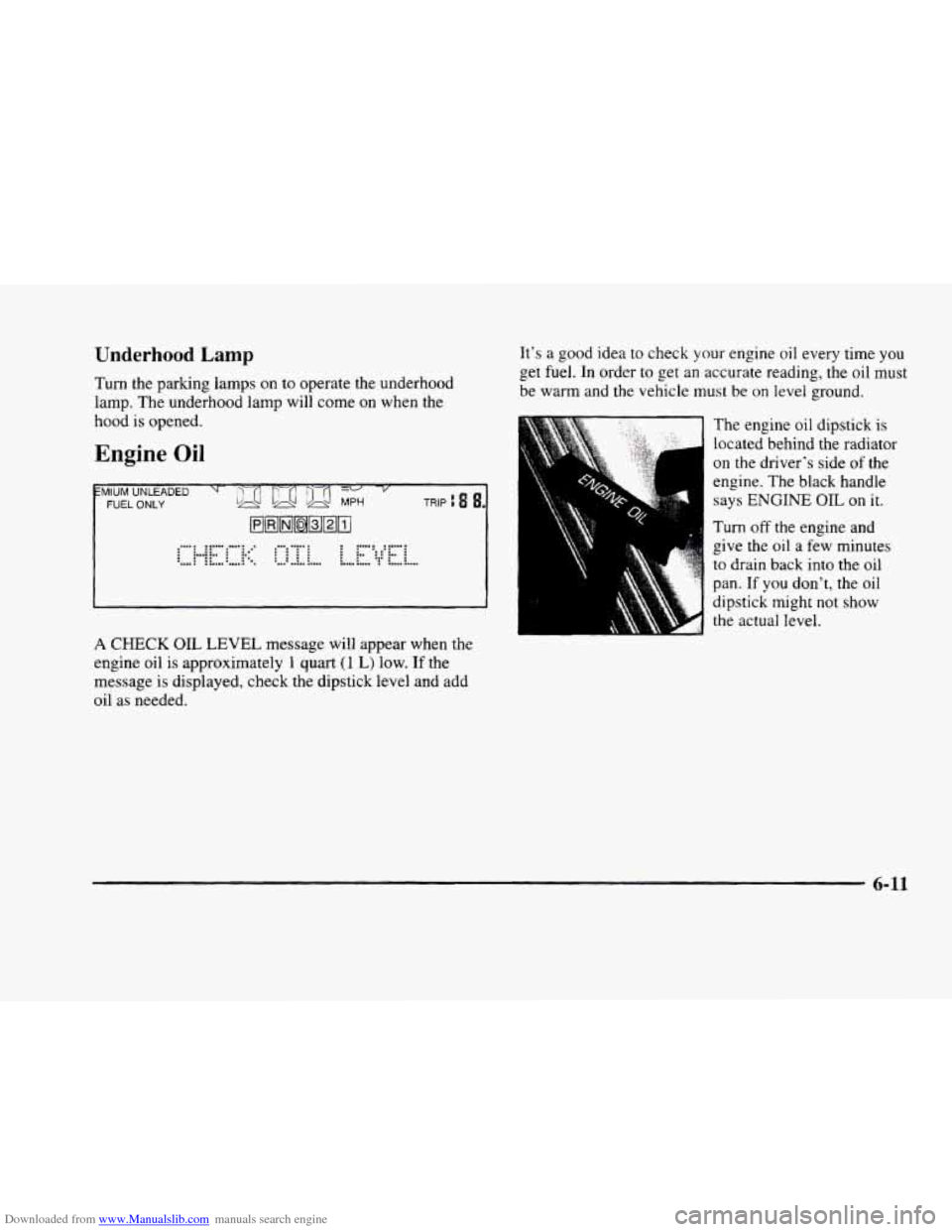
1 CHECK OIL LEVEL message will appear when the
engine oil is approximately
1 quart (1 L) low. If the
message is displayed, check the dipstick level and add
oil
as needed.
It's a good idea to check your engine oil every time you
get fuel. In order to get an accurate reading, the oil must
be warm and the vehicle must be on level ground.
The engine oil dipstick is
located behind
the radiator
on the driver's side of the
engine. The black handle
says ENGINE OIL on it.
Turn off the engine and
give
the oil a few minutes
to drain back into the oil
pan.
If you don't, the oil
dipstick might not show
the actual level.
6-11
Page 293 of 380
Downloaded from www.Manualslib.com manuals search engine What Kind of Engine Oil to Use
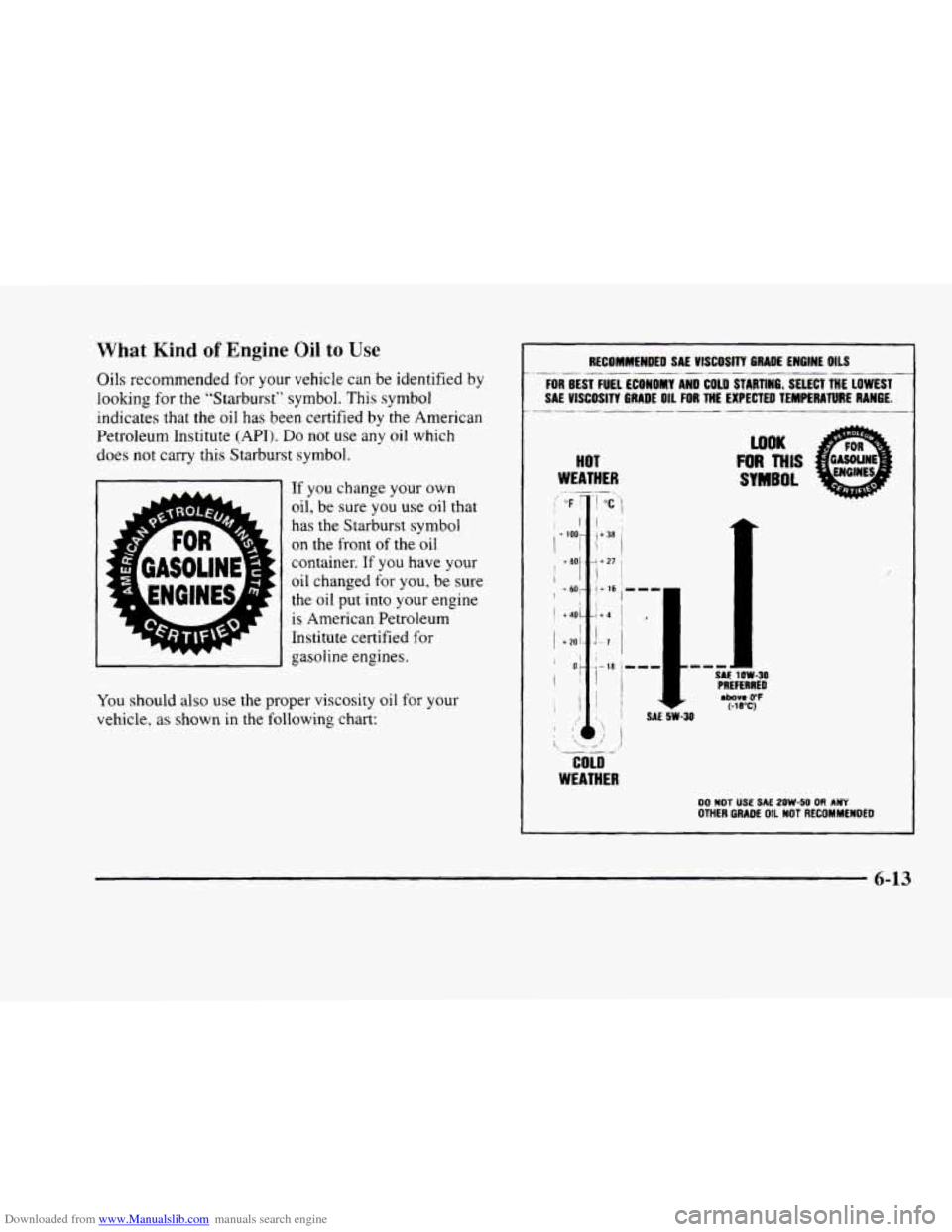
Oils recommended for your vehicle can be identified by
looking for
the "Starburst" symbol. This symbol
indicates that
the oil has been certified by the American
Petroleum Institute
(API). Do not use any oil which
does
not carry this Starburst symbol.
If you change your own
oil, be
sure you use oil that
has the Starburst symbol
on the front of the oil
container. If you have your
oil changed for you,
be sure
the oil put into your engine
is American Petroleum
Institute certified for
gasoline engines.
I .I I
You should also use the proper viscosity oil for your
vehicle, as shown in the following
chart:
RECOMMENOED SAL VISCOSITY GRADE ENGINE OILS
FOR BEST FUEL ECONOMY AND COLD STARTINB, SELECT T&-LOWEST
SAE
VISCOSITY GRADE OIL FOR THE EXPECTED TEMPERATURE RANGE. -. I
HOT
WEATHER
I- SAE I 1OW-30
PREFERRED abovo QF (- 18%)
DO NOT USE SA€ 20W-50 OR ANY OTHER GRADE OIL NOT RECOMMENDED
6-13
Page 320 of 380
Downloaded from www.Manualslib.com manuals search engine NOTICE:
Don’t let anyone tell you that underinflation or
overinflation
is all right. It’s not. If your tires
don’t have enough air (underinflation), you can
get
the following:
Too much flexing
Too much heat
0 Tire overloading
0 Bad wear
Bad handling
Bad fuel economy.
If your tires have too much air (overinflation),
you can get the following:
Unusual wear
Bad handling
0 Rough ride
0 Needless damage from road hazards. When
to Check
Check your tires once a month or more.
Don’t forget your compact spare tire. It should be at
60
psi (420 Wa).
How to Check
Use a good quality pocket-type gage to check tire
pressure.
You can’t tell if your tires are properly inflated
simply by looking
at them. Radial tires may look
properly inflated even when they’re underinflated.
Be sure to put the valve caps back on the valve
stems. They help prevent leaks by keeping out dirt
and moisture.
Tire Inspection and Rotation
Tires should be rotated every 6,000 to 8,000 miles
( 10 000 to 13 000 km). Any time you notice unusual
wear, rotate your tires as soon as possible and
check wheel alignment. Also check for damaged
tires or wheels. See “When It’s Time for New Tires”
and “Wheel Replacement” later in this section for
more information.
a
Page 333 of 380
Downloaded from www.Manualslib.com manuals search engine Underbody Maintenance
Chemicals used for ice and snow removal and dust
control can collect on
the underbody. If these are not
removed, accelerated corrosion (rust) can occur
on
the underbody parts such as fuel lines, frame, floor
pan and exhaust system even though they have
corrosion protection.
At least every spring, flush these materials from the
underbody with plain water. Clean any areas where mud
and other debris can collect. Dirt packed in closed areas
of the frame should be loosened before being flushed.
Your dealer or an underbody car washing system can
do
this for you.
Chemical Paint Spotting
Some weather and atmospheric conditions can create
a chemical fallout, Airborne pollutants can fall upon
and attack painted surfaces
on your vehicle. This
damage can take two
forms: blotchy, ringlet-shaped
discolorations, and small irregular dark spots etched
into the paint surface.
Although
no defect in the paint job causes this, Cadillac
will repair, at
no charge to the owner, the surfaces of
new vehicles damaged by this fallout condition within
12 months or 12,000 miles (20 000 km) of purchase,
whichever occurs first.
6-53
Page 337 of 380

Downloaded from www.Manualslib.com manuals search engine Fuse
BODY 1
BODY 2
BODY 3
Usage
Road Sensing Suspension (RSS) Fuse
(ETC Only), Convenience Fuse, BATT
Fuse, Antenna Fuse, Passenger and
Driver Seat Belt Comfort Solenoids,
Trunk and Fuel Door Release
Solenoids and Relays, Door
Lock/Unlock Relays, Damper Relay
(ETC Only), Parking Lamp Relay,
Right and Left Park Fuse, Rear Fog
Lamp Relay (Export)
Defog Relay, Pull-Down Fuse, Right
and
Left Heated Seat Fuse, Electronic
Level Control (ELC) Fusemelay,
Antenna Fuse, Heated Mirror Fuse,
Heated Backlite Fuse, Electronic Level,
Control Breaker
Controlled Power Relay, Controlled
Power Back-up Relay, Cluster
Fuse,
Platform Zone Module (PZM) Fuse,
Radio Fuse,
DAB Relay, Trunk and
Fuel Door Release Relay, High-Beam
Relay, Comfort Fuse, AMP (Bose
Only) Fuse, Right and Left Bose Relay
Fuse Usage
INADVERT Inadvertent Power Relay, Interior
Lamps Fuse, Cigarette Lighter-
1 Fuse,
Courtesy Lamp Relay
LAMPS
IGN 1
Headlamps Fusemelay, High/Low
Beam Control Relay, Fog Lamp
Fuse,
DlU Fuse, Hazard Fuse, Mirror Fuse,
Inadvertent Power Relay, Right and
Left High-Beam Fuse, Right and Left
Low-Beam
Fuse, Stop Fuse, Fog Lamp
Relay, DRL Relay
Rear Ignition-
1 Relay, Wiper Fuse,
Relay Ignition-
1 Fuse, Supplemental
Inflatable Restraint (SIR) Fuse, Accessory Relay
WINDOWS Delayed Accessory Bus (DAB) Relay
SEATS
BATT
3
BATT 2
Horn Relay, Driver and Passenger
Lumbar IdOut Relays, Driver and
Passenger Up/Down Relays
Steering Column Ignition Switch
Steering Column Ignition Switch
6-57
Page 338 of 380

Downloaded from www.Manualslib.com manuals search engine Fuse
IGN 1”
BATT 1
BRAKES
Usage
Front and Rear Ignition- 1 Relay,
Oxygen Sensor
1 and 2 Fuse, Fuel
Fuse, Cruise Fuse,
DFU Relay, Front
and Rear Fog Lamp Relay, Control
Power Back-up Relay, Ignition-
1 Fuse,
Fuel Pump Relay
Starter Relay and Solenoid, ParldXev
Fuse, Park Relay, PCM Fuse, AC
Compressor Fuse and Relay,
Fan
Relays, Reverse Relay
ABS Brake Modulator
COOL
FNS Cooling Fan Relays 1 and 3
* Do not alter OBD I1 related fuses or circuit breakers.
Fuses and Circuit Breakers
The wiring circuits in your vehicle are protected from
short circuits by a combination
of fuses and circuit
breakers.
This greatly reduces the chance of fires
caused by electrical problems.
Look at the silver-colored band inside the fuse. If the
band is broken or melted, replace the fuse. Be sure you
replace a bad fuse with
a new one of the identical size
and rating.
If you ever have a problem on the road and don’t have
a spare fuse, you can “borrow” one that has the same
amperage. Pick some feature of your vehicle that
you can get along without
-- like the radio or
cigarette lighter -- and use its fuse, if it is the correct
amperage. Replace it as soon as you can.
There
are two fuse blocks in your vehicle: the engine
compartment fuse block and the rear compartment
fuse block.
6-58
Page 341 of 380

Downloaded from www.Manualslib.com manuals search engine Fuse
WIPERS A/C COMP
PCM
(BAT)*
PARWREV
ECS*
PCM (IGN)*
Usage
Accessory Relay, Wiper Switch
AC Compressor Relay, Cooling Fan
Relays
I, 2.3, Compressor Clutch
PCM
TCC and Exterior Travel Brake
Switch, Reverse Relay, Right and
Left Back-up Lamps,
Electrochromic Mirror
(in Header).
Park Relay, Brake Transaxle- Shift Interlock (BTSI) Switch,
BTSI, PZM
Transaxle Shift Solenoids, Mass
Aifflow, Canister Purge, PCM,
Linear Exhaust Gas Recirculation
(EGR), Front Ignition-
1 Relay,
Torque Converter
Powertrain Control
Module (PCM)
Fuse
DIS *
CRUISE
INJ*
INJ*
Usage
Electronic Ignition Control Module
Stepper Motor Cruise Control,
Power Steering Pressure Switch,
Low Refrigerant Pressure Cutoff
Switch, Park
Relay
Injectors 1,4. 6, 7
Injectors 2. 3. 5, 8
FUEL PUMP* PCM, Fuel Pump Relay, Fuel Pump
OXY SEN1 * Oxygen Sensor Front, CAT Front
Oxygen Sensor
OXY SEN2* *Oxygen Sensor Rear.
Catalytic Converter (CAT)
Rear Oxygen Sensor
* Do not alter OBD I1 related fuses or circuit breakers.
6-61