1998 BUICK REGAL ignition
[x] Cancel search: ignitionPage 33 of 388

NOTICE:
If you damage the covering for the driver’s or the
right front passenger’s
air bag, the bag may not
work properly. You may have to replace the
air
bag module in the steering wheel or both the air
bag module and the instrument panel for the
right front passenger’s
air bag. Do not open or
break the air bag coverings.
If your vehicle ever gets into a lot of water -- such as
water up to the carpeting or higher
-- or if water enters
your vehicle and soaks the carpet, the air bag controller
can be soaked and ruined.
If this ever happens, and then
you start your vehicle, the damage could make the air
bags inflate, even
if there’s no crash. You would have to
replace the air
bags as well as the sensors and related
parts.
If your vehicle is ever in a flood, or if it’s exposed
to water that
soaks the carpet, you can avoid needless
repair costs by turning off the vehicle immediately.
Don’t let anyone start the vehicle, even to tow it, unless
the battery cables
are first disconnected.
Servicing Your Air Bag-Equipped Vehicle
Air bags affect how your vehicle should be serviced.
There are parts
of the air bag system in several places
around your vehicle.
You don’t want the system to
inflate while someone is working on your vehicle. Your
dealer and the Regal Service Manual have information
about servicing your vehicle and the air bag system. To
purchase a service manual, see “Service and Owner
Publications” in the Index.
For up to 10 minutes after the ignition key is
turned off and the battery is disconnected, an air
bag can still inflate during improper service. You
can be injured
if you are close to an air bag when
it inflates. Avoid yellow connectors. They are
probably part of the air bag system. Be sure
to
follow proper service procedures, and make sure
the person performing work for you
is qualified
to do
so.
The air bag system does not need regular maintenance.
1-25
ProCarManuals.com
Page 75 of 388
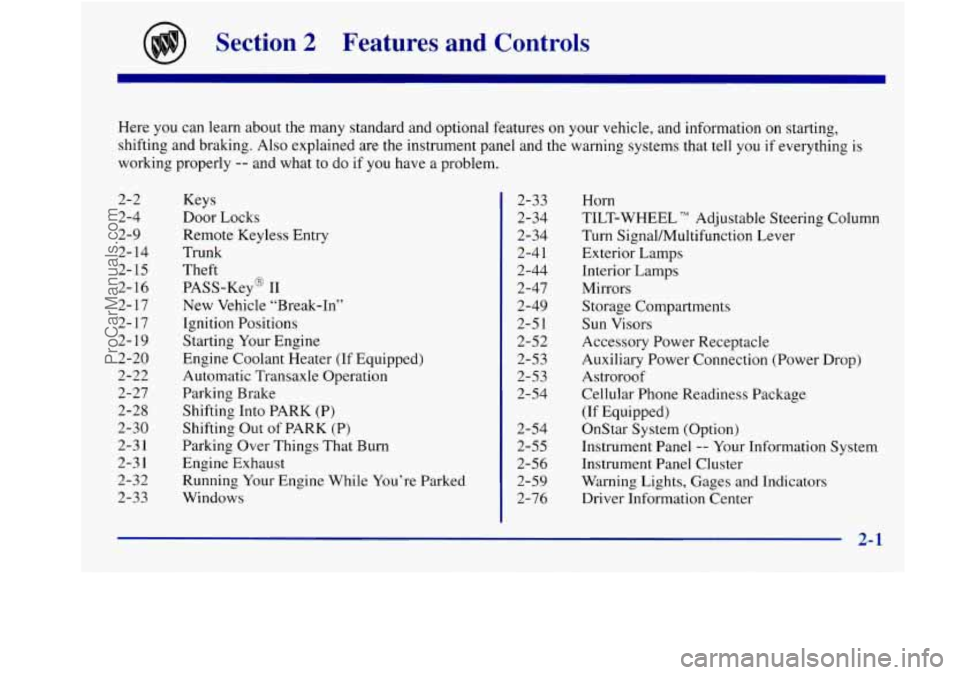
Section 2 Features and Controls
Here you can learn about the many standard and optional features on your vehicle, and information on starting,
shifting and bralung. Also explained are the instrument panel and the warning systems that tell you
if everything is
working properly
-- and what to do if you have a problem.
2-2
2-4
2-9
2- 14
2- 15
2- 16
2- 17
2-1 7
2- 19
2-20
2-22
2-27
2-28
2-30
2-3 1
2-3 1
2-32
2-33 Keys
Door Locks
Remote Keyless Entry
Trunk
Theft
PASS-Key@ I1
New Vehicle “Break-In”
Ignition Positions Starting Your Engine
Engine Coolant Heater (If Equipped)
Automatic Transaxle Operation
Parking Brake
Shifting Into PARK (P)
Shifting
Out of PARK (P)
Parking Over Things That Burn
Engine Exhaust Running Your Engine While You’re Parked
Windows 2-33
2-34
2-34
2-4 1
2-44
2-47
2-49
2-5 1
2-52
2-53
2-53
2-54
2-54
2-55
2-56
2-59
2-76 Horn
TILT-WHEEL
TM Adjustable Steering Column
Turn Signal/Multifunction Lever
Exterior Lamps
Interior Lamps
Mirrors
Storage Compartments
Sun Visors
Accessory Power Receptacle
Auxiliary Power Connection (Power Drop)
Astroroof
Cellular Phone Readiness Package
(If Equipped)
OnStar System (Option)
Instrument Panel
-- Your Information System
Instrument Panel Cluster
Warning Lights, Gages and Indicators
Driver Information Center
2-1
ProCarManuals.com
Page 76 of 388

Keys
fi CAUTION:
Leaving young children in a vehicle with the
ignition key is dangerous for many reasons.
A child or others could be badly injured or
even killed.
They could operate power windows or other
controls or even make the vehicle move. Don't
leave the keys in
a vehicle with young children.
2-2
ProCarManuals.com
Page 77 of 388

The ignition key is for the
The door key
is for the
doors and all other locks. The
ignition and door keys don’t have plugs.
Your
dealer or Buick Premium Roadside Assistance has the
code for your keys.
If you need a new ignition or door key, contact your
dealer who can obtain the correct key code,
or, in an
emergency, call Buick Premium Roadside Assistance
at
1-800-252- 1 1 12. In Canada, call 1-800-268-6800.
NOTICE:
Your vehicle has a number of features that can
help prevent theft. But you can have a lot
of
trouble getting into your vehicle if you ever lock
your keys inside. You may even have to damage
your vehicle
to get in. So be sure you have
extra keys.
2-3
ProCarManuals.com
Page 79 of 388

Power Door Locks
/-
E
Press the power door lock
switch to lock or unlock
all doors.
The rear doors do not have power door lock switches.
The lever on each rear door works only that door’s lock.
It won’t lock or unlock all the doors.
Lockout Protection Feature
This feature prevents a driver who has left the key in the
vehicle’s ignition from locking the doors by using the
power door locks while any
door is open. The feature
works by disabling the power
door locks when a key is
in the ignition and any door is open.
You may override the Lockout Protection Feature by
holding the power door lock switch
in the lock position
for more than three seconds while the key is
in the
ignition and any door
is open.
Remember, this feature can’t guarantee that you’ll never
be locked
out of your vehicle. If you use the manual
door lock or
if you don’t leave the key in the ignition,
you could still lock your keys inside your vehicle.
Always remember to take your keys with you.
2-5
ProCarManuals.com
Page 81 of 388

Programmable Automatic Power
Door Locks
Programmable Automatic Power Door Locks is a
standard feature that
is intended to provide enhanced
security and convenience by automatically locking and
unlocking doors. This feature provides four operating
modes. For your vehicle, you may select and program
one of the following four operating modes:
Mode 1: No automatic door lock or unlock.
Mode 2: Automatic all-door lock when the transaxle is
shifted out of PARK (P); no automatic door unlock.
Automatic door relock when any door is unlocked,
opened and then all doors are again closed while
the
vehicle is not in PARK (P) or NEUTRAL (N) and the
driver’s foot is on the brake pedal.
Mode 3: Automatic all-door lock when the transaxle is
shifted out
of PARK (P).
Automatic all-door unlock when the transaxle is shifted
into PARK (P).
Automatic door relock when any door is unlocked,
opened and then all doors are again closed while the
vehicle is not in PARK (P) or NEUTRAL
(N) and the
driver’s foot is
on the brake pedal.
Mode 4: Automatic all-door lock when the transaxle is
shifted out
of PARK (P).
Automatic driver’s door only unlock when the transaxle
is shifted into PARK
(P).
Automatic door relock when any door is unlocked,
opened and then all doors are again closed while the
vehicle is not in PARK (P) or NEUTRAL
(N) and the
driver’s foot is on the brake pedal.
The operating mode of the Programmable Automatic
Power Door Locks will be changed when the driver
performs the following sequence with the engine not
running, the doors closed and the ignition key in RUN:
1. Apply your regular brakes.
2. Press and hold the power door lock switch. While
holding the door lock switch, cycle the transaxle out
of and back into PARK (P).
After an initial transaxle cycle, each additional cycle
will advance the operating mode by one, starting from
the current operating mode. During this procedure, the
automatic door lock and unlock functions will operate
as defined
by each mode above, providing the driver
with feedback of the current operating mode. If cycled
beyond Mode
4, the vehicle will enter operating
Mode
1. When the door lock switch is released, the
vehicle will remain in the most recent operating mode.
2-7
ProCarManuals.com
Page 82 of 388

Disconnecting the vehicle’s battery for up to a year will
not change the programmed mode
of the Programmable
Automatic Power Door Locks.
Delayed Locking
Delayed Locking allows the doors to be locked while
passengers are exiting the vehicle. This feature also
provides
a brief time period after all the doors are
closed, but before the doors are locked, in which the
doors may be reopened. Delayed Locking
is user
programmable for the enabling or disabling of
the feature.
Delayed Locking is activated when a door lock switch is
pressed while the key is not
in the vehicle’s ignition, and
a
door is open, The door lock switch may be either the
lock switch on the door or the lock button on the remote
keyless entry transmitter (see “Remote Keyless Entry”
later in this section for more details). The doors do not
lock when the lock switch is pressed, but instead, three
chimes are heard. These chimes indicate that the
Delayed Locking function has been activated. You
have three actions possible once Delayed Locking
is activated:
1. Cancel the Delayed Locking by pressing the unlock
switch or by fully inserting the key in the ignition.
2. Override the Delayed Locking feature and lock the
doors immediately by pressing the lock switch a
second time.
3. Let the Delayed Locking feature complete the
locking of the vehicle.
If you wish to let the Delayed Locking feature complete
the locking
of the vehicle, no additional action is
required. The Delayed Locking feature will lock the
doors automatically after all the doors have been closed
for a period
of five seconds. During this five second
period, any door may be reopened, at which time the
three possible actions shown above are again available.
2-8
ProCarManuals.com
Page 83 of 388

You may also customize your vehicle to activate the
Delayed Locking feature as described above, or you
may choose to completely disable the feature at all
times.
If disabled, the power door locks will activate
immediately when a power door lock switch is pressed.
The enabled/disabled state of the Delayed Locking
feature will be toggled when you perform the following
sequence with the doors closed and the ignition key
in RUN:
1. Apply your regular brakes.
2. Press and hold the power door unlock switch. While
holding the door unlock switch, cycle the transaxle
out of and back into PARK (P).
After an initial transaxle cycle, each additional cycle
will toggle the enable/disable state of the Delayed
Locking feature. During this procedure, the chime will
sound, providing you with feedback. A single chime
will be heard if the Delayed Locking feature is disabled
and two chimes will be heard if the feature is enabled.
When the door unlock switch is released, the vehicle
will remain in the most recent operating mode.
Leaving Your Vehicle
If you are leaving the vehicle, take your keys, open your
door and set the locks from inside. Then get out and
close the door. (Also see “Delayed Locking” in this
section for more information.)
Remote Keyless Entry
You can lock and unlock your doors or unlock your
trunk from about
3 feet (1 m) up to 30 feet (9 m) away
using the remote keyless entry transmitter supplied with
your vehicle.
Your remote keyless entry system operates on a radio
frequency subject to Federal Communications
Commission (FCC) Rules and with Industry Canada.
This device complies with Part 15 of
the FCC Rules.
Operation is subject to the following two conditions:
(1) this device may not cause harmful interference,
and
(2) this device must accept any interference
received, including interference that may cause
undesired operation.
Disconnecting the vehicle battery for up to a year will
not change the programmed mode of the Delayed
Locking feature.
2-9
ProCarManuals.com