1998 BUICK PARK AVENUE service
[x] Cancel search: servicePage 322 of 426
The check tire pressure system detects differences in tire
rotation speeds that are caused
by changes in tire
pressure. The system can alert
you about a OW tire --
but it doesn’t replace normal tire maintenance. See
“Tires”
in the Index.
When the TIRE PRESSURE LOW: CWECK TIRES
message appears on the Driver Information Center,
you should stop as soon as YOU can and check all your
tires
for damage. (If a tire is flat, see ‘‘If a Tire Goes
Flat” in the Index.) Also check the tire pressure in all
four tires as SOOIZ 2s you can. See “Inflati~n-Tire
Pressure”
in the Index.
Any time
you adjust tire’s pressure or have one or
more tires repaired or replaced, you’ll need to reset
(calibrate) tE-ae check
tire pressure system. YOU’BI a~so
Reed to reset the system whenever you rotate the tires,
buy new
rim, install or remove the compact spare, and
whenever the vehicle‘s battery has been disconnected.
Don’t reset the check tire pressure system without first
correcting the
cause of the problem and checking and
adjusting the pressure in all four tires. If you reset the
system when the tire pressures are incorrect, the check
tire presswe system will
not work properly and may ~QB
alert you when a tire is Bow or high.
To reset (calibrate) the system:
3. Press and hold the CIC RESET button for abut
five seconds. After five seconds, the display will
show TIRE PRESSUFE RESET. Hf TIE
PRESSURE RESET does not appear on the display
after about five seconds, see your dealer for service.
After
you release the DIC RESET button, TIRE
PRESSURE NORMAL will appear on the display.
The system completes the calibration process
during
driving. During the first 10 to 25 miles ( I5 to 40 kw) of
drivhg, the system will not alert you if a tire is high or
SOW. After 25 to EOO miles (40 to 160 h>, the system
will oniy alert YOU about pressure differences of 12 psi
(85 Wa) or more. After about 100 miles (160 h) of
driving, the system will alert you if one tire is IO psi
(69 kPaj different from the other thee tires.
ProCarManuals.com
Page 326 of 426
''I+he brcadwear grade is a comparative rating based Q~Z
t tze wcx rate of the tire when tested under controlled
conditions
on a specified government test course.
For example, a tire graded 150 would wear one md a
Mf (I U2) times as well on the government course
:H tire graded 100. The relative performance of tires
depends
upon the actual conditions of their use,
however, and may depart significantly from the norm
tErrc to variations in driving habits, service practices
and differences in road characteristics and climate.
'The traction grades, from highest
to !owest, are A, 3,
and C, and they represent the tire's ability to stop ora
wet pavement as measured mder controlled conditions
on specified government test surfaces of asphalt
2nd concrete. A tire marked &: may have poor
traction performance.
Warning: The traction grade assigned
to this tire is based
on
braking (straight alead) traction tests and does not
ifgcllude cornering (turning) traction. heat
and its ability to dissipate heat when tested under
controlled csndidsns on a specified indoor laboratory
test wheel. Sustained
high temperature can cause the
material of the tire to degenerate and reduce tire life, and
excessive ternperaFure can lead to sudden fire faifwe.
The grade C corresponds to a level of pedomance
which ail passenger cx tires must meet e~nder the
Federal
Motor Vehicle Safety Stmda-d No. i09. Grades
B asci A represent higher levels of perhmance an the
laboratory test wheel than the minimum required by law.
The wheels OR your vehicle were aligned and balanced
careEulIy at the factory to give you the longest tire life
acd best overall performance.
Scheduled wheel alignment
and wheel balancing are not
needed. However, if you notice unusual tire wear or
your vehicle pulling GR~ way OF the other, the akignment
may need
to be reset. If YOU notice your vehicle
vibrating
when driving on a smooth road, your wheels
may need
to be rebalaaaced.
ProCarManuals.com
Page 335 of 426
If your vehicle is damaged and requires sheet metal
repair
or replacement, make sure the body repair shop
applies anti-corrosion material
to the parts repaired or
replaced to restore corrosion protection.
Any stone
chips, fractures or deep scratches in the finish
should be repaired right away. Bare metal will corrode
quickly and may develop into
a major repair expense.
Minor
chips and scratches can be repaired with IOUCR-UP
materials available from your dealer or other service
outlets. Larger areas
of finish damage can be corrected
in
your dealer's body and paint shop.
Chemicals used €or ice and snow removal and dust
control can collect on the underbody.
If these are not
removed, accelerated corrosion
(rustj can occur on
the underbody
parts such as fuel lines, frame, floor
pan and exhaust system even though they have
corrosion protection. At least
every
spring, Rush these materials from the
underbody with plain water. Clean any areas where
mud and other debris can collect. Dirt packed in ciosed
areas of the frame should be loosened before being
flushed. Your dealer
or an underbody car washing
system can do this for you.
Some weather and atmospheric conditions can create
a chemical fallout. Airborne pollutants can fail upon
and attxk painted surfaces on your vehicle. This
damage can take two forms: blotchy, ringlet-shaped
discolorations,
and small irregular dark spots etched
into the paint surface.
Although
no defect in the paint job causes this, Buick
will repair,
at no charge to the owner, the surfaces of
new vehicles damaged by this fallout condition within
I2 months or 12,000 miles (20 000 km) of ourchase,
whichever
CCCU~S first.
ProCarManuals.com
Page 337 of 426
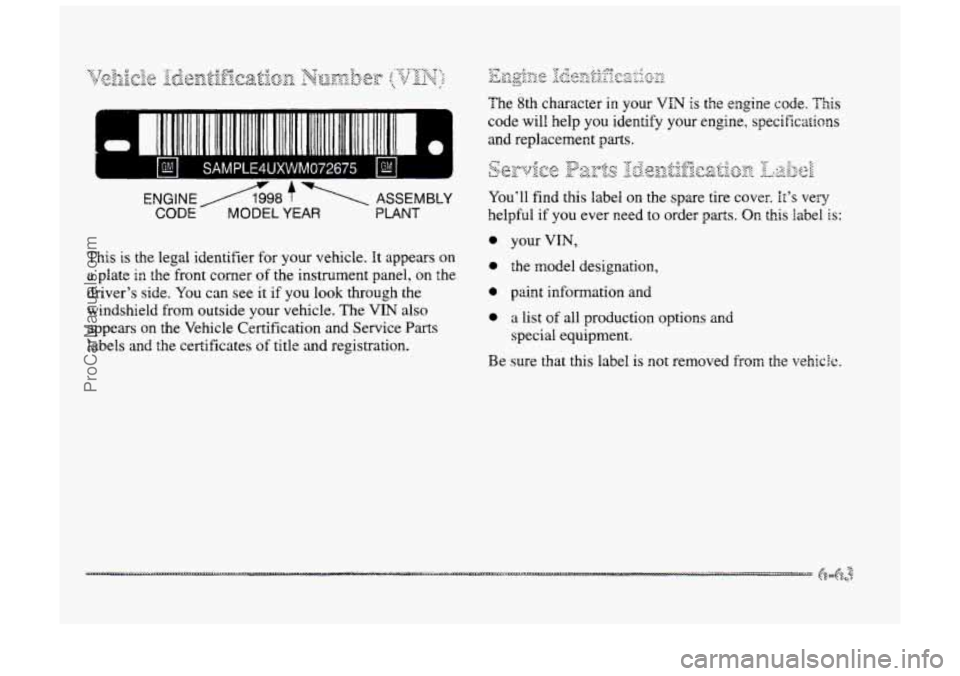
I U 1 SAMPLE4UXWM072675 I E! I I
ENGINE A98 f 1 ASSEMBLY
CbDE A MODEL YEAR PLANT
This is the legal identifier for your vehicle. It appears on
a plate in the front comer of the instrument panel, on the
driver's side. You can
see it if you look through the
windshield from outside your vehicle. The VIN
also
appears on the Vehicle Certification and Service Parts
labels and the certificates of title and registration.
Be sure that this label is
not removed from the vek-rlc?~.
ProCarManuals.com
Page 345 of 426
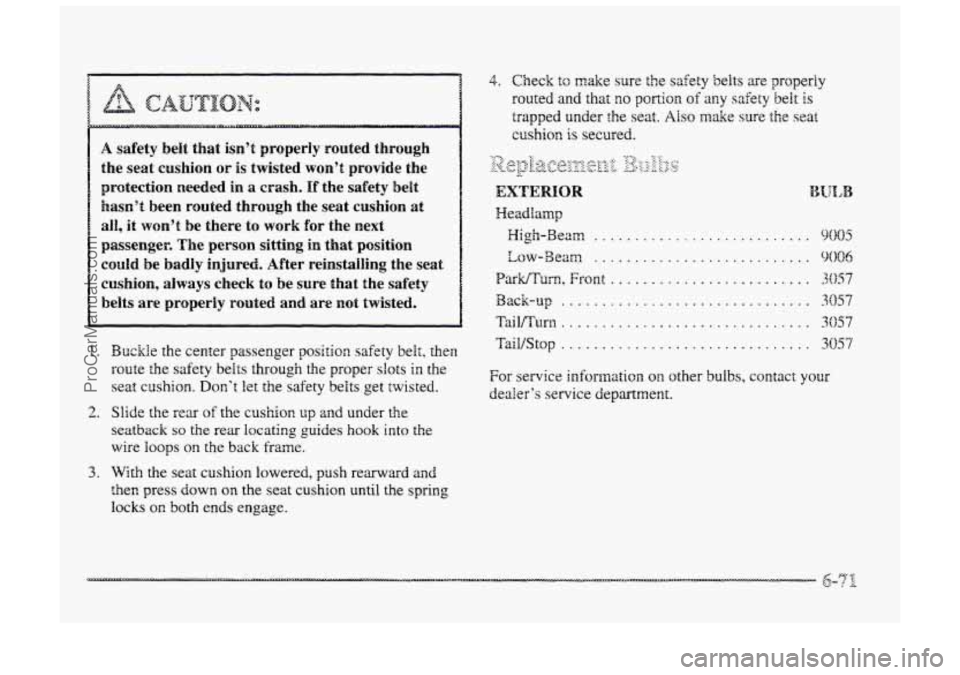
4. Check to make sure the safety belts are properly
routed
and that no p~rtion of any safety belt is
trapped under the seat. Also make sure the seat
cushion is secured.
A safety belt that isn’t properly routed through
the
seat cushion or is twisted won’t provide the
protection needed
in a crash. If the sa€ety beit
hasn’t been routed through the seat cushion at
all, it won’t be there to work for the next
passenger. The person sitting
in that position
couId be badly injured. After reinstalling the seat
cushion, always check to be sure that the safety
belts are properly routed and
are not twisted.
I.
2.
3.
Buckle the center passenger position safety beE:, then
route the safety belts though
the proper slots in the
seat csshion. Don’t let the safety belts get twisted.
Slide the rear
of the cushion up and under the
seatback so the rear locating guides hook into the
wire loops
on the back frame.
With the seat cushion lowered, push rearward
and
then press down on the seat cushion until the spring
locks on both ends engage.
EXTERIOR BBJIAB
Headlamp
High-Beam ........................... 9005
Zow-Beam ........................... 9006
ParWTum, Front ......................... 3057
Back-up ............................... 3057
Tai1Rtu-n ............................... 3057
TaiVStQp ............................... 3857
For service information on other bulbs, contact your
dealer’s service department.
ProCarManuals.com
Page 351 of 426
7- 2
7-3
7-4
7-4 7-4
7-3 1
7-3 1
Introduction
How
This Section is Organized
Bart A: Scheduled Maintenance Services
Using Your Maintenance Schedule
Selecting the Right Schedule
Part B: Owner Checks and Services
At Each Fuei Fill
At Least oncc a h4onth
At Least Twice a Year
At Least Once a Year
Part C: Periodic Maintenance hspections
Part D: Recommended Fluids and Lubricants
Part E: Maintenance Record
ProCarManuals.com
Page 353 of 426
._y 0 C. 12‘3\+7 p &-2cbisn Tq LL
The remainder of this section is divided into five pms:
”Part A: Scheduled Maintenance Services” shows
what to have done and how oftec. Some of these
services
can be complex, so unless you are technically
qualified and have the necessary equipnent, you should
let your dealer’s service department
or another qualified
service center
do these jobs.
Performing maintenance work on a vehicle can
be dangerous.
In trying to do some Jobs, you can
be seriously injured.
Do your own maintenance
work O~Y if you have the required know-how
and the proper tools and equipment for the job.
If you have any doubt, have a qualified
technician
do the work.
If you are skilled enough to do some work on your
vehicle, you will probably want
to get the service
information. See “Service and Owner Publications”
in the Index.
“Part 8: Owner Cheeks and Services” tells you
what should be checked and when.
It also explains
what YOU can easily do to help keep your vehicle in
good condition.
“Part C: Periodic Maintenance Inspections”
explains important inspections that your deater’s
service department or another quaiifled service center
should perfom.
“Part D: Recommended Fluids and Llph~ricipn~’’
lists some recommended products to hcBp keep your
vehicle properly
maintained. T’kzesc 19n~lucts, or their
equivalents, should
be used wlacikct. you do the work
yourself or have
it done.
“Past E: Maintenance Record’’ provides a,place for
you to record the ~naintcrrance performed on your
vehicle. Whenever any n:aintcnancc is performed, be
sure to write it down in Ffris part. ’his will help you
determine when your next nraintenance should be done.
In addition,
it is ;L good idca to keep your maintenance
receipts.
They may be rleedcd to qualify your vehicle
for warranty repairs.
ProCarManuals.com
Page 354 of 426
We at General Motors want to kelp you keep your
vehicle
ia good working condition. But we don’t
know exactly
how you’ll drive it. You may drive very
short distances only
a few times a week. Or you may
drive long distances
aEB the time in very hot, dusty
weather.
You may use your vehicle in making deliveries.
Or
YOU may drive it to work, to do errands or in
many other ways.
Because of all thc different ways people use their
vehicles, maintenance
rreeds vary. You may even
need
more frequent checks and repiacements than
you’ll
find in the schedules in this section. So please
read this section
and note how you drive. If you have
any questions on how to keep your vehicle in
good
condition, see your Buick dealer.
This part tells
you the maintenance services you should
have done and when you should schedule them. If you
go to your dealer for your service needs, you’ll know
that GM-trained and supported service people will
perform the work
using genuine GM parts. The
proper fluids and
lubricants to use are listed in
Part D. Make sure whoever services your vehicle
uses these. All
parts should be replaced and a1
necessary repairs done before you
or anyone else
drives the vehicle.
These schedules
are for vehicles that:
cany passengers and cargo within recommended
limits.
You will find these limits on your vehicle’s
Tire-Loading Information label. See “Loading Your
Vehicle”
in the Index.
are driven on reasonable road surfaces within legal
use the recommended fuei. See “Fuel” in the Index.
driving
limits.
First you’ll need to decide which
of the two schedules is
right for your vehicle. Here’s how to decide which
schedule
to follow:
ProCarManuals.com