1998 BMW 740I engine
[x] Cancel search: enginePage 180 of 211
179n
RepairsIndexOverview Controls Car care Technology Data
Jump-startingNever use spray starter fluids to start
the engine.
If the battery is discharged, you can use
two jumper cables to start your car with
power from the battery of a second ve-
hicle. Always use jumper cables with
fully insulated handles on the terminal
clamps.
Do not touch high-voltage wiring
and cables on a running engine.
There is a risk of fatal injury if you do
this.<
Carefully comply with the following in-
structions to avoid personal injury and
damage to one or both vehicles:
1 Ensure that the battery on the sup-
port vehicle is also rated at 12 volts,
and that the capacities of the two
batteries (Ah) are roughly comparable
(printed on casing)
2 Leave your battery connected to the
car electrical system
3 Make sure that there is no contact
between the bodywork of the two ve-
hicles – short circuit risk.
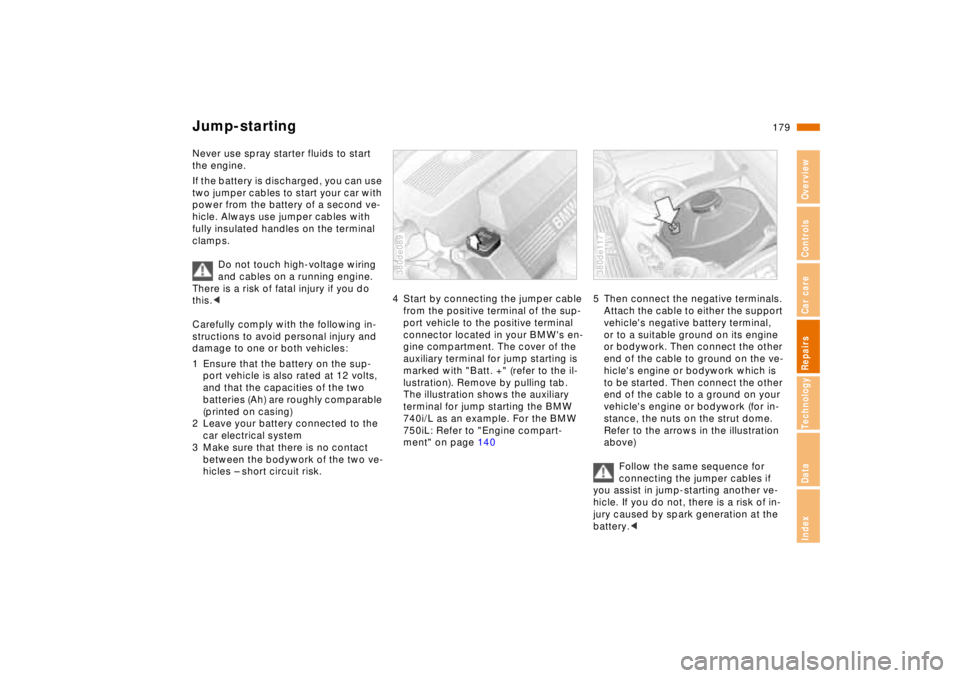
4 Start by connecting the jumper cable
from the positive terminal of the sup-
port vehicle to the positive terminal
connector located in your BMW's en-
gine compartment. The cover of the
auxiliary terminal for jump starting is
marked with "Batt. +" (refer to the il-
lustration). Remove by pulling tab.
The illustration shows the auxiliary
terminal for jump starting the BMW
740i/L as an example. For the BMW
750iL: Refer to "Engine compart-
ment" on page 140380de089
5 Then connect the negative terminals.
Attach the cable to either the support
vehicle's negative battery terminal,
or to a suitable ground on its engine
or bodywork. Then connect the other
end of the cable to ground on the ve-
hicle's engine or bodywork which is
to be started. Then connect the other
end of the cable to a ground on your
vehicle's engine or bodywork (for in-
stance, the nuts on the strut dome.
Refer to the arrows in the illustration
above)
Follow the same sequence for
connecting the jumper cables if
you assist in jump-starting another ve-
hicle. If you do not, there is a risk of in-
jury caused by spark generation at the
battery.< 380de117
Page 181 of 211
180n
Jump-starting Towing the vehicle6 If the battery of the support vehicle is
weak, start its engine and let it run
7 Start the engine on the vehicle need-
ing the jump-start, and allow it to run
as usual. If the first start attempt is
not successful, wait a few minutes
before another attempt in order to
allow the discharged battery to re-
charge
8 Before disconnecting the jumper ca-
bles from your BMW, turn on the rear
window defroster and set the blower
to the highest speed; allow the en-
gine to run approx. 10 seconds. This
will prevent a voltage surge from the
voltage regulator to the electrical ac-
cessories
9 Then disconnect the jumper cables in
reverse sequence.
Have the battery recharged if neces-
sary.
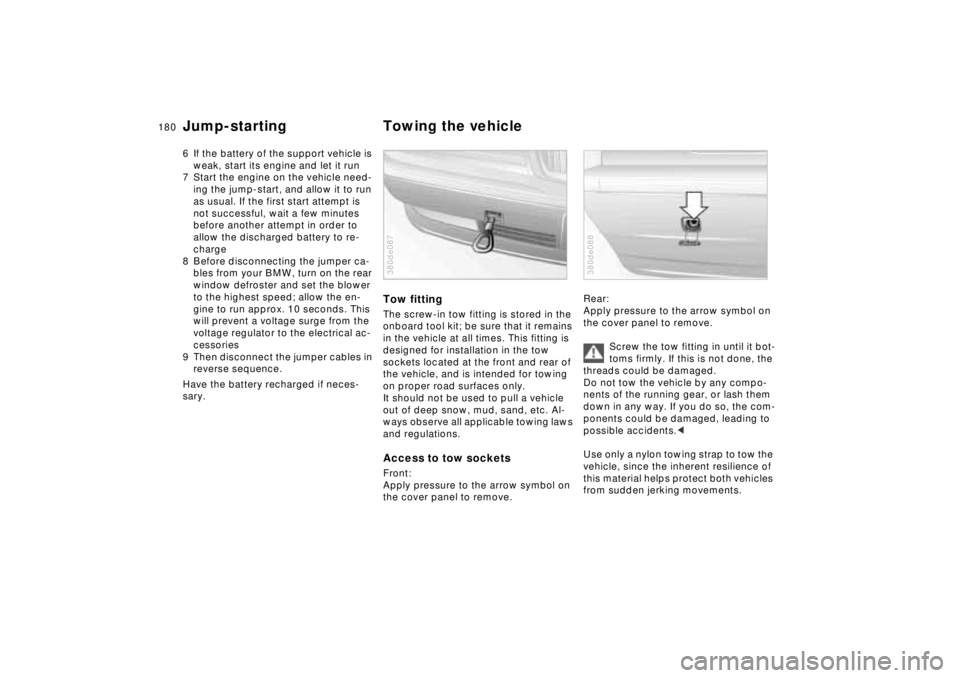
Tow fittingThe screw-in tow fitting is stored in the
onboard tool kit; be sure that it remains
in the vehicle at all times. This fitting is
designed for installation in the tow
sockets located at the front and rear of
the vehicle, and is intended for towing
on proper road surfaces only.
It should not be used to pull a vehicle
out of deep snow, mud, sand, etc. Al-
ways observe all applicable towing laws
and regulations.Access to tow socketsFront:
Apply pressure to the arrow symbol on
the cover panel to remove.380de087
Rear:
Apply pressure to the arrow symbol on
the cover panel to remove.
Screw the tow fitting in until it bot-
toms firmly. If this is not done, the
threads could be damaged.
Do not tow the vehicle by any compo-
nents of the running gear, or lash them
down in any way. If you do so, the com-
ponents could be damaged, leading to
possible accidents.<
Use only a nylon towing strap to tow the
vehicle, since the inherent resilience of
this material helps protect both vehicles
from sudden jerking movements.380de088
Page 182 of 211
181n
RepairsIndexOverview Controls Car care Technology Data
Towing the vehicle
The towed vehicle should always
be the lighter of the two vehicles.
If this is not the case, it is no longer
possible to control vehicle response.<
Tow-startingIt is not possible to start the engine of
vehicles equipped with automatic trans-
mission by towing or pushing.
For instructions on jump starting, refer
to page 179.
Never attempt to use your vehicle to
push another car, as damage to the
energy-absorbing bumpers could
result.
Towing a vehicle with automatic
transmission1 Place selector lever in position N
2 Towing speed:
Max. 45 mph (70 km/h)
3 Towing distance:
Max. 95 miles (150 km)
4 Leave the ignition key at position 1 to
ensure that the brake lamps, turn sig-
nals, horn and windshield wipers re-
main operative, and to prevent the
steering lock detent from engaging
5 Switch on the hazard-warning system
(observe country-specific regula-
tions).
Find some means of identifying the ve-
hicle in tow, for instance, place a sign
or warning triangle in the rear window.
Make sure that the ignition key re-
mains in position 1 even when the
electrical system has failed to prevent
the steering lock from engaging.
The steering and brakes are without
power assist when the engine is off.
This means that increased effort is re-
quired for steering and braking.<
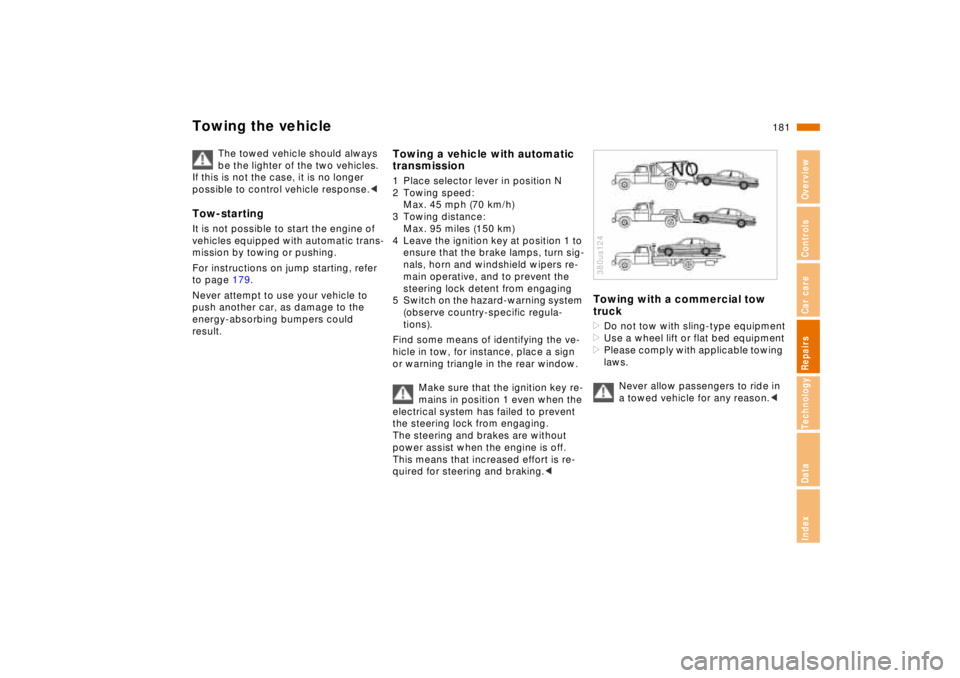
Towing with a commercial tow
truck>Do not tow with sling-type equipment
>Use a wheel lift or flat bed equipment
>Please comply with applicable towing
laws.
Never allow passengers to ride in
a towed vehicle for any reason.< 380us124
Page 186 of 211

185n
RepairsIndexOverview Controls Car care Technology Data
In order to take driving conditions into
account, ATC registers corners and
both uphill and downhill gradients. For
example, if you maintain speed through
a curve, the transmission does not up-
shift.
On uphill gradients, it shifts only when
the engine speed increases in order to
make more efficient use of power re-
serves. On downhill gradients ATC
downshifts when the speed of the vehi-
cles increases causing the driver to
step on the brakes.
With respect to road conditions, ATC
monitors the friction between the tires
and the road. The system responds to
slippery road surfaces (snow and ice)
by activating the winter program.
Second gear is used when moving
away from a standstill, upshifts occur
sooner, and on descents downshifting
does not occur in spite of the applica-
tion of brakes. This enables you to
"feel" the road as you drive and pro-
duces greater dynamic stability. If the
friction between the tires and the road
is adequate, the normal system is again
activated. The system also leaves the
winter program when you shift from
drive position "D" to "S," "3" or "2," or if
the ASC+T/DSC
* is deactivated.By recognizing traffic conditions, ATC
can retain maximum driving comfort.
For instance, the system recognizes
stop-and-go traffic and then proceeds
only in second gear until it encounters
higher starting loads.
Of course the selector lever can still be
used to select specific gear ratios. Per-
formance-oriented driving is enabled by
shifting from drive position "D" to "S,"
"3" or "2." Positions "3" and "2" each
limit upshifts to the next gear. Position
"2" is best for driving on steep mountain
slopes with a heavy load.Precision sensors monitor the number
of revolutions of the wheels. When
equipped with DSC, they also monitor
steering angle, lateral acceleration,
brake pressure and the movement of
the vehicle around its vertical axis.
If differences in the wheel speeds oc-
cur, the system counteracts the danger
of wheelspin by reducing torque. If nec-
essary, the system also responds with
additional applications of the brakes at
the rear wheels.
If the system detects an instability in the
vehicle's condition, the braking action
can also be directed to the front wheels
by the DSC in order to stabilize the ve-
hicle.
You may need some time to become
accustomed to this system intervention.
However, it helps provide optimum pro-
pulsive force and driving stability.
The braking intervention may be ac-
companied by a certain degree of
noise.
ATC ASC+T/DSC
*
Page 187 of 211
186n
Radio reception BMW Active Seat
*
AM provides substantially longer recep-
tion ranges than FM. AM broadcast sig-
nals, propagated at ground level in the
form of surface waves, are also re-
flected from the ionosphere as atmo-
spheric waves.
Frequency-modulation (FM) provides
substantially better sound quality than
AM. However, because FM transmis-
sions rely on line-of-sight broadcast
waves, their effective reception range is
limited.360de062
Although numerous factors combine to
impose inherent limitations on the re-
ception quality available from mobile ra-
dios, specially designed systems can
be employed to minimize their effects:
With radio stations which broadcast
over multiple frequencies, the "Radio
Data System" (RDS) ensures that the
frequency with the best reception qual-
ity will automatically be selected.
The Diversity Antenna system employs
several FM antennas integrated within
the rear window to provide three sepa-
rate sources for receiving broadcast
waves. An integral processor automati-
cally selects the antenna with the best
FM reception quality at any given time.
Because the ongoing antenna selection
process is completed within millisec-
onds, it remains inaudible to the radio
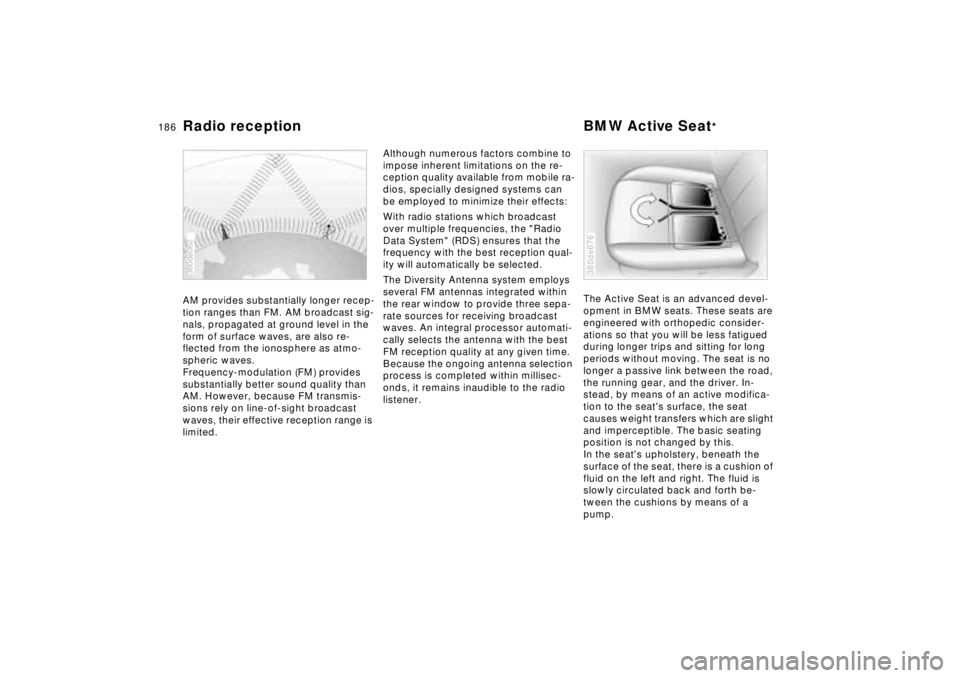
listener.The Active Seat is an advanced devel-
opment in BMW seats. These seats are
engineered with orthopedic consider-
ations so that you will be less fatigued
during longer trips and sitting for long
periods without moving. The seat is no
longer a passive link between the road,
the running gear, and the driver. In-
stead, by means of an active modifica-
tion to the seat's surface, the seat
causes weight transfers which are slight
and imperceptible. The basic seating
position is not changed by this.
In the seat's upholstery, beneath the
surface of the seat, there is a cushion of
fluid on the left and right. The fluid is
slowly circulated back and forth be-
tween the cushions by means of a
pump.
380de676
Page 194 of 211
Overview
Controls and features
Operation, care
and maintenance
Technical data
Index Advanced technology
193n
RepairsIndexOverview Controls Car care Technology Data
Owner service procedures
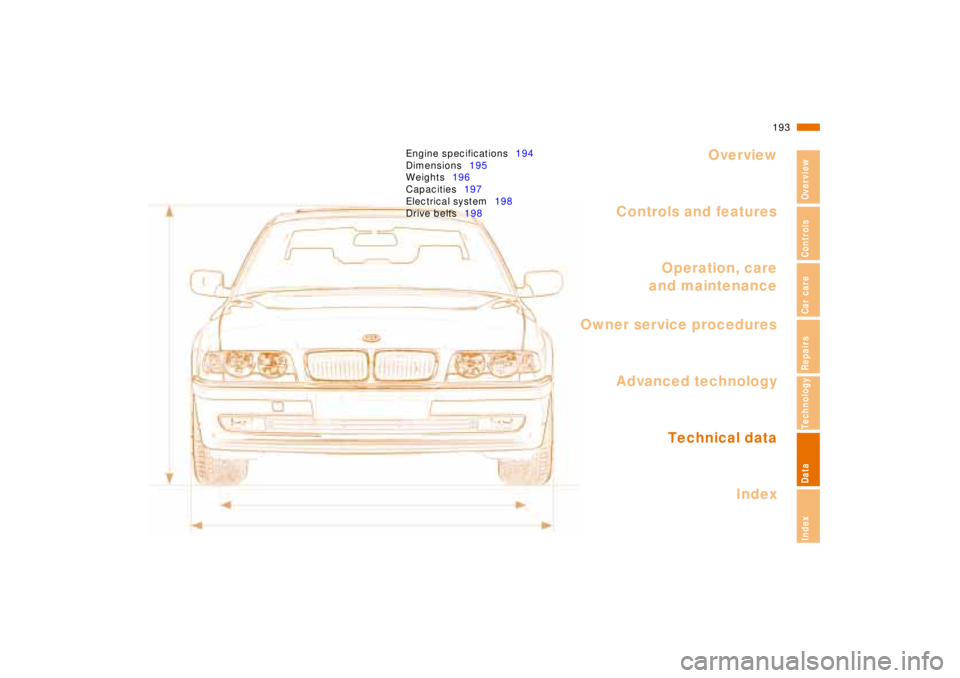
Engine specifications194
Dimensions195
Weights196
Capacities197
Electrical system198
Drive belts198
Page 195 of 211

194n
BMW 740i/L BMW 750iL
Displacement
Number of cylinderscu in (cm
3) 268.4 (4398)
8328.2 (5379)
12
Max. output
at engine speedhp
rpm282
5700326
5000
Maximum torque
at engine speedft
lb (Nm)
rpm310 (420)
3900361 (490)
3900
Compression ratioe10.0 10.0
Stroke/Bore in (mm) 3.26/3.62 (82.7/92.0) 3.11/3.35 (79/85)
Fuel-injection system Digital-electronic engine-management system
Engine specifications
Page 198 of 211
197n
RepairsIndexOverview Controls Car care Technology Data
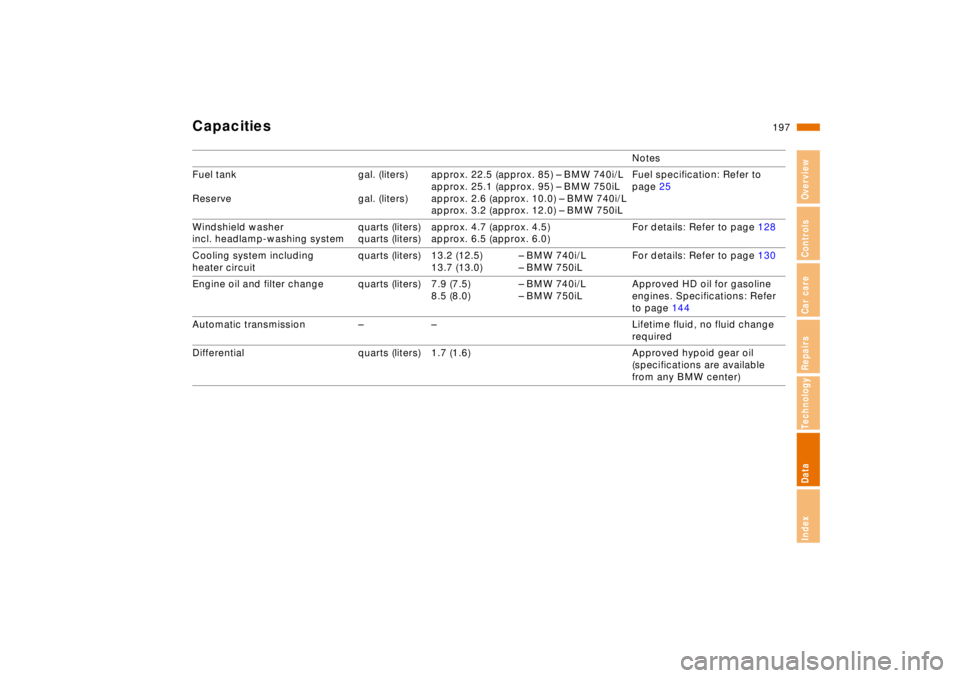
Capacities
Notes
Fuel tank
Reserve gal. (liters)
gal. (liters)approx. 22.5 (approx. 85) – BMW 740i/L
approx. 25.1 (approx. 95) – BMW 750iL
approx. 2.6 (approx. 10.0) – BMW 740i/L
approx. 3.2 (approx. 12.0) – BMW 750iLFuel specification: Refer to
page 25
Windshield washer
incl. headlamp-washing systemquarts (liters)
quarts (liters)approx. 4.7 (approx. 4.5)
approx. 6.5 (approx. 6.0)For details: Refer to page 128
Cooling system including
heater circuitquarts (liters) 13.2 (12.5) – BMW 740i/L
13.7 (13.0) – BMW 750iLFor details: Refer to page 130
Engine oil and filter change quarts (liters) 7.9 (7.5) – BMW 740i/L
8.5 (8.0) – BMW 750iLApproved HD oil for gasoline
engines. Specifications: Refer
to page 144
Automatic transmission – – Lifetime fluid, no fluid change
required
Differential quarts (liters) 1.7 (1.6) Approved hypoid gear oil
(specifications are available
from any BMW center)