Page 136 of 198
1361. Reduce
your speed gradually, keeping
a straight line. Move cautiously off the
road to a safe place well away from the
traf fic. Avoid stopping on the center di-
vider of a highway. Park on a level spotwith firm ground.
2. Stop the engine and turn on your emergency flashers.
3. Firmly set the parking brake and put the transmission in Pº (automatic) or reverse (manual).
4. Have everyone get out of the vehicle on the side away from traffic.
5. Read the following instructions thor- oughly.
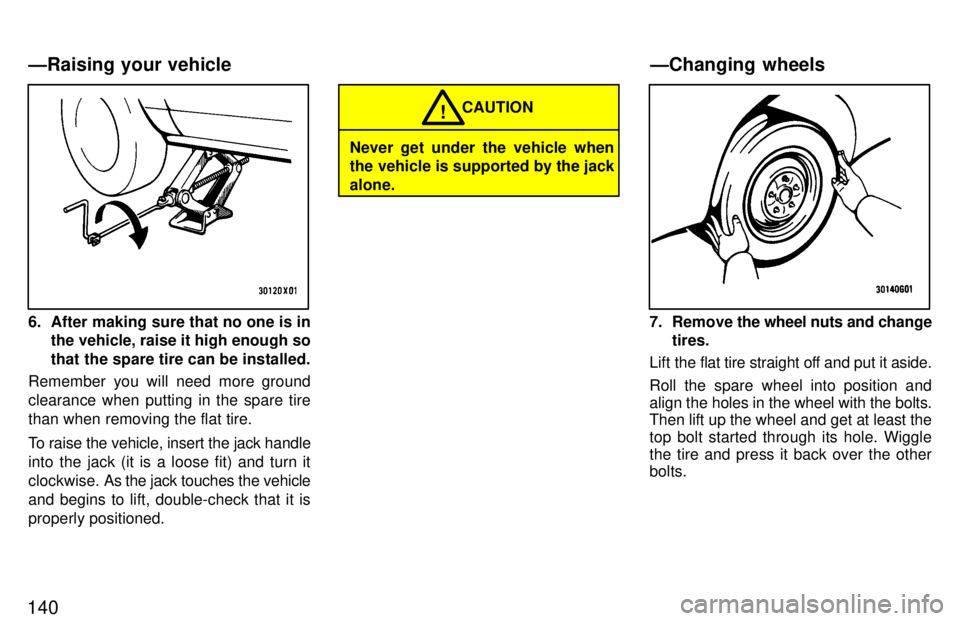
When jacking, be sure to observe
the following to reduce the possibil-
ity of personal injury: Follow jacking instructions.
Do not start or run the engine
while your vehicle is supported by
the jack. CAUTION
!
Stop the vehicle on a level firm
ground, firmly set the parking
brake and put the transmission in Pº (automatic) or reverse (manu-
al). Block the wheel diagonally op-
posite to the one being changed if
necessary.
Make sure to set the jack properly
in the jack point. Raising the ve-
hicle with jack improperly posi-
tioned will damage the vehicle or
may allow the vehicle to fall off thejack and cause injury to the per- son.
Never get under the vehicle when
the vehicle is supported by the jack alone.
Use the jack only for lifting your
vehicle during wheel changing.
Do not raise the vehicle with some-
one in the vehicle.
When raising the vehicle, do not
put an object on or under the jack.
Raise the vehicle only high
enough to remove and change the tire.NOTICE
Do not continue driving with a deflated tire. Driving even a short
distance can damage a tire beyondrepair.
If you have a flat tireÐ
Page 138 of 198
138
To remove the spare tire:
Turn the hold-down nuts counterclock-
wise with the wheel nut wrench and re-move them.
When storing the spare tire, put it in place
and secure it to prevent it from flying for-
ward during a collision or sudden braking.2. Block the wheel diagonally oppo-
site the flat tire to keep the vehicle from rolling when it is jacked up.
When blocking the wheel, place a wheel
block from the front for the front wheels or
from the rear for the rear wheels.Steel wheels
Aluminum wheels
ÐBlocking the wheel ÐRemoving wheel ornament
Page 139 of 198
139
3. Remove the wheel ornament.
Pry off the wheel ornament, using the bev-
eled end of the wheel nut wrench asshown.
Do not try to pull the ornament by
hand. Take due care in handling the
ornament to avoid unexpected
personal injury.
CAUTION
!
4. Loosen all the wheel nuts. Always l
oosen the wheel nuts before rais-
ing the vehicle.
The nuts turn counterclockwise to loosen.
To get maximum leverage, fit the wrench
to the nut so that the handle is on the right
side, as shown above. Grab the wrench
near the end of the handle and pull up on
the handle. Be careful that the wrench
does not slip off the nut.
Do not remove the nuts yetÐjust unscrew
them about one-half turn.5. Position the jack at the following
jack points
1 Front suspension arm rear mounting
2 Rear suspension arm
Make sure the jack is positioned on a l evel
and solid place.
ÐLoosening wheel nuts ÐPositioning the jack
Page 140 of 198
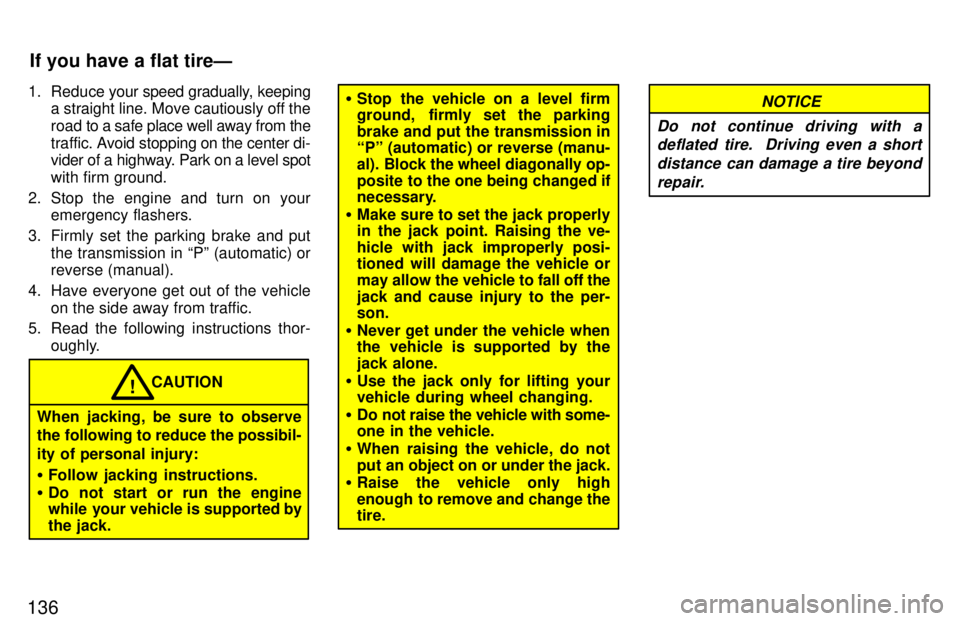
140
6. After making sure that no one is inthe vehicle, raise it high enough so
that the spare tire can be installed.
Remember you will need more ground
clearance when putting in the spare tirethan when removing the flat tire.
To raise the vehicle, insert the jack handle
into the jack (it is a loose fit) and turn it
clockwise. As the j ack touches the vehicle
and begins to lift, double-check that it is
properly positioned.
Never get under the vehicle when
the vehicle is supported by the jack alone. CAUTION
!
7. Remove the wheel nuts and change
tires.
Lift the flat tire straight off and put it aside.
Roll the spare wheel into position and
align the holes in the wheel with the bolts.
Then lift up the wheel and get at least thetop bolt started through its hole. Wigglethe tire and press it back over the other bolts. ÐChanging wheels
ÐRaising your vehicle
Page 141 of 198

141
Before putting on wheels, remove any
corrosion on the mounting surfaces with a
wire brush or such. Installation of wheels
without good metal-to-metal contact at
the mounting surface can cause wheel
nuts to loosen and eventually cause a
wheel to come off while driving. Therefore
after the first 1600 km (1000 miles), check
to see that the wheel nuts are tight.8. Reinstall all the wheel nuts finger
tight.
Reinstall the wheel nuts (tapered end in-
ward) and tighten them as much as youcan by hand. Press back on the tire back and see if you can tighten them more.9. Lower the vehicle completely and tighten the wheel nuts.
Turn the jack handle counterclockwise to lower the vehicle.
Use only the wheel nut wrench and turn it
clockwise to tighten the nuts. Do not use other tools or any additional leverage oth-
er than your hands, such as a hammer,
pipe or your foot. Make sure the wrench is
securely engaged over the nut.
Tighten each nut a little a time in the order
shown. Repeat the process until all the
nuts are tight.
ÐReinstalling wheel nuts ÐLowering your vehicle
Page 144 of 198
144TOWING PRECAUTIONS: Use a safety chain system for all towing,
and abide by the state/provincial and local
laws. The wheels and axle on the ground
must be in good condition. If they are
damaged, use a towing dolly.
Two-wheel drive modelsÐ
(a) Towing with wheel lift type truck
From front
ÐRelease the parking brake.
NOTICE
When lifting wheels, take care to ensure adequate ground clearance
for towing at the opposite end of theraised vehicle. Otherwise, the bumper and/or underbody of thetowed vehicle will be damaged during towing.
From rearÐ Manual transmission:
We recommend using a towing dolly
under the front wheels. If you do not
use a towing dolly, place the ignition key in the ACCº position and put thetransmission in neutral.
NOTICE
Do not tow with the key removed or in the LOCKº position when
towing from the rear without atowing dolly. The steering lock mechanism is not strong enough tohold the front wheels straight.
Automatic transmission: Use a towing dolly under the front wheels.
NOTICE
Never tow a vehicle with an automatic transmission from the
rear with the front wheels on theground, as this may cause serious damage to the transmission.
(b) Using a flat bed truck Four-wheel drive modelsÐ
(a) Towing with a wheel lift type truck
Using a towing dolly under the wheels not
lifted by the truck. (b) Using flat bed truck
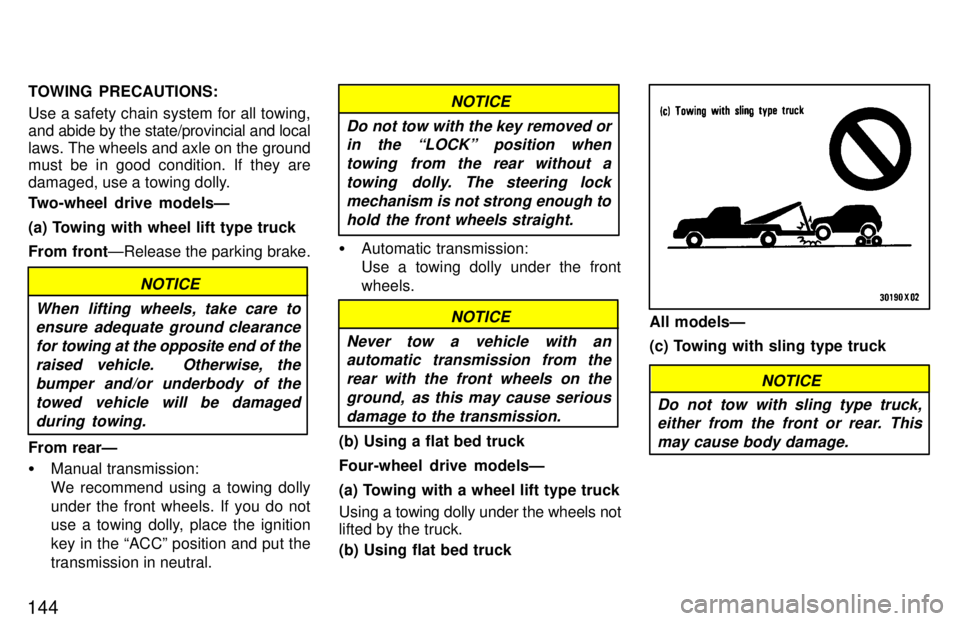
All modelsÐ
(c) Towing with sling type truck
Do not tow with sling type truck,
either from the front or rear. This
may cause body damage.
NOTICE
Page 147 of 198

147
If you cannot shift the selector lever
out of Pº position to other positions
even though the brake pedal is de-pressed, use the shift lock override
button as follows:
1. Turn the ignition key to LOCKºposition. Make sure the parking brake is set.
2. Pry up the cover with a flat-bladed screwdriver or equivalent.3. Insert the screwdriver or equivalent
into the hole to push down the shift
lock override button. You can shift
out of Pº position only while push-
ing the button.
4. Shift into Nº position.
5. Insert the cover.
6. Start the engine. For your safety, keep the brake pedal depressed.
Be sure to have the system checked by
your Toyota dealer as soon as possible. Many Toyota dealers can make a new
key if you can give them the key num-
ber. See the suggestion given in Keysº in Chapter 1-2.
If your keys are locked in the vehicle and
you cannot get a duplicate, many Toyota
dealers
can still open the door for you, us-
ing their special tools. If you must break a
window to get in, we suggest breaking the
smallest side window because it is the least expensive to replace. Be extremely cautious to avoid cuts from the glass.
If you cannot shift automatic transmission selector lever
If you lose your keys
Page 155 of 198

157
Tire surface and wheel nuts Check the tires carefully
for cuts, damage
or excessive wear. See Chapter 7-2 for
additional information. When checking the tires, make sure no nuts are missing,
and check the nuts for looseness. T ighten
them if necessary.
Tire rotation
Rotate the tires every 12000 km (7500
miles). See Chapter 7-2 for additional in-formation.
Fluid leaks Check underneath for leaking fuel, oil, wa-
ter or other fluid after the vehicle has been
parked for a while. If you smell fuel fumes
or notice any leak, have the cause found
and corrected immediately. Doors and engine hood Check that all doors and back door oper-
ate smoothly and all latches lock securely. Make sure the engine hood secondary latch secures the hood from opening
when the primary latch is released. INSIDE THE VEHICLE Items listed below should be checked
regularly, e.g. while performing peri-
odic services, cleaning the vehicle,etc. Lights Make sure the headlights, stop lights, tail lights, turn signal lights, and other lights are all working. Check headlight aim. Service reminder indicators and
warn-
ing buzzers Check that all service reminder indicators
and warning buzzers function properly. Steering wheel
Check that it has the specified freeplay.
Be alert for changes in steering condition,such as hard steering or strange noise. Seats Check that all seat controls such as seat
adjusters, seatback recliner, etc. operate
smoothly and that all latches lock securely
in any position. For folding-up rear
seat-backs, check that the latches lock
securely. Seat belts
Check that the seat belt system such as
buckles, retractors and anchors operate
properly
and smoothly. Make sure the belt
webbing is not cut, frayed, worn or dam-aged. Accelerator pedal Check the pedal for smooth operation and
uneven pedal effort or catching. Clutch pedal Check the pedal for smooth operation. Brake pedal Check the pedal for smooth operation and
that the pedal has the proper clearance. Check the brake booster function. Brakes
At a safe place, check that the brakes do not pull to one side when applied. Parking brake Check that the lever has the proper travel and that, on a safe incline, your vehicle is
held securely with only the parking brake applied.