1997 TOYOTA RAV4 lock
[x] Cancel search: lockPage 62 of 198
59
On the luggage compartment floor
a. Using the illustration as a guide, run your fingers across the luggage compart-
ment floor itself to locate the position of the bolts underneath. b. Remove the bolt.
c. Insert a 10 mm (0.4 in.) spacer and tighten down the anchor bracket for your
child restraint system with a bolt. Torque
the bolt to 16.5-24.7 N
Vm (1.68-2.52 kgr-
V m, 12.2-18.2 ft Vlbf).
To comply with Canada Motor Vehicle
Safety Standards, vehicles sold in Cana-
da are provided with a bracket set in the
glovebox, designed for use with any of the
2 anchor locations shown in the illustra- tion.
If your child restraint system does not pro-
vide any of the necessary parts, ask your
Toyota dealer. (See -Child restraint sys- temº.)
If you remove the anchor brackets when
the child restraint system is necessary no
longer, replace the bolts in the holes to
prevent entry of exhaust emissions, water
or dirt.
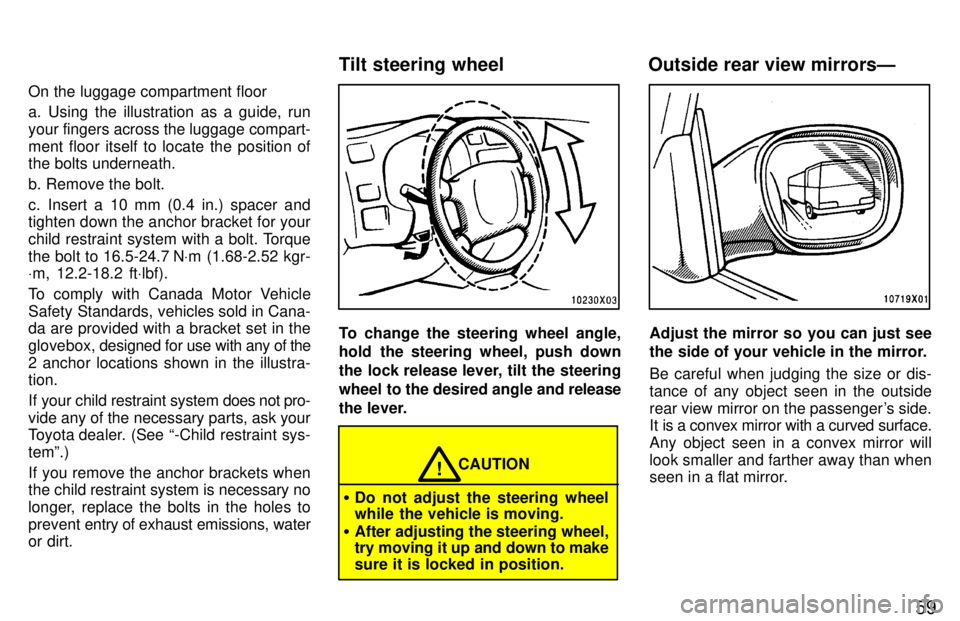
To change the steering wheel angle,
hold the steering wheel, push down
the lock release lever, tilt the steering
wheel to the desired angle and release
the lever.
CAUTION!
Do not adjust the steering wheel
while the vehicle is moving.
After adjusting the steering wheel,try moving it up and down to make sure it is locked in position.
Adjust the mirror so you can just see
the side of your vehicle in the mirror. Be careful when judging the size or dis- tance of any object seen in the outside
rear view mirror on the passenger's side.
It is a convex mirror with a curved surface.
Any object seen in a convex mirror will
look smaller and farther away than when
seen in a flat mirror.
Tilt steering wheel Outside rear view mirrorsÐ
Page 69 of 198

67
For instructions on adding washer fluid, see Adding washer fluidº in Chapter 7-3.
In freezing weather, warm the windshield with the defroster before using the wash-
er. This will help prevent the washer fluid
from freezing on your windshield, which can block your vision.
NOTICE
Do not operate the wipers if the windshield is dry. It may scratch the
glass.
To turn on the rear window wiper, twist
the lever knob upward. The key must be in the ONº position.
Lever position
Speed setting
Position 1Intermittent
Position 2Normal
To squirt washer fluid on the rear window, twist the knob upward or downward as far
as it will go (position 3 or 4). The knob au-
tomatically returns from these potions af-
ter you release it.
For instructions on adding washer fluid, see Adding washer fluidº in Chapter 7-3.
NOTICE
Do not operate the wipers if the windshield is dry. It may sc ratch the
glass.
Rear window wiper and washer
Page 75 of 198

73
NOTICE
Do not continue driving if the engine drive belt is broken or loose.
(d) Low Oil Pressure Warning Light
This light warns that the engine oil pres-
sure is too low.
If it flickers or stays on while you are driv-
ing, pull off the road to a safe place and
stop the engine immediately. Call a Toyo-
ta dealer or qualified repair shop for assis-tance.
The light may occasionally flicker when
the engine is idling or it may come on brief-
ly after a hard stop. There is no cause for concern if it then goes out when the en-
gine is accelerated slightly.
The light may come on when the oil level
is extremely low. It is not designed to indi- cate low oil level, and the oil level must bechecked using the level dipstick.
Do not drive the vehicle with the
warning light onÐeven for one
block. It may ruin the engine. CAUTION
! (e) Malfunction Indicator Lamp
This lamp comes on in the following cases.
a. The fuel tank is completely empty. (See Fuel gaugeº in Chapter 1-5 for in- structions.)
b. The fuel tank cap is not tightened se-
curely. (See Fuel tank capº in Chapter
1-2 for instructions.)
c. There is a problem somewhere in your
engine or automatic transmission electri- cal system.
If it comes on while you are driving in case
c, have your vehicle checked/repaired by
your Toyota dealer as soon as possible.
(f) Low Fuel Level Warning Light
This light comes on when the fuel level in
the tank becomes nearly empty. Fill up the tank as soon as possible.
On inclines or curves, due to the move-
ment of fuel in the tank, the low fuel level
warning light may come on earlier than usual.
(g) ABSº Warning Light
This light warns that there is a problem
somewhere in your anti-lock brake sys- tem. If the light comes on while you are driving,
have your vehicle checked by your T
oyota
dealer as soon as possible.
The light will come on when the ignition
key is turned to the ONº position. After
about 3 seconds, the light will go off. When the ABSº warning light is on (and
the brake system warning light is off), the brake system operates conventionally but
anti-lock brake system is not assisting brake performance so that the wheels can
lock-up during sudden braking or braking
on slippery road surfaces.
(h) Open Door Warning Light
This light remains on until all the doors
and back door are completely closed.
(i) Automatic Transmission Fluid Tem-
perature Warning Light (four-
wheel drive models)
This light warns that the automatic trans- mission fluid temperature is too high.
Page 76 of 198

74If this light comes on while you are driving,
slow
down and pull off the road. Stop the
vehicle at a safe place and put the selector
lever in pº. With the engine idling, wait
until the light goes off If the light goes off,
you can start the vehicle again. If the light
does not go off, call a Toyota dealer or
qualified repair shop for assistance.
NOTICE
Continued driving with the warning light on may damage the automatic
transmission.
(j) SRS Airbag Warning Light This light will come on when the igni-
tion key is turned to the ACCº or ONº
position. After about 6 seconds, the
light w ill go off. This means the airbag
system is operating properly.
The warning light system monitors the
front airbag sensors, center airbag sensor
assembly, inflators, warning light, inter-
connecting wiring and power sources.
If either of the following conditions occurs, this indicates a malfunction somewhere in the parts monitored by the warning light
system. Contact your Toyota dealer as
soon as possible to service the vehicle.
The light does not come on when the
ignition key is turned to the ACCº or
ONº position or remains on.
The light comes on while driving.
(k) Light Reminder Buzzer
This buzzer will sound if the driver's door is opened with the key removed from the
ignition switch and the headlight switch
left on. (l) Key Reminder Buzzer
This buzzer reminds you to remove the
key when you open the driver's door with the ignition key in the ACCº or LOCKº position.
CHECKING SERVICE REMINDER INDI-
CATORS (except the low fuel level
warning light)
1. Apply the parking brake.
2. Open one of the doors. The open door warning light should come on.
3. Close the door. The open door warning light should go
off.
4. Turn the ignition key to ACCº. The SRS airbag warning light should
come on. It goes off after about 6 sec-onds. 5. Turn the ignition key to ONº, but do
not start the engine.
All the service reminder indicators ex-
cept the open door warning light, SRS
airbag warning light and automatictransmission fluid temperature warn-
ing light should come on. The ABSº
warning light goes off after about 3 seconds.
6. Turn the ignition key to STARTº. The automatic transmission fluid tempera-
ture warning light should come on.
If any service reminder indicator or warn-
ing buzzer does not function as described above, either the bulb is burned out or the
circuit is in need of repair. Have it checked
by your Toyota dealer as soon as pos-sible.
Page 77 of 198

Part 1Ignition switch with steering lock
75
OPERATION OF INSTRUMENTS ANDCONTROLSÐ
Chapter 1-6 Ignition switch,
Transmission and Parking brake
Ignition swi
tch with steering lock
Automatic transmission
Manual transmission
Center differential lock system
Parking brake
Cruise control
Startº - Starter motor on. The key will
return to the ONº position when re- leased.
For starting tips, see Part 3.
ONº - Engine on and all accessories on. This is the normal driving position. ACCº - Accessories such as the ra-
dio operate, but the engine is off.
If you leave the key in the ACCº or
LOCKº position and open the driver's
door, a buzzer will remind you to remove
the key. LOCKº - Engine is off and the steer-
ing wheel is locked. The key can be re-
moved only at this position. You must push in the key to turn the key
from ACCº to the LOCKº position. On
vehicles with an automatic transmission,
the selector lever must be in the Pº posi-
tion before pushing the key. When starting the engine, the key may
seem stuck at the LOCKº position. To
free it, first be sure the key is pushed all
the way in, and then rock the steering
wheel slightly
while turning the key gently.For manual transmission: Never remove the key when the ve-
hicle is moving, as this will lock the
steering wheel and result in loss ofsteering control. CAUTION
!
NOTICE
Do not leave the key in the ONº position if the engine is not running.
The battery will discharge and the ignition could be damaged.
Page 79 of 198
77
Your automatic transmission has a shift
lock system to minimize the possibility of
incorrect operation. This means you can
only shift out of Pº position when the brake
pedal is depressed (with the ignition
switch in ONº position and the lock re-
lease button depressed). (a) Normal Driving
1. Start the engine as instructed in How to start the engineº in Part 3. The trans- mission must be in Pº or Nº.
2. With your foot holding down the brake pedal, shift the selector lever to Dº.
In Dº position, the automatic transmis-
sion system will select the most suitable
gear for running conditions such as nor-
mal cruising, hill climbing, hard towing, etc.
Always turn the overdrive switch on for
better fuel economy and quieter driving. If
the engine coolant temperature is low, thetransmission will not shift into the over-
drive gear even with the overdrive switch on.
Never put your foot in the accelera- tor pedal while shifting. CAUTION
! 3. Release the parking brake and brake
pedal. Depress the accelerator pedal
slowly for smooth starting.
(b) Using engine braking
To use engine braking, you can downshift the transmission as follows: Turn off the overdrive switch. The O/D
OFFº indicator light will come on and the transmission will downshift to the
third gear.
Shift into the 2º position. The trans-
mission will downshift to the second
gear when the vehicle speed drops down to or lower than the following speed, and more powerful engine
braking will be obtained.
Two-wheel drive models
108 km/h (67 mph)
Four-wheel drive models 215/70R16 tires
96km/h (60 mph)
235/60R16 tires
93 km/h (58 mph)
Shift into the Lº position. The trans- mission will downshift to the first gear
when the vehicle speed drops down to
or lower than the following speed, and
maximum engine braking will be ap- plied.
Two-wheel drive models
55 km/h (34 mph)
Four-wheel drive models 215/70R16 tires 44 km/h (27 mph)
235/60R16 tires 43 km/h (27 mph)
Be careful when downshifting on a
slippery surface. Abrupt shifting
could cause the vehicle to spin orskid. CAUTION
!
(c) Using the 2º and Lº positions
The 2º and Lº positions are used for
strong engine braking as described pre-
viously. With the selector lever in 2º or Lº, you
can start the vehicle in motion as with the
lever in Dº.
Page 81 of 198

79
NOTICE
Do not hold the vehicle on an upgrade with the accelerator pedal.
It can cause the transmission tooverheat. Always use the brake pedal or parking brake.
(g) Rocking your vehicle if stuck
To rock you vehicle if it becomes
stuck in snow, mud, sand, etc., first check that there are no objects or
people around the vehicle. During
the rocking operation the vehicle
may suddenly move forward or
backward as it becomes unstuck,
causing injury or damage to nearby
people or objects. CAUTION
!
NOTICE
If you rock your vehicle, observe the following precautions to prevent
damage to the transmission andother parts.
Do not depress the acceleratorpedal while shifting the selectorlever or before the transmission is
completely shifted to forward or reverse gear.
Do not race the engine and avoid
spinning the wheels.
If your vehicle remains stuck afterrocking the vehicle several times,
consider other ways such as tow-ing.
(h) Driving in POWERº mode In the POWERº mode, the transmission
is shifted up and down at a higher vehicle
speed than in the NORMALº mode and a
more powerful acceleration is achieved.
To set the POWERº mode, push in the
driving pattern selector button. The
POWERº mode indicator light comes on.
For ordinary driving, Toyota recommends
using the NORMALº mode to improve
fuel economy.
(i) If you cannot shift the selector lever
out of Pº position
If you cannot shift the selector lever from the Pº position even though the brake
pedal is depressed, use the shift lock
override button. For instructions, see If you cannot shift automatic transmission selector leverº in Part 4.
Page 83 of 198

81
When towing a trailer, in order to main-
tain engine braking efficiency, do not
use the fifth gear.
Be careful when downshifting on a
slippery surface. Abrupt shifting
could cause the vehicle to spin orskid. CAUTION
!
NOTICE
Make sure the vehicle is completely stopped before shifting into
reverse.
The center differential lock system is pro-
vided for use only when the vehicle does not have enough traction to move itself out of the following situations. All front wheels or rear wheels are off the ground or on a slippery surface.
One of the four wheels is off the ground or on a slippery surface.
Operating precautions If the front wheels and rear wheels are
worn unevenly, the center differential
may not lock or unlock smoothly.
Before locking the center differential,
make sure the wheels have stopped spinning.
Unlock the center differential immedi-
ately after you finish using the center
differential lock system. An indicatorbuzzer will sound while the center dif-ferential is being unlocked.
After you have pushed the center dif-ferential lock switch to lock and moved
the vehicle a short distance, the indi-
cator light in the instrument panel
stays on. If the light either fails to come
on or goes out, ask your Toyota dealer
to check the electrical system and the
locking mechanism.
The center differential must be un- locked in normal driving. Locking the center differential will result in
difficult cornering control. CAUTION
!
NOTICE
Do not drive on a dry paved surface with the center differential locked.
This may damage the lockingmechanism and the drive system.
Center differential lock system (four-wheel drive models with manual transmission)