Page 203 of 223

206WHEN TO REPLACE YOUR WHEELS
If you have wheel damage such as
bending, cracks or heavy corrosion,
the wheel should be replaced.
If you fail to replace damaged wheels, the
tire may slip off the wheel or they may cause loss of handling control. WHEEL SELECTION
When replacing wheels, care should
be taken to ensure that the wheels are
replaced by ones with the same load
capacity, diameter, rim width, and off-set.
Correct
replacement wheels are available
at your Toyota dealer.
A wheel of a different size or type may ad-
versely affect handling, wheel and bear-
ing life, brake cooling, speedometer/
odometer calibration, stopping ability,
headlight aim, bumper height, vehicle
ground clearance, and tire or snow chain clearance to the body and chassis. Replacement
with used wheels is not rec-
ommended as they may have been sub-jected to rough treatment or high mileage
and could fail without warning. Also, bent
wheels which have been straightened
may have structural damage and there-
fore should not be used. Never use an in-
ner tube in a leaking wheel which is de-
signed for a tubeless tire.
After driving your vehicle the first 1600
km (1000 miles), check that the wheel
nuts are tight.
If you have rotated, repaired, or
changed your tires, check that the
wheel nuts are still tight after driving
1600 km (1000 miles).
When using tire chains, be careful not
to damage the aluminum wheels.
Use only the Toyota wheel nuts and
wrench designed for your aluminumwheels.
When balancing your wheels, use only
Toyota balance weights or equivalent
and a plastic or rubber hammer.
As with any wheel, periodically checkyour aluminum wheels for damage. If
damaged, replace immediately.
Aluminum wheel precautions
Replacing wheels
Page 218 of 223
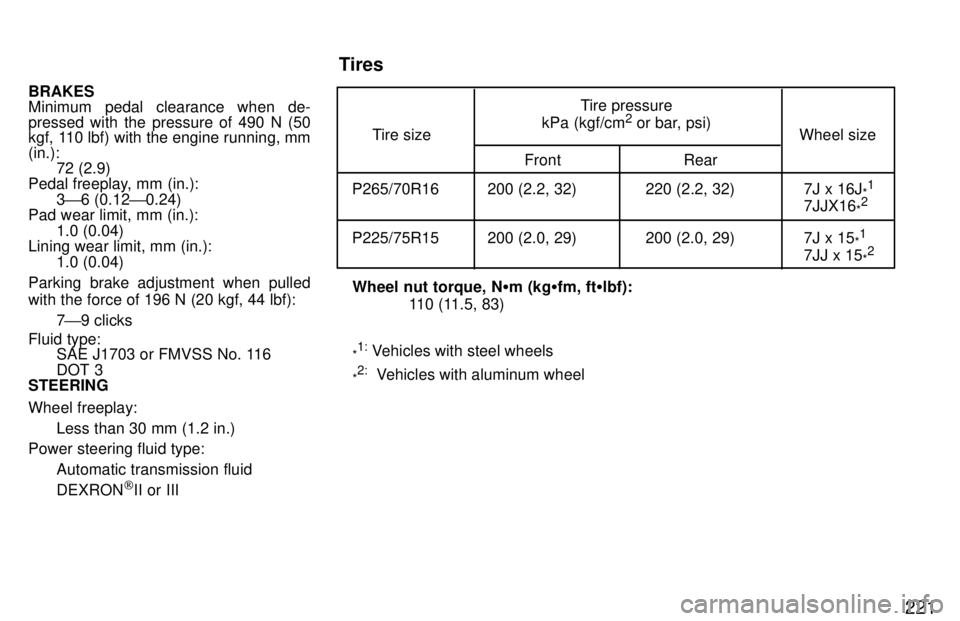
P265/70R16 200 (2.2, 32) 220 (2.2, 32) 7J x 16J*1
7JJX16 *2
P225/75R15 200 (2.0, 29) 200 (2.0, 29) 7J x 15 *1
7JJ x 15 *2
Tire size
Tire pressure
kPa (kgf/cm 2
or bar, psi)
Front Rear Wheel size
Wheel nut torque, N
m (kg fm, ft lbf):
110 (11.5, 83)
* 1:
Vehicles with steel wheels
* 2:
Vehicles with aluminum wheel
221
BRAKES Minimum pedal clearance when de-pressed with the pressure of 490 N (50
kgf, 110 lbf) with the engine running, mm (in.):
72 (2.9)
Pedal freeplay, mm (in.):
3' 6 (0.12 '0.24)
Pad wear limit, mm (in.):
1.0 (0.04)
Lining wear limit, mm (in.):
1.0 (0.04)
Parking brake adjustment when pulled with the force of 196 N (20 kgf, 44 lbf): 7' 9 clicks
Fluid type: SAE J1703 or FMVSS No. 116 DOT 3
STEERING Wheel freeplay:
Less than 30 mm (1.2 in.)
Power steering fluid type:
Automatic transmission fluid DEXRON [
II or III Tires
Page 220 of 223
223
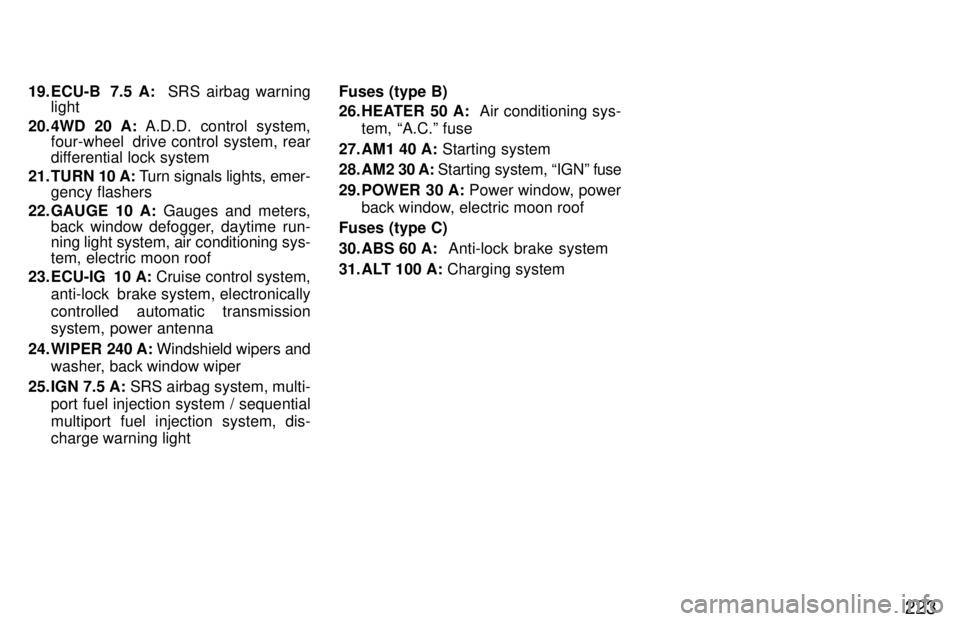
19. ECU-B 7.5 A:
SRS airbag warning
light
20. 4WD 20 A: A.D.D. control system,
four-wheel drive control system, rear
differential lock system
21. TURN 10 A: Turn signals lights, emer-
gency flashers
22. GAUGE 10 A: Gauges and meters,
back window defogger, daytime run-
ning light system, air conditioning sys-
tem, electric moon roof
23. ECU-IG 10 A: Cruise control system,
anti-lock brake system, electronically
controlled automatic transmission
system, power antenna
24. WIPER 240 A: Windshield wipers and
washer, back window wiper
25. IGN 7.5 A: SRS airbag system, multi-
port fuel injection system / sequential
multiport fuel injection system, dis-
charge warning light Fuses (type B)
26. HEATER 50 A:
Air conditioning sys-
tem, A.C.º fuse
27. AM1 40 A: Starting system
28.AM2 30 A: Starting system, IGNº fuse
29. POWER 30 A: Power window, power
back window, electric moon roof
Fuses (type C)
30. ABS 60 A: Anti-lock brake system
31. ALT 100 A: Charging system