1997 TOYOTA 4RUNNER Brake
[x] Cancel search: BrakePage 161 of 223
164
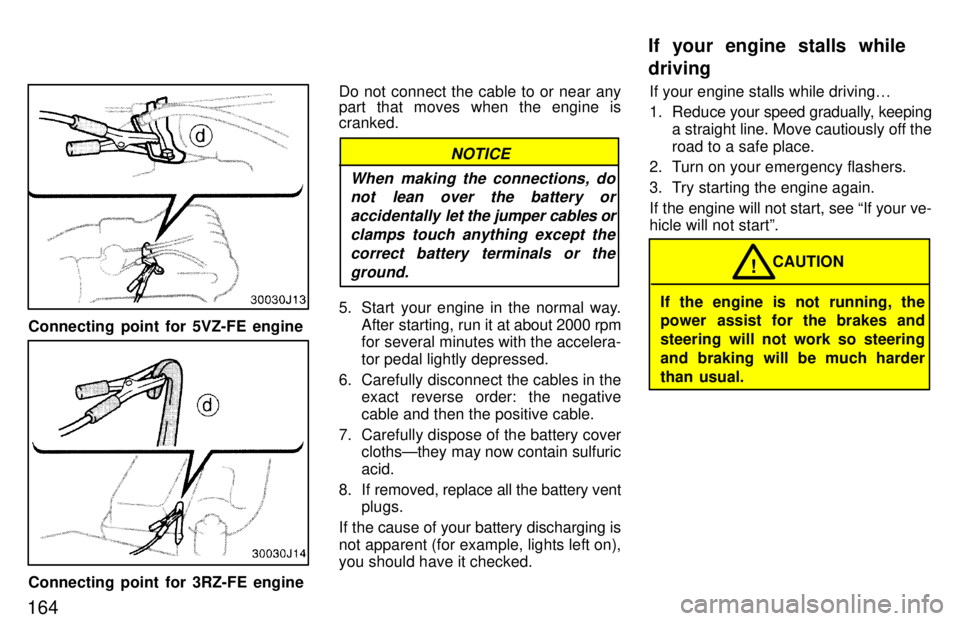
Connecting point for 5VZ-FE engine
Connecting point for 3RZ-FE engineDo not connect the cable to or near any
part that moves when the engine is cranked.
NOTICE
When making the connections, do not lean over the battery or
accidentally let the jumper cables or
clamps touch anything except the correct battery terminals or the ground.
5. Start your engine in the normal way. After starting, run it at about 2000 rpm
for several minutes with the accelera- tor pedal lightly depressed.
6. Carefully disconnect the cables in the exact reverse order: the negative
cable and then the positive cable.
7. Carefully dispose of the battery cover clothsÐthey may now contain sulfuricacid.
8. If removed, replace all the battery vent plugs.
If the cause of your battery discharging is
not apparent (for example, lights left on), you should have it checked. If your engine stalls while driving
0
1. Reduce your speed gradually, keeping
a straight line. Move cautiously off the
road to a safe place.
2. Turn on your emergency flashers.
3. Try starting the engine again.
If the engine will not start, see If your ve-
hicle will not startº.If the engine is not running, the
power assist for the brakes and
steering will not work so steering
and braking will be much harder
than usual. CAUTION
!
If your engine stalls while driving
Page 162 of 223

165
If your engine coolant temperature
gauge indicates overheating, if you
experience a loss of power, or if you
hear a
loud knocking or pinging noise,
the engine has probably overheated.
You should follow this procedure 0
1. Pull safely off the road, stop the ve- hicle and turn on your emergency
flashers. Put the transmission in Pº
(automatic) or neutral (manual) and
apply the parking brake. Turn off the
air conditioning if it is being used.
2. If coolant or steam is boiling out of the radiator or reservoir, stop the engine.
Wait until the steam subsides before
opening the hood. If there is no coolant
boiling over or steam, leave the engine running.
To help avoid personal injury, keep
the hood closed until there is no steam. Escaping steam or coolant is
a sign of very high pressure. CAUTION
! 3. Visually check to see if the engine
drive belt (fan belt) is broken or loose.
Look for obvious coolant leaks from
the radiator, hoses, and under the ve-
hicle. However, note that water drain-ing from the air conditioning is normal if it has been used.
When the engine is running, keep
hands and clothing away from the
moving fan and engine drive belts. CAUTION
!
4. If the engine drive belt is broken of the coolant is leaking, stop the engine im-
mediately. Call a Toyota dealer for as- sistance.
5. If the engine drive belt is O.K. and there are no obvious leaks, you may
help the engine cool down more quick-
ly by running it at about 1500 rpm for
a few minutes with the accelerator
pedal lightly depressed.
6. Check the coolant reservoir. If it is dry, add coolant to the reservoir while the
engine is running. Fill it about half full.
Do not attempt to remove the
radiator cap when the engine and
radiator are hot. Serious injury
could result from scalding hot fluid
and steam blown out underpressure. CAUTION
!
7. After the engine coolant temperature has cooled to normal, again check the
coolant level in the reservoir. If neces-
sary, bring it up to half full again. Seri-
ous coolant loss indicates a leak in the
system. You should have it checked as
soon as possible at your Toyota deal-
er.
If your vehicle overheats
Page 163 of 223

1661. Reduce
your speed gradually, keeping
a straight line. Move cautiously off the
road to a safe place well away from the
traf fic. Avoid stopping on the center di-
vider of a highway. Park on a level spotwith firm ground.
2. Stop the engine and turn on your emergency flashers.
3. Firmly set the parking brake and put the transmission in Pº (automatic) or reverse (manual).
4. Have everyone get out of the vehicle on the side away from traffic.
5. Read the following instructions thor- oughly.
When jacking, be sure to observe
the following to reduce the poss- ibility of personal injury: Follow jacking instructions.
Use the jack only for lifting your
vehicle during wheel changing.
Never get beneath the vehicle
when supported by the jack.
Do not start or run the engine
while your vehicle is supported bya jack. CAUTION
!
NOTICE
Do not continue driving with a deflated tire. Driving even a short
distance can damage a tire beyondrepair.
1. Get the required tools and spare tire.
1. Tool bag
2. Jack handle
3. Jack
To prepare yourself for an emergency, you should familiarize yourself with the
use of the jack, each of the tools and their storage locations.
If you have a flat tireÐ
ÐRequired tools and spare tire
Page 170 of 223
173
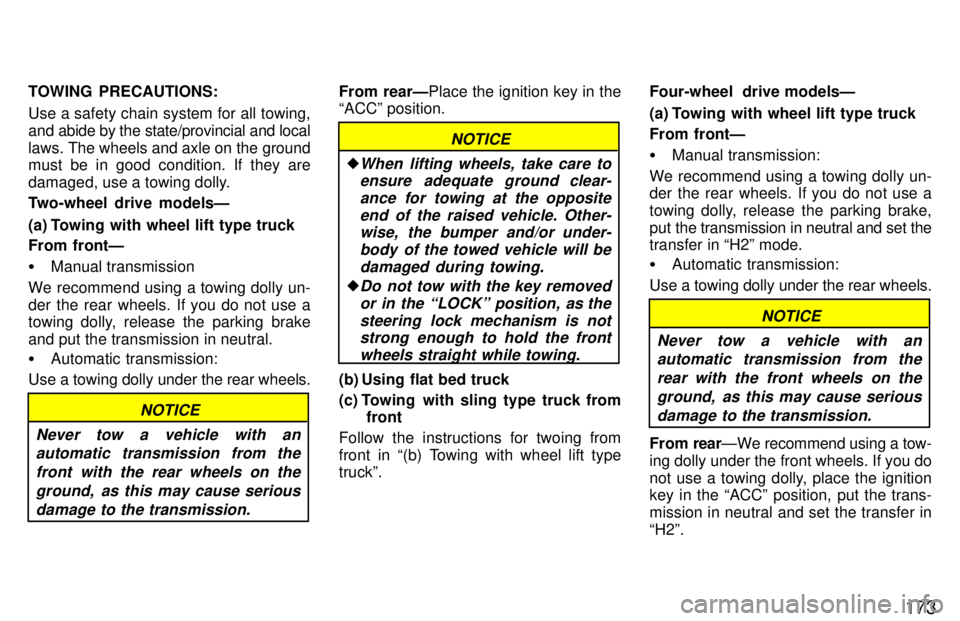
TOWING PRECAUTIONS: Use a safety chain system for all towing,
and abide by the state/provincial and local
laws. The wheels and axle on the ground
must be in good condition. If they are
damaged, use a towing dolly.
Two-wheel drive modelsÐ
(a) Towing with wheel lift type truck From frontÐ
Manual transmission
We recommend using a towing dolly un-
der the rear wheels. If you do not use a
towing dolly, release the parking brake
and put the transmission in neutral. Automatic transmission:
Use a towing dolly under the rear wheels.
NOTICE
Never tow a vehicle with an automatic transmission from the
front with the rear wheels on theground, as this may cause serious damage to the transmission.
From rearÐ Place the ignition key in the
ACCº position.
NOTICE
When lifting wheels, take care to
ensure adequate ground clear-
ance for towing at the oppositeend of the raised vehicle. Other-wise, the bumper and/or under-
body of the towed vehicle will be damaged during towing.
Do not tow with the key removedor in the LOCKº position, as thesteering lock mechanism is notstrong enough to hold the front
wheels straight while towing.
(b) Using flat bed truck
(c) Towing with sling type truck from front
Follow the instructions for twoing from
front in (b) Towing with wheel lift type truckº. Four-wheel drive modelsÐ
(a) Towing with wheel lift type truck From frontÐ
Manual transmission:
We recommend using a towing dolly un-
der the rear wheels. If you do not use a
towing dolly, release the parking brake,
put the transmission in neutral and set the
transfer in H2º mode. Automatic transmission:
Use a towing dolly under the rear wheels.
NOTICE
Never tow a vehicle with an automatic transmission from the
rear with the front wheels on theground, as this may cause serious damage to the transmission.
From rearÐWe recommend using a tow-
ing dolly under the front wheels. If you do
not use a towing dolly, place the ignition key in the ACCº position, put the trans- mission in neutral and set the transfer inH2º.
Page 171 of 223
174
NOTICE
Do not tow with the key removed or in the LOCKº position when
towing from the rear without atowing dolly. The steering lock mechanism is not strong enough tohold the front wheels straight.
(b) Using flat bed truck
(c) Towing with sling type truck from front
Follow the instructions for towing from
front in (b) Towing with wheel lift type truckº.
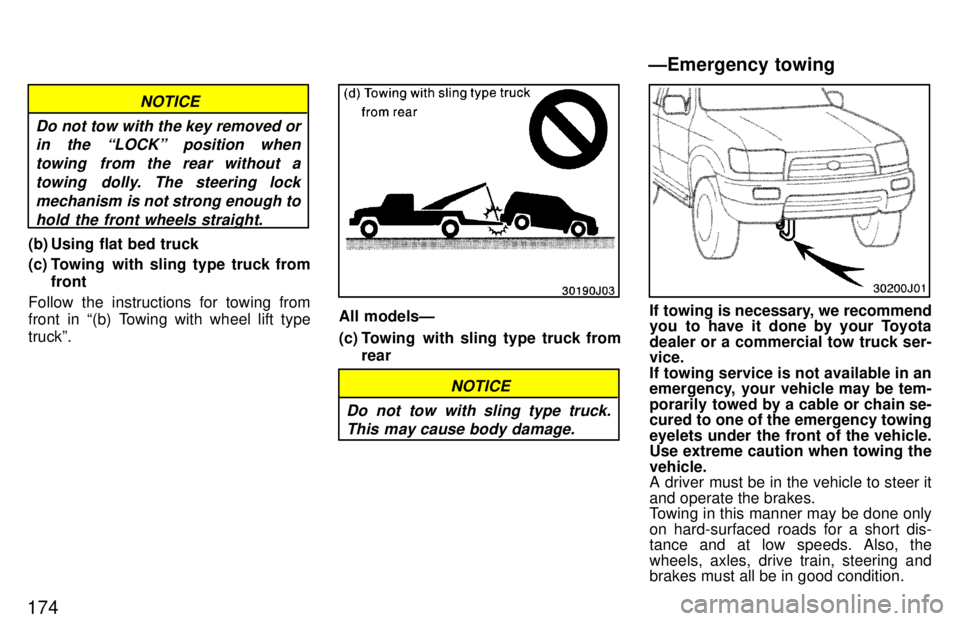
All modelsÐ
(c) Towing with sling type truck from rear
NOTICE
Do not tow with sling type truck. This may cause body damage.
If towing is necessary, we recommend
you to have it done by your Toyota
dealer or a commercial tow truck ser- vice.
If towing service is not available in an
emergency, your vehicle may be tem-
porarily towed by a cable or chain se-
cured to one of the emergency towing
eyelets under the front of the vehicle.
Use extreme caution when towing the vehicle.
A driver must be in the vehicle to steer it and operate the brakes.
Towing in this manner may be done only
on hard-surfaced roads for a short dis-
tance and at low speeds. Also, the
wheels, axles, drive train, steering and brakes must all be in good condition.
ÐEmergency towing
Page 172 of 223
175
CAUTION!
Use extreme caution when towing
vehicles. Avoid sudden starts or
erratic driving maneuvers which
would place excessive stress on the
emergency towing hook and towing
cable or chain. The hook and towing
cable or chain may break and cause
serious injury or damage.
NOTICE
Use only a cable or chain specific- ally intended for use in towing
vehicles. Securely fasten the cableor chain to the towing eyelet provided.
Before towing, release the parking brake
and put the transmission in neutral
(manual) or Nº (automatic)And transfer in
H2º (four-wheel drive models). The key
must be in ACCº (engine off) or ONº (en-
gine running).
CAUTION!
If the engine is not running, the
power assist for the brakes and
steering will not work so steering
and braking will be much harder
than usual.
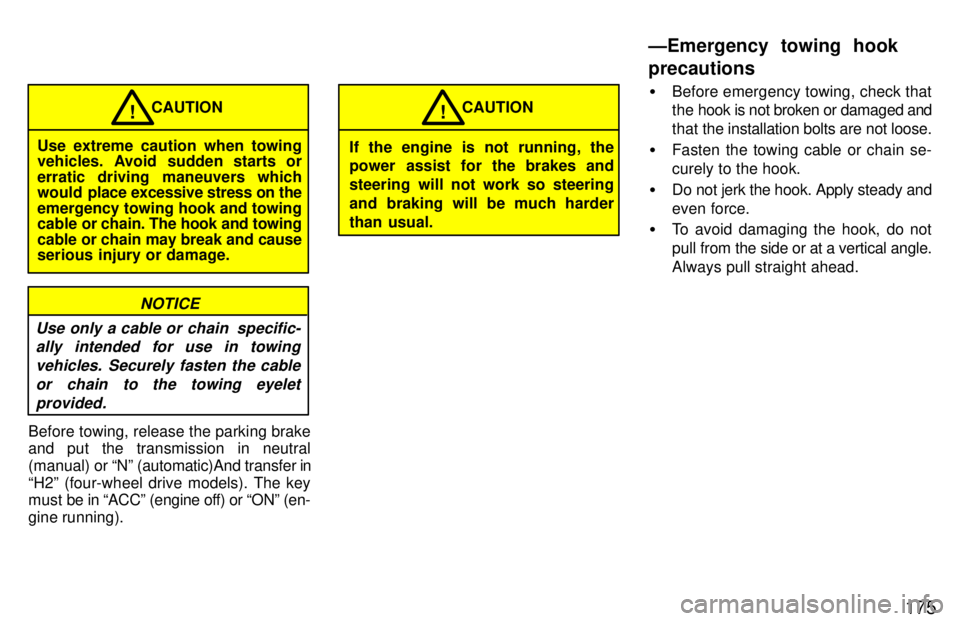
Before emergency towing, check that
the hook is not broken or damaged and
that the installation bolts are not loose.
Fasten the towing cable or chain se-curely to the hook.
Do not jerk the hook. Apply steady and
even force.
To avoid damaging the hook, do not
pull from the side or at a vertical angle.
Always pull straight ahead.
ÐEmergency towing hook precautions
Page 173 of 223
176
If the emergency towing hook is
used to get out when your vehicle
becomes stuck in the mud, sand or
other condition from which the
vehicle can not be driven out under
its own power, make sure to observe
the precautions mentioned below.
Otherwise, excessive stress will be
put on the hook and the towing
cable or chain may break, causing
serious injury or damage. If the towing vehicle can hardly
move, do not forcibly continue the
towing. Contact your Toyota deal-
er or a commercial tow truck ser- vice for assistance.
Tow the vehicle as straight ahead as possible.
Keep away from the vehicle during
towing. CAUTION
!
The following methods are effective to
use when your vehicle is stuck in the mud, sand or other condition from which the ve-
hicle cannot be driven out under its own
power. Use extreme caution when
towing
the vehicle. In addition, keep away from
the vehicles and towing cable or chain
when towing. Remove the soil and sand in the front and the back of the tires.
Place stones or wood under the tires.
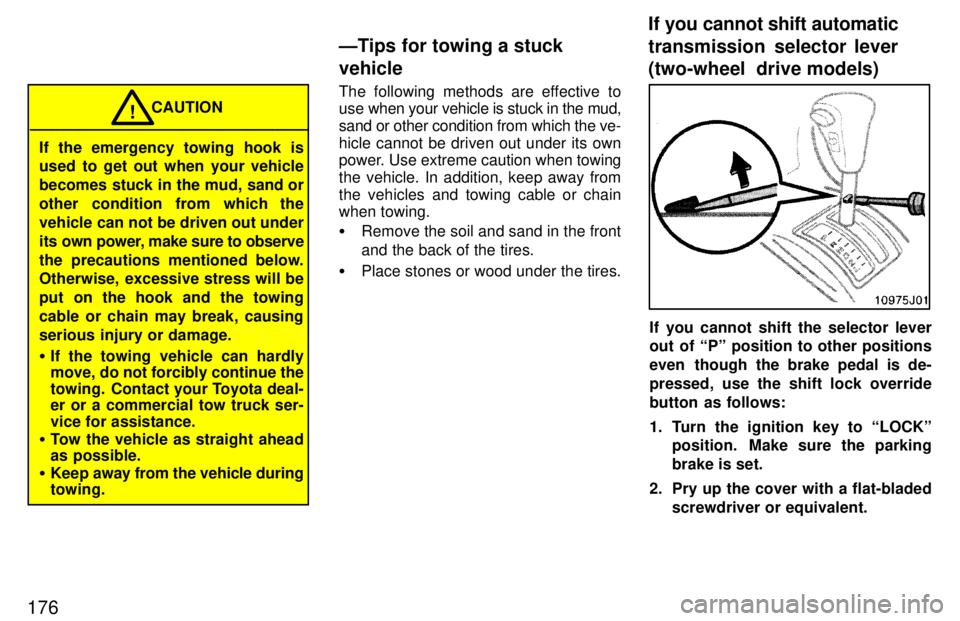
If you cannot shift the selector lever
out of Pº position to other positions
even though the brake pedal is de-pressed, use the shift lock override
button as follows:
1. Turn the ignition key to LOCKº
position. Make sure the parking brake is set.
2. Pry up the cover with a flat-bladed screwdriver or equivalent.
ÐTips for towing a stuck vehicle
If you cannot shift automatic
transmission selector lever
(two-wheel drive models)
Page 174 of 223

177
3. Insert the screwdriver or equivalent
into the hole to push up the shift
lock override button. You can shift
out of Pº position only while push-
ing the button.
4. Shift into Nº position.
5. Insert the cover.
6. Start the engine. For your safety, keep the brake pedal depressed.
Be sure to have the system checked by
your Toyota dealer as soon as possible.If you cannot shift the selector lever
out of Pº position to other positions
even though the brake pedal is de-pressed, use the shift lock override
button as follows:
1. Turn the ignition key to LOCKº position. Make sure the parking brake is set.
2. Pry up the cover with a flat-bladed screwdriver or equivalent.3. Insert your finger into the hole tomove the shift lock override lever
backward. You can shift out of Pº
position only while holding back
the lever.
4. Shift into Nº position.
5. Insert the cover.
6. Start the engine. For your safety, keep the brake pedal depressed.
Be sure to have the system checked by
your Toyota dealer as soon as possible.
If you cannot shift automatic
transmission selector lever
(four-wheel drive models)