Page 251 of 371
When to Check and What to Use
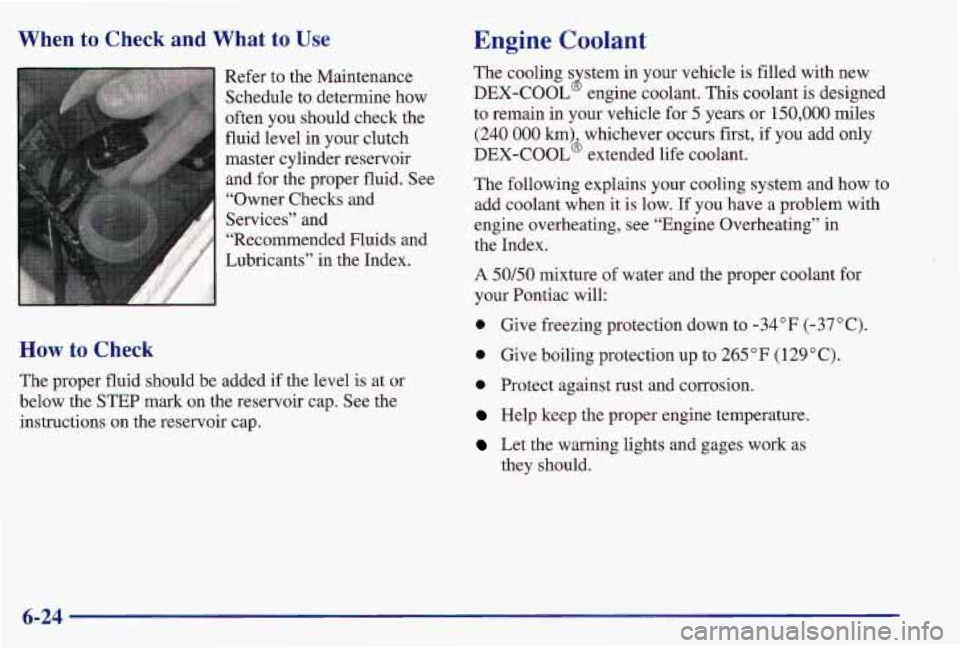
Refer to the Maintenance Schedule to determine how
often you should check the
fluid level in your clutch
master cylinder reservoir
and for the proper fluid. See
“Owner Checks and
Services” and
“Recommended Fluids and
Lubricants” in the Index.
., , I . ...
How to Check
The proper fluid should be added if the level is at or
below the STEP mark on the reservoir cap. See the
instructions on the reservoir cap.
Engine Coolant
The cooling s stem in your vehicle is filled with new
DEX-COOL
J engine coolant. This coolant is designed
to remain in your vehicle for
5 years or 150,000 miles
(240
000 krn) whichever occurs first, if you add only
DEX-COOLd extended life coolant.
The following explains
your cooling system and how to
add coolant when it is low. If you have a problem with
engine overheating, see “Engine Overheating” in
the Index.
A 50/50 mixture of water and the proper coolant for
your Pontiac will:
0 Give freezing protection down to -34°F (-37°C).
0 Give boiling protection up to 265 OF (1 29 O C).
0 Protect against rust and corrosion.
Help keep the proper engine temperature.
Let the warning lights and gages work as
they should.
6-24
Page 253 of 371
NOTICE:
If you use an improper coolant mix, your engine
could overheat and be badly damaged. The
repair cost wouldn’t be covered
by your
warranty. Too much water in the mix can freeze
and crack the engine, radiator, heater core and
other parts.
If you have to add coolant more than four times a year,
have your dealer check your cooling system.
I NOTICE:
~ ~~
If you use the proper coolant, you don’t have to
add extra inhibitors or additives which claim to
improve the system. These can be harmful.
Checking Coolant
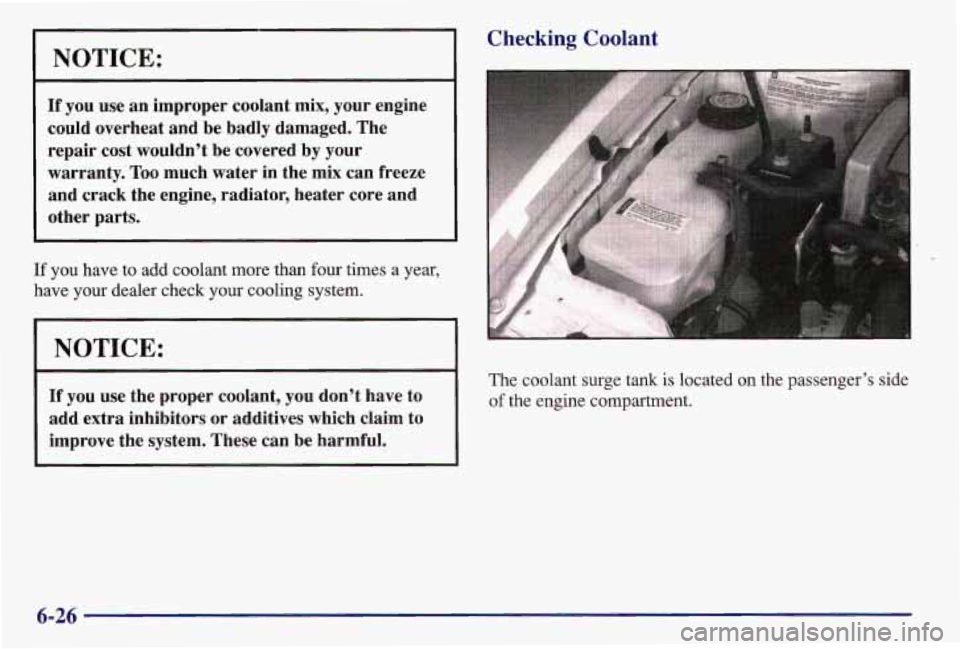
The coolant surge tank is located on the passenger’s side
of the engine compartment.
6-26
Page 255 of 371
Surge Tank Pressure Cap
NOTICE:
Your pressure cap is an 15 psi (105 kPa)
pressure-type cap and must be tightly installed to
prevent coolant loss and possible engine damage
from overheating.
When you replace your surge tank pressure cap, a GM
cap is recommended.
Thermostat
Engine coolant temperature is controlled by a thermostat
in the engine coolant system. The thermostat stops the
flow of coolant through the radiator until the coolant
reaches a preset temperature.
When you replace your thermostat, an
AC@ thermostat
is recommended.
Power Steering Fluid
When to Check Power Steering Fluid
It is not necessary to regularly check power steering
fluid unless you suspect there is a leak in the system
or
you hear an unusual noise. A fluid loss in this system
could indicate
a problem. Have the system inspected
and repaired.
Page 256 of 371

How To Check Power Steering Fluid
When the engine compartment is cool, wipe the cap and
the top of the reservoir clean, then unscrew the cap and
wipe the dipstick with a clean rag. Replace the cap and
completely tighten it. Then remove the cap again and
look at the fluid level on the dipstick.
The level should be at the
C mark. If necessary, add only
enough fluid to bring the level up
to the mark.
What to Use
Refer to the Maintenance Schedule to determine what
kind of fluid to use. See “Recommended Fluids and
Lubricants” in the Index. Always use the proper fluid. Failure to use the proper fluid can cause leaks and
damage hoses and seals.
Windshield Washer Fluid
What to Use
When you need windshield washer fluid, be sure to read
the manufacturer’s instructions before use. If you will be
operating your vehicle in an area where the temperature
may fall below freezing, use a fluid that has sufficient
protection against freezing.
Adding Washer Fluid
Open the cap labeled WASHER FLUID ONLY. Add
washer fluid until the tank is
full.
6-29
Page 285 of 371
Vehicle Identification Number (VIN)
II 11111111 1111 111111 111 11111111 111111111111 111111111 11= e
bd SAMPLE4UXVM072675 bd
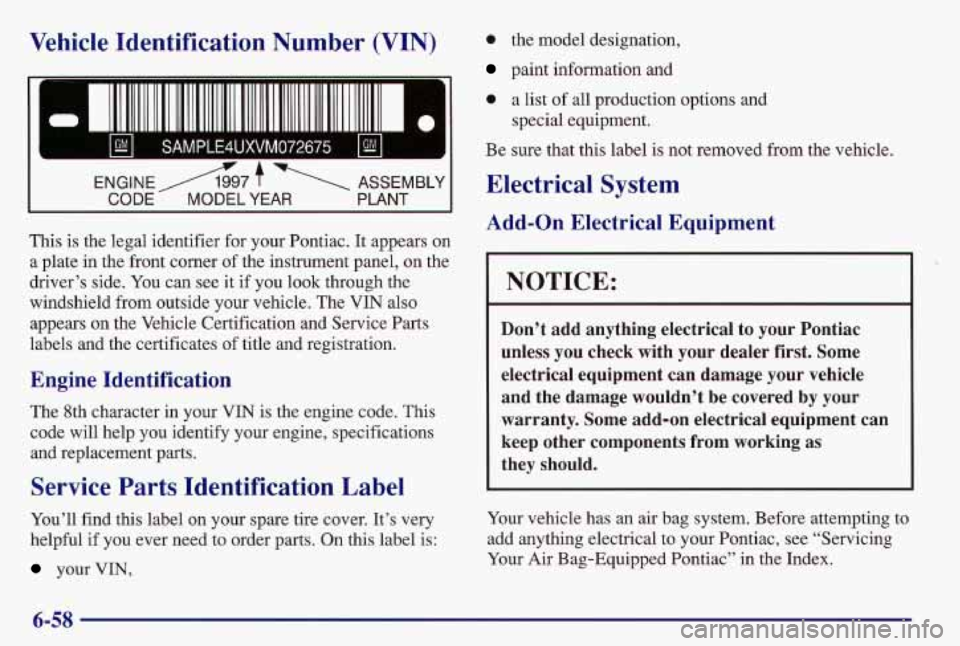
This is the legal identifier for your Pontiac. It appears on
a plate in the front corner of the instrument panel, on the
driver’s side. You can see it if you
look through the
windshield from outside your vehicle. The
VIN also
appears on the Vehicle Certification and Service Parts
labels and the certificates of title and registration.
Engine Identification
The 8th character in your VIN is the engine code. This
code will help you identify your engine, specifications
and replacement parts.
Service Parts Identification Label
You’ll find this label on your spare tire cover. It’s very
helpful
if you ever need to order parts. On this label is:
your VIN,
0 the model designation,
paint information and
0 a list of all production options and
special equipment.
Be sure that this label is not removed from the vehicle.
Electrical System
Add-on Electrical Equipment
I NOTICE:
Don’t add anything electrical to your Pontiac
unless you check with your dealer
first. Some
electrical equipment can damage your vehicle
and the damage wouldn’t be covered by your
warranty. Some add-on electrical equipment can
keep other components from working as
they should.
Your vehicle has an air bag system. Before attempting to
add anything electrical to your Pontiac, see “Servicing
Your Air Bag-Equipped Pontiac” in the Index.
6-58
Page 286 of 371
Headlamp Wiring
The headlamp wiring is protected by a circuit breaker
located in the instrument panel fuse block. An electrical
overload will cause the headlamps to go on and off, or
in
some cases to remain off. If this happens, have your
headlamp system checked right away.
Windshield Wipers
The windshield wiper motor is protected by a circuit
breaker and a fuse. If the motor overheats due to heavy
snow, etc., the wiper will stop until the motor cools.
If
the overload is caused by some electrical problem, have
it fixed.
Power Windows and Other Power Options
Circuit breakers in the fuse panel protect the power
windows and other power accessories. When the current
load is too heavy, the circuit breaker opens and closes,
protecting the circuit until the problem is fixed.
Fuses and Circuit Breakers
The wiring circuits in your vehicle are protected from
short circuits by a combination of fuses, circuit breakers
and fusible links. This greatly reduces the chance of
damage caused by electrical problems.
Look at the silver-colored band inside the fuse. If the
band is broken or melted, replace the fuse. Be sure to
replace a bad fuse with a new one of the identical size
and rating.
If you ever have a problem on the road and don’t have a
spare fuse, you can “borrow” one that has the same
amperage. Just pick a feature of your vehicle that you
can get along without
-- like the radio or cigarette
lighter
-- and use its fuse, if it is the correct amperage.
Replace
it as soon as you can.
There are two fuse blocks in your vehicle: the
instrument panel fuse block and the engine compartment
fuse block.
6-59
Page 334 of 371
Part B: Owner Checks and Services
Listed below are owner checks and services which
should be performed at the intervals specified to help
ensure the safety, dependability and emission control
performance
of your vehicle.
Be sure any necessary repairs are completed at once.
Whenever any fluids or lubricants are added to your
vehicle, make sure they
are the proper ones, as shown
in
Part D.
At Each Fue- - --II
It is important for you or a service station attendant to
per$orm these underhood checks at each fie1
fill.
Engine Oil Level Check
Check the engine oil level and add the proper oil
if necessary, See “Engine Oil” in the Index for
further details.
Engine Coolant Level Check
Check the engine coolant level and add DEX-COOL@
coolant mix if necessary. See “Engine Coolant’’ in the
Index for further details.
Windshield Washer Fluid Level Check
Check the windshield washer fluid level in the
windshield washer tank and add the proper fluid
if
necessary. See “Windshield Washer Fluid” in the
Index for further details.
At Least Once a Month
Tire Inflation Check
Make sure tires are inflated to the correct pressures. See
“Tires” in the Index for further details.
Cassette Deck Service
Clean cassette deck. Cleaning should be done every
50 hours of tape play. See “Audio Systems” in the Index
for further details.
7-41
Page 336 of 371
Starter Switch Check
A CAUTION: ,
I
When you are doing this check, the vehicle could
move suddenly.
If it does, you or others could be
injured. Follow the steps below.
1.
2.
3.
Before you start, be sure you have enough room
around the vehicle.
Firmly apply both the parking brake (see “Parking Brake”
in the Index if necessary) and the regular brake.
NOTE:
Do not use the accelerator pedal, and be
ready to turn off the engine immediately if
it starts.
On automatic transaxle vehicles, try
to start the
engine in each gear. The starter should work only in
PARK
(P) or NEUTRAL (N). If the starter works in
any other position, your vehicle needs service.
On manual transaxle vehicles, put the shift lever in
NEUTRAL
(N), push the clutch down halfway and
try to start the engine. The starter should work only
when the clutch is pushed down all the way to the
floor.
If the starter works when the clutch isn’t
pushed all the way down, your vehicle needs service.
Brake-Transaxle Shift Interlock (BTSI) Check
(Automatic Transaxle)
A CAUTION:
When you are doing this check, the vehicle could
move suddenly. If
it does, you or others could be
injured. Follow the steps below.
1. Before you start, be sure you have enough
room around the vehicle.
It should be parked on
a level surface.
2. Firmly apply the parking brake (see “Parking Brake”
in the Index if necessary).
NOTE: Be ready to apply the regular brake
immediately if the vehicle begins to move.
3. With the engine off, turn the key to the RUN position,
but don’t start the engine. Without applying the
regular brake, try to move the shift lever out
of
PARK (P) with normal effort. If the shift lever moves
out of PARK (P), your vehicle’s BTSI needs service.
7-43