Page 235 of 371
Checking Things Under the Hood
I
' A CAUTION:
An electric fan under the hood can start up and
injure
you even when the engine is not running.
Keep hands, clothing and tools away from any
underhood electric fan.
A CAUTION:
Things that burn can get on hot engine parts and
start a fire. These include liquids like gasoline,
oil, coolant, brake fluid, windshield washer and
other fluids, and plastic or rubber.
You or others
could be burned. Be careful not to drop or spill
things
that will burn onto a hot engine.
Hood Release
The following sections tell you how to check fluids,
lubricants and important parts underhood.
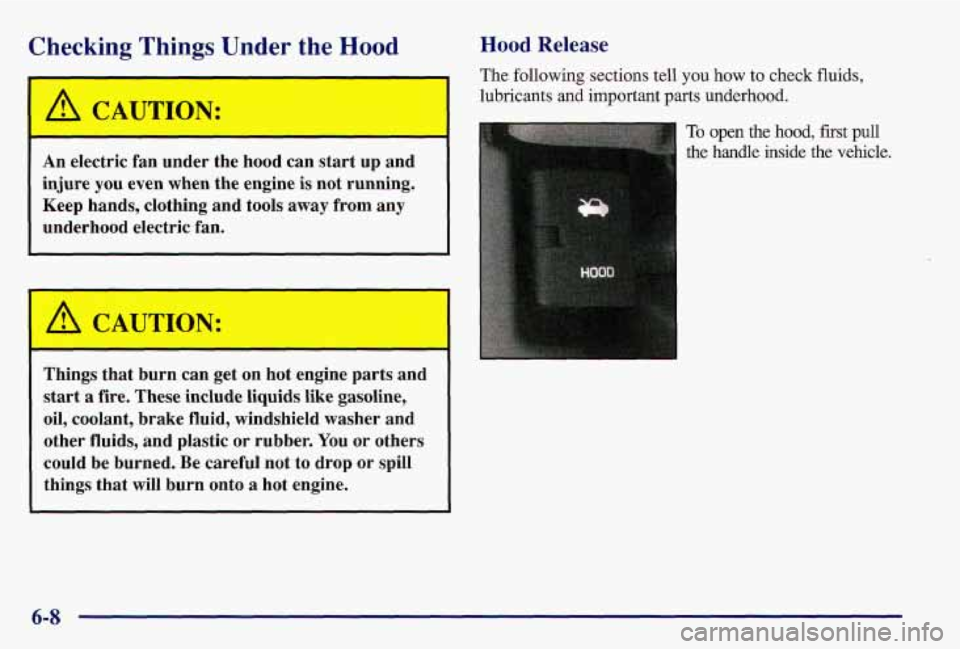
To open the hood, first pull
the handle inside the vehicle.
6-8
Page 239 of 371
Engine Oil
CHECK
OIL
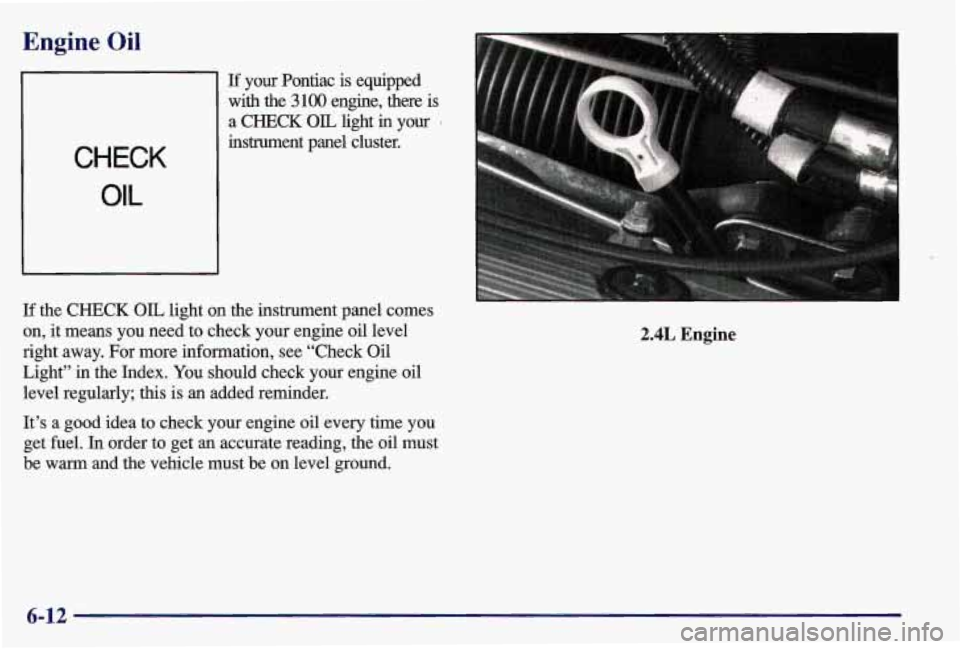
If your Pontiac is equipped
with the
3100 engine, there is
a CHECK
OIL light in your .
instrument panel cluster.
If the
CHECK OIL light on the instrument panel comes
on, it means you need to check your engine oil level
right away. For more information, see “Check Oil
Light” in the Index. You should check your engine oil
level regularly; this is an added reminder.
It’s a good idea to check your engine oil every time you
get fuel. In order to get an accurate reading, the oil must
be warm
and the vehicle must be on level ground.
2.4L Engine
6-12
Page 240 of 371
1 Checking Engine Oil
Pull out the dipstick and clean it with a paper towel or
cloth, then push it back in all the way. Remove it again,
keeping the tip down, and check the level.
3100 Engine
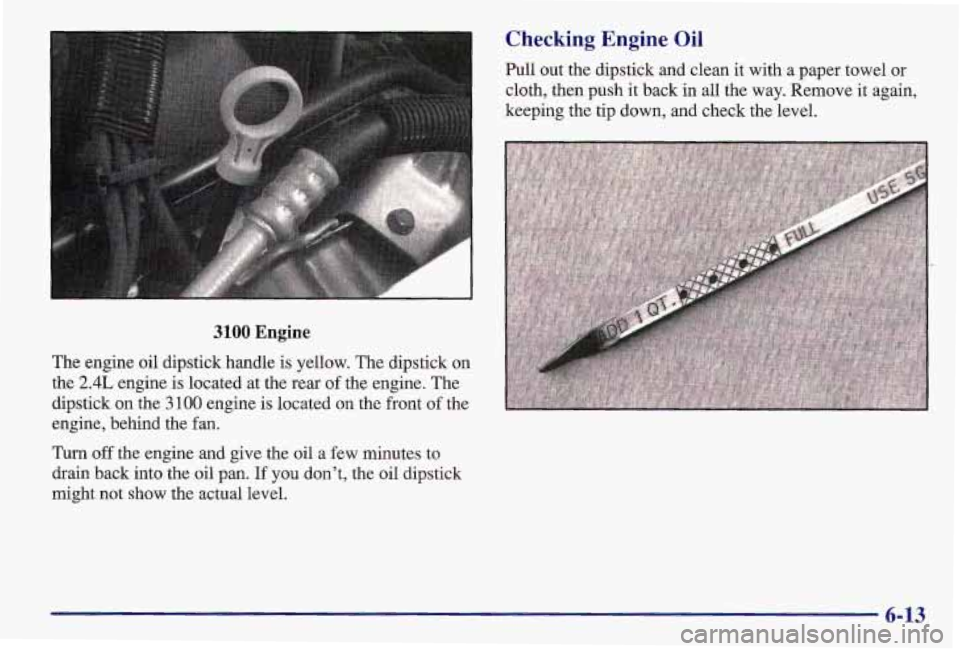
The engine oil dipstick handle is yellow. The dipstick on
the
2.4L engine is located at the rear of the engine. The
dipstick on the
3100 engine is located on the front of the
engine, behind the fan.
Turn off the engine and give the oil a few minutes to
drain back into the oil pan. If you don’t, the oil dipstick
might not show the actual level.
6-13
Page 245 of 371
Air Cleaner Refer to the Maintenance Schedule to determine when to
replace the air filter.
See “Scheduled Maintenance Services” in the Index.
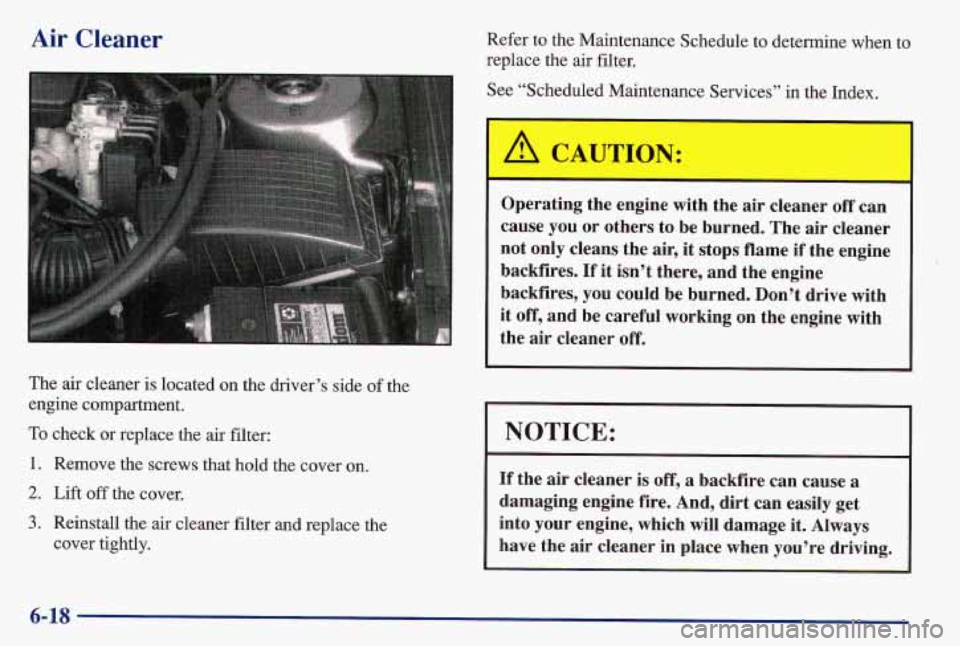
The air cleaner
is located on the driver’s side of the
engine compartment.
To check or replace the air filter:
1. Remove the screws that hold the cover on.
2. Lift off the cover.
3. Reinstall the air cleaner filter and replace the
cover tightly.
-
Operating the engine with the air cleaner off can
cause you or others to be burned. The air cleaner
not only cleans the air, it stops flame if the engine
backfires.
If it isn’t there, and the engine
backfires,
you could be burned. Don’t drive with
it off, and be careful working on the engine with
the air cleaner off.
L
A CAUTION:
NOTICE:
If the air cleaner is off, a backfire can cause a
damaging engine fire. And, dirt can easily get
into your engine, which will damage it. Always
have the air cleaner in place when you’re driving.
6-18
Page 246 of 371
Automatic Transaxle Fluid
When to Check and Change
A good time to check your automatic transaxle fluid
level is when the engine oil is changed.
Change both the fluid and filter every
50,000 miles
(83
000 lun) if the vehicle is mainly driven under one or
more of these conditions:
In heavy city traffic where the outside temperature
regularly reaches 90°F (32°C) or higher.
In hilly or mountainous terrain.
When doing frequent trailer towing.
Uses such as found in taxi, police or delivery service.
If you do not use your vehicle under any of these
conditions, the fluid and filter do not require changing.
See “Scheduled Maintenance Services” in the Index.
How to Check
Because this operation can be a little difficult, you may
choose to have this done at your Pontiac dealership
Service Department.
If you do it yourself, be sure to follow all the instructions
here, or you could get a false reading on the dipstick.
NOTICE:
Too much or too little fluid can damage your
transaxle.
Too much can mean that some of the
fluid could come out and fall on hot engine parts
or exhaust system parts, starting
a fire. Be sure to
get an accurate reading if you check your
transaxle fluid.
Wait at least 30 minutes before checking the transaxle
fluid level
if you have been driving:
When outside temperatures are above 90°F (32°C).
At high speed for quite a while.
In heavy traffic -- especially in hot weather.
While pulling a trailer.
To get the right reading, the fluid should be at normal
operating temperature, which is 180°F to
200°F (82°C
to 93°C).
Get the vehicle warmed up by driving about 15 miles
(24 km) when outside temperatures are above 50°F
(10°C). If it’s colder than 50°F (lO”C), you may have
to drive longer.
6-19
Page 247 of 371
Checking the Fluid Level 'hen, without shutting off the engine, follow these steps:
' 0 Park your vehicle on a level place. Keep the
engine running.
With the parking brake applied, place the shift lever
in PARK (P).
With your foot on the brake pedal, move the shift
lever through each gear range, pausing
for about
three seconds
in each range. Then, position the shift
lever
in PARK (P).
Let the engine run at idle for three to five minutes.
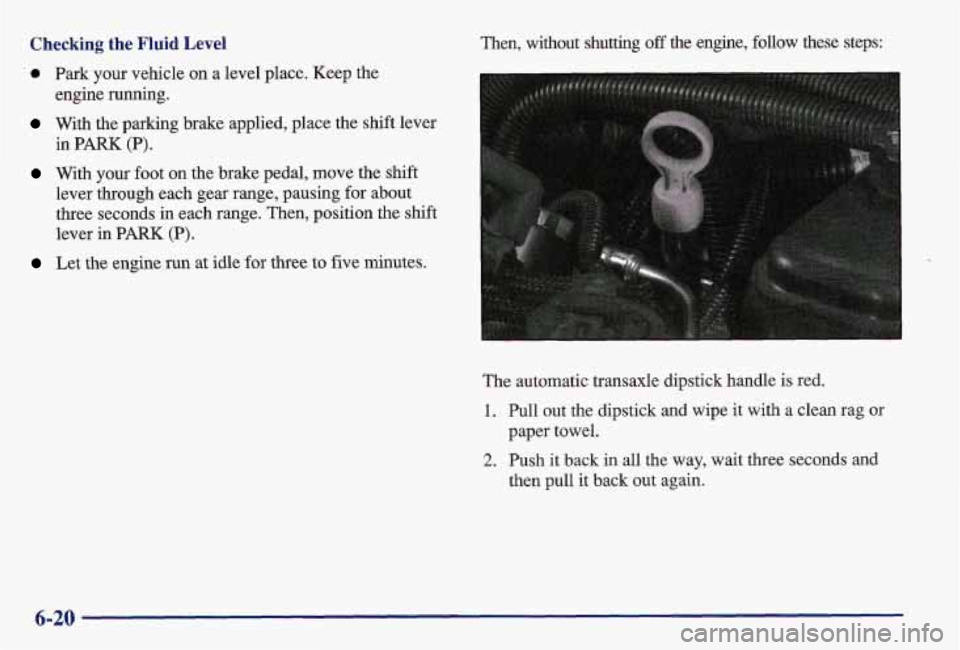
The automatic transaxle dipstick handle is red.
1. Pull out the dipstick and wipe it with a clean rag or
paper towel.
then pull it back out again.
2. Push it back in all the way, wait three seconds and
6-20
Page 248 of 371
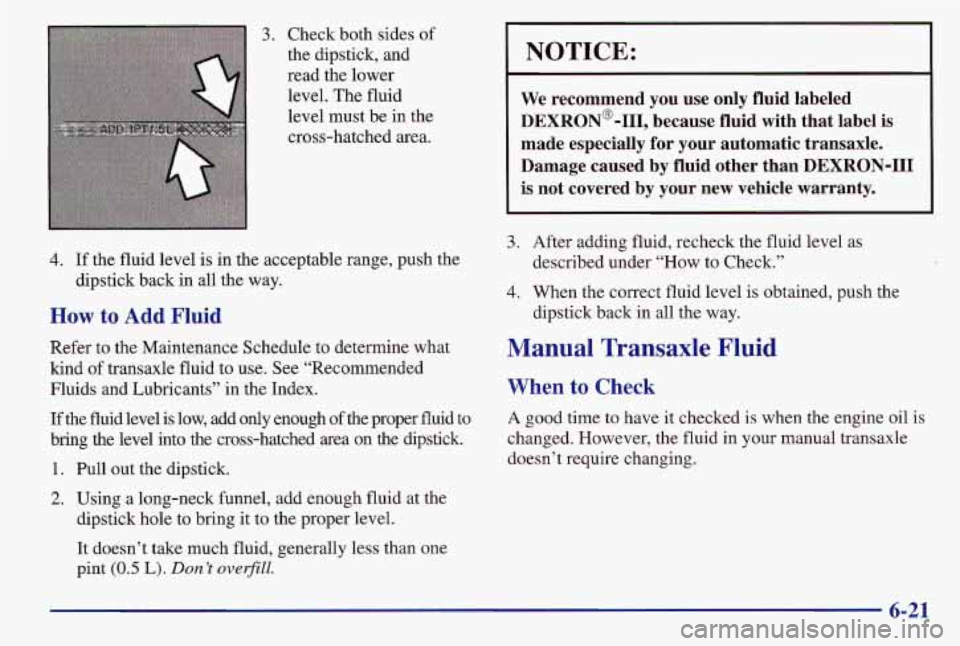
3. Check both sides of
the dipstick, and
read the lower
level. The fluid
level must be in the
cross-hatched area.
4. If the fluid level is in the acceptable range, push the
dipstick back in all the way.
How to Add Fluid
Refer to the Maintenance Schedule to determine what
kind
of transaxle fluid to use. See “Recommended
Fluids and Lubricants” in the Index.
If the fluid level is low, add only enough of the proper fluid to
bring the level into the cross-hatched area on the dipstick.
1. Pull out the dipstick.
2. Using a long-neck funnel, add enough fluid at the
dipstick hole to bring
it to the proper level.
It doesn’t take much fluid, generally less than one
pint
(0.5 L). Don’t overfill.
NOTICE:
We recommend you use only fluid labeled
DEXRON@-111, because fluid with that label
is
made especially for your automatic transaxle.
Damage caused by fluid other than DEXRON-I11
is not covered by your new vehicle warranty.
3. After adding fluid, recheck the fluid level as
described under
“How to Check.”
4. When the correct fluid level is obtained, push the
dipstick back in all the way.
Manual Transaxle Fluid
When to Check
A good time to have it checked is when the engine oil is
changed. However, the fluid in your manual transaxle
doesn’t require changing.
6-21
Page 249 of 371
How to Check
Because this operation can be a little difficult, you may
choose to have this done at your Pontiac dealership
Service Department.
If you
do it yourself, be sure to follow all the
instructions here, or you could get a false reading on
the dipstick.
NOTICE:
Too much or too little fluid can damage your
transaxle. Too much can mean that some of the
fluid could come out and fall on hot engine parts or exhaust system parts, starting
a fire. Be sure to
get an accurate reading if
you check your
transaxle fluid.
Check the fluid level only when your engine is off, the
vehicle is parked on a level place and the transaxle is
cool enough for you to rest your fingers on the
transaxle case. Then, follow these steps:
The manual transaxle dipstick is white and
is located on
the driver's side rear
of the engine.
' . Flip the handle up and then pull out the dipstick and
2. Push it back in all the way and remove it.
clean
it with a rag or paper towel.
6-22