1997 PONTIAC BONNEVILLE fuel
[x] Cancel search: fuelPage 6 of 405
L
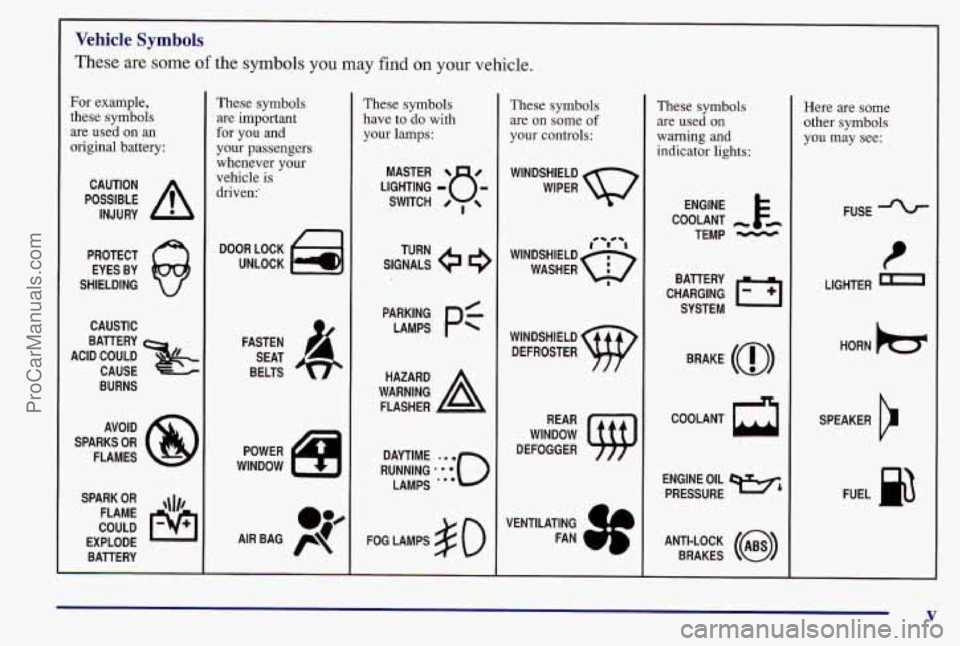
Vehicle Symbols
These are some of the symbols you may find on your vehicle.
For example,
these symbols
are used on an
original battery:
POSSIBLE A
CAUTION
INJURY
PROTECT EYES BY
SHIELDING
CAUSTIC
ACID COULD BATTERY
CAUSE
BURNS
AVOID
SPARKS
OR
FLAMES
SPARK
OR ,111,
COULD FLAME
EXPLODE BATTERY
These symbols are important
for you and
your passengers
whenever your
vehicle
is
driven:'
DOOR LOCK
UNLOCK
FASTEN SEAT
BELTS
These symbols
have to
do with
your lamps:
SIGNALS e
TURN
FOG LAMPS # 0
These symbols
are on some
of
your controls:
WINDSHIELD
WIPER
WINDSHIELD DEFROSTER
WINDOW
DEFOGGER
VENTILATING
(
FAN
These symbols
are used on
warning and
indicator lights:
COOLANT -
TEMP -
CHARGING I-1
BAllERY
SYSTEM
BRAKE
(a)
COOLANT
a
ENGINE OIL
PRESSURE
-4
ANTI-LOCK (@)
BRAKES
Here are some
other symbols
you may see:
FUSE
t
LIGHTER a
HORN )tr
SPEAKER
b
FUEL p3
V
ProCarManuals.com
Page 63 of 405
This device complies with RSS-210 of Industry and
Science Canada. Operation
is subject to the following
two conditions:
(1) this device may not cause
interference,
and (2) this device must accept any
intederence received, including interference that may
cause undesired operation
of the device.
Changes or modifications to this system by other than an
authorized service facility could void authorization to
use this equipment.
This system has a range of about 3 feet (1 m) up to
30 feet (9 m). At times you may notice a decrease in
range.
This is normal for any remoste keyless entry
system. If the transmitter does not work or if you have
to stand closer to your vehicle for
the transmitter to
work, try this:
Check to determine if battery replacement is
necessary. See the instructions that follow.
0 Check the distance. You may be too far from your
vehicle.
You may need to stand closer during r’ainy
or snowy weather.
Check the location. Other vehicles or objects may be
blocking the signal. Take a few steps to the left or right,
hold the transmitter higher, and
try again.
0 If you’re still having trouble, see your Pontiac dealer
or a qualified technician for service.
Operation
The driver’s door will unlock when UNLOCK is
pressed. The fuel door will
also unlock when UNLOCK
is pressed, if
you have the optional fuel door lock.
If UNLOCK is pressed again within five seconds, all
doors
will unlock. Pressing the UNLOCK button will
also illuminate the interior lamps. See “Illuminated
Entry” in the index.
All doors will lock when
LOCK is pressed.
ProCarManuals.com
Page 71 of 405
PASS-K~~~ 11
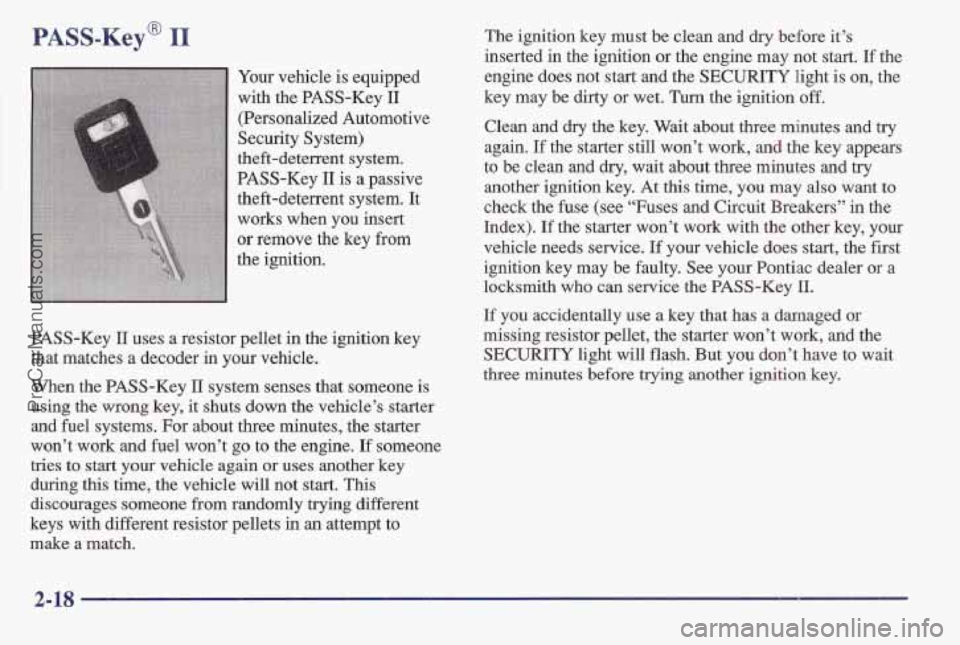
Your vehicle is equipped
with the PASS-Key
11
(Person’alized Automotive
Security System)
theft-deterrent system.
PASS-Key
11 is a passive
theft-deterrent system. It
works when
you insert
or remove the key from
the ignition.
PASS-Key
I1 uses a resistor pellet in the ignition key
that matches a decoder
in your vehicle.
When the PASS-Key
I1 system senses that someone is
using
the wrong key, it shuts down the vehicle’s starter
and fuel systems. For about thee minutes, the starter
won’t work and fuel won’t go to the engine.
If someone
tries to start your vehicle again or uses another key
during this time, the vehicle will not start. This
discourages someone
from randomly trying different
keys with different resistor pellets in
an attempt to
make a match. The
ignition key must be clean and
dry before it’s
inserted in the ignition or the engine may not start.
If the
engine does not start and the SECURITY light is
on, the
key may be dirty or wet.
Turn the ignition off.
Clean and dry the key. Wait about three minutes and try
again. If the starter s’till won’t work, and the key appears
to be clean and dry, wait about three minutes
and try
another ignition key. At this time, you may also want to
check the fuse (see “Fuses and Circuit Breakers” in the
Index);
If the staster won’t work with the other key, your
vehicle needs service.
If your vehicle does start, the first
ignition key may be faulty. See
your Pontiac dealer or a
locksmith who can service the PASS-Key 11.
If you accidentally use a key that has a damaged or
missing resistor pellet, the starter won’t work, and the
SECURITY light will flash. But you don’t have to wait
three minutes before trying another ignition key.
2-18
ProCarManuals.com
Page 76 of 405
Engine Coolant Heater (Option)
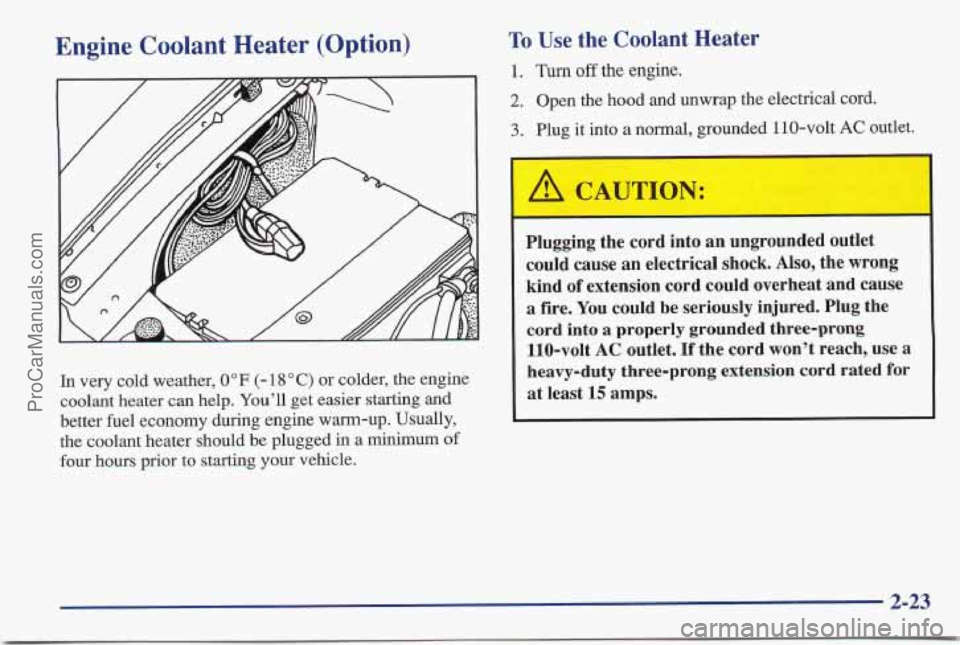
In very cold weather, 0 OF (- 18 O C) or colder, the engine
coolant heater can help. You’ll get easier starting and
better fuel economy during engine warm-up. Usually,
the coolant heater should be plugged in
a minimum of
four hours prior to starting your vehicle.
To Use the Coolant Heater
1. Turn off the engine.
2. Open the hood and unwrap the electrical cord.
3. Plug it into a normal, grounded 11 O-volt AC outlet.
m
A CAUTION:
Plugging the cord into an ungrounded outlet
could cause an electrical shock. Also, the wrong
kind of extension cord could overheat and cause
a fire. You could be seriously injured. Plug the
cord into a properly grounded three-prong
110-volt
AC outlet. If the cord won’t reach, use a
heavy-duty three-prong extension cord rated for
at least 15 amps.
2-23
ProCarManuals.com
Page 79 of 405
NEUTRAL (N): In this position, your engine
doesn’t connect with the wheels.
To restart when you’re
already moving,
use NEUTRAL (N) only. Also, use
NEUTRAL (N) when your vehicle is being towed.
I
Damage to your transaxle caused by shifting out
of
PARK (P) or NEUTRAL (N) with the engine
racing isn’t covered by your warranty.
Shifting
out of PARK (P) or NEUTRAL (N) while
your engine is
“racing” (running at high speed) is I
dangerous. Unless your foot is firmly on the
brake pedal, your vehicle could move very
rapidly.
You could lose control and hit people
or objects. Don’t shift out
of PARK (P) or
NEUTRAL (N) while your engine is racing.
NOTICE:
AUTOMATIC OVERDRIVE (a): This position is for
normal driving. If you need more power fOr passing, and
you’re:
Going less than about 35 mph (56 km/h), push your
accelerator pedal about halfway down.
0 Going about 35 mph (56 h/h) or more, push the
accelerator all the way down.
You’ll shift down to the next gear and have more power.
NOTICE:
If your vehicle seems to start up rather slowly,
or if it seems not
to shift gears as you go faster,
something may be wrong with
a transaxle system
sensor.
If you drive very far that way, your
vehicle can be damaged.
So, if this happens, have
your vehi’cle serviced right away. Until then, you
can
use SECOND (2) when you are driving less
than
35 mph (56 kmh) and AUTOMATIC
OVERDRIVE (0) for higher speeds.
DRIVE
(D): This position is also used for normal
driving, however, it offers more power and lower fuel
economy than
AUTOMATIC OVERDRIVE (@).
2-26
ProCarManuals.com
Page 80 of 405
Here are some times you might choose DRIVE (D)
instead of AUTOMATIC OVERDRIVE (@):
0 When driving on hilly, winding roads.
0 When towing a trailer, so there is less shifting
between gears.
When going down a steep hill.
SECOND (2): This position gives you more power but
lower fuel economy. You
can use SECOND (2) on hills.
It can help control your speed as you go down steep
mountain roads, but then you would also want to use
your brakes
off and on.
NOTICE:
Don’t drive in SECOND (2) for more than 5 miles
(8 km), or at speeds over 55 mph (88 km/h),
or you can damage your transaxle. Use
AUTOMATIC OVERDRIVE (@) or DRIVE (D)
as much as possible.
Don’t shift into SECOND
(2) unless you are going
s‘lower than 65 mph (105 km/h), or you can
damage
your engine.
FIRST (1): This position gives you even more power
(but lower fuel economy) than
SECOND (2). You can
use it
on very steep hills, or in deep snow or mud. If
the selector lever is put in FIRST (I ), the transaxle
won’t shift into first gear until the vehicle is going
slowly enough.
I NOTICE:
If your front wheels can’t rotate, don’t try to
drive. This might happen if you were stuck in
very deep sand or mud or were up against
a solid
object.
You could damage your transaxle.
Also, if you stop when going uphill, don’t hold
your vehicle there with only the accelerator
pedal. This could overheat
and damage the
transaxle. Use
your brakes or shift into PARK (P)
to hold your vehicle in position on a hill.
ProCarManuals.com
Page 81 of 405
Performance Shifting (Option) Computer Command Ride (Option)
Vehicles equipped with computer command ride provide
improved passenger ride comfort under a variety of road
and driving conditions.
For normal driving conditions, press the
TOURING
RIDE button to get a more refined comfortable ride.
When driving conditions require improved handling,
press the
PERFORM RIDE button to get a firm ride.
This mode minimizes how much the passenger
compartment leans in turns, and decreases the
up-and-down motion
of the front and rear of the vehicle
during acceleration
or braking.
Press
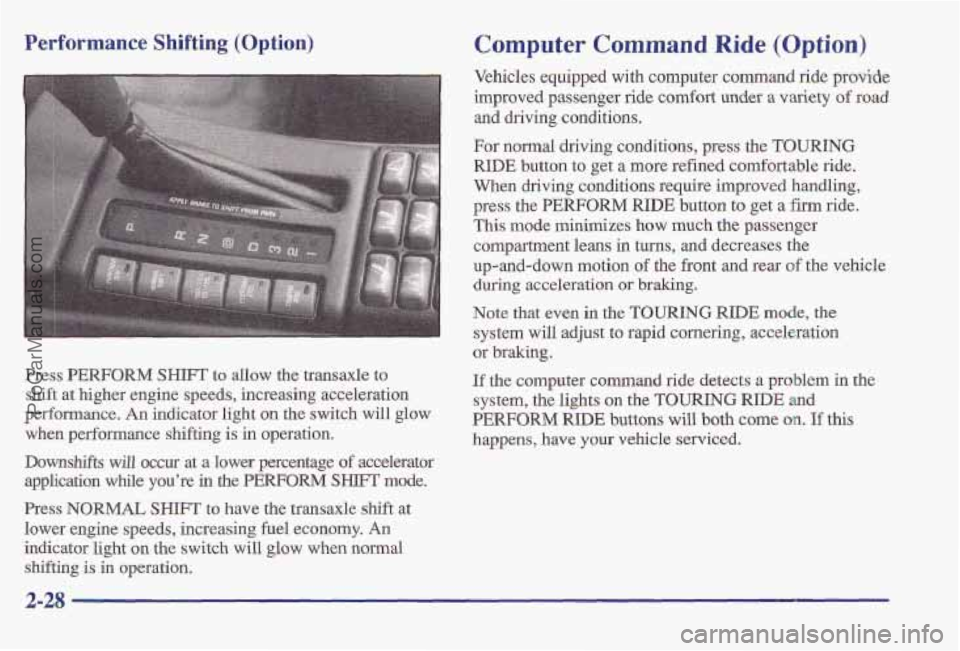
PERFORM SHIFT to allow the transaxle to
shift at higher engine speeds, increasing acceleration
performance.
An indicator light on the switch will glow
when performance shifting is in operation.
Downshifts will occur at a lower percentage of accelerator
application while you're
in the PERFORM SHIFT' mode,
Press NORMAL
SHIFT to have the transaxle shift at
lower engine speeds, increasing fuel economy. An
indicator light
on the switch will glow when normal
shifting
is in operation. Note
that even
in the TOURING RIDE mode, the
system will adjust to rapid cornering, acceleration
or
braking.
If the computer command ride detects a problem in the
system, the lights
on the TOURING RIDE and
PERFORM RIDE buttons will both come on. If this
happens, have
your vehicle serviced.
2-28
ProCarManuals.com
Page 113 of 405
Instrument Panel Clusters
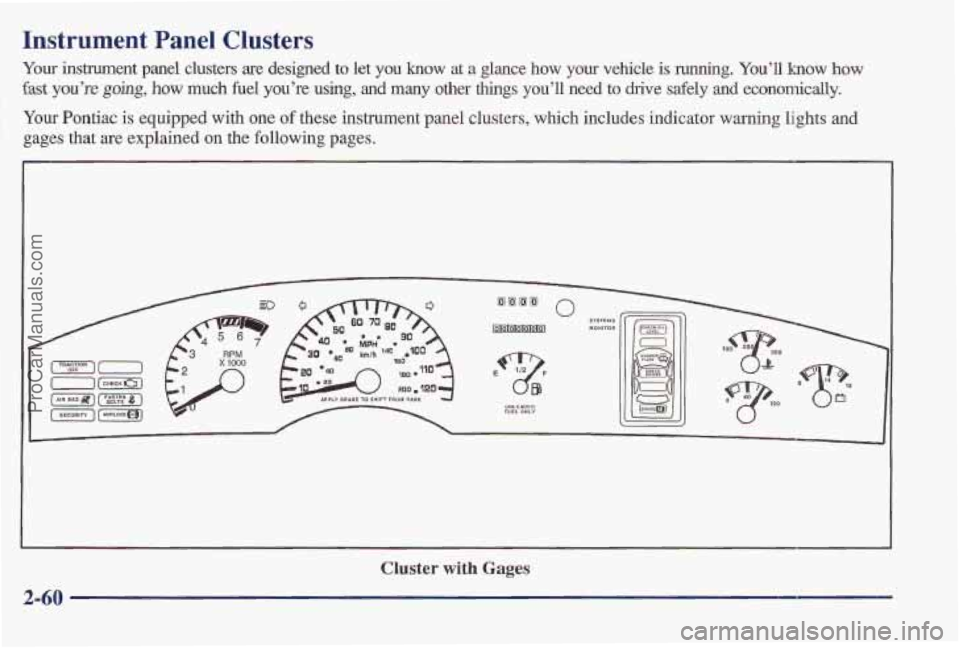
Your instrument panel clusters are designed to let you know at a glance how your vehide is running. You’ll know how
fast you’re going, how much fuel you’re using, and many other things you’ll need to drive safely and economically.
Your Pontiac is equipped with one of these instrument panel clusters, which includes indicator warning lights and -
gages that are explained on the following pages.
--
I ~~~~~~
~ -- -
FUEL ONLY UNLEADED
2-60
ProCarManuals.com