Page 6 of 405
L
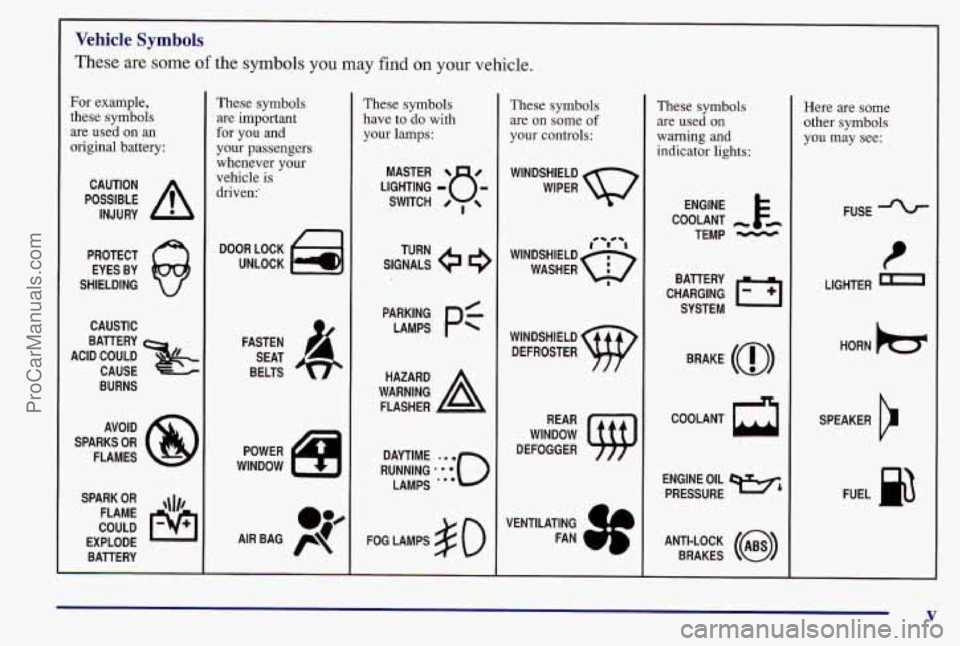
Vehicle Symbols
These are some of the symbols you may find on your vehicle.
For example,
these symbols
are used on an
original battery:
POSSIBLE A
CAUTION
INJURY
PROTECT EYES BY
SHIELDING
CAUSTIC
ACID COULD BATTERY
CAUSE
BURNS
AVOID
SPARKS
OR
FLAMES
SPARK
OR ,111,
COULD FLAME
EXPLODE BATTERY
These symbols are important
for you and
your passengers
whenever your
vehicle
is
driven:'
DOOR LOCK
UNLOCK
FASTEN SEAT
BELTS
These symbols
have to
do with
your lamps:
SIGNALS e
TURN
FOG LAMPS # 0
These symbols
are on some
of
your controls:
WINDSHIELD
WIPER
WINDSHIELD DEFROSTER
WINDOW
DEFOGGER
VENTILATING
(
FAN
These symbols
are used on
warning and
indicator lights:
COOLANT -
TEMP -
CHARGING I-1
BAllERY
SYSTEM
BRAKE
(a)
COOLANT
a
ENGINE OIL
PRESSURE
-4
ANTI-LOCK (@)
BRAKES
Here are some
other symbols
you may see:
FUSE
t
LIGHTER a
HORN )tr
SPEAKER
b
FUEL p3
V
ProCarManuals.com
Page 98 of 405
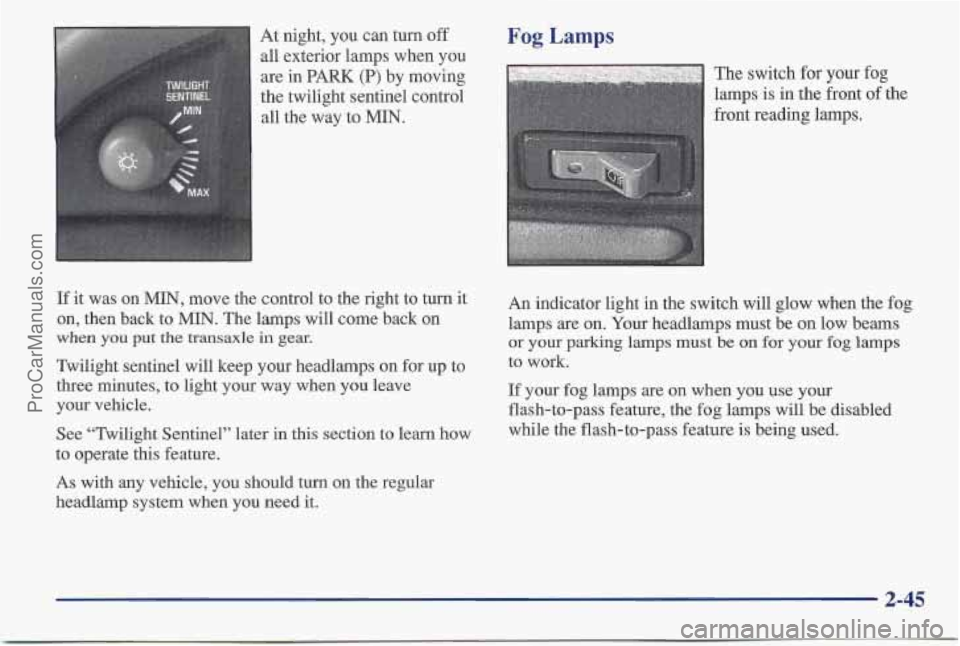
At night, you can turn off
all exterior lamps when you
are in PARK (P) by moving
the twilight sentinel control
all the way to MIN. Fog Lamps
The switch for your fog
lamps is in the front of the
front reading lamps.
If it Was On Mm, move the control to the right to tUlTl it
An indicator light in the switch will glow when the fog
on, then back to MIN. The lamps will come back on
lamps are on. Your headlamps must be on low beams
when you put the transaxle in gear. or your parking lamps must be on for your fog lamps
Twilight sentinel will keep your headlamps on for up to to
Work-
three minutes, to light
your way when you leave If your fog lamps are on when you use your
your vehicle. flash-to-pass feature, the
fog lamps will be disabled
to operate this feature. See
‘‘Twilight Sentinel” later in this section to learn how while the flash-to-pass feature is being used.
As with any vehicle, you should turn on the regular
headlamp system when you need
it.
2-45
ProCarManuals.com
Page 147 of 405
Air Conditioning
On hot days, open the windows long enough to let hot
inside
air escape. This reduces the time it takes for your
vehicle to cool down. Then keep your windows closed
for the air conditioner to work its best.
If
you have the standard system, for 'quick cool-down on
very hot days, use
MAX with the temperature knob in
the blue
area. If this setting is used for long periods of
time, the air in your vehicle may become too cold and
dry. For normal cooling on hot
days, use A/C with the
temperature
knob in the blue area. This setting cools the
air entering your vehicle and directs it through the
instrument panel outlets.
If you have the electronic system, press the A/C button
to turn
the system on. The system will cool and
dehumidify the air inside the vehicle.
Also while in
AUTO mode, the system will use RECIRC as necessary
to cool the air.
On cool but
sunny days, with the standard system or
through manual operation
of the electronic system, use
BI-LEVEL to deliver warm air to the floor and cooler air
to the middle instrument panel outlets. To warm or cool
the air delivered, push
the TEMP button up or down.
When the air conditioning system is in
AUTO mode,
the
A/C light will always be on. When the ambient
-/
temperature outside the vehicle reaches 40°F (4" C),
the compressor will remain on continuously.
Heating
If you have the standard system, on cold days use
HEATER with the temperature knob in the red area. If
you have the electronic system, press AUTO and adjust
the temperature by pressing the
TEMP up or down
arrow. You may also adjust the electronic system
nmnually
by pressing the MODE button and selecting
HEAT. Again, adjust the temperature by pressing the
TEMP up or down arrow.
With each system, outside air will
be brought in and sent
through the floor outlets. The heater works best if you
keep your windows closed while using it.
Ventilation System
For mild outside temperatures when little heating or
cooling
is needed, use VENT (on the standard system)
to direct outside air through your vehicle. Air will flow
through the middle instrument panel 'outlets.
Your vehicle's flow-through ventilation system supplies
outside air into the vehicle when
it's moving, When the
vehicle is not moving, you can get outside air to flow
through by selecting any air choice (except the rear
window defogger) and any fan
speed.
5-6
ProCarManuals.com
Page 150 of 405
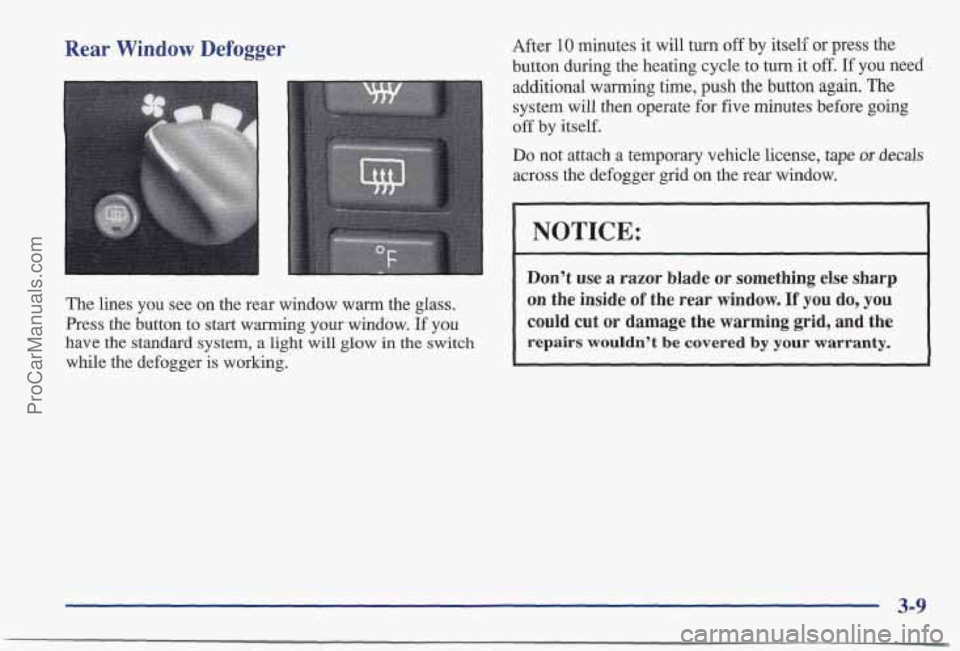
Rear Window Defogger
The lines you see on the rea window warm the glass.
Press the button to start warming your window. If you
have
the standard system, a light will glow in the switch
while the defogger is working. After
10 minutes
it will turn off by itself or press the
button during the heating cycle to turn it off.
If you need
additional warming time, push the button again.
The
system will then operate for five minutes before going
off by itself.
Do not attach a temporary vehicle license, tape or decals
across the defogger grid on the rear window.
NOTICE:
Don’t use a razor blade or something else sharp
on the inside
of the rear window. If you do, you
could cut or damage the warming grid, and the
repairs wouldn’t be covered by your warranty.
3-9
ProCarManuals.com
Page 316 of 405
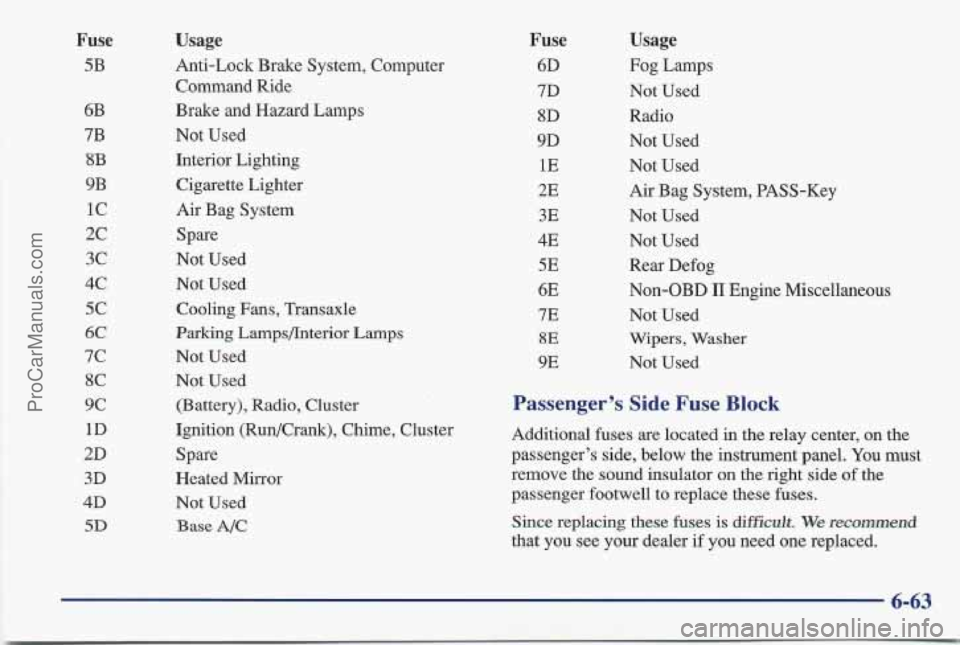
Fuse
5B
6B
7B
8B
9B
1c
2c
3c
4c
5c
6C
7c
8C
9c
1D
2D
3D
4D
5D
Usage
Anti-Lock Brake System, Computer Command Ride
Brake and Hazard Lamps
Not Used Interior Lighting
Cigarette Lighter
Air Bag System Spare
Not Used
Not Used
Cooling Fans, Transaxle
Parking LampsDnterior Lamps
Not Used
Not Used
(Battery), Radio, Cluster
Ignition (Run/Crank), Chime, Cluster Spare
Heated Mirror
Not Used
Base A/C
Fuse Usage
6D Fog Lamps
7D Not Used
8D Radio
9D Not Used
1E Not Used
2E Air Bag System, PASS-Key
3E Not Used
4E Not Used
5E Rear Defog
6E Non-OBD I1 Engine Miscellaneous
7E Not Used
8E Wipers, Washer
9E Not Used
Passenger’s Side Fuse Block
Additional fuses are located in the relay center, on the
passenger’s side, below the instrument panel. You must
remove the sound insulator on the right side
of the
passenger footwell to replace these
fuses.
Since replacing these fuses is difficult. We recommend
that you see your dealer if you need one replaced.
6-63
ProCarManuals.com