Page 17 of 405
&: If I’m a good driver, and I never drive far from
A: You may be an excellent driver, but if you’re in an
home, why should I wear safety belts?
accident -- even one that isn’t your fault -- you and
your passengers can be hurt. Being a good driver
doesn’t protect you from things beyond your
control, such as bad drivers.
Most accidents occur within
25 miles (40 km) of
home. And the greatest number of serious injuries
and deaths occur at speeds of less than
40 mph (65
km/h).
Safety belts are for everyone.
How to Wear Safety Belts Properly
Adults
This part is only for people of adult size.
Be aware that there are special things to know about safety
belts
and children. And there are different rules for smaller
children and babies. If a child will be riding in
your
Pontiac, see the part of this manual called “Children.”
Follow those rules for everyone’s protection.
First, you’ll want to know which restraint systems your
vehicle has.
We’ll start with the driver position.
Driver Position
This part describes the driver’s restraint system.
Lap-Shoulder Belt
The driver has a lap-shoulder belt. Here’s how to wear
it properly.
1. Close and lock the door.
2. Adjust the seat (to see how, see “Seats” in the Index)
so you can sit up straight.
1-10
ProCarManuals.com
Page 57 of 405
Door Locks
Unlocked doors can be dangerous.
Passengers
-- especially children -- can easily
open the doors and fall
out. When a door is
locked, the inside handle won’t open it.
Outsiders can easily enter through an unlocked
door when you slow down or stop your vehicle.
This may not be so obvious: You increase the
chance
of being thrown out of the vehicle in a
crash if the doors aren’t locked. Wear safety belts
properly, lock your doors, and
you will be far
better
off whenever you drive your vehicle.
There
are several ways to lock and unlock your vehicle.
From the outside, use your door key or Remote Keyless
Entry transmitter, if your vehicle has this option. With
your door key, turning the key toward the rear of the
vehicle will lock
the door and turning the key toward the
front
of the vehicle will unlock it.
If your vehicle has a theft-deterrent system and it is
activated, unlock
the doors only with the key or Remote
Keyless
Entry system. This will avoid setting off
the alarm.
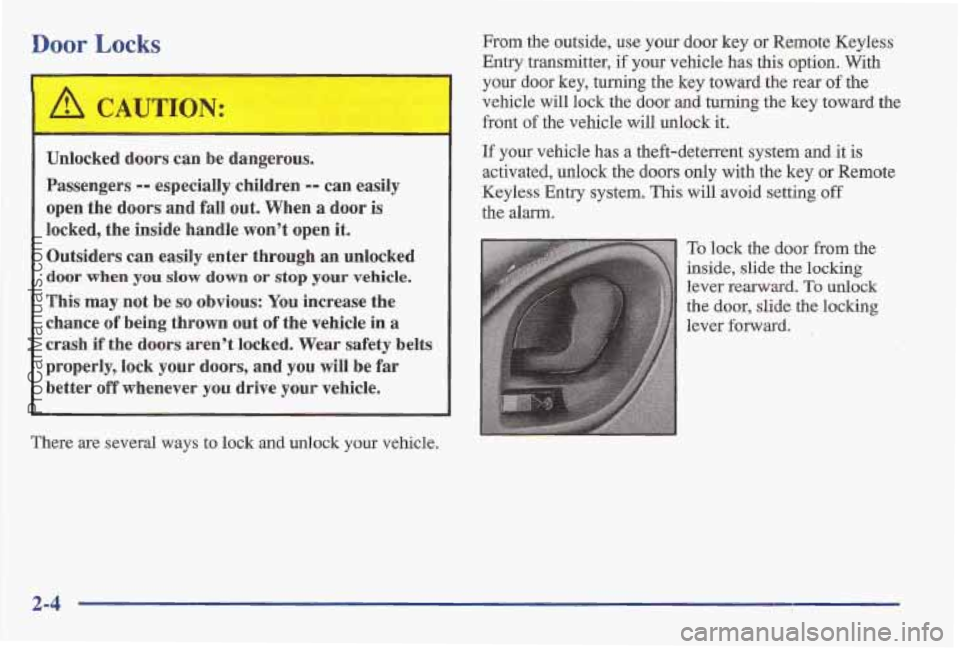
To lock the door
from the
inside,
slide the locking
lever rearward.
To unlock
the door, slide the locking
lever forward.
,
2-4
ProCarManuals.com
Page 62 of 405
If you don’t cancel the security lock feature, adults or
older children who ride in the rear won’t be able to open
the rear door from the inside. You should let adults and
older children know how these security locks work, and
how
to cancel the locks.
To cancel the rear door lock:
1. Unlock the door and open the door from the outside.
2. Move the lever all the way down.
3. D’o the same for the other rear door.
The rear door locks will now work normally.
Anti-Lockout Feature
The power door locks will not work if the key is left in the
ignition with
the driver’s door open. You can override this
feature by holding the power door lock switch for more than three seconds, unless the engine is running.
Leaving Your Vehicle
If you are leaving the vehicle, take your keys, open your
door and set
the locks from the inside. Then get out and
close the door. You may also use the lock button on the
remote keyless entry transmitter after shutting the doors.
If your vehicle
has a theft-deterrent system, see
“Universal Theft-Deterrent” in the Index.
Remote Keyless Entry (Option)
If your Pontiac has this option, you can lock and unlock
your doors or unlock your trunk from about
3 feet (1 m)
up to 30 feet (9 m) away using the remote keyless entry
transmitter supplied with your vehicle.
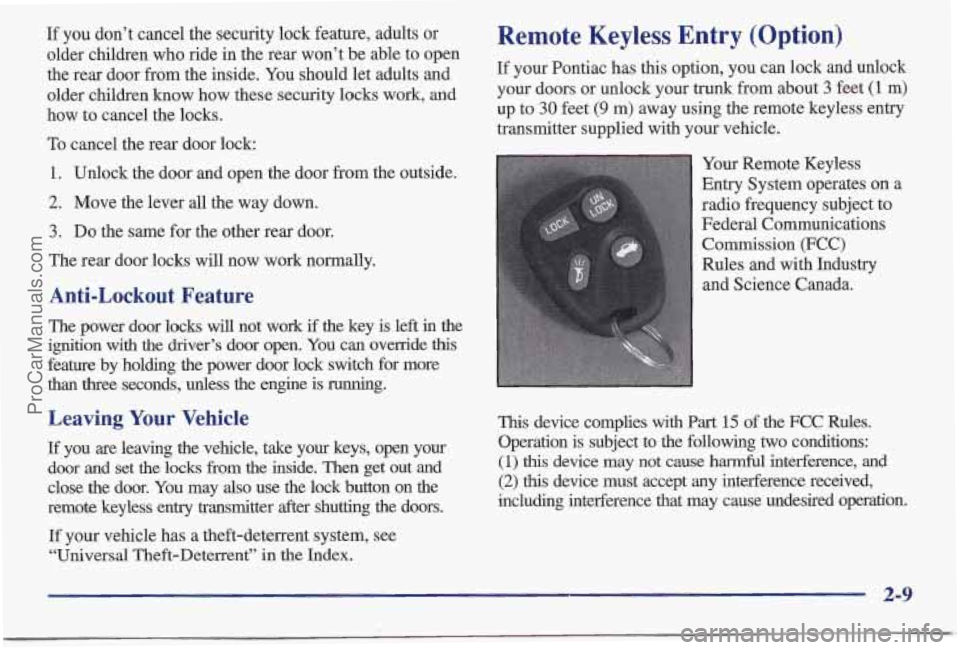
Your Remote Keyless
Entry System operates
on a
radio frequency subject to
Federal Communications Commission
(FCC)
Rules and with Industry
and Science Canada.
This device complies with Part 15 of the FCC Rules.
Operation is subject to the following
two conditions:
(1) this device may not cause harmful interference, and
(2) this device must accept any interference received,
including interference that may cause undesired operation.
2-9
ProCarManuals.com
Page 185 of 405
Steering in Emergencies
There are times when steering can be more effective
than braking. For example, you come over a hill and
find
a truck stopped in your lane, or a car suddenly pulls
out from nowhere, or a child darts out from b’etween
parked cars
and stops right in front of you. You can
avoid these problems
by braking -- if you can stop
in time. But sometimes
you can’t; there isn’t room.
That’s the time for evasive action -- steering around
the problem.
Your Pontiac can perform very well in emergencies like
these. First apply your brakes. (See “Braking
in
Emergencies” earlier in this section.) It is better to
remove
as much speed as you can from a possible
collision. Then steer around the
problem, to the left or
right depending on the space available.
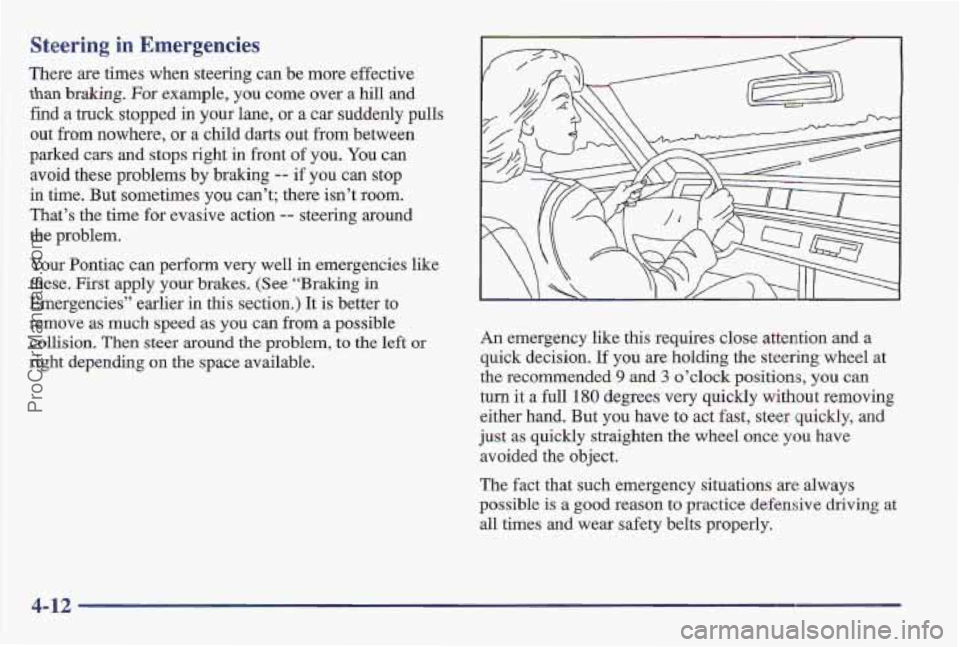
An emergency like this requires close attention and a
quick decision.
If you are holding the steering wheel at
the recommended 9 and 3 o’clock positions, you can
turn it a full 180 degrees very quickly without removing
either hand. But
you have to act fast, steer quickly, and
just as quickly straighten the wheel once you have
avoided the object.
The fact that such emergency situations are always
possible is a
good reason to practice defensive driving at
all times and wear safety belts properly.
4-12
ProCarManuals.com