1997 PONTIAC BONNEVILLE tow
[x] Cancel search: towPage 29 of 405
What makes an air bag inflate?
In an impact of sufficient severity, the air bag sensing
system detects that the vehicle is in a crash. The sensing
system triggers a release of gas from the inflator, which
inflates the air bag. The inflator, air bag and related
hardware are all part of the air bag modules inside the
steering wheel and in the instrument panel in front of the
right front passenger.
How does an air bag restrain?
In moderate to severe frontal or near-frontal collisions,
even belted occupants can contact the steering wheel or
the instrument panel. Air bags supplement the protection
provided by safety belts. Air bags distribute the force of
the impact more evenly over the occupant’s upper body,
stopping the occupant more gradually. But air bags
would not help
you in many types of collisions,
including rollovers, rear impacts and side impacts,
primarily because an occupant’s motion is not toward
those air bags. Air bags should never be regarded as
anything more than a supplement to safety belts,
and then only in moderate to severe frontal or
near-frontal collisions.
What will you see after an air bag inflates?
After an air bag inflates, it quickly deflates, so quickly
that some people may not even realize the air bag
inflated. Some components of the air bag module in the
steering wheel hub for the driver’s air bag, or the
instrument panel for the right front passenger’s bag, will
be hot for a short time. The parts of the bag that come
into contact with you may be warm, but not too hot to
touch. There will be some smoke and dust coming from
vents in the deflated air bags. Air bag inflation doesn’t
prevent the driver from seeing or from being able
to
steer the vehicle, nor does it stop people from leaving
the vehicle.
When an air bag inflates, there is dust in the air.
This dust could cause breathing problems for
people with a history of asthma or other
breathing trouble. To avoid this, everyone in the
vehicle should get out as soon as
it is safe to do so.
If you have breathing problems but can’t get out
of the vehicle after an air bag inflates, then get
fresh air by opening a window or door.
1-22
ProCarManuals.com
Page 49 of 405
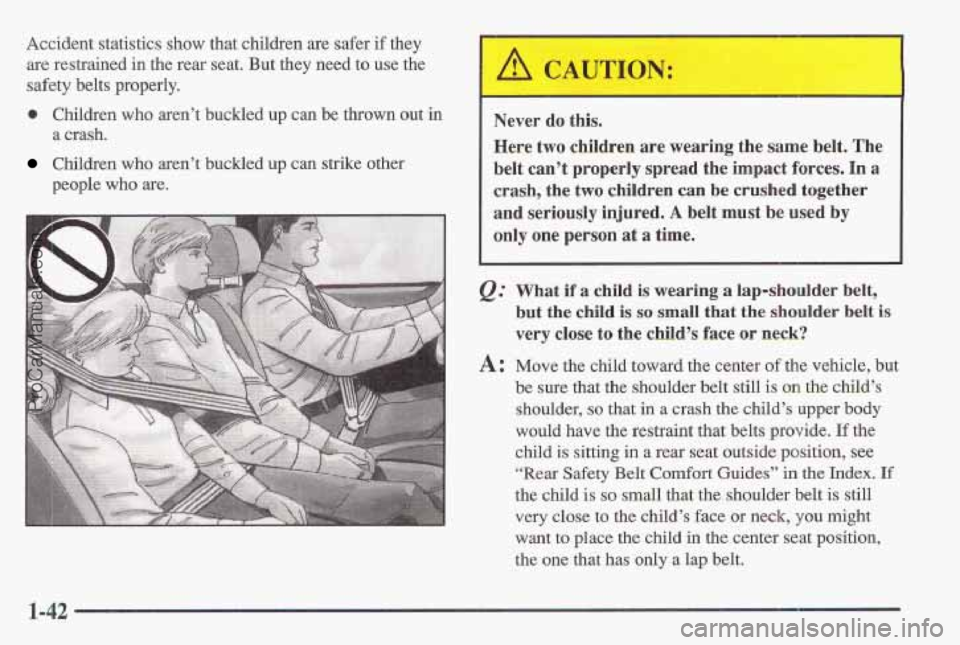
Accident statistics show that children are safer if they
are restrained in the rear seat. But they need to use the
safety belts properly.
0 Children who aren’t buckled up can be thrown out in
a crash.
Children who aren’t buckled up can strike other
people who
are.
Never do this.
Here two children are wearing the same belt. The
belt can’t properly spread the impact forces.
In a
crash, the two children can be crushed together
and seriously injured.
A belt must be used by
only one person
at a time.
A:
What if a child is wearing a lap-shoulder belt,
but the
child is so small that the shoulder belt is
very close to the child’s face or neck?
Move the child toward the center
of the vehicle, but
be sure that the shoulder belt still is
on the child’s
shoulder, so that in a crash the child’s upper body
would have the restraint that belts provide.
If the
child is sitting in a rear seat outside position,
see
“Rear Safety Belt Comfort Guides” in the Index. If
the child is so small that the shoulder belt is still
very close to the child’s face or neck, you might
want
to place the child in the center seat position,
the one that has only a lap belt.
1-42
ProCarManuals.com
Page 57 of 405
Door Locks
Unlocked doors can be dangerous.
Passengers
-- especially children -- can easily
open the doors and fall
out. When a door is
locked, the inside handle won’t open it.
Outsiders can easily enter through an unlocked
door when you slow down or stop your vehicle.
This may not be so obvious: You increase the
chance
of being thrown out of the vehicle in a
crash if the doors aren’t locked. Wear safety belts
properly, lock your doors, and
you will be far
better
off whenever you drive your vehicle.
There
are several ways to lock and unlock your vehicle.
From the outside, use your door key or Remote Keyless
Entry transmitter, if your vehicle has this option. With
your door key, turning the key toward the rear of the
vehicle will lock
the door and turning the key toward the
front
of the vehicle will unlock it.
If your vehicle has a theft-deterrent system and it is
activated, unlock
the doors only with the key or Remote
Keyless
Entry system. This will avoid setting off
the alarm.
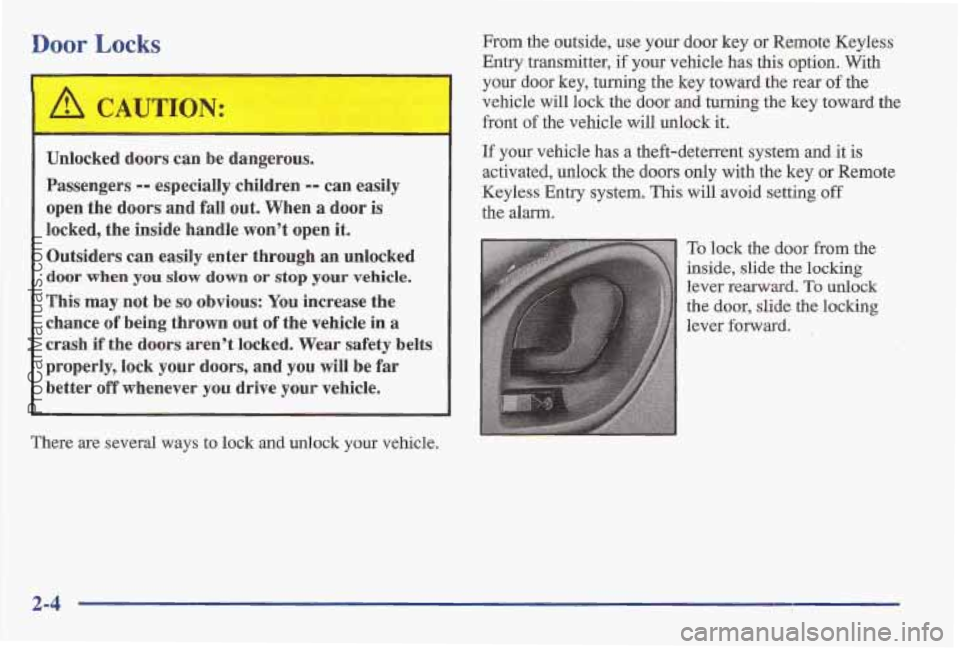
To lock the door
from the
inside,
slide the locking
lever rearward.
To unlock
the door, slide the locking
lever forward.
,
2-4
ProCarManuals.com
Page 72 of 405
See your Pontiac dealer or a locksmith who can service
the PASS-Key
I1 to have a new key made.
If you’re ever driving and the SECURITY light comes
on and remains on, you will
be able to restart your
engine
if you turn it off. Your PASS-Key I1 system,
however,
is not working properly and must be serviced
by your Pontiac dealer. Your vehicle is not protected by
the PASS-Key
I1 system.
If you lose or damage a PASS-Key I1 ignition key,
see your Pontiac dealer or a locksmith
who can service
PASS-Key
I1 to have a new key made. In an emergency,
call the Pontiac Roadside Assistance Center
at
l-SOO-ROADSI~, or 1-800-762-3743.
New Vehicle CCBreak-In”
NOTICE:
Your modern Pontiac doesn’t need an elaborate
“break-in.” But it will perform better in the long
run if you follow these guidelines:
Don’t drive at any one speed -- fast or
slow
-- for the first 500 miles (805 km).
Don’t make full-throttle starts.
200 miles (322 km) or so. During this time
your new brake linings aren’t yet broken
in. Hard stops with new linings can mean
premature wear and earlier replacement.
Follow
this breaking-in guideline every
time you get new brake linings.
See “Towing
a Trailer” in the Index for
more information.
Avoid making hard stops for the first
Don’t tow a trailer during break-in.
2-19
ProCarManuals.com
Page 73 of 405
Ignition Positions
C
A E
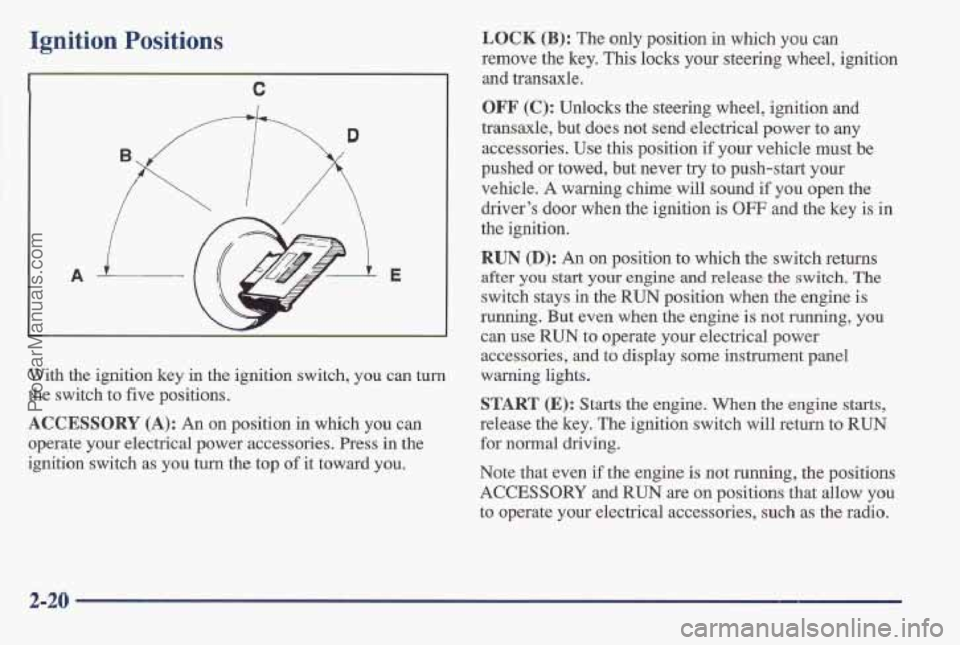
With the ignition key in the ignition switch, you can turn
the switch to five positions.
ACCESSORY (A): An on position in which you can
operate your electrical power accessories. Press in the
ignition switch as you
turn the top of it toward you.
LOCK (B): The only position in which you can
remove the key. This locks your steering wheel, ignition
and transaxle.
OFF (C): Unlocks the steering wheel, ignition and
transaxle, but does not send electrical power to any
accessories. Use this position if your vehicle must be
pushed
or towed, but never try to push-start your
vehicle.
A warning chime will sound if you open the
driver’s door when the ignition
is OFF and the key is in
the ignition.
RUN (D): An on position to which the switch returns
after you start your engine and release the switch. The
switch stays in the RUN position when the engine is
running. But even when the engine is not running, you
can use RUN
to operate your electrical power
accessories, and
to display some instrument panel
warning lights.
START (E): Starts the engine. When the engine starts,
release the key. The ignition switch will return to RUN
for normal driving.
Note that even
if the engine is not running, the positions
ACCESSORY and RUN are on positions that allow
you
to operate your electrical accessories, such as the radio.
2-20
ProCarManuals.com
Page 75 of 405
NOTICE:
Holding your key in START for longer than
15 seconds at a time will cause your battery to
be drained much sooner. And the excessive heat
can damage
your starter motor.
2. If it doesn’t start right away, hold your key in
START for about three to five seconds at a time until
your engine starts. Wait about
15 seconds between
each try to help avoid draining your battery.
3. If your engine still won’t start (or starts but then
stops), it could be flooded with too much gasoline.
Try pushing your accelerator pedal all the way to the
floor and holding
it there as you hold the key in
START for about three seconds. If the vehicle starts
briefly
but then stops again, do the same thing, but
this time keep the pedal down for five or six seconds.
This clears the extra gasoline from the engine.
After
waiting about 15 seconds, repeat the normal
starting procedure.
NOTICE:
Your engine is designed to work with the
electronics in your vehicle. If you add electrical
parts or accessories, you could change the way
the engine operates. Before adding electrical
equipment, check with your dealer.
If you don’t,
your engine might not perform properly.
If you ever have to have your vehicle towed, see
the part
of this manual that tells how to do it
without damaging your vehicle. See “Towing
Your Vehicle” in the Index.
2-22
ProCarManuals.com
Page 78 of 405
r
It is dangerous to get out of your vehicle if the
shift lever is not fully in
PARK (P) with the
parking brake firmly set. Your vehicle can
roll.
Don’t leave your vehicle when the engine is
running unless you have to. If you have left the
engine running, the vehicle can move suddenly.
You or others could be injured. To be sure your
vehicle won’t move, even when you’re on fairly
level ground, always
set your parking brake and
move the shift lever
to PARK (P).
See “Shifting Into PARK (P)” in the Index. If
you’re pulling a trailer, see “Towing a Trailer” in
the Index. Ensure
the shift lever is fully in PARK
(P) range before
starting the engine. Your Pontiac has a brake-transaxle
shift interlock. You have to fully
apply your regular
brakes
before you can shift from PARK (P) when the
ignition key is in an on position. If you cannot shift out
of PARK (P), ease pressure on the shift lever
-- push the
shift lever all the way into
PARK (P) and also release
the shift lever button
on floor shift console models as
you maintain brake application. Then move the shift lever into the gear you wish. (Press the shift lever button
before moving the shift lever on floor shift console
models.) See “Shifting Out of PARK
(P)” later in
this section.
REVERSE (R): Use this gear to back up.
I NOTICE:
Shifting to REVERSE (R) while your vehicle is
moving forward could damage your transaxle.
Shift to
REVERSE (R) only after your vehicle
is stopped.
To rock your vehicle back and forth to get out’of snow,
ice or sand without damaging your transaxle, see
“Stuck: In
Sand, Mud, Ice or Snow” in the Index.
2-25
- ProCarManuals.com
Page 79 of 405
NEUTRAL (N): In this position, your engine
doesn’t connect with the wheels.
To restart when you’re
already moving,
use NEUTRAL (N) only. Also, use
NEUTRAL (N) when your vehicle is being towed.
I
Damage to your transaxle caused by shifting out
of
PARK (P) or NEUTRAL (N) with the engine
racing isn’t covered by your warranty.
Shifting
out of PARK (P) or NEUTRAL (N) while
your engine is
“racing” (running at high speed) is I
dangerous. Unless your foot is firmly on the
brake pedal, your vehicle could move very
rapidly.
You could lose control and hit people
or objects. Don’t shift out
of PARK (P) or
NEUTRAL (N) while your engine is racing.
NOTICE:
AUTOMATIC OVERDRIVE (a): This position is for
normal driving. If you need more power fOr passing, and
you’re:
Going less than about 35 mph (56 km/h), push your
accelerator pedal about halfway down.
0 Going about 35 mph (56 h/h) or more, push the
accelerator all the way down.
You’ll shift down to the next gear and have more power.
NOTICE:
If your vehicle seems to start up rather slowly,
or if it seems not
to shift gears as you go faster,
something may be wrong with
a transaxle system
sensor.
If you drive very far that way, your
vehicle can be damaged.
So, if this happens, have
your vehi’cle serviced right away. Until then, you
can
use SECOND (2) when you are driving less
than
35 mph (56 kmh) and AUTOMATIC
OVERDRIVE (0) for higher speeds.
DRIVE
(D): This position is also used for normal
driving, however, it offers more power and lower fuel
economy than
AUTOMATIC OVERDRIVE (@).
2-26
ProCarManuals.com