1997 PONTIAC BONNEVILLE air condition
[x] Cancel search: air conditionPage 124 of 405
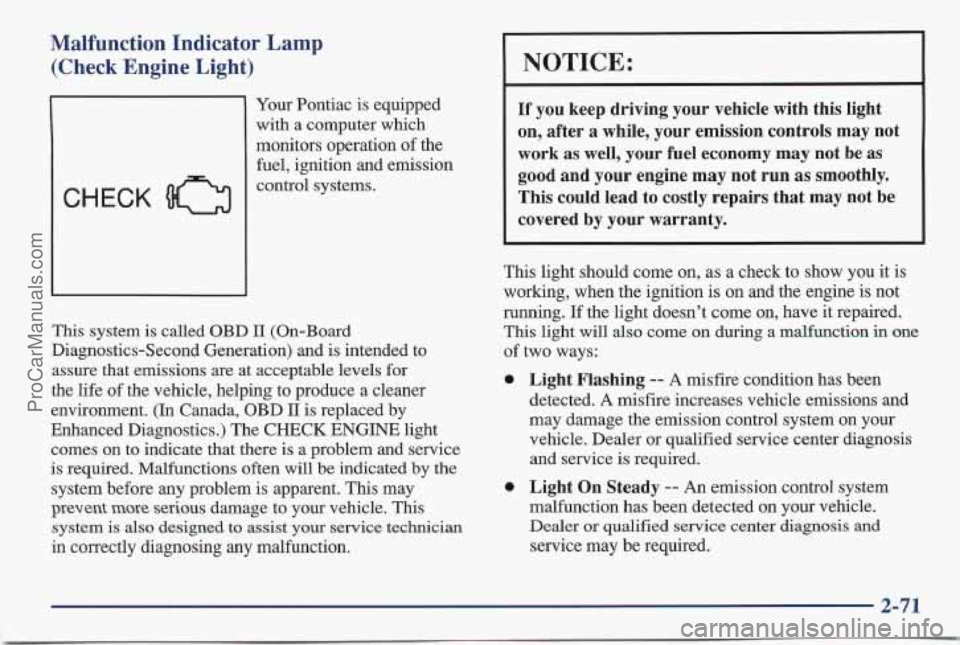
Malfunction Indicator Lamp (Check Engine Light)
CHECK
Your Pontiac is equipped
with a computer which
monitors operation
of the
fuel, ignition and emission
control systems.
This system is called OBD
I1 (On-Board
Diagnostics-Second Generation) and is intended to
assure that emissions
are at acceptable levels for
the life
of the vehicle, helping to produce a cleaner
environment. (In Canada,
OBD I1 is replaced by
Enhanced Diagnostics.) The CHECK ENGINE light
comes on to indicate that there is a problem and service
is required. Malfunctions often will be indicated by the
system before any problem is apparent. This may
prevent more serious damage to your vehicle. This
system
is also designed to assist your service technician
in correctly diagnosing any malfunction.
NOTICE:
If you keep driving your vehicle with this light
on, after a while, your emission controls may not
work as well, your fuel economy may not be
as
good and your engine may not run as smoothly.
This could lead to costly repairs that may not be covered by your warranty.
This light should come on, as a check to show you it is
working, when the ignition
is on and the engine is not
running.
If the light doesn’t come on, have it repaired.
This light will also come on during a malfunction in
one
of two ways:
0 Light Flashing -- A misfire condition has been
detected.
A misfire increases vehicle emissions and
may damage the emission control system on your
vehicle. Dealer or qualified service center diagnosis
and service is required.
0 Light On Steady -- An emission control system
malfunction has been detected on your vehicle.
Dealer or qualified
service center diagnosis and
service may be required.
2-71
ProCarManuals.com
Page 142 of 405
Section 3 Comfort Controls and Audio Systems
In this section, you’ll find out how to operate the comfort control and audio systems offered with your Pontiac. Be
sure to read about the particular systems supplied with your vehicle.
3-2 3-2
3-3
3-6 3-6
3-6
3-8
3-9
3-10 3-10
3-10 Comfort Controls
Standard Climate Control System
Electronic Climate Control System Air Conditioning
Heating
Ventilation System
Defogging and Defrosting
Rear Window Defogger
Setting the Clock for AM-FM Stereo
Setting the Clock for All Systems Except
AM-FM Stereo
AM-FM Stereo 3-16
3-19 3-22
3-25 3-27
3-28
3-28 3-29 3-29
3-30 AM-FM Stereo with Cassette
Tape Player
and Equalizer
AM-FM Stereo with Compact Disc Player AM-FM Stereo with Compact Disc Player
and Equalizer
Theft-Deterrent Feature Steering Wheel Controls
Understanding Radio Reception
Tips About Your Audio System
Care of Your Cassette Tape Player
Care
of Your Compact Discs
Fixed Mast Antenna
3-1
ProCarManuals.com
Page 143 of 405
Comfort Controls
This section tells you how to make your air system
work for
you. Your comfort control system uses
ozone-friendly
R- 134a refrigerant.
With these systems, you can control the heating, cooling
and ventilation
in your Pontiac. Your vehicle also has a
flow-through ventilation system described later in
this section.
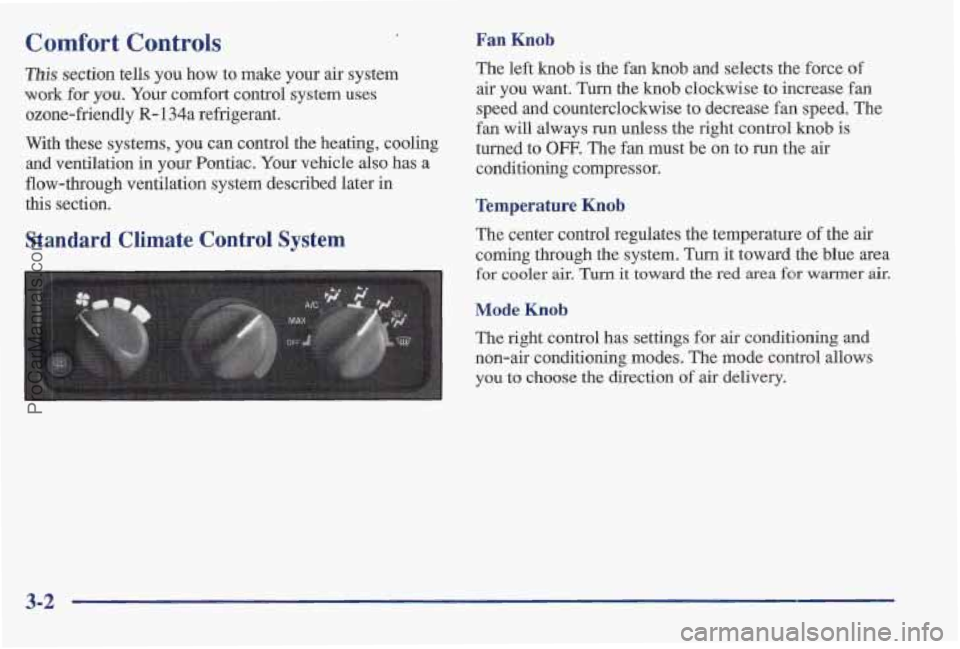
Standard Climate Control System
Fan Knob
The left knob is the fan knob and selects the force of
air you want. Turn the knob clockwise to increase fan
speed
and counterclockwise to decrease fan speed. The
fan will always
run unless the right control knob is
turned to
OFF. The fan must b'e on to run the air
conditioning compressor.
Temperature Knob
The center control regulates the temperature of the air
coming through the system. Turn it toward the blue area
for cooler air. Turn it toward the red area for warmer air.
Mode Knob
The right control has settings for air conditioning and
non-air conditioning modes. The mode control allows
you to choose
the direction of air delivery.
3-2
ProCarManuals.com
Page 144 of 405
MAX: This setting provides maximum cooling with the
least amount
of work. MAX recirculates much of the air
inside your vehicle
so it cools quickly. The air is
directed through the instrument panel outlets.
A/C: This setting cools the air entering your vehicle
and directs
it through the instrument panel outlets.
The air conditioning compressor operates in all air
conditioner positions.
12 BI-LEVEL: This setting directs air into your
vehicle in two ways. Cool air is directed to the upper
portion of your body through the middle instrument
panel outlets while warmed air is directed to the floor.
2 VENT This setting directs airflow through the
middle
instrument panel outlets. The air conditioning
compressor is not working when
VENT is selected.
'I! HEATER: This setting directs warmed air through
the floor outlets. Some warm air is diverted to the
windshield to minimize fogging.
+# DEFOG: This setting directs air to the HEATER
outlets and toward the windshield.
w.
DEFROST This setting directs most of the air
toward the windshield.
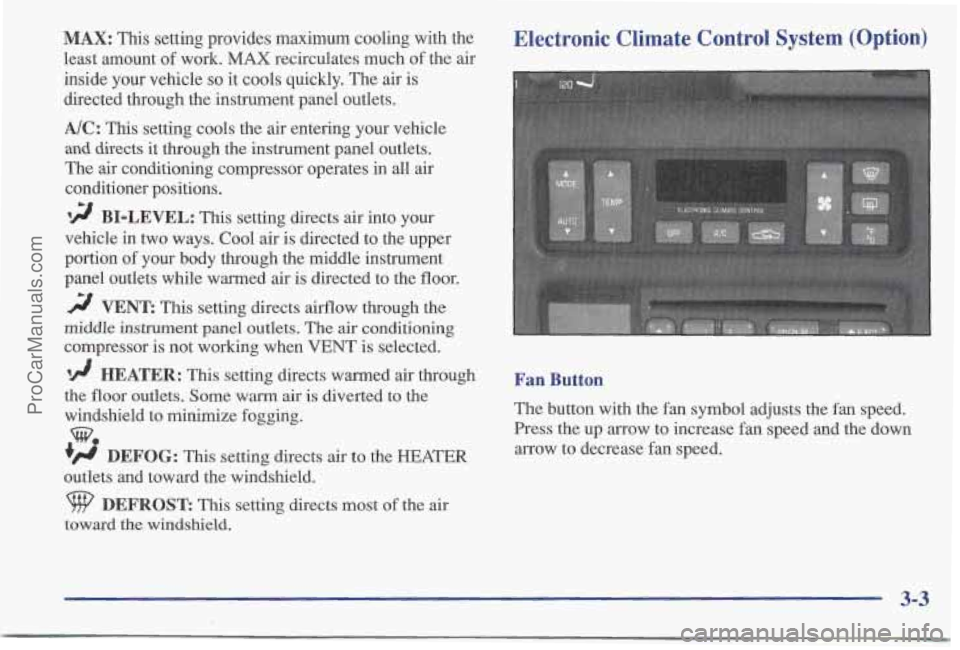
Electronic Climate Control System (Option)
Fan Button
The button with the fan symbol adjusts the fan speed.
Press the up arrow to increase fan speed and the down
arrow to decrease fan speed.
3-3
ProCarManuals.com
Page 146 of 405
Manual Operation
You may also manually adjust the air delivery mode or
fan speed.
'!A HEAT Manually selecting HEAT by cycling
through the MODE settings will deliver air to the
floor outlets.
+' DEFOG: Manually selecting DEFOG by cycling
through the MODE settings will deliver ,air to the floor
and windshield outlets.
'!! BI-LEVEL: Manually selecting BI-LEVEL by
cycling through the MODE setting will deliver warm air
to the floor and cooler air to the middle instrument
panel outlets.
OFF: Press this button to turn the system off.
Fresh air will continue to flow through the vehicle,
and the system will try
to maintain the previously set
temperature. The outside temperature will show in the
display when the system is
off.
w.
A/C: Press this button to turn the air conditioning on
and
off. The system will cool and dehumidify the air
inside the vehicle.
In the AUTO mode, the display will
show that A/C is active, but the air conditioning
compressor only operates when the system determines
it is needed.
RECIRC: Press this button to limit the amount of fresh
air entering your vehicle.
You may use this setting to
limit odors entering your vehicle. Press RECIRC to
change to a manual MODE and
air will recirculate until
the RECIRC button is pressed again. RECIRC will show
on the display and then return to EXT TEMP display.
Operating the RECIRC mode in cold temperatures or
under high humidity conditions may cause moisture to
form on the inside of the windshield. If this condition
occurs, deselect the RECIRC button.
DEFROST ,Press this button to clear the windshield.
The system will automatically control the fan speed
if
you select defrost from AUTO.
OF O C: Press this button to display the temperature
in degrees Fahrenheit or Celsius.
3-5
ProCarManuals.com
Page 147 of 405
Air Conditioning
On hot days, open the windows long enough to let hot
inside
air escape. This reduces the time it takes for your
vehicle to cool down. Then keep your windows closed
for the air conditioner to work its best.
If
you have the standard system, for 'quick cool-down on
very hot days, use
MAX with the temperature knob in
the blue
area. If this setting is used for long periods of
time, the air in your vehicle may become too cold and
dry. For normal cooling on hot
days, use A/C with the
temperature
knob in the blue area. This setting cools the
air entering your vehicle and directs it through the
instrument panel outlets.
If you have the electronic system, press the A/C button
to turn
the system on. The system will cool and
dehumidify the air inside the vehicle.
Also while in
AUTO mode, the system will use RECIRC as necessary
to cool the air.
On cool but
sunny days, with the standard system or
through manual operation
of the electronic system, use
BI-LEVEL to deliver warm air to the floor and cooler air
to the middle instrument panel outlets. To warm or cool
the air delivered, push
the TEMP button up or down.
When the air conditioning system is in
AUTO mode,
the
A/C light will always be on. When the ambient
-/
temperature outside the vehicle reaches 40°F (4" C),
the compressor will remain on continuously.
Heating
If you have the standard system, on cold days use
HEATER with the temperature knob in the red area. If
you have the electronic system, press AUTO and adjust
the temperature by pressing the
TEMP up or down
arrow. You may also adjust the electronic system
nmnually
by pressing the MODE button and selecting
HEAT. Again, adjust the temperature by pressing the
TEMP up or down arrow.
With each system, outside air will
be brought in and sent
through the floor outlets. The heater works best if you
keep your windows closed while using it.
Ventilation System
For mild outside temperatures when little heating or
cooling
is needed, use VENT (on the standard system)
to direct outside air through your vehicle. Air will flow
through the middle instrument panel 'outlets.
Your vehicle's flow-through ventilation system supplies
outside air into the vehicle when
it's moving, When the
vehicle is not moving, you can get outside air to flow
through by selecting any air choice (except the rear
window defogger) and any fan
speed.
5-6
ProCarManuals.com
Page 149 of 405
Ventilation Tips
0
0
0
0
Keep the hood and front air inlet free of ice, snow or
any other obstruction such as leaves. The heater and
defroster will work better, reducing the chance
of
fogging your windows.
When you enter a vehicle with the standard system
in
cold weather, select HEATER to supply air through
the floor outlets. Then turn the fan
on high for a few
moments before driving away. This will blow moist
air from the intake outlets toward the floor, not the
windshield. It reduces
the chance #of fogging your
windows. If you have the electronic system, the
AUTO
setting will do this for you. Manual operation
of the electronic system
in the HEAT mode will also
supply air though the floor outlets.
Keep the air path under the front 'seats clear of objects.
This helps air to circulate throughout your vehicle.
When the engine idles for a long time, the exterior
temperature sensor may cause the system
to blow air
that is. too cool. Once the vehicle is moving again the
system will try to maintain the set temperature inside
your vehicle.
When you start your vehicle
and the EXT TEMP
display flashes (electronic system only) for some time,
the system may need repair. See your Pontiac dealer.
Defogging and Defrosting
On cool, humid days, use DEFOG to keep the
windshield
and side windows clear. Use DEFROST to
remove fog or ice from the windshield quickly in
extremely humid or cold conditions.
If you have the standard system, use
DEFOG and adjust
the
fan speed to your comfort level. Use DEFROST
with the temperature toward'the red area and the fan
control toward high.
If you have the electronic system, press the
DEFOG
button and adjust the fan speed by pressing the fan
button up or down to your comfort level. Adjust
fan
speed by pressing the fan up or down mow. If you
select DEFROST from AUTO, the system will control
the fan speed. Adjust the temperature to your comfort
level by pressing the
TEMP up or down arrow.
3-8
ProCarManuals.com
Page 230 of 405
If No Steam Is Coming From Your Engine
If you get the overheat warning but see or hear no
steam, the problem may not be
too serious. Sometimes
the engine can get a little too hot when you:
Climb a long hill on a hot day.
Stop after high-speed driving.
Idle for long periods in traffic.
Tow a trailer.
If you get the overheat warning with no sign of steam,
try this
for a minute or so:
1. Turn off your air conditioner.
2. Turn on your heater to full hot at the highest fan
speed and open the window as necessary.
3. If you’re in a traffic jam, shift to NEUTRAL (N);
otherwise, shift to the highest gear while
driving
-- AUTOMATIC OVERDRIVE (@)
or DRIVE (D).
If you no longer have the overheat warning, you can
drive. Just to be safe, drive slower for about 10 minutes.
If the warning doesn’t come back on, you can
drive normally.
If the warning continues, pull over, stop, and park your
vehicle right away.
If there’s still no sign of steam, you can idle the engine
for two or three minutes while you’re parked, to see
if the warning stops. But then, if you still have the
warning,
turn off the engine and get everyone out
of the vehicle until it cools down.
You may decide not to lift the hood but to get service
help right away.
5-17
ProCarManuals.com