1997 PONTIAC BONNEVILLE brakes
[x] Cancel search: brakesPage 6 of 405
L
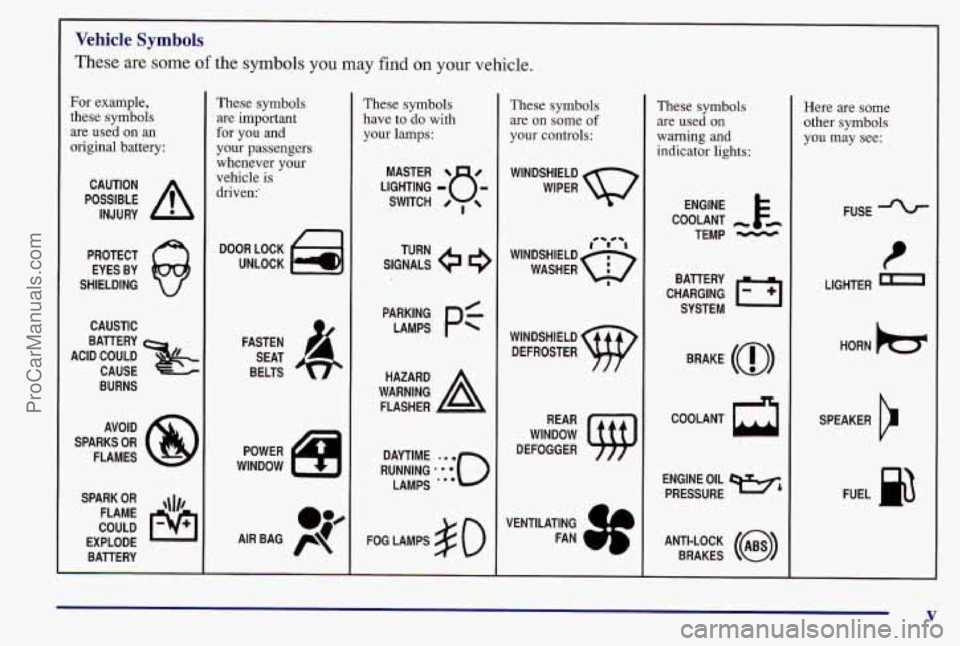
Vehicle Symbols
These are some of the symbols you may find on your vehicle.
For example,
these symbols
are used on an
original battery:
POSSIBLE A
CAUTION
INJURY
PROTECT EYES BY
SHIELDING
CAUSTIC
ACID COULD BATTERY
CAUSE
BURNS
AVOID
SPARKS
OR
FLAMES
SPARK
OR ,111,
COULD FLAME
EXPLODE BATTERY
These symbols are important
for you and
your passengers
whenever your
vehicle
is
driven:'
DOOR LOCK
UNLOCK
FASTEN SEAT
BELTS
These symbols
have to
do with
your lamps:
SIGNALS e
TURN
FOG LAMPS # 0
These symbols
are on some
of
your controls:
WINDSHIELD
WIPER
WINDSHIELD DEFROSTER
WINDOW
DEFOGGER
VENTILATING
(
FAN
These symbols
are used on
warning and
indicator lights:
COOLANT -
TEMP -
CHARGING I-1
BAllERY
SYSTEM
BRAKE
(a)
COOLANT
a
ENGINE OIL
PRESSURE
-4
ANTI-LOCK (@)
BRAKES
Here are some
other symbols
you may see:
FUSE
t
LIGHTER a
HORN )tr
SPEAKER
b
FUEL p3
V
ProCarManuals.com
Page 78 of 405
r
It is dangerous to get out of your vehicle if the
shift lever is not fully in
PARK (P) with the
parking brake firmly set. Your vehicle can
roll.
Don’t leave your vehicle when the engine is
running unless you have to. If you have left the
engine running, the vehicle can move suddenly.
You or others could be injured. To be sure your
vehicle won’t move, even when you’re on fairly
level ground, always
set your parking brake and
move the shift lever
to PARK (P).
See “Shifting Into PARK (P)” in the Index. If
you’re pulling a trailer, see “Towing a Trailer” in
the Index. Ensure
the shift lever is fully in PARK
(P) range before
starting the engine. Your Pontiac has a brake-transaxle
shift interlock. You have to fully
apply your regular
brakes
before you can shift from PARK (P) when the
ignition key is in an on position. If you cannot shift out
of PARK (P), ease pressure on the shift lever
-- push the
shift lever all the way into
PARK (P) and also release
the shift lever button
on floor shift console models as
you maintain brake application. Then move the shift lever into the gear you wish. (Press the shift lever button
before moving the shift lever on floor shift console
models.) See “Shifting Out of PARK
(P)” later in
this section.
REVERSE (R): Use this gear to back up.
I NOTICE:
Shifting to REVERSE (R) while your vehicle is
moving forward could damage your transaxle.
Shift to
REVERSE (R) only after your vehicle
is stopped.
To rock your vehicle back and forth to get out’of snow,
ice or sand without damaging your transaxle, see
“Stuck: In
Sand, Mud, Ice or Snow” in the Index.
2-25
- ProCarManuals.com
Page 80 of 405
Here are some times you might choose DRIVE (D)
instead of AUTOMATIC OVERDRIVE (@):
0 When driving on hilly, winding roads.
0 When towing a trailer, so there is less shifting
between gears.
When going down a steep hill.
SECOND (2): This position gives you more power but
lower fuel economy. You
can use SECOND (2) on hills.
It can help control your speed as you go down steep
mountain roads, but then you would also want to use
your brakes
off and on.
NOTICE:
Don’t drive in SECOND (2) for more than 5 miles
(8 km), or at speeds over 55 mph (88 km/h),
or you can damage your transaxle. Use
AUTOMATIC OVERDRIVE (@) or DRIVE (D)
as much as possible.
Don’t shift into SECOND
(2) unless you are going
s‘lower than 65 mph (105 km/h), or you can
damage
your engine.
FIRST (1): This position gives you even more power
(but lower fuel economy) than
SECOND (2). You can
use it
on very steep hills, or in deep snow or mud. If
the selector lever is put in FIRST (I ), the transaxle
won’t shift into first gear until the vehicle is going
slowly enough.
I NOTICE:
If your front wheels can’t rotate, don’t try to
drive. This might happen if you were stuck in
very deep sand or mud or were up against
a solid
object.
You could damage your transaxle.
Also, if you stop when going uphill, don’t hold
your vehicle there with only the accelerator
pedal. This could overheat
and damage the
transaxle. Use
your brakes or shift into PARK (P)
to hold your vehicle in position on a hill.
ProCarManuals.com
Page 82 of 405
Parking Brake
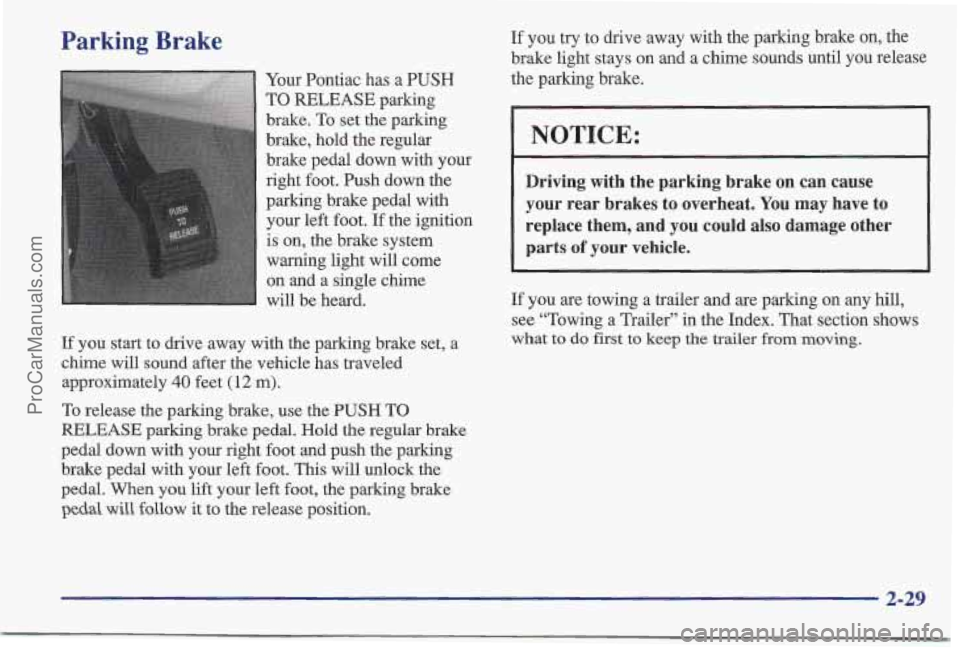
Your Pontiac has a PUSH
TO RELEASE parking
brake.
To set the parking
brake, hold the regular
brake pedal down with your
right foot. Push down the
parking brake pedal with
your left foot. If the ignition
is on, the brake system
warning light will come
on and a single chime
will be heard.
If you start to drive away with the parking brake set, a
chime will sound after the vehicle has traveled
approximately
40 feet (12 m).
If you try to drive away with the parking brake on, the
brake light stays on and a chime sounds until you release
the parking brake.
NOTICE:
Driving with the parking brake on can cause
your rear brakes to overheat.
You may have to
replace them, and you could also damage other
parts
of your vehicle.
If you are towing a trailer and are parking on any hill,
see “Towing a Trailer” in the Index. That section
shows
what to do first to keep the trailer from moving.
To release the parking brake, use the PUSH TO
RELEASE parking brake pedal. Hold the regular brake
pedal down with your right foot and push the parking
brake pedal with your left foot. This will unlock the
pedal.
When you lift your left foot, the parking brake
pedal will follow it to the release position.
2-29
ProCarManuals.com
Page 93 of 405
Windshield Washer Cruise Control
At the top of the turn signal/multifunction lever, there’s
a paddle with the word PUSH on it. To spray washer
fluid on the windshield, push the paddle for less than a
second. The wipers
will clear the window and either
stop or return to your preset speed. For more washer
cycles, push
and hold the paddle.
Some models have
a WASHER FLUID warning that
indicates if the fluid level in the windshield washer
reservoir is low.
See “Low Washer Fluid Warning Light”
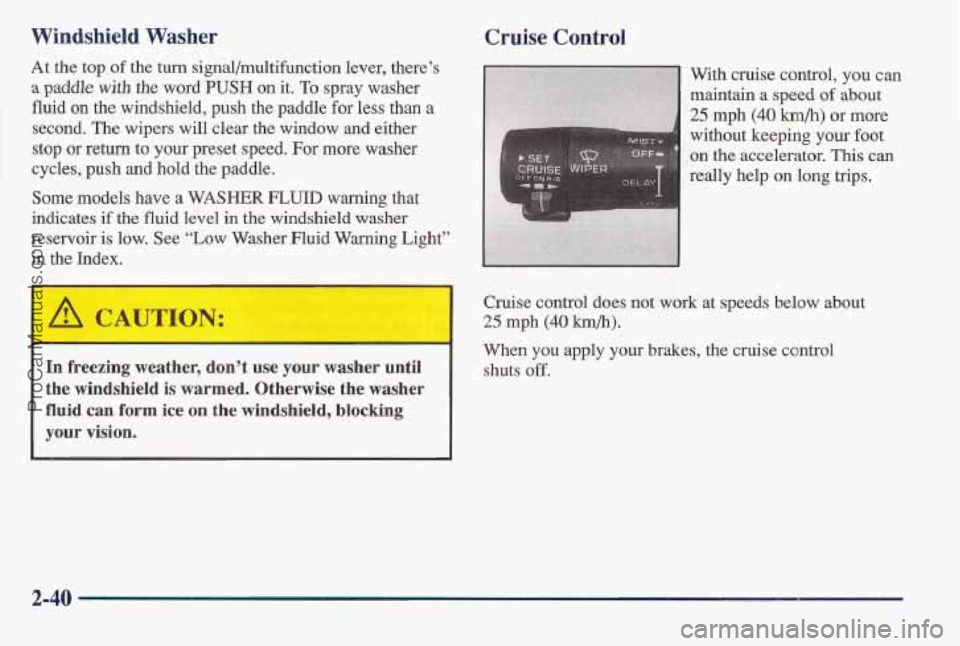
in the Index. With cruise control,
you can
maintain a speed
of about
25 mph (40 km/h) or more
without keeping your foot
~ on the accelerator. This can
really help on long trips.
4 Cruise control do’es not work at speeds below about
I
25 mph (40 km/h).
When you apply your brakes, the cruise control
In freezing weather, don’t use your washer until shuts off.
the windshi’eld is warmed, Otherwise the washer
fluid cam €orm ice on the windshield, blocking
your vision.
2-40 ~
ProCarManuals.com
Page 121 of 405
Anti-Lock Brake System Warning Light
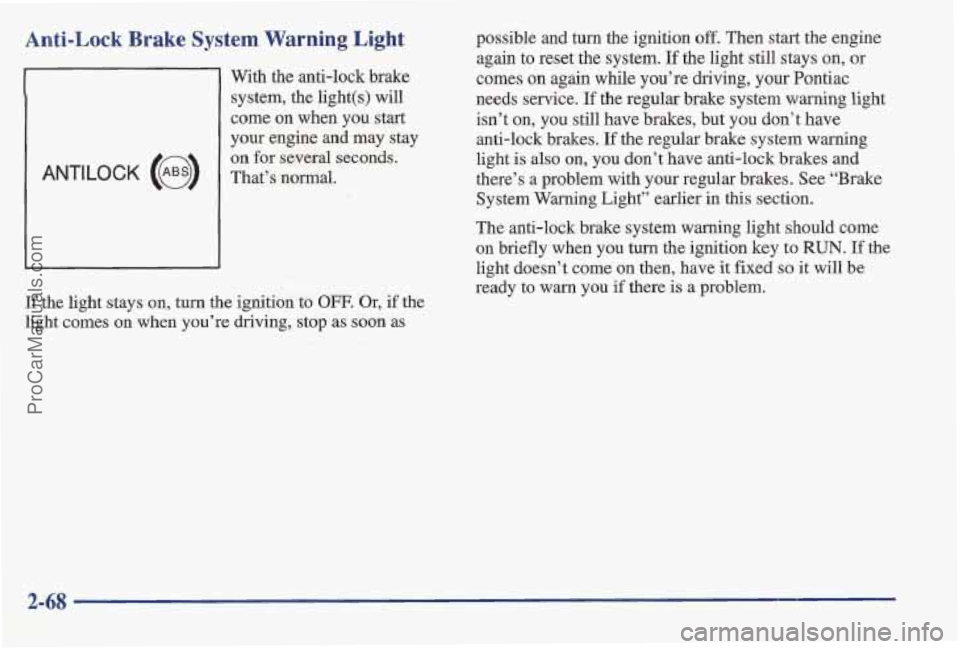
With the anti-lock brake
system, the light(s) will
come
on when you start
your engine and
may stay
The anti-lock brake system warning light should come
on briefly when you turn the ignition key to
RUN. If the
light doesn’t come
on then, have it fixed so it will be
ready to warn you if there
is a problem.
If the light stays on, turn
the ignition to OFF. Or, if the
light comes on when you’re driving, stop as
soon as possible
and turn the ignition off. Then start the engine
again to reset the system.
If the light still stays on, or
comes on again while you’re driving, your Pontiac
needs service.
If the regular brake system warning light
isn’t on, you still have brakes, but you don’t have
anti-lock brakes.
If the regular brake system warning
light
Is also on, you don’t have anti-lock brakes and
there’s a problem with your regular brakes. See “Brake
System Warning Light” earlier in this section.
2-68
ProCarManuals.com
Page 122 of 405
Traction Control System Warning Light (Option)
TRACTION
OFF
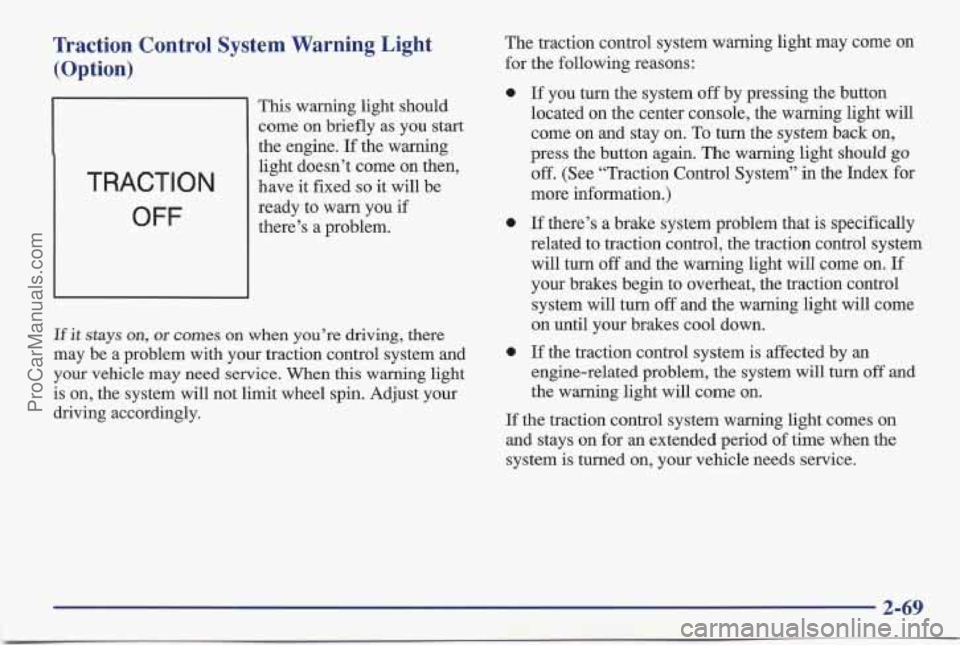
This warning light should
come on briefly as you start
the engine.
If the warning
light doesn’t come on then,
have it fixed
so it will be
ready to warn you
if
there’s a problem.
Hit stays on, or comes on when you’re driving, there
may be a problem with your traction control system and
your vehicle may need service. When this warning light
is on, the system will not limit wheel
spin. Adjust your
driving accordingly. The
traction control system warning light may come on
for the following reasons:
0
a
0
If you turn the system off by pressing the button
located on the center console, the warning light will
come on and stay on.
To turn the system back on,
press the button again. The warning light should go
off. (See “Traction Control System” in the Index for
more information.)
If there’s a brake system problem that is specifically
related to traction control, the traction control system
will turn off and the warning light will come on.
If
your brakes begin to overheat, the traction control
system will turn off and the warning light will come
on until your brakes cool down.
If the traction control system is affected by an
engine-related problem, the system will turn off and
the warning light will come on.
If the traction control system warning light comes on
and stays on for an extended period of time when the
system is turned on, your vehicle needs service.
2-69
ProCarManuals.com
Page 179 of 405
Control of a Vehicle
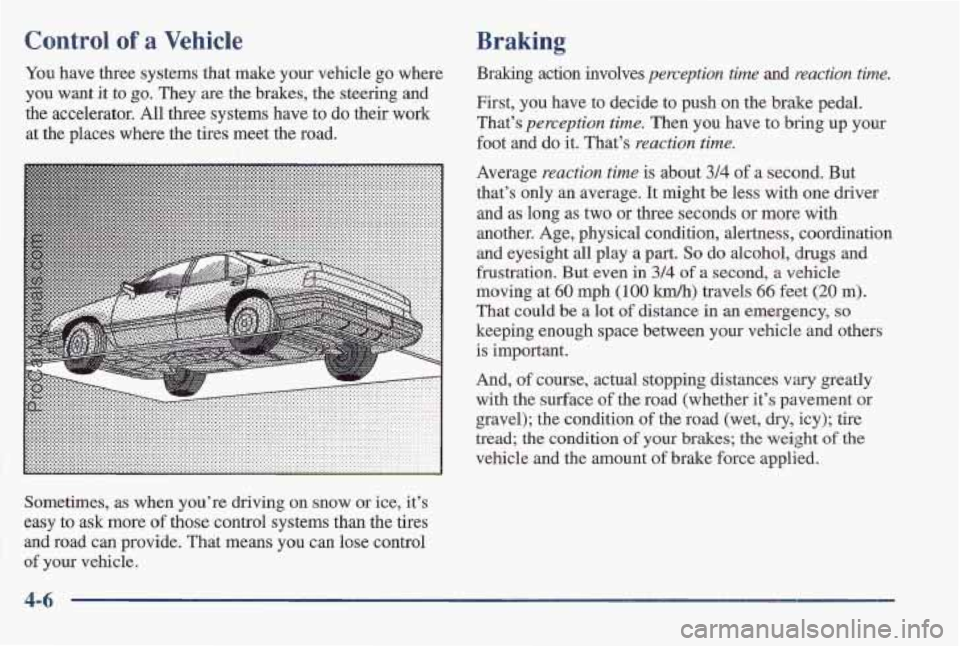
You have thee systems that make your vehicle go where
you want it to go. They are the brakes, the steering and
the aclcelerator.
All three systems have to do their work
at the places where the tires meet the xoad.
Sometimes, as when you’re driving
on snow or ice, it’s
easy
to ask more of those control systems than the tires
and road can provide. That means you can lose control
of your vehicle.
Braking
Braking action involves perception time and reaction time.
First, you have to decide to push on the brake pedal.
That’s
perception time. Then you have to bring up your
foot and
do it. That’s reaction time.
Average reaction time is about 3/4 of a second. But
that’s only
an average. It might be less with one driver
and
as long as two or three seconds or more with
another. Age, physical condition, alertness, coordination
and eyesight all play
a part. So do alcohol, drugs and
frustration. But even in 3/4 of a second, a vehicle
moving at
60 mph (100 Wh) travels 66 feet (20 m).
That could be
a lot of distance in an emergency, so
keeping enough space between your vehicle and others
is important.
And,
of course, actual stopping distances vary greatly
with the surface
of the road (whether it’s pavement or
gravel); the condition
of the road (wet, dry, icy); tire
tread;
the condition of your brakes; the weight of the
vehicle and the amount of brake force applied.
ProCarManuals.com