1997 PONTIAC BONNEVILLE torque
[x] Cancel search: torquePage 85 of 405
Leaving Your Vehicle With the
Engine Running
It can be ldangerous to leave your vehicle with
the engine running. Your vehicle could
move
sudldenly if the shift lever is not fully in PARK (P)
with the parking brake firmly set, And, if you
leave the vehicle with the engine running, it ,could
overheat and even catch
fire. You or others could
be injured. Don’t leave your vehicle with the
engine running unless you have
to.
If you have to leave your vehicle with the engine
running, be
sure your vehicle is in PARK (P) and your
parking brake is firmly set before you leave it. After
you’ve
moved the shift lever into the PARK (I?)
position, hold the regular brake pedal down. Them, see if
you can move the shift lever away from PARK (P)
without first pulling it toward you (or, if you have the
console shift lever, without fist pushing the button).
If
you can, it means that the shift lever wasn’t fully locked
into PARK (P).
Torque Lock
If you are parking on a hill and you don’t shift your
transaxle into PARK (P) properly, the weight of the
vehicle
may put too much force on the parking pawl in
the transaxle. You may find it difficult to pull the shift
lever out of
PARK (P). This is called “torque lock.” To
prevent torque lock, set the parking brake and then shift
into
PARK (P) properly before you leave the driver’s
seat.
To find out how, se’e “Shifting Into PARK (P)” in
the Index.
When you
are ready to drive, move the shift lever out of
PARK (P) before you release the parking brake.
If torque lock does occur, you may need to have another
vehicle
push yours a little uphill to take some of the
pressure from the paking pawl in the transaxle, so you
can pull the shift lever out of PARK
(P).
ProCarManuals.com
Page 247 of 405
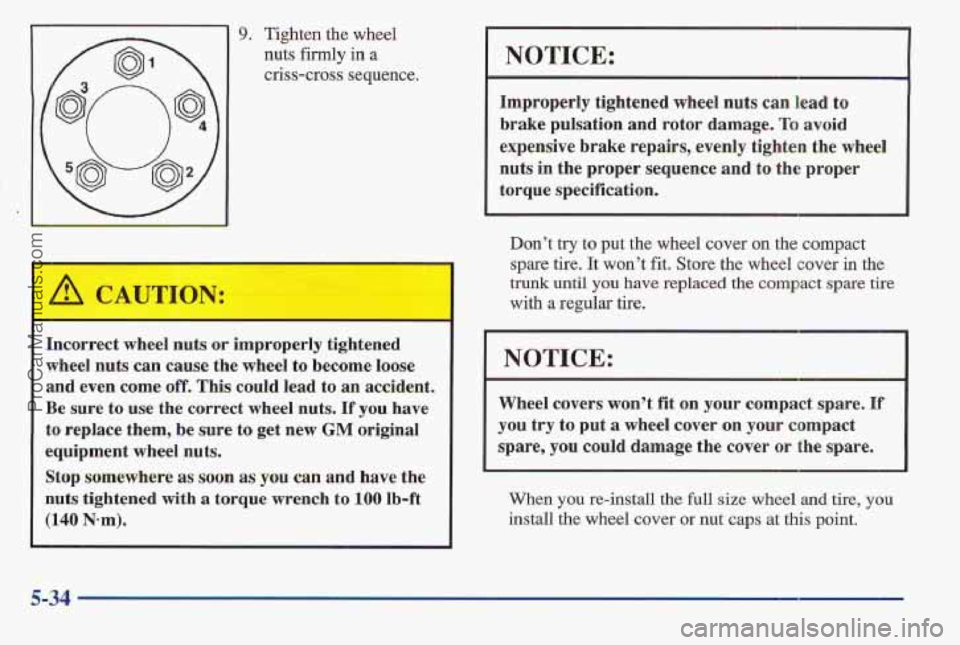
9. Tighten the wheel
nuts firmly in a
criss-cross sequence.
Incorrect wheel nuts or improperly tightened
wheel nuts can cause the wheel
to become loose
and even
come off. This could lead to an accident.
Be sure
to use the correct wheel nuts. If you have
to replace them, be sure to get new
GM original
equipment wheel nuts.
Stop somewhere
as soon as you can and have the
nuts tightened with
a torque wrench to 100 Ib-ft
(140 N-m).
NOTICE:
~~~
Improperly tightened wheel nuts can lead to
brake pulsation and rotor damage. To avoid
expensive brake repairs, evenly tighten the wheel
nuts in the proper sequence and to the proper
torque specification.
Don’t try to put the wheel cover
on the compact
spare tire. It won’t fit. Store the wheel cover in the
trunk until you have replaced the compact spare tire
with a regular tire.
Wheel covers won’t fit
on your compact spare. If
you try to put a wheel cover on your compact
spare, you could damage the cover or the spare.
When
you re-install the full size wheel and tire, you
install the wheel cover or nut caps at this point.
5-34
ProCarManuals.com
Page 274 of 405
How to Check and Add Oil
Check oil only when the engine is cold. Allow the
engine to cool two to three hours after running.
If you remove the supercharger oil fill plug while
the engine
is hot, pressure may cause hot oil to
blow out
of the oil fill hole. You may be burned.
Do not remove the plug until the engine cools.
1. Clean the area around the oil fill plug before
removing it.
2. Remove the oil fill plug using a 3/16 inch
Allen wrench.
3. The oil level is correct when it just reaches the
bottom
of the threads of the inspection hole.
4. Replace the oil plug with the O-ring in place. Torque
to
88 lb-in (10 N-m).
Automatic Transaxle Fluid
When to Check and Change
A good time to check your autamatic transaxle fluid
level is when the engine
oil is changed.
Change both the fluid and filter every
50,000 miles
(83 000 km) if the vehicle is mainly driven under one
or more of these conditions:
0 In heavy city traffic where the outside temperature
regularly reaches
90 OF (32 O C) or higher.
In hilly or mountainous terrain.
When doing frequent trailer towing.
0 Uses such as found in taxi, police or delivery service.
If you do not use your vehicle under any
of these
conditions, the fluid and filter do not require changing.
See “Scheduled Maintenance Services”
in the Index.
6-21
ProCarManuals.com
Page 285 of 405
Brake Wear
Your Pontiac has front disc brakes and rear drum brakes.
Disc brake pads have built-in wear indicators that make
a
high-pitched warning sound when the brake pads are worn
and new pads are needed. The
sound may come and go or
be heard all the time your vehicle is moving (except when
you are pushing on the brake pedal fiiy).
Le brake wear warning sound means that soon
your brakes won’t work well. That could lead to
an accident. When you hear the brake wear
warning sound, have
your vehicle serviced.
I NOTICE:
Continuing to drive with worn-out brake pads
could
result in costly brake repair.
Some driving conditions or climates may cause a brake
squeal when the brakes are first applied or lightly
applied. This does not mean something
is wrong
with your brakes.
See “Caliper/Knuckle Maintenance Inspection” in
Section
7 of this manual under Part C “Periodic
Maintenance Inspections.”
Properly torqued wheel nuts are necessary to help
prevent brake pulsation. When tires are rotated, inspect
brake pads for wear
and evenly torque wheel nuts in the
proper sequence to
GM specifications.
Your rear drum brakes don’t have wear indicators, but if
you ever hear a rear brake rubbing noise, have the rear
brake linings inspected.
Also, the rear brake drums should
be removed
and inspected each time the tires are removed
for rotation or changing. When you have the front brakes
replaced, have the rear brakes inspected, too.
Brake linings
should always be replaced as complete
axle sets.
See “Brake System Inspection”
in Section 7 of this manual
under Part
C 44Periodic Maintenance Inspections”.
6-32
ProCarManuals.com
Page 297 of 405
When to Check
Check your tires once a month or more.
Don’t forget your compact spare tire. It should be at
60 psi (420 kPa).
How to Check
Use a good quality pocket-type gage to check tire
pressure.
You can’t tell if your tires are properly inflated
simply by looking at them. Radial tires may look
properly inflated even
when they’re underinflated.
Be sure to put
the valve caps back on the valve stems.
They help prevent leaks by keeping out
dirt and moisture.
Tire Inspection and Rotation
Tires should be rotated every 6,080 to 8,000 miles
(10 000 to 13 000 h). Any time you notice unusual
wear, rotate your tires as soon as possible and check
wheel alignment. Also check for damaged tires or
wheels. See “When It’s Time for New Tires’’
and
“Wheel Replacement” later in this section for
more information.
The purpose
of regular rotation is to achieve more
unifQm
wear .- - for .. dl tires ., on . h .. vehicle. . The first rotation
is the most important. See “Scheduled
Maintenance Services” in the Index for scheduled
rotation intervals.
m I
n
7
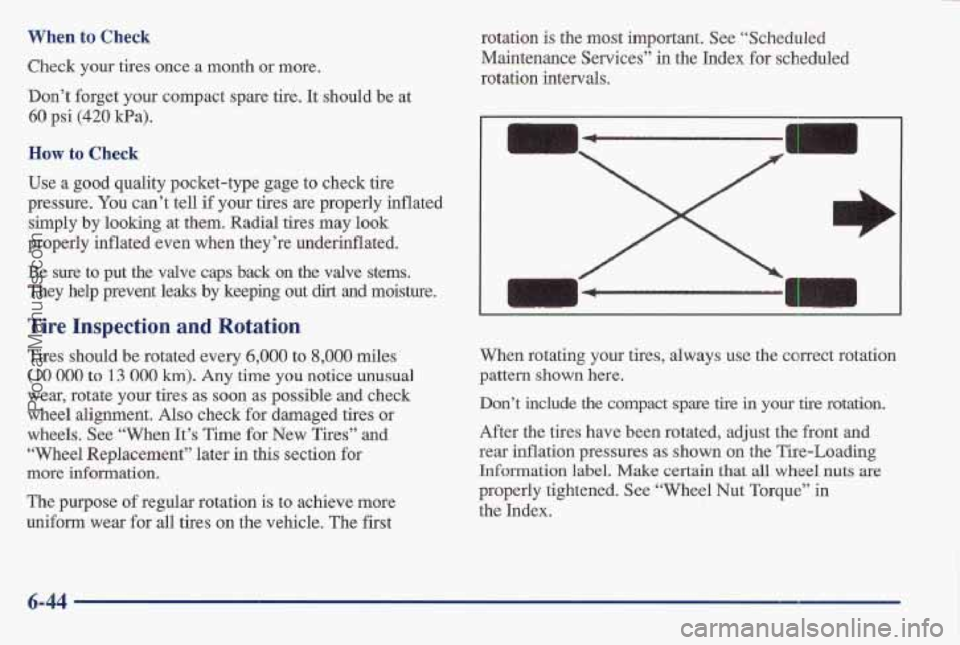
When rotating your tires, always use the correct rotation
pattern shown here.
Don’t include the compact spare tire in your tire rotation.
After the tires have been rotated, adjust the front and
rear inflation pressures
as shown on the Tire-Loading
Information label.
Make certain that all wheel nuts are
properly tightened. See “Wheel Nut Torque” in
the Index.
4-44
ProCarManuals.com
Page 319 of 405
Capacities and Spc Ltions
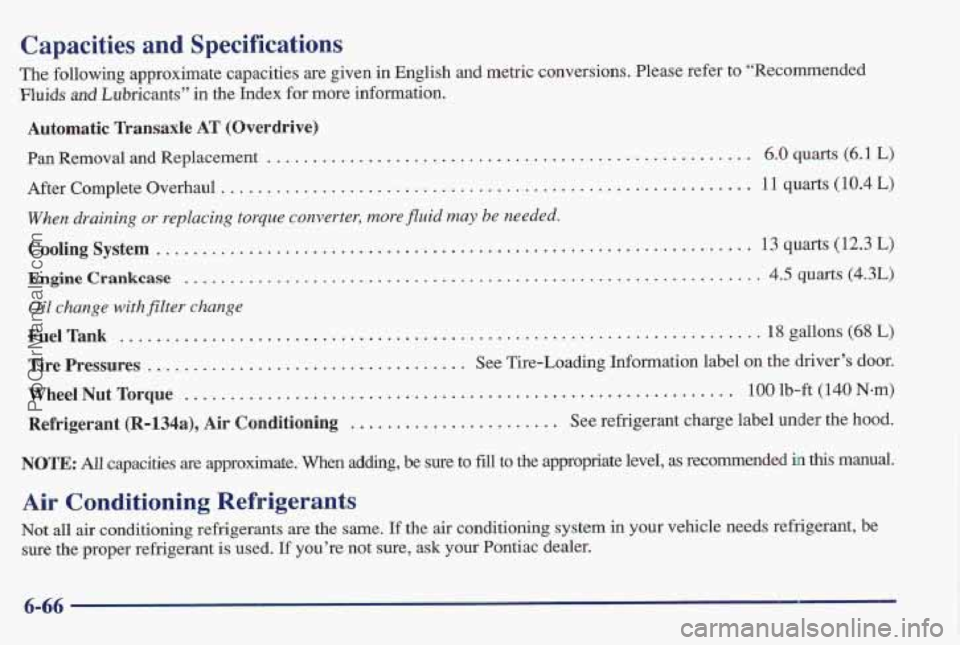
The following approximate capacities are given in English and metric conversions. Please refer to “Recommended
Fluids and Lubricants’’ in the Index for more information.
Automatic Transaxle AT (Overdrive)
Pan Removal and Replacement ......... ........................................ 6.0 quarts (6.1 L)
After Complete Overhaul .......................................................... 11 quarts (10.4 L)
Cooling System ................................................................. 13 quarts (12.3 L)
Engine Crankcase ............................................................... 4.5 quarts (4.3L)
When draining or replacing torque conver,ter, more fluid may be needed.
.......
Oil change with filter change
FuelTank ........................... ................................ 18 gallons (68 L)
Tire Pressures ................................... See Tire-Loading Information label on the driver’s door.
Refrigerant (R=134a), Air Conditioning ....................... See refrigerant charge label under the hood.
WheelNutTorque ............................................................ 100 lb-ft (140 N-m)
NOTE: All capacities are approximate. When adding, be sure to fill to the appropriate level, as recommended in this manual.
Air Conditioning Refrigerants
Not all air conditioning refrigerants are the same. If the air conditioning system in your vehicle needs refrigerant, be
sure the proper refrigerant is used.
If you’re not sure, ask your Pontiac dealer.
6-66
ProCarManuals.com