1997 PONTIAC BONNEVILLE ABS
[x] Cancel search: ABSPage 107 of 405
Convenience Net (Option)
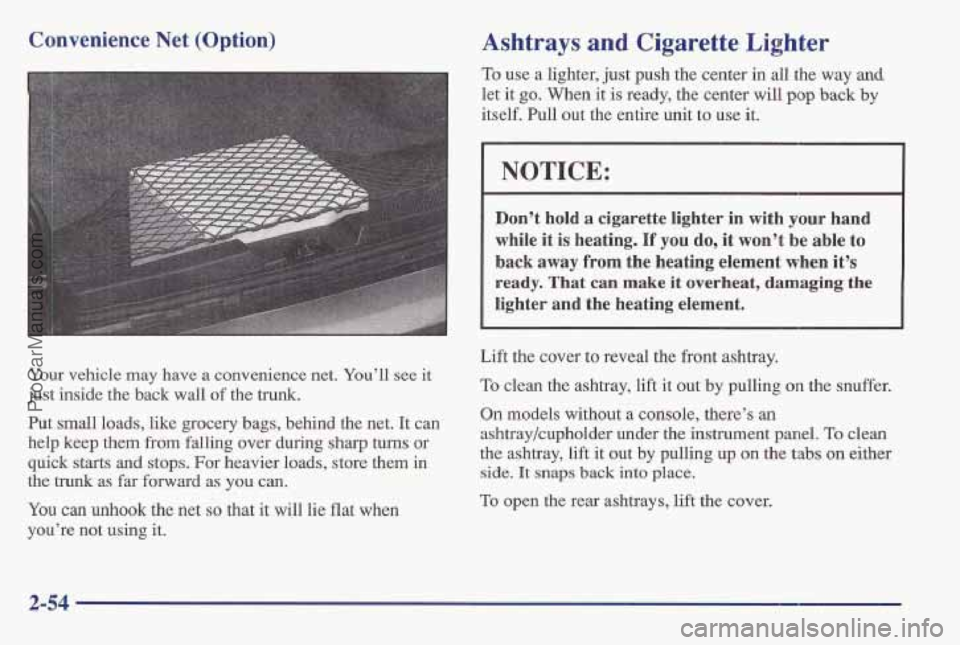
Your vehicle may have a convenience net. You’ll see it
just inside the back wall of the trunk.
Put small loads, like grocery bags, behind the net.
It can
help keep them from falling
over during sharp turns or
quick starts
and stops. For heavier loads, store them in
the trunk as far forward as you can.
You can unhook the net so that it will lie flat when
you’re not using
it.
Ashtrays and Cigarette Lighter
To use a lighter, just push the center in all the way and
let it go. When it is ready, the center will pop back by
itself. Pull out the entire unit to use it.
I NOTICE:
Don’t hold a cigarette lighter in with your hand
while it is heating.
If you do, it won’t be able to
back away from the heating element when it’s
ready. That can make it overheat, damaging the
lighter and the heating element.
Lift the cover to reveal the front ashtray.
To clean the ashtray, lift it out by pulling on the snuffer.
On models without a console, there’s an
ashtray/cupholder under the instrument panel.
To clean
the ashtray, lift it out by pulling up
on the tabs on either
side. It snaps back into place.
To open the rear ashtrays, lift the cover.
2-54
ProCarManuals.com
Page 180 of 405
Avoid needless heavy braking. Some people drive in
spurts
-- heavy acceleration followed by heavy
braking
-- rather than keeping pace with traffic. This is a
mistake. Your brakes may not have time to cool between
hard stops. Your brakes will wear out much faster
if you
do a lot of heavy braking.
If you keep pace with the
traffic and allow realistic following distances, you will
eliminate a lot of unnecessary braking. That means
better braking and longer brake life.
If your engine ever stops while you’re driving, brake
normally but don’t pump your brakes.
If you do, the
pedal may get harder to pus’h down.
If your engine
stops, you will still have some power brake assist. But
you will use
it when you brake. Once the power assist is
used up, it may take longer to stop and the brake pedal
will be harder to push.
Anti-Lock Brakes (ABS)
Your vehicle has anti-lock brakes (ABS). ABS is an
advanced electronic braking system that will help
prevent a braking skid.
When you start your engine, or when you begin to drive
away, your anti-lock brake system will check itself. You
may hear a momentary motor or clicking noise while
this test is going on, and you may even notice that
your
brake pedal moves a little. This is normal.
ANTILOCK (e)
If there’s a problem with the
anti-lock brake system, this
warning light will stay
on.
See “Anti-Lock Brake
System
Warning Light” in
the Index.
4-7
ProCarManuals.com
Page 181 of 405
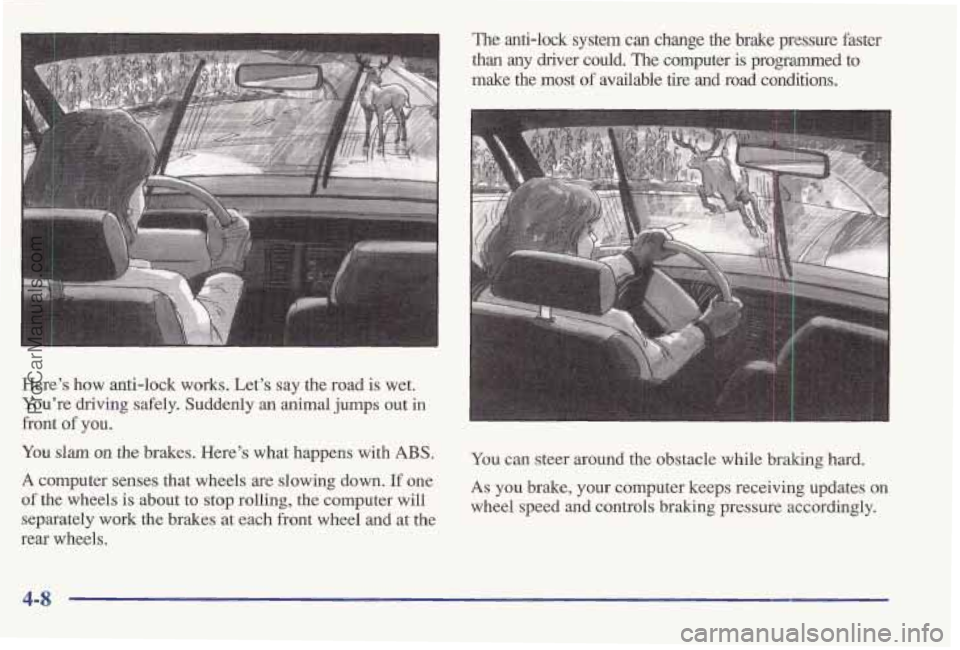
Here’s how anti-lock works. Let’s say the road is wet.
You’re driving safely. Suddenly an animal jumps out in
front of you.
You slam on the brakes. Here’s what happens with ABS.
A computer senses that wheels are slowing down. If one
of the wheels is about to stop rolling, the computer will
separately
work the brakes at each front wheel and at the
rear wheels.
The anti-lock system can change the brake pressure faster
than
any driver could. The computer is programmed to
make the most of available tire
and road conditions.
You can steer around the obstacle while braking hard.
As you brake, your computer keeps receiving updates on
wheel speed and controls braking pressure accordingly.
4-8
ProCarManuals.com
Page 188 of 405
Loss of Control
Let’s review what driving experts say about what
happens when the three control systems (brakes, steering
and acceleration) don’t have enough friction where the
tires meet the road to do what the driver has asked.
In any emergency, don’t give up. Keep trying to steer and
constantly seek
an escape route or area of less danger.
Skidding
In a skid, a driver can lose control of the vehicle.
Defensive drivers avoid most skids by taking reasonable care suited to existing conditions, and
by not “overdriving”
those conditions. But skids
are always possible.
The three types of skids correspond to your Pontiac’s
three control systems. In the braking skid, your wheels
aren’t rolling. In the steering or cornering skid,
too
much speed or steering in a curve causes tires to slip and
lose cornering force. And in the acceleration skid, too
much throttle causes the driving wheels
to spin.
A cornering skid is best handled by easing your foot off
the accelerator pedal.
If
you have the traction control system, remember: It
helps avoid only the acceleration skid.
If you do not have traction control, or if the system is
off, then an acceleration skid is also best handled by
easing your foot off the accelerator pedal.
If your vehicle starts to slide, ease your foot off the
accelerator pedal and quickly steer the way you want the
vehicle to go. If you start steering quickly enough,
your
vehicle may straighten out. Always be ready for a
second skid if it occurs.
Of course, traction is reduced when water, snow, ice,
gravel or other material is
on the road. For safety, you’ll
want to slow down and adjust your driving to these
conditions.
It is important to slow down on slippery
surfaces because stopping distance will be longer and
vehicle control more limited.
While driving
on a surface with reduced traction, try
your best to avoid sudden steering, acceleration or
braking (including engine braking by shifting to a lower
gear). Any sudden changes could cause the tires to slide.
You may not realize the surface is slippery until your
vehicle is skidding. Learn to recognize warning
clues
-- such as enough water, ice or packed snow on
the road to make a “mirrored surface” -- and slow
down when you have any doubt.
Remember: Any anti-lock brake system
(ABS) heIps
avoid only the braking skid.
4-15
ProCarManuals.com
Page 211 of 405
Driving On Grades
Reduce speed and shift to a lower gear before you start
down
a long or steep downgrade. If you don’t shift
down,
you might have to use your brakes so much that
they would get hot and no longer work well,
Parking on Hills
You really should not park your vehicle, with a trailer
attached,
on a hill. If something goes wrong, your rig
could start
to move. People can be injured, and both
your vehicle and the trailer can be damaged.
But
if you ever have to park your rig on a hill, here’s
how to
do it:
1.
2.
3.
4.
5.
Apply your regular brakes, but don’t shift into
PARK (P) yet.
Have someone place chocks under the trailer wheels.
When the wheel chocks are in place, release the
regular brakes until the chocks absorb the load.
Reapply the regular brakes. Then apply your parking
brake, and then shift
to PARK (P).
Release the regular brakes.
When You Are Ready to Leave After
Parking
on a Hill
1. Apply your regular brakes and hold the pedal down
while you:
Start your engine;
Shift into a gear; and
Release the parking brake.
2. Let up on the brake pedal.
3. Drive slowly until the trailer is clear of the chocks.
4. Stop and have someone pick up and store the chocks.
Maintenance When Trailer Towing
Your vehicle will need service more often when you’re
pulling a trailer. See the Maintenance Schedule for more
on this. Things that are especially important in trailer
operation are automatic transaxle fluid (don’t overfill),
engine oil, belts, cooling system and brake adjustment.
Each of these is covered in this manual, and the Index
will help you find them quickly. If you’re trailering, it’s
a good idea to review these sections before you start
your trip.
Check periodically to see that all hitch nuts and bolts
are tight.
4-38
ProCarManuals.com
Page 310 of 405
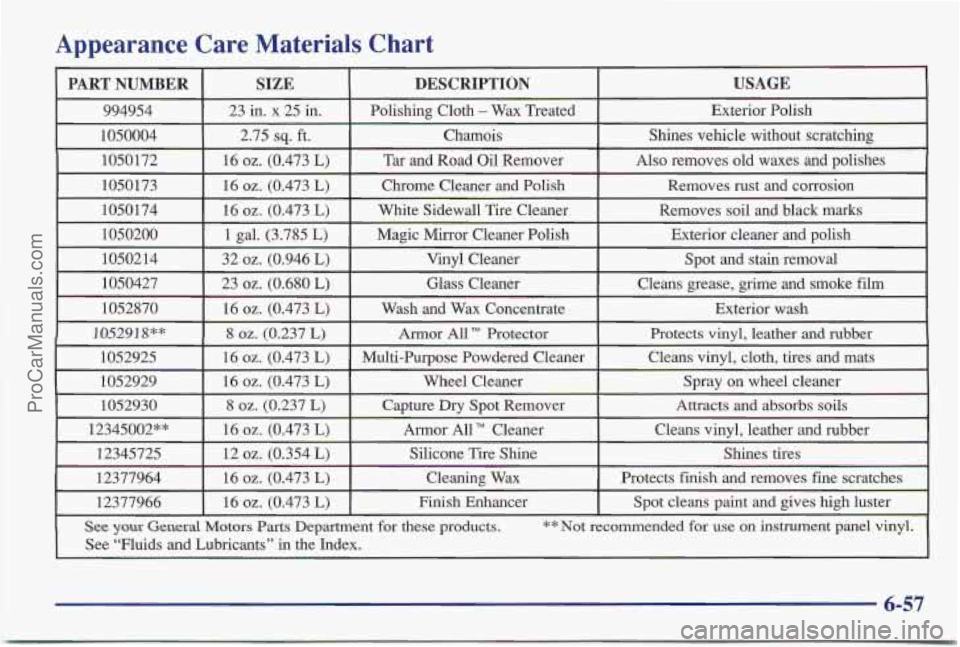
Appearance Care Materials Chart
PART NUMBER USAGE
DESCRIPTION
SIZE
994954 Exterior
Polish
Polishing Cloth - Wax Treated
23 in. x 25 in.
1050004
Exterior wash
Wash
and Wax Concentrate
16
oz. (0.473 L) 1052870 Cleans
grease, grime
and smoke film
Glass Cleaner
23 oz. (0.680 L) 1050427 Spot
and stain removal
Vinyl Cleaner
32
oz. (0.946 L) 1050214 Exterior
cleaner and polish
Magic Mirror Cleaner Polish
1 gal. (3.785
L) 1050200 Removes
soil and black marks
White Sidewall
Tire Cleaner
16
oz. (0.473 L) 1050174 Removes rust
and corrosion
Chrome Cleaner and Polish
16
oz. (0.473 L) 1050173 Also removes
old waxes and polishes Tar and Road
Oil Remover
16
OZ. l(0.473 L) 1050172 Shines
vehicle without scratching Chamois
2.75
sq. ft.
1052918""
Attracts and absorbs soils
1052930 8 oz. (0.237 L) Capture Dry Spot Remover Spray
on wheel cleaner
Wheel Cleaner
16
oz. (0.473 L)
1052929 Cleans
vinyl, cloth, tires and mats
Multi-Purpose Powdered Cleaner
16
oz. (0.473 L) 1052925 Protects
vinyl, leather and rubber Armor
All" Protector
8 oz. (0.237 L)
12345002"" 16 oz. (0.473 L) Armor All TM Cleaner
Cleans vinyl, leather and rubber
12345725---
Spot
cleans paint and gives high luster Finish Enhancer
16 oz. (0.473 L) 12377966 Protects finish
and removes fine scratches
Cleaning Wax
16
oz. (0.473 L) 12377964 Shines tires
Silicone Tire Shine
12
oz. (0.354 L)
See you General Motors Parts Department for these products. ** Not recommended for use on instrument panel vinyl.
See "Fluids and Lubricants" in the Index.
6-57
ProCarManuals.com