1997 NISSAN SENTRA Gas
[x] Cancel search: GasPage 118 of 194
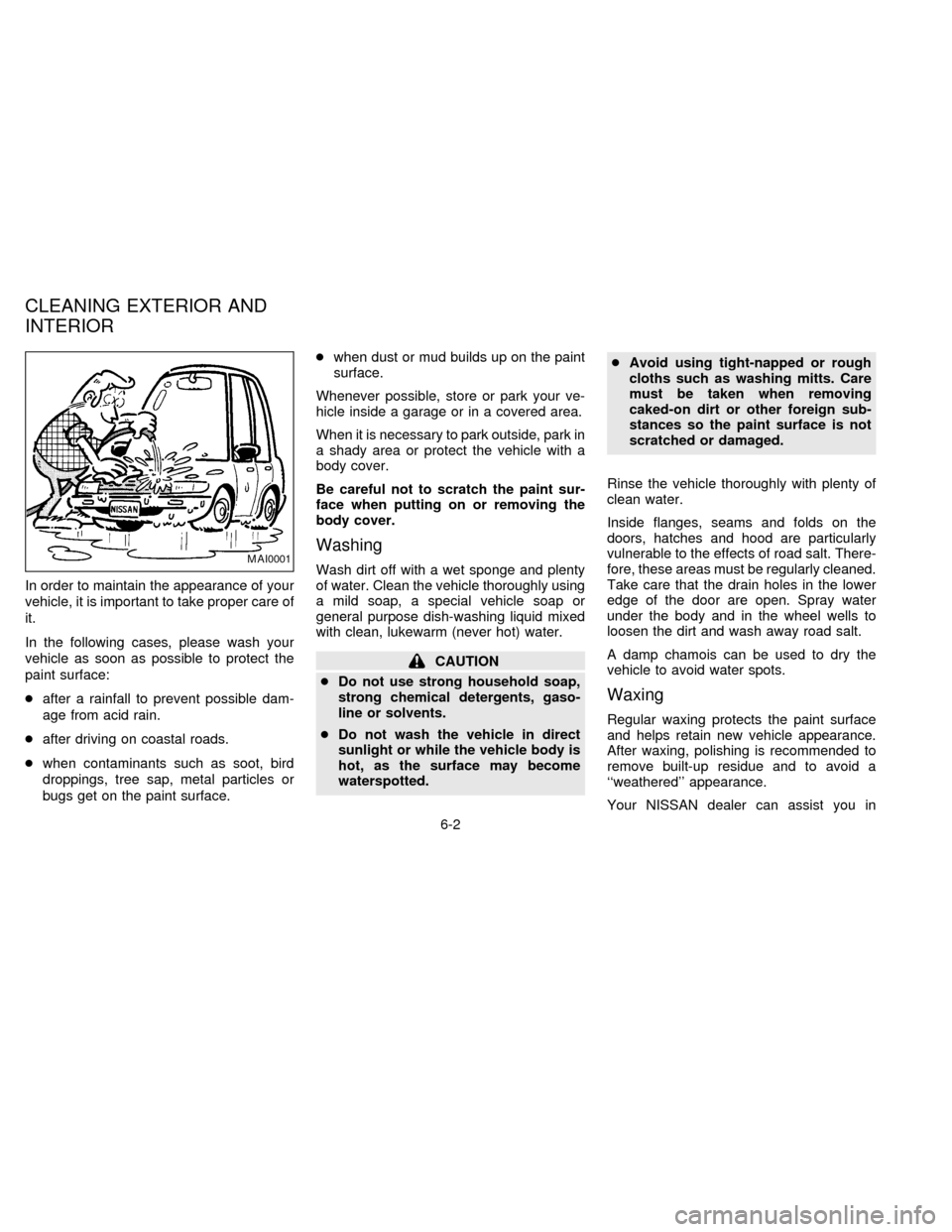
In order to maintain the appearance of your
vehicle, it is important to take proper care of
it.
In the following cases, please wash your
vehicle as soon as possible to protect the
paint surface:
cafter a rainfall to prevent possible dam-
age from acid rain.
cafter driving on coastal roads.
cwhen contaminants such as soot, bird
droppings, tree sap, metal particles or
bugs get on the paint surface.cwhen dust or mud builds up on the paint
surface.
Whenever possible, store or park your ve-
hicle inside a garage or in a covered area.
When it is necessary to park outside, park in
a shady area or protect the vehicle with a
body cover.
Be careful not to scratch the paint sur-
face when putting on or removing the
body cover.
Washing
Wash dirt off with a wet sponge and plenty
of water. Clean the vehicle thoroughly using
a mild soap, a special vehicle soap or
general purpose dish-washing liquid mixed
with clean, lukewarm (never hot) water.
CAUTION
cDo not use strong household soap,
strong chemical detergents, gaso-
line or solvents.
cDo not wash the vehicle in direct
sunlight or while the vehicle body is
hot, as the surface may become
waterspotted.cAvoid using tight-napped or rough
cloths such as washing mitts. Care
must be taken when removing
caked-on dirt or other foreign sub-
stances so the paint surface is not
scratched or damaged.
Rinse the vehicle thoroughly with plenty of
clean water.
Inside flanges, seams and folds on the
doors, hatches and hood are particularly
vulnerable to the effects of road salt. There-
fore, these areas must be regularly cleaned.
Take care that the drain holes in the lower
edge of the door are open. Spray water
under the body and in the wheel wells to
loosen the dirt and wash away road salt.
A damp chamois can be used to dry the
vehicle to avoid water spots.
Waxing
Regular waxing protects the paint surface
and helps retain new vehicle appearance.
After waxing, polishing is recommended to
remove built-up residue and to avoid a
``weathered'' appearance.
Your NISSAN dealer can assist you in
MAI0001
CLEANING EXTERIOR AND
INTERIOR
6-2
ZX
Page 124 of 194
When performing any inspection or mainte-
nance work on your vehicle, always take
care to prevent serious accidental injury to
yourself or damage to the vehicle. The
following are general precautions which
should be closely observed.
WARNING
cPark the vehicle on a level surface,
apply the parking brake securely and
block the wheels to prevent the ve-
hicle from moving. For a manual
transmission, move the gearshift
control lever to Neutral (N). For an
automatic transmission, move the
shift lever to P (Park).
cBe sure the ignition key is OFF when
performing any parts replacement or
repairs.
cBe sure to turn the ignition key to the
OFF or LOCK position. When the
ignition key is in the ON or ACC
position, the cooling fan may start to
operate suddenly even when the en-
gine is not running.cIf you must work with the engine
running, keep your hands, clothing,
hair and tools away from moving
fans, belts and any other moving
parts.
cIt is advisable to remove ties and any
jewelry, such as rings, watches, etc.,
before working on your vehicle.
cIf you must run the engine in an
enclosed space such as a garage, be
sure there is proper ventilation for
exhaust gases.
cNever get under the vehicle while it
is supported only by a jack. If it is
necessary to work under the vehicle,
support it with safety stands.
cKeep smoking materials, flame and
sparks away from fuel and battery.
cOn gasoline engine models with the
Multiport Fuel Injection (MFI) sys-
tem, the fuel filter or fuel lines
should be serviced by a NISSAN
dealer because the fuel lines are
under high pressure even when the
engine is off.
CAUTION
cDo not work under the hood while
the engine is hot. Turn the engine off
and wait until it cools down.
cNever connect or disconnect either
the battery or any transistorized
component connector while the igni-
tion is ON.
c
Avoid contact with used motor oil.
Improperly disposed motor oil and/or
other vehicle fluids can hurt the en-
vironment. Always conform to local
regulations for disposal of vehicle
fluid.
This ``Do-it-yourself operations'' section
gives instructions regarding only those
items which are relatively easy for an owner
to perform.
You should be aware that incomplete or
improper servicing may result in operating
difficulties or excessive emissions, and
could affect your warranty coverage.If in
doubt about any servicing, have it done
by your NISSAN dealer.
MAINTENANCE
PRECAUTIONS
7-2
ZX
Page 133 of 194
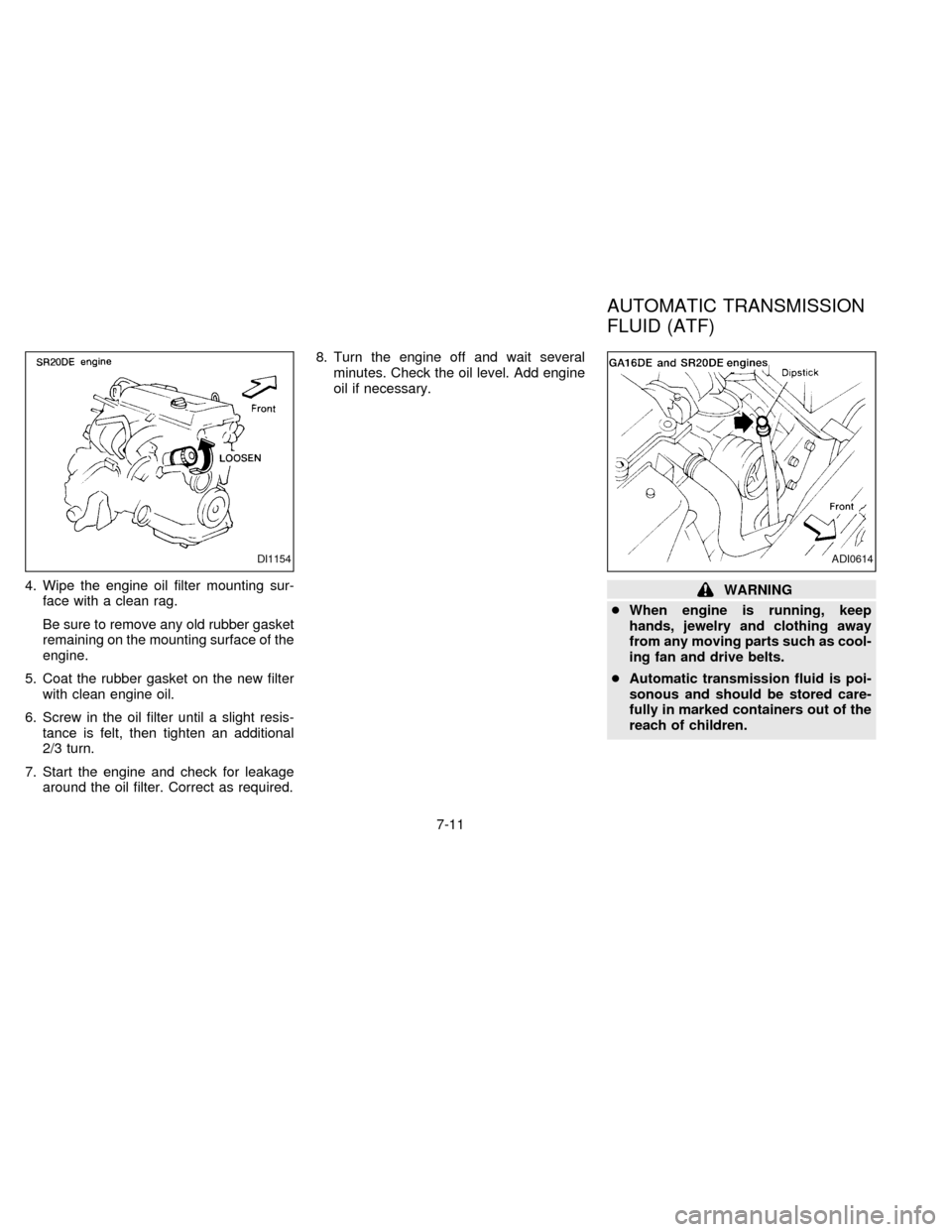
4. Wipe the engine oil filter mounting sur-
face with a clean rag.
Be sure to remove any old rubber gasket
remaining on the mounting surface of the
engine.
5. Coat the rubber gasket on the new filter
with clean engine oil.
6. Screw in the oil filter until a slight resis-
tance is felt, then tighten an additional
2/3 turn.
7. Start the engine and check for leakage
around the oil filter. Correct as required.8. Turn the engine off and wait several
minutes. Check the oil level. Add engine
oil if necessary.WARNING
cWhen engine is running, keep
hands, jewelry and clothing away
from any moving parts such as cool-
ing fan and drive belts.
cAutomatic transmission fluid is poi-
sonous and should be stored care-
fully in marked containers out of the
reach of children.
DI1154ADI0614
AUTOMATIC TRANSMISSION
FLUID (ATF)
7-11
ZX
Page 137 of 194
Canada Only
Add fluid when the low washer fluid warning
light comes on. Add a washer solvent to the
water for better cleaning. In the winter sea-
son, add a windshield washer antifreeze.
Follow the manufacturer's instructions for
the mixture ratio.
CAUTION
Do not substitute engine antifreeze
coolant for windshield washer solution.
This may result in damage to the paint.cKeep the battery surface clean and dry.
Any corrosion should be washed off with
a solution of baking soda and water.
cMake certain the terminal connections
are clean and securely tightened.
cIf the vehicle is not to be used for 30 days
or longer, disconnect the negative (þ)
battery terminal cable to prevent dis-
charge.
WARNING
cDo not expose the battery to flames
or electrical sparks. Hydrogen gas
generated by battery action is explo-
sive. Do not allow battery fluid to
contact your skin, eyes, fabrics, or
painted surfaces. After touching a
battery or battery cap, do not touch
or rub your eyes. Thoroughly wash
your hands. If the acid contacts your
eyes, skin or clothing, immediately
flush with water for at least 15 min-
utes and seek medical attention.
cWhen working on or near a battery,
always wear suitable eye protection
and remove all jewelry.
cKeep the battery out of the reach of
children.
Type 1
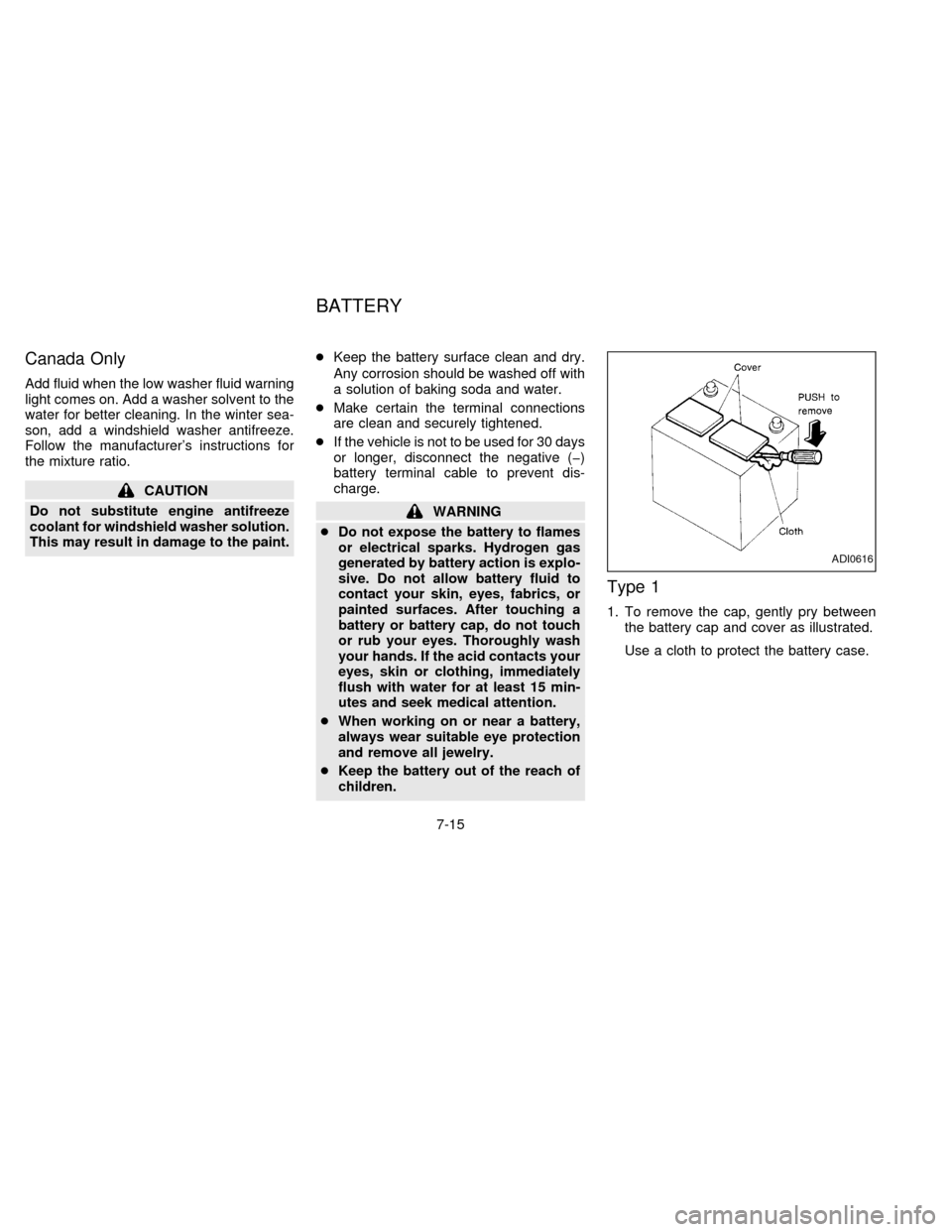
1. To remove the cap, gently pry between
the battery cap and cover as illustrated.
Use a cloth to protect the battery case.
ADI0616
BATTERY
7-15
ZX
Page 147 of 194
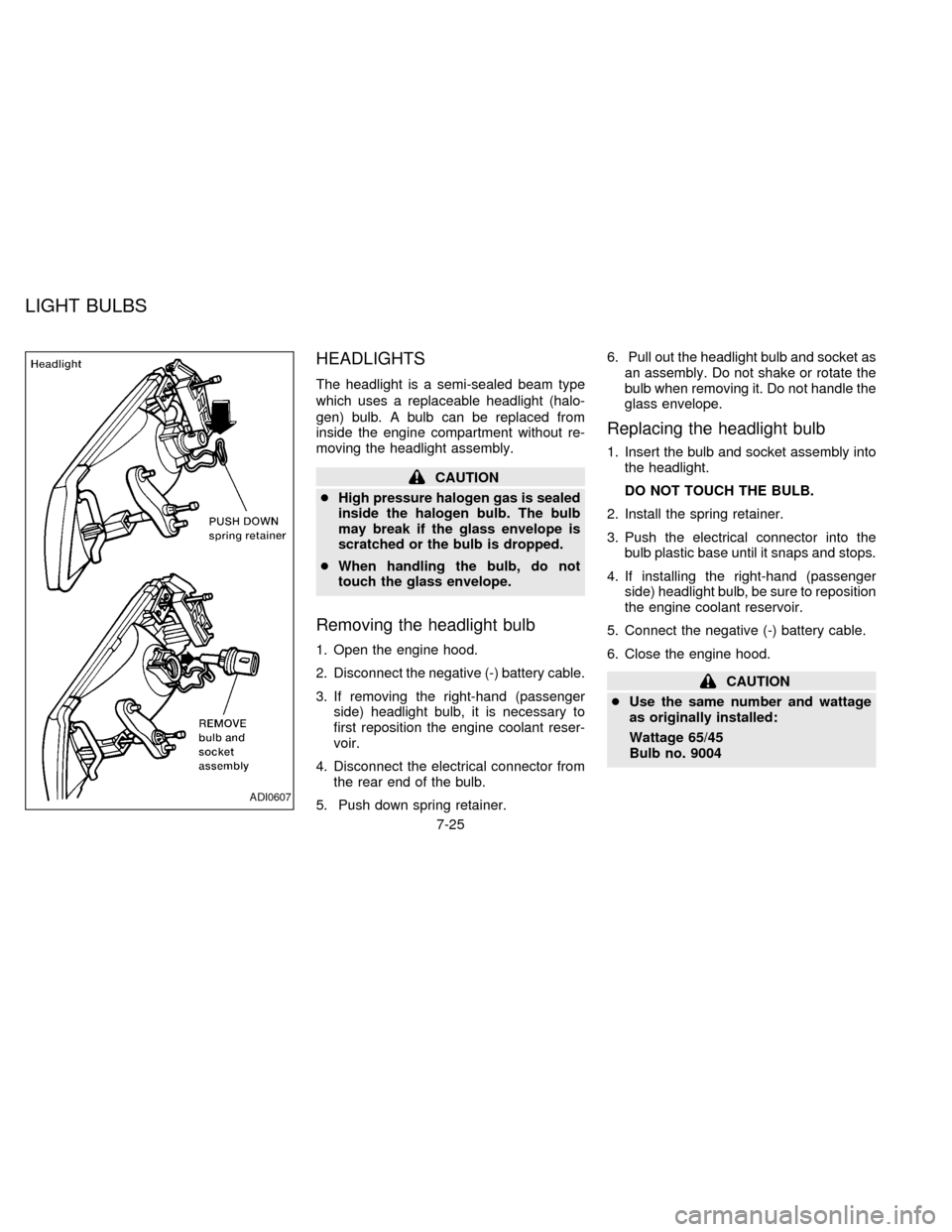
HEADLIGHTS
The headlight is a semi-sealed beam type
which uses a replaceable headlight (halo-
gen) bulb. A bulb can be replaced from
inside the engine compartment without re-
moving the headlight assembly.
CAUTION
cHigh pressure halogen gas is sealed
inside the halogen bulb. The bulb
may break if the glass envelope is
scratched or the bulb is dropped.
cWhen handling the bulb, do not
touch the glass envelope.
Removing the headlight bulb
1. Open the engine hood.
2. Disconnect the negative (-) battery cable.
3. If removing the right-hand (passenger
side) headlight bulb, it is necessary to
first reposition the engine coolant reser-
voir.
4. Disconnect the electrical connector from
the rear end of the bulb.
5. Push down spring retainer.6. Pull out the headlight bulb and socket as
an assembly. Do not shake or rotate the
bulb when removing it. Do not handle the
glass envelope.
Replacing the headlight bulb
1. Insert the bulb and socket assembly into
the headlight.
DO NOT TOUCH THE BULB.
2. Install the spring retainer.
3. Push the electrical connector into the
bulb plastic base until it snaps and stops.
4. If installing the right-hand (passenger
side) headlight bulb, be sure to reposition
the engine coolant reservoir.
5. Connect the negative (-) battery cable.
6. Close the engine hood.
CAUTION
cUse the same number and wattage
as originally installed:
Wattage 65/45
Bulb no. 9004
ADI0607
LIGHT BULBS
7-25
ZX
Page 162 of 194

with only the parking brake applied.
Automatic transmission ``Park'' mecha-
nism ÐOn a fairly steep hill check that your
vehicle is held securely with the selector
lever in the P position without applying any
brakes.
UNDER THE HOOD AND VEHICLE
The maintenance items listed here should
be checked periodically, such as each time
you check the engine oil or refuel.
Additional information on the following
items with ``*'' is found in the ``Do-it-
yourself operations'' section.
Windshield washer fluid* ÐCheck for
adequate fluid in the tank.
Engine coolant level* ÐCheck the cool-
ant level when the engine is cold.
Radiator and hoses ÐCheck the front of
the radiator and clean off any dirt, insects,
leaves, etc., that may have accumulated.
Make sure the hoses have no cracks, de-
formation, rot or loose connections.
Brake fluid level* ÐMake sure the brake
and clutch fluid level is between the MAX
and MIN lines on the reservoir.Battery* ÐCheck the fluid level in each
cell.
Engine drive belts* ÐMake sure no belt is
frayed, worn, cracked or oily.
Engine oil level* ÐCheck the level after
parking the vehicle on a level spot and
turning off the engine. Wait a few minutes
for the oil to drain back into the oil pan.
Power steering fluid level* and lines Ð
Check the level when the fluid is cold and
the engine is turned off. Check the lines for
proper attachment, leaks, cracks, etc.
Automatic transmission fluid level* Ð
Check the level after putting the selector
lever in P with the engine idling.
Exhaust system ÐMake sure there are no
cracks, holes, loose joints or supports. If the
sound of the exhaust seems unusual or
there is a smell of exhaust fumes, immedi-
ately have the exhaust system inspected by
a qualified individual. (See the carbon mon-
oxide warning in the ``Starting and driving''
section.)
Underbody ÐThe underbody is frequently
exposed to corrosive substances such as
those used on icy roads or to control dust. Itis very important to remove these sub-
stances, otherwise rust forms on the floor
pan, frame, fuel lines and around the ex-
haust system. At the end of winter, the
underbody should be thoroughly flushed
with plain water, being careful to clean
those areas where mud and dirt may accu-
mulate. See the ``Appearance and interior
care'' section for additional information.
Fluid leaks ÐCheck under the vehicle for
fuel, oil, water or other fluid leaks after the
vehicle has been parked for awhile. Water
dripping from the air conditioner after use is
normal. If you should notice any leaks or if
gasoline fumes are evident, check for the
cause and have it corrected immediately.
8-4
ZX
Page 170 of 194
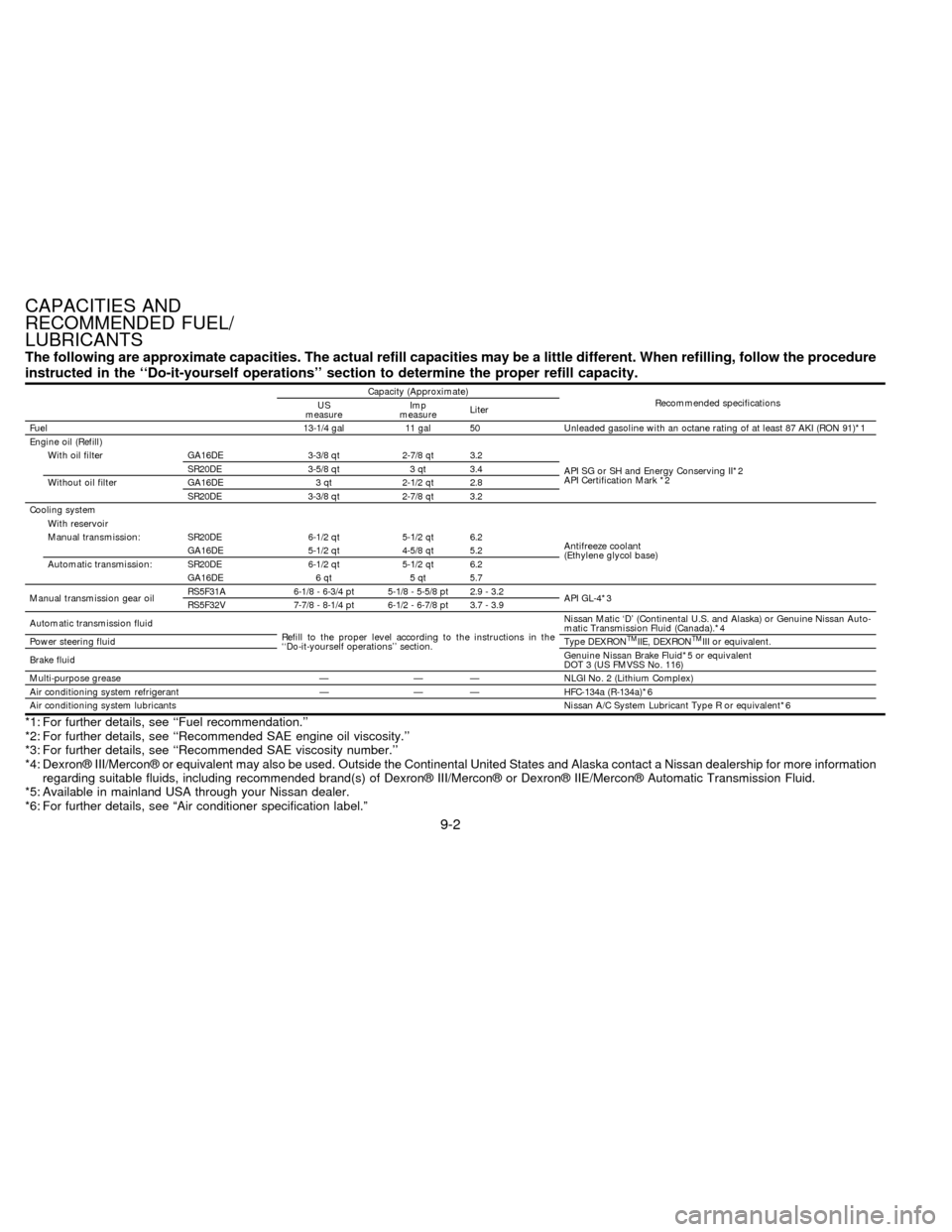
The following are approximate capacities. The actual refill capacities may be a little different. When refilling, follow the procedure
instructed in the ``Do-it-yourself operations'' section to determine the proper refill capacity.
Capacity (Approximate)
Recommended specifications
US
measureImp
measureLiter
Fuel 13-1/4 gal 11 gal 50 Unleaded gasoline with an octane rating of at least 87 AKI (RON 91)*1
Engine oil (Refill)
With oil filter GA16DE 3-3/8 qt 2-7/8 qt 3.2
API SG or SH and Energy Conserving II*2
API Certification Mark *2 SR20DE 3-5/8 qt 3 qt 3.4
Without oil filter GA16DE 3 qt 2-1/2 qt 2.8
SR20DE 3-3/8 qt 2-7/8 qt 3.2
Cooling system
With reservoir
Antifreeze coolant
(Ethylene glycol base) Manual transmission: SR20DE 6-1/2 qt 5-1/2 qt 6.2
GA16DE 5-1/2 qt 4-5/8 qt 5.2
Automatic transmission: SR20DE 6-1/2 qt 5-1/2 qt 6.2
GA16DE 6 qt 5 qt 5.7
Manual transmission gear oilRS5F31A 6-1/8 - 6-3/4 pt 5-1/8 - 5-5/8 pt 2.9 - 3.2
API GL-4*3
RS5F32V 7-7/8 - 8-1/4 pt 6-1/2 - 6-7/8 pt 3.7 - 3.9
Automatic transmission fluid
Refill to the proper level according to the instructions in the
``Do-it-yourself operations'' section.Nissan Matic `D' (Continental U.S. and Alaska) or Genuine Nissan Auto-
matic Transmission Fluid (Canada).*4
Power steering fluidType DEXRON
TMIIE, DEXRONTMIII or equivalent.
Brake fluidGenuine Nissan Brake Fluid*5 or equivalent
DOT 3 (US FMVSS No. 116)
Multi-purpose grease Ð Ð Ð NLGI No. 2 (Lithium Complex)
Air conditioning system refrigerant Ð Ð Ð HFC-134a (R-134a)*6
Air conditioning system lubricantsNissan A/C System Lubricant Type R or equivalent*6
*1: For further details, see ``Fuel recommendation.''
*2: For further details, see ``Recommended SAE engine oil viscosity.''
*3: For further details, see ``Recommended SAE viscosity number.''
*4: Dexronž III/Merconž or equivalent may also be used. Outside the Continental United States and Alaska contact a Nissan dealership for more information
regarding suitable fluids, including recommended brand(s) of Dexronž III/Merconž or Dexronž IIE/Merconž Automatic Transmission Fluid.
*5: Available in mainland USA through your Nissan dealer.
*6: For further details, see ªAir conditioner specification label.º
CAPACITIES AND
RECOMMENDED FUEL/
LUBRICANTS
9-2
ZX
Page 171 of 194
FUEL RECOMMENDATION
All models are designed to operate on
unleaded gasoline with an octane rating
of at least 87 AKI (Anti-Knock Index)
(Research octane number 91).
CAUTION
cUsing a fuel other than that specified
could adversely affect the emission
control devices and systems, and
could also affect the warranty
coverage.
cUnder no circumstances should a
leaded gasoline be used, since this
will damage the three way catalyst.
Reformulated Gasoline
Some fuel suppliers are now producing re-
formulated gasolines. These gasolines are
specially designed to reduce vehicle emis-
sions. NISSAN supports efforts towards
cleaner air and suggests that you use refor-
mulated gasoline when available.
Gasoline containing oxygenates
Some fuel suppliers sell gasoline containing
oxygenates such as ethanol, MTBE andmethanol with or without advertising their
presence. NISSAN does not recommend
the use of fuels of which the oxygenate
content and the fuel compatibility for your
NISSAN cannot be readily determined. If in
doubt, ask your service station manager.
If you use oxygenate-blend gasoline, please
take the following precautions as the usage
of such fuels may cause vehicle performance
problems and/or fuel system damage.
cThe fuel should be unleaded and
have an octane rating no lower than
that recommended for unleaded
gasoline.
cIf an oxygenate-blend other than a
methanol blend is used, it should
contain no more than 10% oxygenate.
(MTBE may, however, be added up to
15%.)
cIf a methanol blend is used, it should
contain no more than 5% methanol
(methyl alcohol, wood alcohol). It
should also contain a suitable
amount of appropriate cosolvents
and corrosion inhibitors. If not prop-
erly formulated with appropriate co-
solvents and corrosion inhibitors,such methanol blends may cause
fuel system damage and/or vehicle
performance problems. At this time,
sufficient data is not available to en-
sure that all methanol blends are suit-
able for use in NISSAN vehicles.
If any driveability problems such as engine
stalling and hard hot-starting are experi-
enced after using oxygenate-blend fuels,
immediately change to a non-oxygenate
fuel or a fuel with a low blend of MTBE.
Take care not to spill gasoline during
refueling. Gasoline containing oxygen-
ates can cause paint damage.
After Market Fuel Additives
NISSAN does not recommend the use of
any fuel additives (i.e., fuel injector cleaners,
octane boosters, intake valve deposit re-
movers, etc.) which are sold commercially.
Many of these additives intended for gum,
varnish or deposit removal may contain ac-
tive solvents or similar ingredients that can
be harmful to the fuel system and engine.
Octane rating tips
In most parts of North America, you should
use unleaded gasoline with an octane rating
9-3
ZX