1997 NISSAN SENTRA Gas
[x] Cancel search: GasPage 172 of 194
![NISSAN SENTRA 1997 B14 / 4.G Owners Manual of at least 87 AKI (Anti-Knock Index). How-
ever, you may use unleaded gasoline with
an octane rating as low as 85 AKI (Anti-
Knock Index) in high altitude areas (over
4,000 ft [1,219 m]) such as: Col](/manual-img/5/605/w960_605-171.png "NISSAN SENTRA 1997 B14 / 4.G Owners Manual of at least 87 AKI (Anti-Knock Index). How-
ever, you may use unleaded gasoline with
an octane rating as low as 85 AKI (Anti-
Knock Index) in high altitude areas (over
4,000 ft [1,219 m]) such as: Col")
of at least 87 AKI (Anti-Knock Index). How-
ever, you may use unleaded gasoline with
an octane rating as low as 85 AKI (Anti-
Knock Index) in high altitude areas (over
4,000 ft [1,219 m]) such as: Colorado, Mon-
tana, New Mexico, Utah, Wyoming, north-
eastern Nevada, southern Idaho, western
South Dakota, western Nebraska, and that
part of Texas which is directly south of New
Mexico.
Using unleaded gasoline with an octane
rating lower than stated above can cause
persistent, heavy ``spark knock.'' (``Spark
knock'' is a metallic rapping noise.) If
severe, this can lead to engine damage. If
you detect a persistent heavy spark
knock even when using gasoline of the
stated octane rating, or if you hear steady
spark knock while holding a steady
speed on level roads, have your dealer
correct the condition. Failure to correct
the condition is misuse of the vehicle, for
which NISSAN is not responsible.
Incorrect ignition timing results in knocking,
after-run and/or overheating. This in turn
may cause excessive fuel consumption or
damage to the engine. If any of the above
symptoms are encountered, have your ve-hicle checked at a NISSAN dealer or other
competent service facility.
However, now and then you may notice
light spark knock for a short time while
accelerating or driving up hills. This is
not a cause for concern, because you
get the greatest fuel benefit when there
is light spark knock for a short time
under heavy engine load.
9-4
ZX
Page 176 of 194
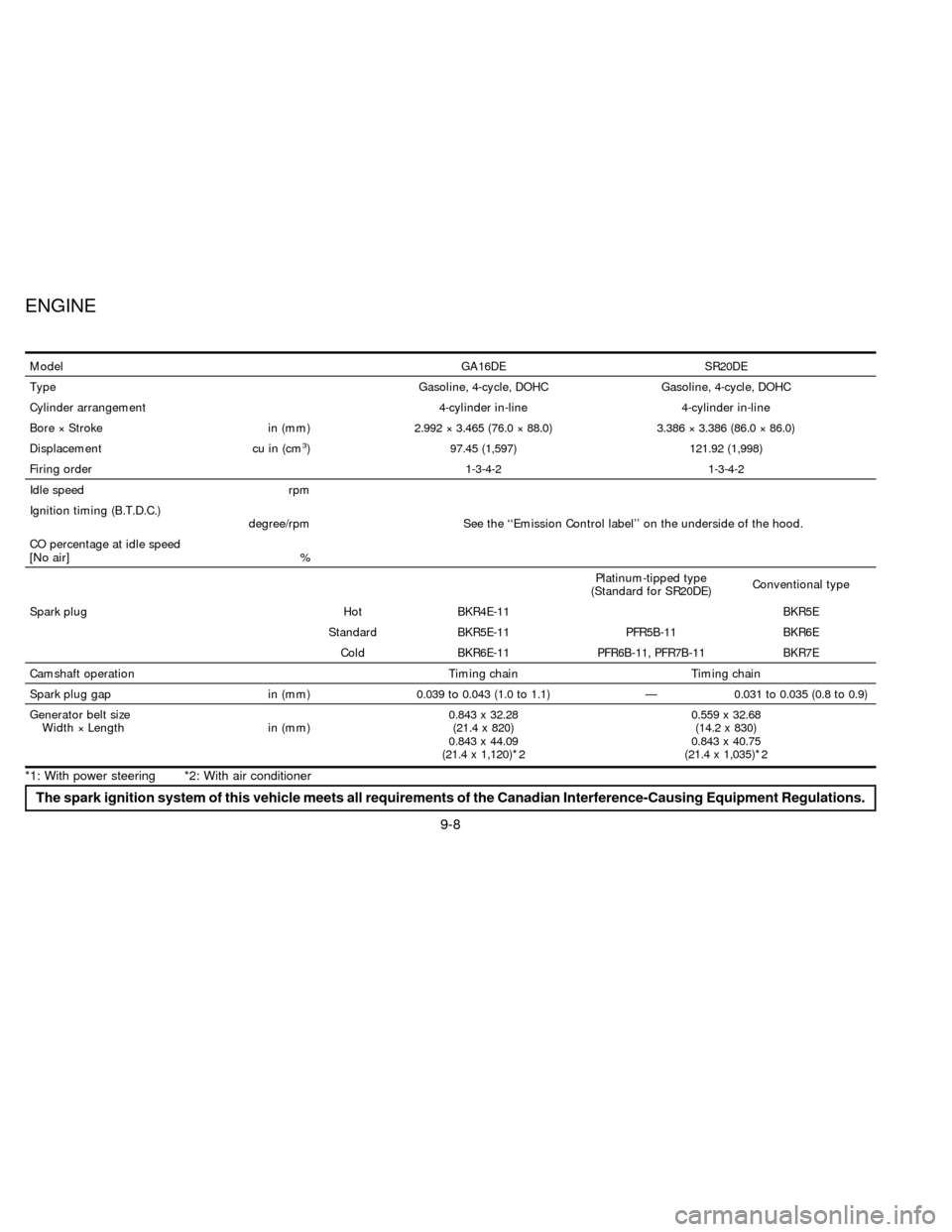
ModelGA16DE SR20DE
Type Gasoline, 4-cycle, DOHC Gasoline, 4-cycle, DOHC
Cylinder arrangement 4-cylinder in-line 4-cylinder in-line
Bore ý Stroke in (mm) 2.992 ý 3.465 (76.0 ý 88.0) 3.386 ý 3.386 (86.0 ý 86.0)
Displacement cu in (cm
3) 97.45 (1,597) 121.92 (1,998)
Firing order1-3-4-2 1-3-4-2
Idle speed rpm
See the ``Emission Control label'' on the underside of the hood. Ignition timing (B.T.D.C.)
degree/rpm
CO percentage at idle speed
[No air] %
Platinum-tipped type
(Standard for SR20DE)Conventional type
Spark plug Hot BKR4E-11 BKR5E
Standard BKR5E-11 PFR5B-11 BKR6E
Cold BKR6E-11 PFR6B-11, PFR7B-11 BKR7E
Camshaft operation Timing chain Timing chain
Spark plug gap in (mm) 0.039 to 0.043 (1.0 to 1.1) Ð 0.031 to 0.035 (0.8 to 0.9)
Generator belt size
Width ý Length in (mm)0.843 x 32.28
(21.4 x 820)
0.843 x 44.09
(21.4 x 1,120)*20.559 x 32.68
(14.2 x 830)
0.843 x 40.75
(21.4 x 1,035)*2
*1: With power steering *2: With air conditioner
The spark ignition system of this vehicle meets all requirements of the Canadian Interference-Causing Equipment Regulations.
ENGINE
9-8
ZX
Page 178 of 194

When planning to travel in another coun-
try,you should first find out if the fuel
available is suitable for your vehicle's en-
gine.
Using fuel with too low an octane/cetane
rating may cause engine damage. All gaso-
line vehicles must be operated with un-
leaded engine gasoline. Therefore, avoid
taking your vehicle to areas where appropri-
ate fuel is not available.
When transferring the registration of
your vehicle to another country, state,
province or district,it may be necessary to
modify the vehicle to meet local laws and
regulations.
The laws and regulations for motor vehicle
emission control and safety standards vary
according to the country, state, province or
district; therefore, vehicle specifications
may differ.
When any vehicle is to be taken into
another country, state, province or dis-
trict and registered, its modifications,
transportation, and registration are the
responsibility of the user. NISSAN is not
responsible for any inconvenience that
may result.
VEHICLE IDENTIFICATION
NUMBER (VIN) PLATE
The vehicle identification number (VIN)
plate is attached to the top of the instrument
panel on the driver's side. This number is
the identification for your vehicle and is
used in the vehicle registration.
VEHICLE IDENTIFICATION
NUMBER (Chassis number)
The chassis number is stamped as shown.
TI1050MATI0605
REGISTERING YOUR VEHICLE
IN ANOTHER COUNTRYVEHICLE IDENTIFICATION
9-10
ZX
Page 190 of 194

D
Daytime running light system (Canada
only) ........................................................... 1-12
Defogger switch
Rear window defogger switch .............. 1-11
Dimensions and weights.............................. 9-9
Door ajar warning light ................................ 1-6
Door locks .................................................... 2-2
Drive belts .................................................. 7-17
Driving
Cold weather driving............................. 4-19
Driving with automatic transmission ....... 4-6
Driving with manual transmission ........... 4-9
Precautions when starting and
driving ..................................................... 4-2
E
Economy - fuel........................................... 4-14
Emission control information label............. 9-12
Emission control system warranty ............. 9-18
Engine
Before starting the engine ...................... 4-5
Capacities and recommended fuel/
lubricants ................................................ 9-2
Changing engine coolant........................ 7-6
Changing engine oil................................ 7-9
Changing engine oil filter...................... 7-10
Checking engine coolant level ............... 7-5
Checking engine oil level ....................... 7-8Engine compartment check
locations .......................................... 7-3, 7-4
Engine coolant temperature gauge ........ 1-3
Engine cooling system ........................... 7-5
Engine oil ................................................ 7-8
Engine oil and oil filter
recommendation ..................................... 9-5
Engine oil pressure warning light ........... 1-5
Engine oil viscosity ................................. 9-5
Engine serial number ........................... 9-11
Engine specifications .............................. 9-8
Starting the engine ............................... 4-11
Exhaust gas (Carbon monoxide) ................. 4-2
F
Flashers (See hazard warning flasher
switch) ........................................................ 1-14
Flat tire ......................................................... 5-2
Floor mat positioning aid ............................. 6-4
Fluid
Automatic transmission fluid (ATF) ...... 7-11
Brake fluid............................................. 7-14
Capacities and recommended fuel/
lubricants ................................................ 9-2
Engine coolant ........................................ 7-5
Engine oil ................................................ 7-8
Power steering fluid .............................. 7-13
Window washer fluid ............................ 7-14
F.M.V.S.S. certification label ..................... 9-11
Front fog light switch ................................. 1-13
Front seats ................................................. 2-12Fuel
Capacities and recommended fuel/
lubricants ................................................ 9-2
Fuel economy ....................................... 4-14
Fuel filler cap ........................................ 2-10
Fuel filler lid lock opener lever ............. 2-10
Fuel gauge.............................................. 1-4
Fuel octane rating................................... 9-3
Fuel recommendation ............................. 9-3
Fuses ......................................................... 7-23
Fusible links ............................................... 7-23
G
Gauge
Engine coolant temperature gauge ........ 1-3
Fuel gauge.............................................. 1-4
Speedometer .......................................... 1-3
Tachometer............................................. 1-3
Trip odometer ......................................... 1-3
General maintenance .................................. 8-2
Glove box..................................................... 2-8
H
Hazard warning flasher switch .................. 1-14
Head restraints .......................................... 2-14
Headlight aiming adjustment ..................... 7-26
Headlight and turn signal switch ............... 1-12
Headlights .................................................. 7-25
10-2
ZX
Page 194 of 194

Recommended fuel:
Unleaded gasoline, at least 87 AKI (RON 91).
For further information on items such as gaso-
hol, see ``Fuel recommendation'' in the ``Tech-
nical and consumer information'' section.
Recommended engine oil:
cAPI SG or SH and Energy Conserving II
cAPI Certification Mark
c
SAE 5W-30 viscosity oil is preferred for all
ambient temperatures.
See ``Engine oil and oil filter recommenda-
tion'' in the ``Technical and consumer infor-
mation'' section.
Tire cold pressure:
See tire placard affixed to the driver side
center pillar.
Recommended new vehicle
break-in procedure:
During the first 1,000 miles (1,600 km) of
vehicle use, follow the recommendations out-
lined in the ªBREAK-IN SCHEDULE Informa-
tion found in the ªStarting and Drivingº section
of this Owner's Manual. Follow these recom-
mendations for the future reliability and
economy of your new vehicle. Failure to follow
these recommendations may result in vehicle
damage or shortened engine life.
AGS0601
GAS STATION INFORMATION QUICK REFERENCE
ZX