1997 NISSAN SENTRA Recommended SAE
[x] Cancel search: Recommended SAEPage 103 of 194

Freeing a frozen door lock
To prevent a door lock from freezing, apply
de-icer or glycerin to it through the key hole.
If the lock becomes frozen, heat the key
before inserting it into the key hole.
Anti-freeze
In the winter when it is anticipated that the
temperature will drop below 32ÉF (0ÉC),
check the anti-freeze (ethylene glycol base)
to assure proper winter protection. For de-
tails, see ``Engine cooling system'' in the
``Do-it-yourself operations'' section.
Battery
If the battery is not fully charged during
extremely cold weather conditions, the bat-
tery fluid may freeze and damage the bat-
tery. To maintain maximum efficiency, the
battery should be checked regularly. For
details, see ``Battery'' in the ``Do-it-yourself
operations'' section.
Draining of coolant water
If the vehicle is to be left outside without
anti-freeze, drain the cooling system by
opening the drain valves located under the
radiator and on the engine block. Refillbefore operating the vehicle. See ``Chang-
ing Engine Coolant'' in the ``Do-it-yourself
operations'' section.
Tire equipment
1. SUMMER tires are of a tread design to
provide superior performance on dry
pavement. However, the performance of
these tires will be substantially reduced
in snowy and icy conditions. If you oper-
ate your vehicle on snowy or icy roads,
NISSAN recommends the use of MUD &
SNOW or ALL SEASON TIRES on all
four wheels. Please consult your NIS-
SAN dealer for the tire type, size, speed
rating and availability information.
2. For additional traction on icy roads, stud-
ded tires may be used. However, some
provinces and states prohibit their use.
Check local, state and provincial laws
before installing studded tires.
Skid and traction capabilities of studded
snow tires on wet or dry surfaces may be
poorer than that of non-studded snow
tires.
3. Tire chains may be used if desired. Make
sure they are of proper size for the tires
on your vehicle and are installed accord-ing to the chain manufacturer's sugges-
tions.
Use of tire chains may be prohibited
according to location. Check the local
laws before installing tire chains. When
installing tire chains, make sure they are
of proper size for the tires on your vehicle
and are installed according to the chain
manufacturer's suggestions.Use only
SAE Class ªSº chains.Other types may
damage your vehicle. Use chain tension-
ers when recommended by the tire chain
manufacturer to ensure a tight fit. Loose
end links of the tire chain must be se-
cured or removed to prevent the possi-
bility of whipping action damage to the
fenders or underbody. If possible, avoid
fully loading your vehicle when using tire
chains. In addition, drive at a reduced
speed. Otherwise, your vehicle may be
damaged and/or vehicle handling and
performance may be adversely affected.
Never install tire chains on T-type spare
tires. Do not use tire chains on dry roads.
COLD WEATHER DRIVING
4-19
ZX
Page 155 of 194

Summer tires
NISSAN specifies summer tires on some
models to provide superior performance on
dry roads. Summer tire performance in
snow and ice is substantially reduced. Sum-
mer tires do not have the tire traction rating
``M&S'' on the tire sidewall.
If you plan to operate your vehicle in snowy
or icy conditions, NISSAN recommends the
use of ``SNOW'' or ``ALL SEASON'' tires on
all four wheels.
Snow tires
If snow tires are needed, it is necessary to
select tires equivalent in size and load rating
to the original equipment tires. If you do not,
it can adversely affect the safety and han-
dling of your vehicle.
Generally, snow tires have lower speed
ratings than factory equipped tires and may
not match the potential maximum vehicle
speed. Never exceed the maximum speed
rating of the tire.
For additional traction on icy roads, studded
tires may be used. However, some prov-
inces and states prohibit their use. Check
local, state and provincial laws before in-stalling studded tires. Skid and traction ca-
pabilities of studded snow tires on wet or dry
surfaces may be poorer than that of non-
studded snow tires.
Tire chains
Use of tire chains may be prohibited accord-
ing to location. Check the local laws before
installing tire chains. When installing tire
chains, make sure they are of proper size
for the tires on your vehicle and are installed
according to the chain manufacturer's sug-
gestions.Use only SAE class ªSº chains.
Other types may damage your vehicle. Use
chain tensioners when recommended by
the tire chain manufacturer to ensure a tight
fit. Loose end links of the tire chain must be
secured or removed to prevent the possibil-
ity of whipping action damage to the fenders
or underbody. If possible, avoid fully loading
your vehicle when using tire chains. In ad-
dition, drive at a reduced speed. Otherwise,
your vehicle may be damaged and/or ve-
hicle handling and performance may be
adversely affected.
Never install tire chains on a T-type spare
tire. Do not use tire chains on dry roads.
Tire rotation
NISSAN recommends rotating the tires
every 7,500 miles (12,000 km).
See ``Flat tire'' in the ``In case of emergency''
section for tire replacing procedures.
As soon as possible, tighten the wheel
nuts to the specified torque with a nut
tightening torque:
72 to 87 ft-lb (98 to 118 Nzm)
The wheel nuts must be kept tightened to
specifications at all times. It is recom-
mended that wheel nuts be tightened to
specification at each tire rotation inter-
val.
ADI0656
7-33
ZX
Page 169 of 194

9Technical and consumer information
Capacities and recommended fuel/lubricants ........9-2
Fuel recommendation.............................................9-3
Engine oil and oil filter recommendation................9-5
Recommended SAE viscosity number...................9-7
Air conditioner system refrigerant and
lubricant recommendations ....................................9-7
Engine ....................................................................9-8
Wheel/tire size ........................................................9-9
Dimensions and weights ........................................9-9
Registering your vehicle in another country ........9-10
Vehicle identification ............................................9-10
Vehicle identification number (VIN) plate.............9-10
Vehicle identification number (chassis
number) ................................................................9-10Engine serial number ...........................................9-11
F.M.V.S.S. certification label ................................9-11
Emission control information label .......................9-12
Tire placard ..........................................................9-12
Air conditioner specification label.........................9-12
Installing license plate ..........................................9-13
Vehicle loading information ..................................9-13
Trailer towing ........................................................9-14
Uniform tire quality grading ..................................9-17
Emission control system warranty .......................9-18
Reporting safety defects (USA) ...........................9-18
Readiness for inspection/maintenance (I/M)
test ........................................................................9-19
ZX
Page 170 of 194

The following are approximate capacities. The actual refill capacities may be a little different. When refilling, follow the procedure
instructed in the ``Do-it-yourself operations'' section to determine the proper refill capacity.
Capacity (Approximate)
Recommended specifications
US
measureImp
measureLiter
Fuel 13-1/4 gal 11 gal 50 Unleaded gasoline with an octane rating of at least 87 AKI (RON 91)*1
Engine oil (Refill)
With oil filter GA16DE 3-3/8 qt 2-7/8 qt 3.2
API SG or SH and Energy Conserving II*2
API Certification Mark *2 SR20DE 3-5/8 qt 3 qt 3.4
Without oil filter GA16DE 3 qt 2-1/2 qt 2.8
SR20DE 3-3/8 qt 2-7/8 qt 3.2
Cooling system
With reservoir
Antifreeze coolant
(Ethylene glycol base) Manual transmission: SR20DE 6-1/2 qt 5-1/2 qt 6.2
GA16DE 5-1/2 qt 4-5/8 qt 5.2
Automatic transmission: SR20DE 6-1/2 qt 5-1/2 qt 6.2
GA16DE 6 qt 5 qt 5.7
Manual transmission gear oilRS5F31A 6-1/8 - 6-3/4 pt 5-1/8 - 5-5/8 pt 2.9 - 3.2
API GL-4*3
RS5F32V 7-7/8 - 8-1/4 pt 6-1/2 - 6-7/8 pt 3.7 - 3.9
Automatic transmission fluid
Refill to the proper level according to the instructions in the
``Do-it-yourself operations'' section.Nissan Matic `D' (Continental U.S. and Alaska) or Genuine Nissan Auto-
matic Transmission Fluid (Canada).*4
Power steering fluidType DEXRON
TMIIE, DEXRONTMIII or equivalent.
Brake fluidGenuine Nissan Brake Fluid*5 or equivalent
DOT 3 (US FMVSS No. 116)
Multi-purpose grease Ð Ð Ð NLGI No. 2 (Lithium Complex)
Air conditioning system refrigerant Ð Ð Ð HFC-134a (R-134a)*6
Air conditioning system lubricantsNissan A/C System Lubricant Type R or equivalent*6
*1: For further details, see ``Fuel recommendation.''
*2: For further details, see ``Recommended SAE engine oil viscosity.''
*3: For further details, see ``Recommended SAE viscosity number.''
*4: Dexronž III/Merconž or equivalent may also be used. Outside the Continental United States and Alaska contact a Nissan dealership for more information
regarding suitable fluids, including recommended brand(s) of Dexronž III/Merconž or Dexronž IIE/Merconž Automatic Transmission Fluid.
*5: Available in mainland USA through your Nissan dealer.
*6: For further details, see ªAir conditioner specification label.º
CAPACITIES AND
RECOMMENDED FUEL/
LUBRICANTS
9-2
ZX
Page 173 of 194

ENGINE OIL AND OIL FILTER
RECOMMENDATION
Selecting the correct oil
It is essential to choose the correct quality
and viscosity oil to ensure satisfactory en-
gine life and performance. Nissan recom-
mends the use of a low friction oil (energy
conserving oil) in order to improve fuel
economy and conserve energy. Oils which
do not have the specified quality label
should not be used as they could cause
engine damage.
Only those engine oils with the AmericanPetroleum Institute (API) CERTIFICATION
MARK on the front of the container should
be used. This type of oil supersedes the
existing API SG or SH and Energy Conserv-
ing II categories.
If you cannot find engine oil with the CER-
TIFICATION MARK, an API SG or SH and
Energy Conserving II oil with API Service
Symbol may be used. An oil with a single
designation SG or SH, or in combination
with other categories (for example, SG/CC
or SG/CD) may also be used if one with the
API CERTIFICATION MARK cannot be
found.Mineral based or synthetic type oils may be
used in your NISSAN vehicle. However,
these oils must meet the API quality and
SAE viscosity ratings specified for your ve-
hicle. Do not mix mineral based and syn-
thetic type oils in the engine at the same
time.
Oil additives
NISSAN does not recommend the use of oil
additives. The use of an oil additive is not
necessary when the proper oil type is used
and maintenance intervals are followed.
Oil which may contain foreign matter or has
been previously used should not be used.
Oil viscosity
The engine oil viscosity or thickness
changes with temperature. Because of this,
it is important to select the engine oil viscos-
ity based on the temperatures at which the
vehicle will be operated before the next oil
change. The chart ``Recommended SAE
viscosity number'' shows the recommended
oil viscosities for the expected ambient tem-
peratures. Choosing an oil viscosity other
than that recommended could cause seri-
ous engine damage.
ATI0645
9-5
ZX
Page 175 of 194
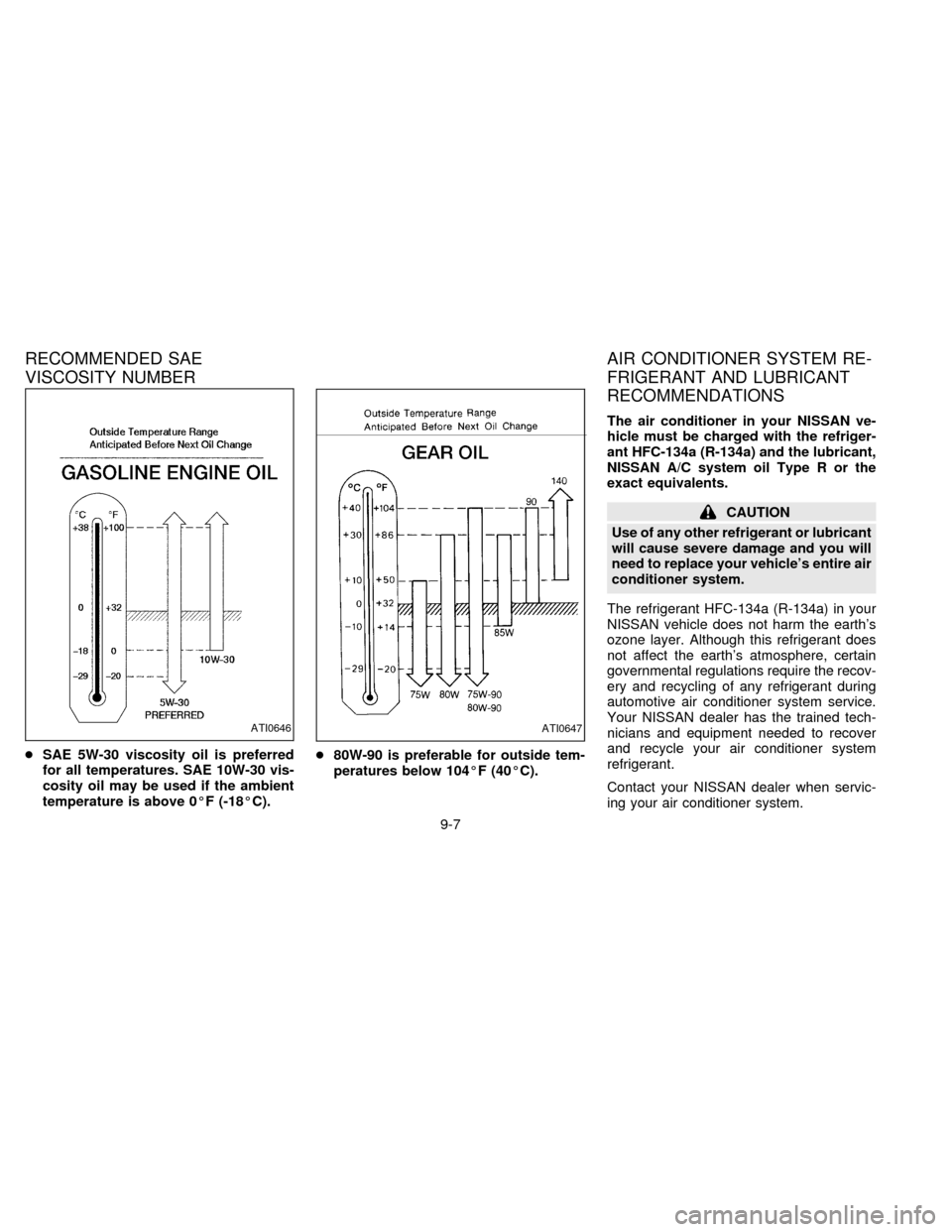
RECOMMENDED SAE
VISCOSITY NUMBER
cSAE 5W-30 viscosity oil is preferred
for all temperatures. SAE 10W-30 vis-
cosity oil may be used if the ambient
temperature is above 0ÉF (-18ÉC).c80W-90 is preferable for outside tem-
peratures below 104ÉF (40ÉC).
AIR CONDITIONER SYSTEM RE-
FRIGERANT AND LUBRICANT
RECOMMENDATIONS
The air conditioner in your NISSAN ve-
hicle must be charged with the refriger-
ant HFC-134a (R-134a) and the lubricant,
NISSAN A/C system oil Type R or the
exact equivalents.
CAUTION
Use of any other refrigerant or lubricant
will cause severe damage and you will
need to replace your vehicle's entire air
conditioner system.
The refrigerant HFC-134a (R-134a) in your
NISSAN vehicle does not harm the earth's
ozone layer. Although this refrigerant does
not affect the earth's atmosphere, certain
governmental regulations require the recov-
ery and recycling of any refrigerant during
automotive air conditioner system service.
Your NISSAN dealer has the trained tech-
nicians and equipment needed to recover
and recycle your air conditioner system
refrigerant.
Contact your NISSAN dealer when servic-
ing your air conditioner system.
ATI0646ATI0647
9-7
ZX
Page 194 of 194

Recommended fuel:
Unleaded gasoline, at least 87 AKI (RON 91).
For further information on items such as gaso-
hol, see ``Fuel recommendation'' in the ``Tech-
nical and consumer information'' section.
Recommended engine oil:
cAPI SG or SH and Energy Conserving II
cAPI Certification Mark
c
SAE 5W-30 viscosity oil is preferred for all
ambient temperatures.
See ``Engine oil and oil filter recommenda-
tion'' in the ``Technical and consumer infor-
mation'' section.
Tire cold pressure:
See tire placard affixed to the driver side
center pillar.
Recommended new vehicle
break-in procedure:
During the first 1,000 miles (1,600 km) of
vehicle use, follow the recommendations out-
lined in the ªBREAK-IN SCHEDULE Informa-
tion found in the ªStarting and Drivingº section
of this Owner's Manual. Follow these recom-
mendations for the future reliability and
economy of your new vehicle. Failure to follow
these recommendations may result in vehicle
damage or shortened engine life.
AGS0601
GAS STATION INFORMATION QUICK REFERENCE
ZX