1997 NISSAN QUEST hood release
[x] Cancel search: hood releasePage 33 of 247

2Pre-driving checks and adjustments
Key .........................................................................2-2
Door locks ..............................................................2-2
Manual door lock ....................................................2-2
Child safety sliding door lock .................................2-4
Power door lock (if so equipped) ...........................2-5
Multi-remote control system (if so equipped).........2-7
Battery replacement ...............................................2-8
Illuminated entry system ........................................2-9
Hood release ........................................................2-10
Rear door lock ......................................................2-11
Cargo net (if so equipped) ...................................2-13
Luggage rack (if so equipped) .............................2-14
Fuel filler lid and cap ............................................2-15
Seats/floor mats ...................................................2-15
Seating arrangements ..........................................2-15
Floor mat positioning ............................................2-17
Seven passenger seating ....................................2-17Three-passenger bench seat in storage
position .................................................................2-17
Five passenger seating ........................................2-18
Five passenger seating with cargo room .............2-18
Three-passenger bench seat in fully forward
position .................................................................2-19
Floor mat positioning aid ......................................2-20
Seat positions .......................................................2-21
With second row bench seat................................2-21
With second row bucket seats .............................2-24
Seats ....................................................................2-26
Manual front seat adjustment...............................2-26
Power front seat adjustment
(if so equipped) ....................................................2-28
Head restraints .....................................................2-30
Armrests ...............................................................2-30
Underseat storage tray.........................................2-31
Tabletop seats ......................................................2-31
ZX
Page 43 of 247
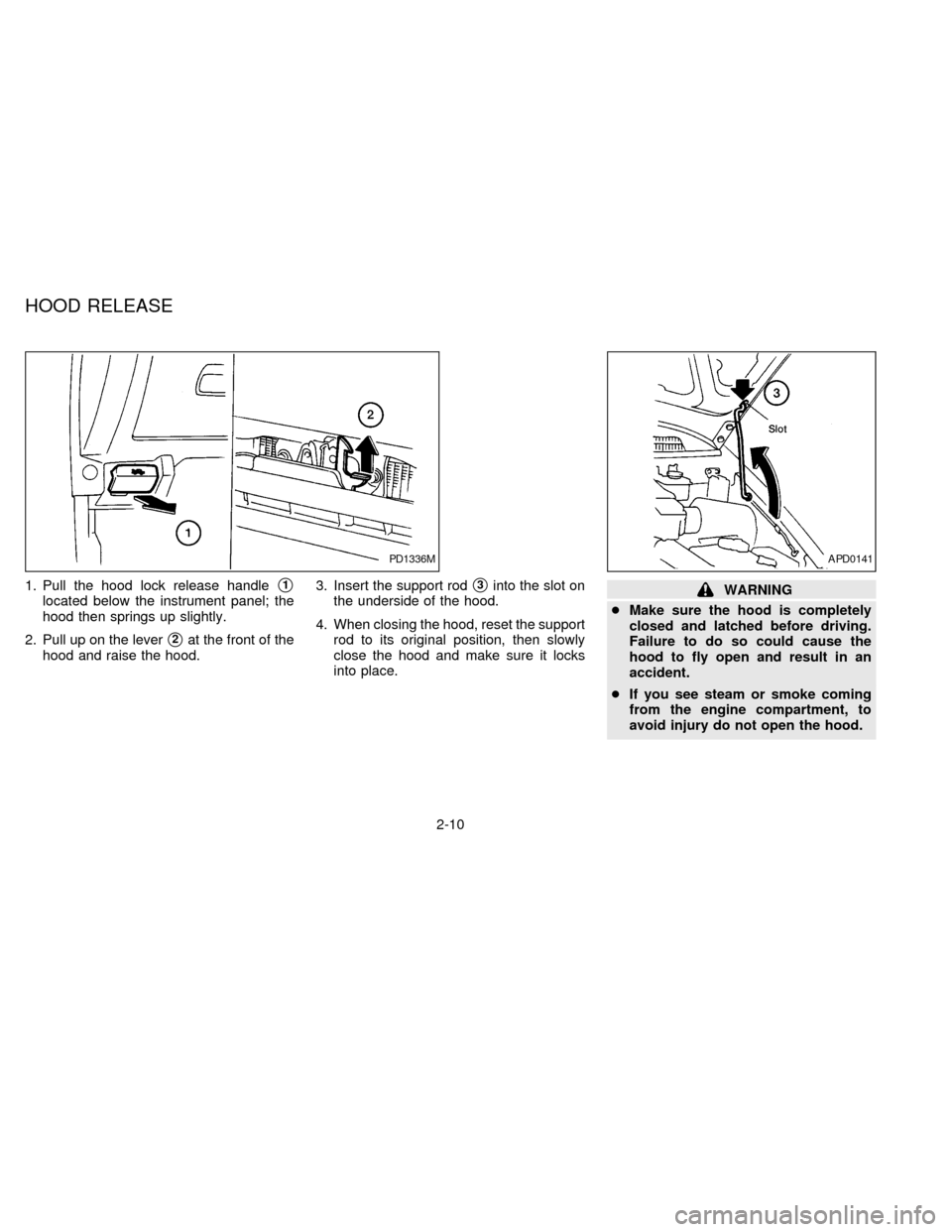
1. Pull the hood lock release handles1
located below the instrument panel; the
hood then springs up slightly.
2. Pull up on the lever
s2at the front of the
hood and raise the hood.3. Insert the support rod
s3into the slot on
the underside of the hood.
4. When closing the hood, reset the support
rod to its original position, then slowly
close the hood and make sure it locks
into place.WARNING
cMake sure the hood is completely
closed and latched before driving.
Failure to do so could cause the
hood to fly open and result in an
accident.
cIf you see steam or smoke coming
from the engine compartment, to
avoid injury do not open the hood.
PD1336MAPD0141
HOOD RELEASE
2-10
ZX
Page 154 of 247
The anti-lock brake system controls the
brakes at each wheel so the wheels do not
lock when braking abruptly or when braking
on slippery surfaces. The system detects the
rotation speed at each wheel and varies the
brake fluid pressure to prevent each wheel
from locking and sliding. By preventing wheel
lockup, the system helps the driver maintain
steering control and helps to minimize swerv-
ing and spinning on slippery surfaces.
Using the system
Depress the brake pedal and hold it down.
WARNING
Do not pump the brake pedal. Doing so
may result in increased stopping dis-
tances.
Normal operation
The anti-lock brake system does not operate
at speeds below 3 to 6 MPH (5 to 10 km/h) to
completely stop the vehicle. (The speeds vary
according to road conditions.) When the anti-
lock system senses one or more wheels are
close to locking up, the actuator (under the
hood) rapidly applies and releases hydraulic
pressure (like pumping the brakes veryquickly). While the actuator is working, you
may feel a pulsation in the brake pedal and
hear a noise or vibration from the actuator
under the hood. This is normal and indicates
the anti-lock system is working properly. How-
ever, the pulsation may indicate road condi-
tions are hazardous and extra care is required
while driving.
Self-test feature
The anti-lock brake system consists of elec-
tronic sensors, electric pumps, and hydraulic
solenoids controlled by a computer. The com-
puter has a built-in diagnostic feature that
tests the system each time you start the
engine and move the vehicle at a low speed in
forward or reverse. When the self-test occurs,
you may hear a ``clunk'' noise and/or feel a
pulsation in the brake pedal. This is normal
and is not an indication of any malfunction. If
the computer senses any malfunction, it
switches the anti-lock brake system OFF and
turns on the ABS brake warning light in the
dashboard. The brake system then operates
normally, but without anti-lock assistance.
If the light comes on during the self-test, or
while driving, take your vehicle to your NIS-
SAN dealer for repair at your earliest conve-
nience.
WARNING
The anti-lock brake system is a sophis-
ticated device, but it cannot prevent
accidents resulting from careless or
dangerous driving techniques. It can
help maintain vehicle control during
braking on slippery surfaces, but re-
member that the stopping distance on
slippery surfaces will be longer than on
normal surfaces, even with the anti-
lock system. Stopping distances may
also be longer on rough, gravel or
snow covered roads, or if you are using
tire chains. Always maintain a safe dis-
tance from the vehicle in front of you.
Ultimately, the responsibility for safety
of self and others rests in the hands of
the driver.
Tire type and condition of tires may
also affect braking effectiveness.
cWhen replacing tires, install the
specified size of tires on all 4 wheels.
ANTI-LOCK BRAKE SYSTEM
(ABS) (if so equipped)
4-15
ZX
Page 210 of 247

make sure no nuts are missing, and check
for any loose nuts. Tighten if necessary.
Tire rotation*Ð Tires should be rotated
every 7,500 miles (12,000 km).
Wheel alignment and balanceÐIfthe
vehicle should pull to either side while driv-
ing on a straight and level road, or if you
detect uneven or abnormal tire wear, there
may be a need for wheel alignment.
If the steering wheel or seat vibrates at
normal highway speeds, wheel balancing
may be needed.
Windshield wiper blades*Ð Check for
cracks or wear if they do not wipe properly.
Doors and engine hoodÐ Check that all
doors and the engine hood operate prop-
erly. Also ensure that all latches lock se-
curely. Lubricate hinges, latches, rollers and
links if necessary. Make sure the secondary
latch keeps the hood from opening when
the primary latch is released.
When driving in areas using road salt or
other corrosive materials, check lubrication
frequently.INSIDE THE VEHICLE
The maintenance items listed here should
be checked on a regular basis, such as
when performing periodic maintenance,
cleaning the vehicle, etc.
Lights*Ð Make sure the headlights, stop
lights, tail lights, turn signal lights, and other
lights are all operating properly and installed
securely. Also check headlight aim.
Warning lights and buzzers/chimesÐ
Make sure all warning lights and
buzzers/chimes are operating properly.
Windshield wiper and washer*Ð Check
that the wipers and washer operate properly
and that the wipers do not streak.
Windshield defrosterÐ Check that the air
comes out of the defroster outlets properly
and in sufficient quantity when operating the
heater or air conditioner.
Steering wheelÐ Check for changes in
the steering conditions, such as excessive
freeplay, hard steering or strange noises.
SeatsÐ Check seat position controls such
as seat adjusters, seatback recliner, etc. to
ensure they operate smoothly and all
latches lock securely in every position.Check that the head restraints move up and
down smoothly and the locks hold securely
in all latched positions. Check that the seat
leg latches lock securely in every anchor
position for the folding down rear seat and
detachable rear seat (if so equipped).
Seat beltsÐ Check that all parts of the seat
belt system (e.g. buckles, anchors, adjust-
ers and retractors) operate properly and
smoothly, and are installed securely. Check
the belt webbing for cuts, fraying, wear or
damage.
Accelerator pedalÐ Check the pedal for
smooth operation and make sure the pedal
does not catch or require uneven effort.
Keep the floor mats away from the pedal.
BrakesÐ Check that the brakes do not pull
the vehicle to one side when applied.
Brake pedal*Ð Check the pedal for
smooth operation and make sure it has the
proper distance under it when depressed
fully. Check the brake booster function. Be
certain to keep floor mats away from the
pedal.
Parking brake*Ð Check that the pedal is
adjusted to specification and confirm that
your vehicle is held securely on a fairly
8-3
ZX
Page 243 of 247

G
Gauge
Engine coolant temperature gauge ........ 1-4
Fuel gauge.............................................. 1-5
Odometer ................................................ 1-4
Speedometer .......................................... 1-4
Tachometer............................................. 1-4
Trip odometer ......................................... 1-4
General maintenance .................................. 8-2
H
Hazard warning flasher switch .................. 1-15
Head restraints .......................................... 2-30
Headlight control switch............................. 1-13
Headlights .................................................. 7-19
Heater
Heater and air conditioner (automatic)
(if so equipped)..................................... 3-10
Heater and air conditioner (manual)....... 3-3
Rear seat heater and air
conditioner ............................................ 3-13
Hood release ............................................. 2-10
I
Ignition switch .............................................. 4-4
Important vehicle information label............ 9-10
Increasing fuel economy............................ 4-12
Indicator lights and chimes (See warning/indicator lights and chimes) ......................... 1-6
Inertial fuel shut off switch ......................... 5-11
Inside mirror ............................................... 2-80
Instrument brightness control .................... 1-15
Integrated child safety seats...................... 2-71
Interior lights .............................................. 1-24
J
Jump starting ...................................... 5-8, 7-12
K
Key ............................................................... 2-2
Keyless entry system (See multi-remote
control system) ............................................ 2-7
L
Labels
Air conditioner specification label ......... 9-11
Emission control information label........ 9-10
Engine serial number ............................. 9-9
F.M.V.S.S. certification label ................ 9-10
Vehicle identification number ................. 9-9
Vehicle identification number (VIN)
plate ........................................................ 9-9
Warning labels (for SRS) ..................... 2-47
License plate
Installing the license plate .................... 9-11Light
Air bag warning light............................. 2-47
Brake light (See stop light) ................... 7-21
Bulb check/instrument panel .................. 1-6
Bulb replacement.................................. 7-21
Cornering light ...................................... 1-15
Headlight control switch ....................... 1-13
Headlights ............................................. 7-19
Interior lights ......................................... 1-24
Light bulbs ............................................ 7-19
Luggage compartment lights ................ 1-24
Spotlights .............................................. 1-25
Warning/indicator lights and chimes ...... 1-6
Lock
Child safety sliding door lock ................. 2-4
Door locks............................................... 2-2
Fuel filler lid lock opener lever ............. 2-15
Power door lock...................................... 2-5
Rear door lock ...................................... 2-11
Luggage compartment lights ..................... 1-24
Luggage rack ............................................. 2-14
Luggage (See vehicle loading
information ................................................. 9-12
M
Maintenance
General maintenance ............................. 8-2
Inside the vehicle.................................... 8-3
Maintenance precautions ....................... 7-2
Outside the vehicle ................................. 8-2
Periodic maintenance schedules ............ 8-5
10-3
ZX