WARNING
cThe air conditioner cooling function
operates only when the engine is
running.
cDo not leave children, unreliable
adults, or pets alone in your vehicle.
On hot sunny days, temperatures in
a closed vehicle could quickly be-
come high enough to cause severe
or possibly fatal injuries to people or
animals.cDo not use the recirculation mode
for long periods as it may cause the
interior air to become stale and the
windows to fog up.
cPositioning of the heating or air con-
ditioning controls should not be
done while driving, in order that full
attention may be given to the driving
operation.
Controls
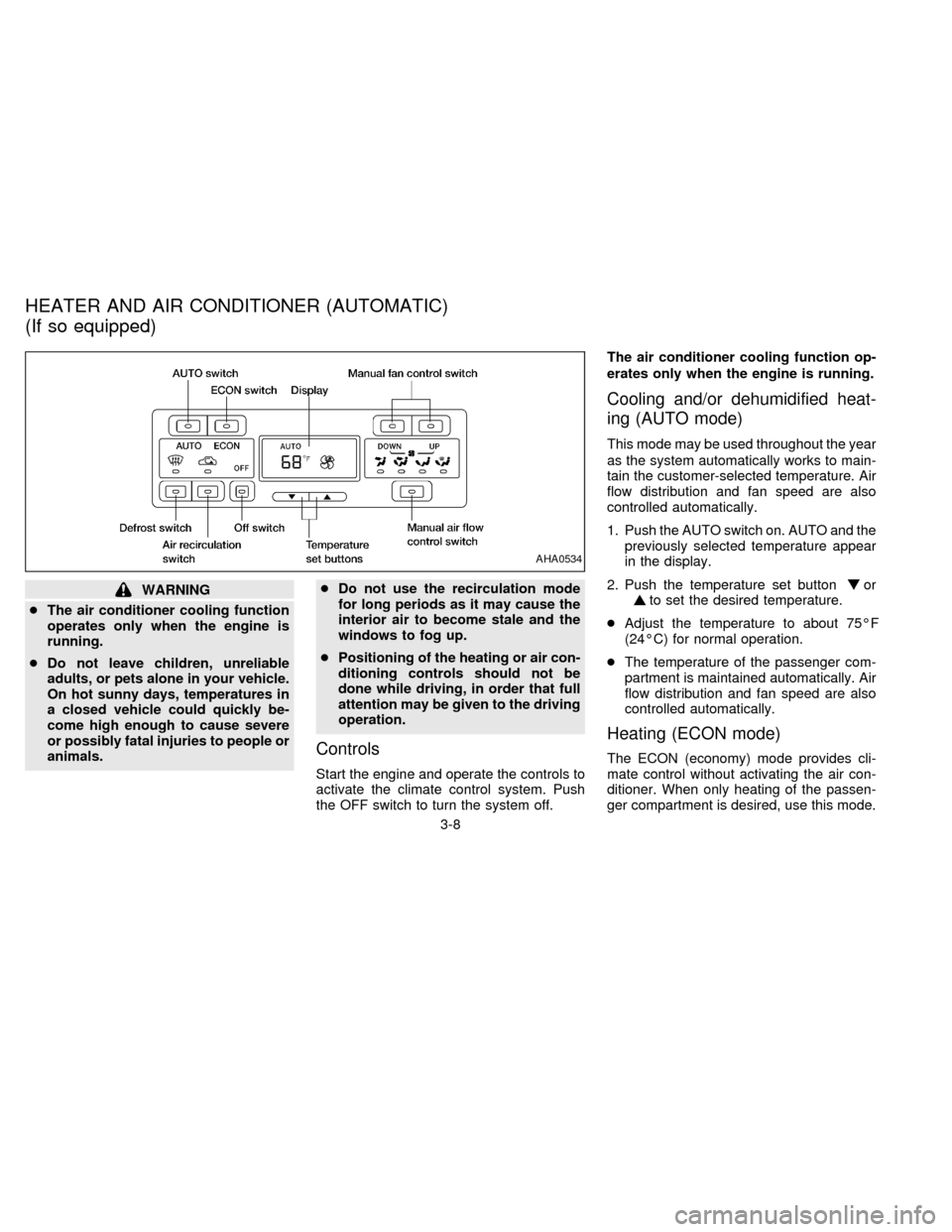
Start the engine and operate the controls to
activate the climate control system. Push
the OFF switch to turn the system off.The air conditioner cooling function op-
erates only when the engine is running.
Cooling and/or dehumidified heat-
ing (AUTO mode)
This mode may be used throughout the year
as the system automatically works to main-
tain the customer-selected temperature. Air
flow distribution and fan speed are also
controlled automatically.
1. Push the AUTO switch on. AUTO and the
previously selected temperature appear
in the display.
2. Push the temperature set button
orto set the desired temperature.
cAdjust the temperature to about 75ÉF
(24ÉC) for normal operation.
cThe temperature of the passenger com-
partment is maintained automatically. Air
flow distribution and fan speed are also
controlled automatically.
Heating (ECON mode)
The ECON (economy) mode provides cli-
mate control without activating the air con-
ditioner. When only heating of the passen-
ger compartment is desired, use this mode.
AHA0534
HEATER AND AIR CONDITIONER (AUTOMATIC)
(If so equipped)
3-8
ZX
cTo maintain engine braking efficiency
and electrical charging performance, do
not use fifth gear (manual transmission)
or overdrive (automatic transmission).
cAvoid holding the brake pedal down too
long or too frequently. This could cause
the brakes to overheat, resulting in re-
duced braking efficiency.
When towing a trailer, change the trans-
mission fluid more frequently.
See the Maintenance Schedule.DOT (Department of Transportation) Qual-
ity Grades: All passenger car tires must
conform to federal safety requirements in
addition to these grades.
Treadwear
Treadwear grade is a comparative rating
based on tire wear rate when tested under
controlled conditions on specified govern-
ment test courses. For example, a tire
graded 150 would wear one and a half
(1-1/2) times as well on the government
course as a tire graded 100. However,
relative tire performance depends on actual
driving conditions, and may vary signifi-
cantly from the norm due to variations in
driving habits, service practices and differ-
ences in road characteristics and climate.
Traction A, B and C
Traction grades are A (the highest), B and
C. They represent a tire's ability to stop on
wet pavement as measured under con-
trolled conditions, on specified government
test surfaces of asphalt and concrete. A tire
marked with a C may have poor traction
performance.
WARNING
The traction grade assigned to your
vehicle tires is based on straight line
braking traction tests and does not
include cornering (turning) traction.
Temperature A, B and C
Temperature grades are A (the highest), B,
and C. They represent a tire's resistance to
heat build-up, and its ability to dissipate
heat when tested under controlled condi-
tions on a specified indoor laboratory test
wheel. Sustained high temperature can
cause tire material to degenerate, reducing
tire life. Excessive temperatures can lead to
sudden tire failure. Grade C corresponds to
a performance level which all passenger car
tires must meet under the Federal Motor
Vehicle Safety Standard No. 109. Grades A
and B represent higher levels of perfor-
mance on laboratory test wheels than the
minimum required by law.
WARNING
The temperature grade for this tire is
established for a tire that is properly
UNIFORM TIRE QUALITY
GRADING
9-18
ZX