Page 837 of 1310

SRS ± SRS Diagnosis Unit (SDU)/Air Bag Module and Clock Spring52B-28
INSPECTION52400220093
�Check the SDU and brackets for dents, cracks or
deformation.
�Check connector for damage, and terminals for
deformation.
Caution
If a dent, crack, deformation or rust is discovered,
replace the SDU with a new one.
NOTE
For checking of the SDU other than described above,
refer to the section concerning troubleshooting. (Refer
to P.52B-6.)
AIR BAG MODULE AND CLOCK SPRING52400240143
Caution
1. Disconnect the battery (±) terminal and wait
for 60 seconds or more before starting work.
Furthermore, the disconnected battery
terminal should be covered with tape to
insulate it. (Refer to P.52B-3, No.4.)
2. Never attempt to disassemble or repair the
air bag modules or clock spring.
If faulty, replace it.
3. Do not drop the air bag modules or clock
spring or allow contact with water, grease
or oil.
Replace it if a dent, crack, deformation or
rust is detected.4. The air bag modules should be stored on
a flat surface and placed so that the pad
surface is facing upward.
Do not place anything on top of it.
5. Do not expose the air bag modules to
temperatures over 93�C.
6. After deployment of an air bag, replace the
clock spring with a new one.
7. Wear gloves and safety glasses when
handling air bags that have already
deployed.
8. An undeployed air bag module should only
be disposed of in accordance with the
procedures (Refer to P.52B-34.)
Page 936 of 1310

± General Information HEATER, AIR CONDITIONER
AND VENTILATION55-3
GENERAL INFORMATION55200010121
The heater system uses a two-way-flow full-air-mix
system that features high performance and low
operating noise, and includes an independent face
air blowing function and a cool air bypass function.The A/C system is basically the same as the
conventional system, but a new refrigerant system
has been adopted as a response to restrictions
on the use of chlorofluorocarbons.
ItemsSpecifications
Heater unitTypeTwo-way-flow full-air-mix system
Heater control assemblyDial type
CompressorModelInclined-plate type
Dual pressure switch
kPa
High-pressure switchON � OFF: 2,648, OF�F ON: 2,059
kPa
Low-pressure switchON � OFF: 177, OFF � ON: 186
Refrigerant and quantity gR-134a (HFC-134a), Approx. 550 ± 600
SAFETY PRECAUTIONS
Because R-134a refrigerant is a hydrofluorocarbon
(HFC) which contains hydrogen atoms in place of
chlorine atoms, it will not cause damage to the
ozone layer.
Refrigerant R-134a is transparent and colourless
in both the liquid and vapour state. Since it has
a boiling point of ± 29.8�C, at atmospheric pressure,
it will be a vapour at all normal temperatures and
pressures. The vapour is heavier than air,
non-flammable, and nonexplosive. The following
precautions must be observed when handling
R-134a.Caution
Wear safety goggles when servicing the
refrigeration system.
R-134a evaporates so rapidly at normal
atmospheric pressures and temperatures that it
tends to freeze anything it contacts. For this reason,
extreme care must be taken to prevent any liquid
refrigerant from contacting the skin and especially
the eyes. Always wear safety goggles when
servicing the refrigeration part of the A/C system.
Keep a bottle of sterile mineral oil handy when
working on the refrigeration system. Should any
liquid refrigerant get into the eyes, use a few drops
of mineral oil to wash them out. R-134a is rapidly
absorbed by the oil. Next splash the eyes with
plenty of cold water. Call your doctor immediately
even though irritation has ceased after treatment.
Page 958 of 1310
± Heater Unit and Heater Core HEATER, AIR CONDITIONER
AND VENTILATION 55-25
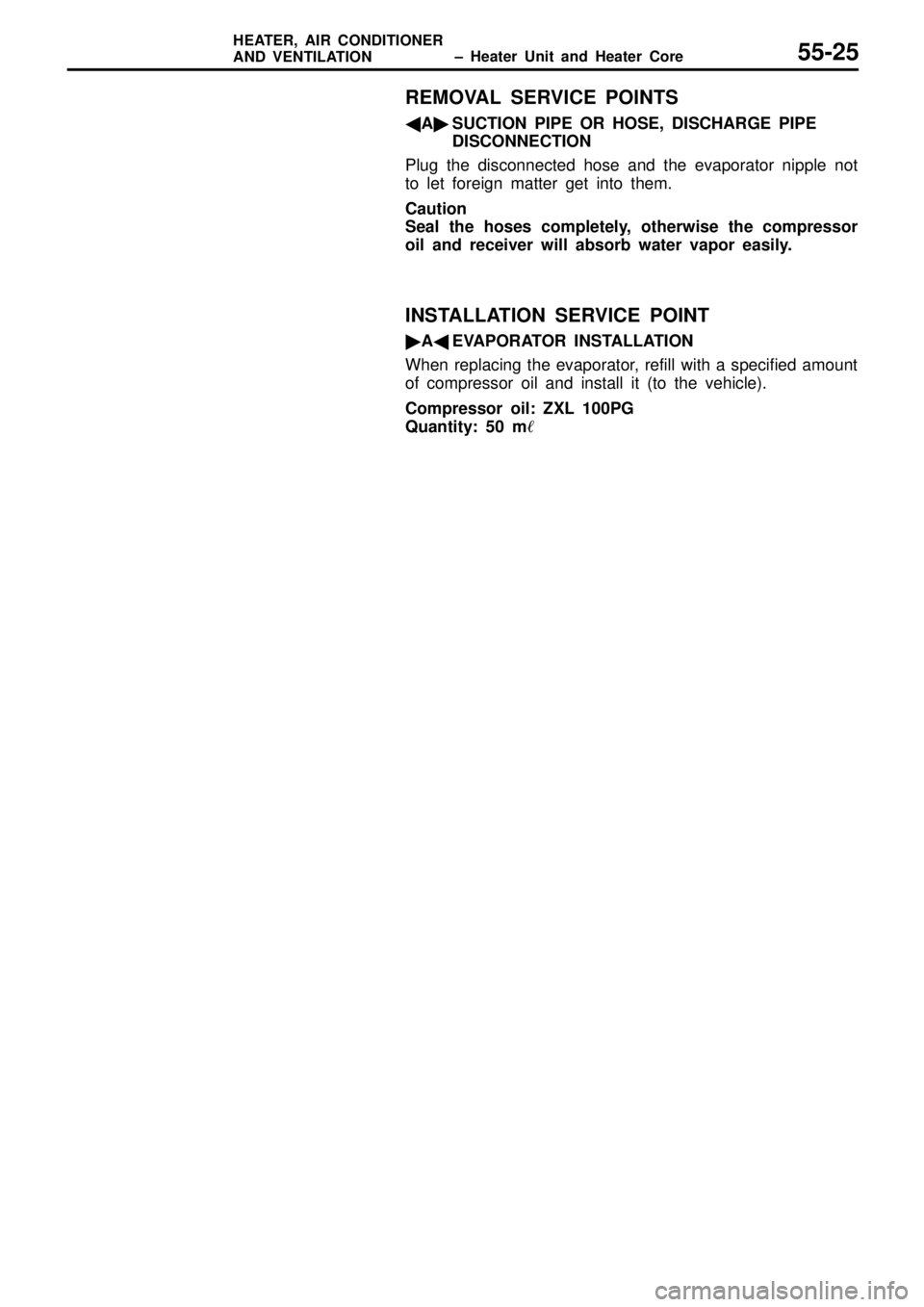
REMOVAL SERVICE POINTS
�A�SUCTION PIPE OR HOSE, DISCHARGE PIPE
DISCONNECTION
Plug the disconnected hose and the evaporator nipple not
to let foreign matter get into them.
Caution
Seal the hoses completely, otherwise the compressor
oil and receiver will absorb water vapor easily.
INSTALLATION SERVICE POINT
�A�EVAPORATOR INSTALLATION
When replacing the evaporator, refill with a specified amount
of compressor oil and install it (to the vehicle).
Compressor oil: ZXL 100PG
Quantity: 50 m�
Page 978 of 1310

2
INSPECTION
· Check the SRS-ECU and brackets for dents, cracks or
deformation.
· Check connectors and lock lever for damage, and
terminals for deformation
Caution
If a dent, crack, deformation or rust is discovered,
replace the SRS-ECU with a new one.
NOTE
For checking of the SRS-ECU other than described
above, refer to the section concerning troubleshooting.
(Refer to P.52B-5.)
AIR BAG MODULES AND CLOCK SPRING
Caution
1. Disconnect the battery (-) terminal and wait
for 60 seconds or more before starting
work. Furthermore, the disconnected
battery terminal should be covered with
tape to insulate it. (Refer to P.52B-3)
2. Never attempt to disassemble or repair the
air bag modules or clock spring.
If faulty, replace it.
3. do not drop the air bag modules or clock
spring or allow contact with water, grease
or oil.
Replace it if a dent, crack, deformation or
rust is detected.4. The air bag modules should be stored on a
flat surface and placed so that the pad
surface is facing upward.
Do not place anything on top of it.
5. Do not expose the air bag modules to
temperatures over 93° C.
6. After deployment of an air bag, replace the
clock spring with a new one.
7. Wear gloves and safety glasses when
handling air bags that have already
deployed.
8. An undeployed air bag module should only
be disposed of in accordance with the
procedures (Refer to P.52B-31.)
52B-22SRS - SRS-ECU/Air Bag Modules and Clock Spring
52400220031
After deployment of an air bag, replace the
air bag modules. Check the clock spring,
and if faulty, replace it with a new part.
52400240044
Page 980 of 1310

4
INSPECTION
· Check the SDU and brackets for dents, cracks or
deformation.
· Check connector for damage, and terminals for
deformation
Caution
If a dent, crack, deformation or rust is discovered,
replace the SDU with a new one.
NOTE
For checking of the SDU other than described above,
refer to the section concerning troubleshooting. (Refer to
P.52B-6.)
AIR BAG MODULES AND CLOCK SPRING
Caution
1. Disconnect the battery (-) terminal and wait
for 60 seconds or more before starting
work. Furthermore, the disconnected
battery terminal should be covered with
tape to insulate it. (Refer to P.52B-3)
2. Never attempt to disassemble or repair the
air bag modules or clock spring.
If faulty, replace it.
3. do not drop the air bag modules or clock
spring or allow contact with water, grease
or oil.
4. Replace it if a dent, crack, deformation or
rust is detected.
4. The air bag modules should be stored on a
flat surface and placed so that the pad
surface is facing upward.
Do not place anything on top of it.
5. Do not expose the air bag modules to
temperatures over 93° C.
6. After deployment of an air bag, replace the
clock spring with a new one.
7. Wear gloves and safety glasses when
handling air bags that have already
deployed.
8. An undeployed air bag module should only
be disposed of in accordance with the
procedures (Refer to P.52B-31.)
52B-28SRS - SRS Diagnosis Unit (SDU)/Air Bag Modules and Clock Spring
52400220093
After deployment of an air bag, replace the
air bag modules. Check the clock spring, and
if faulty, replace it with a new part.
52400240143
Page 1061 of 1310

2
SERIVICE SPECIFICATIONS
ItemsStandard value Limit
With engine running - 50Steering W heel free play mm
With engine stopped 10 or less -
Inner wheel 33°55’-36°55’ -2W D
Outer wheel 30°57’ -
Inner wheel 29°40’-32°40’ -
Steering angle
4W D
Outer wheel 29°30’
Steering gear backlash mm - 0.5
Variation of tie rod end ball joint shaft direction mm - 1.5
Tie rod end ball joint starting torque Nm 3.0 -
Steering gear oil level mm 22 -
4G6 750 ± 100 -Engine idle speed r/min
4D56 750 ± 100 -
Stationairy steering effort N 39.2 or less -
Oil pump relief pressure 8.3 - 9.0 -
Pressure under no-load conditions 0.8 - 1.0 -
Oil pump
pressure MPa
Steering gear retention hydraulic pressure 8.3 - 9.0 -
OFF →
ON 1.5 – 2.0 -Oil pressure switch operating pressure Mpa
ON →
OFF 0.7 – 1.2 -
Mainshaft starting torque Nm 0.49 – 0.78 -
Cross-shaft axial play mm 0.05 or less -
<2WD> 0.98 – 1.47 -Mainshaft total starting torque Nm
<4WD> 0.69 – 1.28 -
Pitman arm ball joint starting torque Nm 0.5 – 1.5 -
Mainshaft axial play mm 0.03 or less -
Backlash between ball groove of rack piston and balls mm - 0.05
2WD 8.8 – 30 -Idler arm sliding resistance N
4WD 2.4 – 16 -
STEERING – Service Specifications37A-3
37100030021
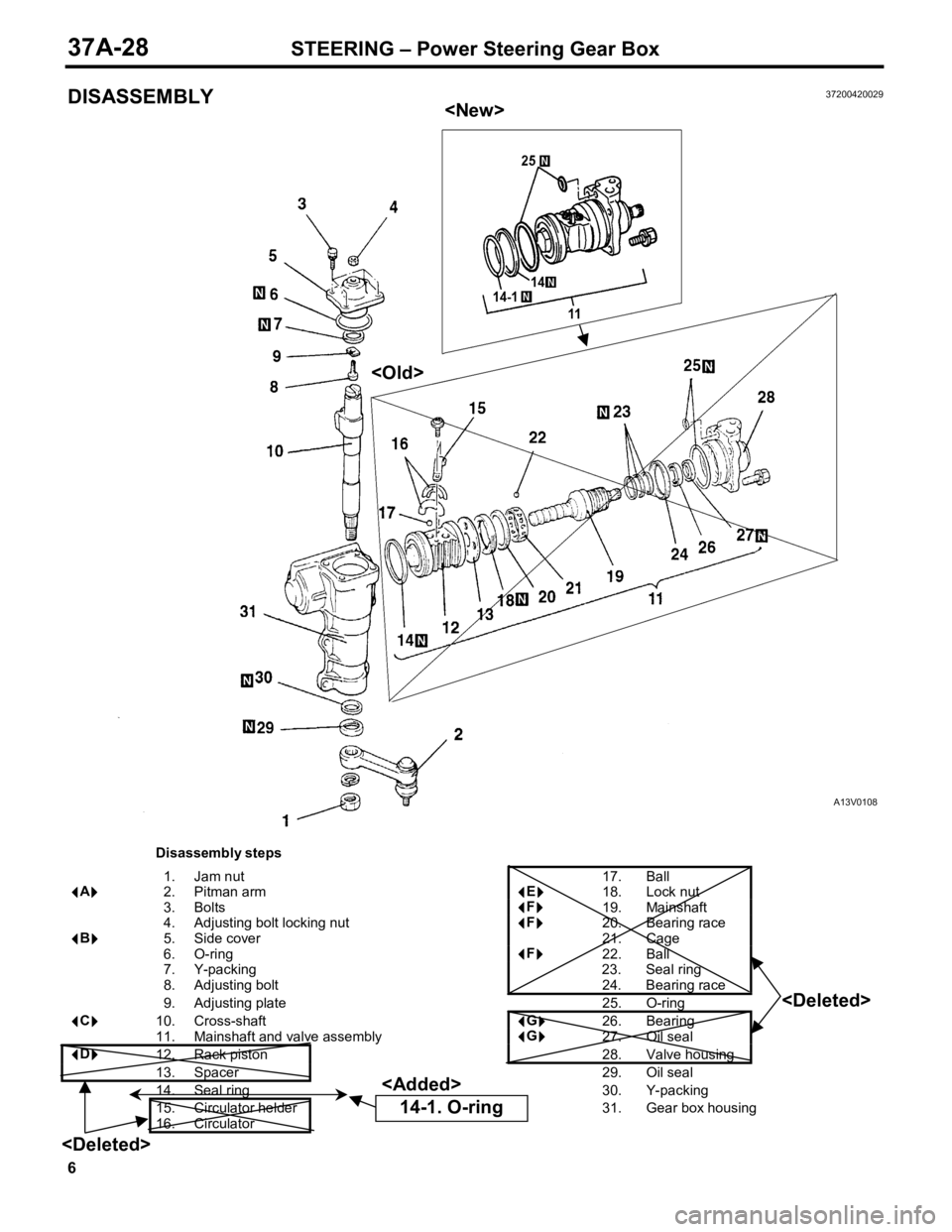
Page 1065 of 1310
0
3. Bolt s
!
! !
! F
"
" "
" 1
9. Main sh aft 0
4. Adju stin g b olt lo ckin g n ut
!
! !
! F
"
" "
" 2
0. Bearin g r a ce 0
6. O-rin g
!
! !
! F
"
" "
" 2
2. Ball 0
7. Y-p ackin g 23. Seal r in g 0
8. Adju stin g b olt 24. Bearin g r a ce 0
9. Adju stin g p la te 25. O-rin g 1
1. Main sh aft a n d v a lv e a sse m bly
!
! !
! G
"
" "
" 2
7. Oil s e a l 1
3. Space r 29. Oil s e a l 1
4. Seal r in g 30. Y-p ackin g 1
5. Cir c u la to r h eld e r 31. Gear b ox h ousin g 1
6. Cir c u la to r 1
4-1 . O -r in g <
A dded >
< D ele te d > <
N ew > <
O ld >
Page 1072 of 1310

13
Items Specifications
Pressure switch activation oil pressure
Mpa (kg/cm2, psi)
OFF
→ ON1.5 – 2.0 (15 – 20, 21-284)
ON
→ OFF0.7 – 1.2 (7.2 – 12, 100-171)
Mainshaft starting torque (Manual steering)
Nm (kgcm, in.lbs.) 0.35 – 0.55 (3.5 – 5.5, 3 – 5)
Mainshaft axial play (Power steering)mm (in.)0.03 – (0.0012) or less
Cross-shaft axial play mm (in.)
Manual steering’ 0.05 (0.0020)
Power steering 0.05 (0.0020)
Mainshaft total starting torque Nm (kgcm, in.lbs.)
Manual steering 0.65 – 0.85 (6.5 – 8.5, 5.7 – 7.3)
Power steering 0.45 – 1.25 (4.5 – 12, 5, 4 – 11)
Ball joint starting torque Nm (kgcm, in.lbs.)
Tie rod end 1 – 3 (10 – 30, 8.9 – 26)
Idler arm 0.5 – 2.0 (5 – 520, 4 – 17)
Idler arm turning torque Nm (kgcm, in.lbs.) 0.3 – 2.0 (3 – 20, 3 – 17)
Spring balance reading N (kg,lbs) 2.3 – 15.4 (0.23 – 1.54, 0.5 – 33.9)
Limit
Steering wheel free play mm (in.)
Manual steering 50 (1.97)
Power steering 50 (1.97)
Steering gear backlash mm (in.) 0.5 (0.020)
Ball joint axia play mm (in.) 1.5 (0.059)
Backlash between ball groove of rack piston
And balls mm (in.) 0.05 (0.0020)
Gap between vane and rotor groove mm (in.) 0.06 (0.0024)
Clearance between oil pump drive shaft
And pump body mm (in.) 0.1 (0.004)
STEERING – Specifications37-3