1997 LINCOLN TOWN CAR brake light
[x] Cancel search: brake lightPage 16 of 305

11
4. Check the coolant level following the
instructions on checking and adding coolant to
your engine, seeEngine Coolantin the Index.
If you do not follow these instructions, you or
others could be injured.
If the coolant continues to overheat, have the
coolant system serviced.
If only the top two and bottom two bars appear on
the gauge, then the system is indicating that it
requires servicing. Contact your dealer for service as
soon as possible.Anti-Lock Brake System LightThis warning light will go on each time you start
your vehicle. If it remains on for longer than 5
seconds, you should shut off your engine and
restart. If the anti-lock brake light stays on, this
indicates that the anti-lock feature is disabled and
should receive immediate attention by a qualifiedservice technician. Normal braking is not affected
unless the brake warning light is also lit.
The Anti-Lock Brake System has self-check
capabilities. As previously described, the system
turns on the anti-lock light each time you start your
engine. After the engine is started and the anti-lock
light is out, the system performs another test the
first time the vehicle reaches 14 mph (22 km/h).
The system turns on the Anti-Lock Brake System
(ABS) pump motor for approximately 1/2 second.
At this time a mechanical noise may be heard. This
is a normal part of the self-check feature. If a
malfunction is found during this check the anti-lock
light will come on.
File:03fnist.ex
Update:Mon Jun 17 13:46:47 1996
Page 22 of 305
17
If one or both of your turn indicators do not flash
or stay on continuously, have them serviced as soon
as possible. In the meantime, be sure to use the
accepted hand signals.Speed Control Indicator LightThis light comes on when the speed control system
is actively maintaining the set speed. It will go off
when the brakes are used or if the speed control is
turned off.
This light does not indicate any problems but is
only a convenience to tell when the speed control
is active.Fuel GaugeThe ignition switch must be in the OFF position
before adding fuel to the tank for proper gauge
operation.
A problem is indicated if the fuel gauge bar graph
displays only the top two bars and the bottom two
bars and the digital ªFUEL REMAINº or ªDIST TO
EMPTYº display ªCOº or ªCSº. If this happens,
contact your dealer for service as soon as possible.
File:03fnist.ex
Update:Mon Jun 17 13:46:47 1996
Page 88 of 305

84q
Accelerate with your accelerator pedal, then
press SET ACCEL.
You may accelerate with the accelerator pedal at
any time during speed control usage. Releasing the
accelerator pedal will return your vehicle speed to
the previously programmed set speed.
To Set a Lower Set Speedq
Press and hold COAST. Release the switch
when the desired vehicle speed is reached. OR
q
Press and release COAST. Each press will
decrease the set speed by 1 mph (1.6 km/h).
OR
q
Depress the brake pedal. When the desired
vehicle speed is reached, press SET ACCEL.
To Disengage Speed Controlq
Depress the brake pedal.
Disengaging the speed control will not erase the
previously programmed set speed.
To Return to a Set Speedq
Press RES (RESUME). For RES (RESUME) to
operate, the vehicle speed must be faster than
30 mph (48 km/h).
Indicator Light (If Equipped)Lights when either the SET ACCEL or RES
(RESUME) switches are pressed and remains lighted
until it is either disengaged or turned off.
File:05fncft.ex
Update:Mon Jun 17 13:49:49 1996
Page 165 of 305

1623. Make sure that the gearshift is in P (Park) and
the parking brake is set before you turn the
key.
Before you start your vehicle, you should test the
warning lights on the instrument panel to make
sure that they work. Refer to theInstrumentation
chapter.Starting Your EngineTo start your engine:
1. Follow the steps underPreparing to Start Your
Vehicleat the beginning of this section.
2. Turn the ignition key to the ON position.
3. DO NOT depress the accelerator pedal when
starting your engine. DO NOT use the
accelerator while the vehicle is parked.4. Turn the key to the START position (cranking)
until the engine starts. Allow the key to return
to the ON position after the engine has started.
If you have difficulty in turning the key, rotate
the steering wheel slightly because it may be
binding.
For a cold engine:
q
At temperatures10ÊF(-12ÊC) andbelow:If
the engine does not start infifteen (15)
secondson the first try, turn the key to OFF,
wait approximately ten (10) seconds so you do
not flood the engine, then try again.
q
At temperaturesabove10ÊF(-12ÊC):If the
engine does not start infive (5) secondson
the first try, turn the key to OFF, wait
approximately ten (10) seconds so you do not
flood the engine, then try again.
File:08fntot.ex
Update:Mon Jun 17 13:51:45 1996
Page 170 of 305

167
DrivingBrakesApplying the BrakesYour vehicle has anti-lock disc brakes on all four
wheels. They adjust automatically as the brake pads
wear down.
When you press down hard on the brake pedal, the
wheels will not lock and slide. The Anti-lock Brake
System (ABS) automatically starts releasing and
reapplying the front brakes independently and the
rear brakes together whenever your wheels start to
lock. When this happens, you will feel the brake
pedal pulsate. This is an indication that the ABS is
working correctly and is normal.
Do not drive with your foot resting on the brake
pedal; you will wear out the linings and increase
your vehicle's stopping distance. Brake rotor damage
may also eventually occur.NOTE:If you are driving down a long or steep hill,
shift to a lower gear and do not apply your brakes
continuously. If you apply your brakes continuously,
they may overheat and become less effective.
Occasional brake squeal during light to moderate
stops does not affect the function of the brake
system and is normal. However, if the squeal
becomes louder or more frequent, have your brakes
inspected by your dealer or a qualified service
technician.
Ford Motor Company has not found any
detrimental effects of popular mobile radio
transmitting equipment installed on vehicles with
the anti-lock brake system, if the equipment is
installed according to the manufacturer's
instructions. However, if mobile radio transmitting
equipment is installed in your vehicle and, if either
the anti-lock brake system cycles or the ANTI-LOCK
File:09fngft.ex
Update:Mon Jun 17 13:52:03 1996
Page 178 of 305

175
R (Reverse)With the gearshift in the R (Reverse) position, the
vehicle will move backward. You should always
come to a complete stop before shifting into or out
of R (Reverse).N (Neutral)With the gearshift in the N (Neutral) position, the
vehicle can be started and is free to roll. Hold the
brake pedal down while in this position.DrivingYour vehicle's gearshift is on the steering column.
The Transmission Control Switch (TCS) is located
on the end of the gearshift lever. The Transmission
Control Indicator Light (OVERDRIVE OFF) is
located on the instrument panel. You can put the
gearshift lever in any of the several positions.
The OVERDRIVE OFF light is off (not illuminated)
during normal vehicle operation. This allows the
transmission to upshift and downshift from 1stthrough 4th gears. When the TCS is pressed, the
Transmission Control Indicator Light will illuminate
(OVERDRIVE OFF) on the instrument panel. When
this OVERDRIVE OFF is illuminated the
transmission will upshift and downshift from 1st
through 3rd gears.
If OVERDRIVE OFF light does not come ªONº
when TCS is depressed or if the light flashes when
you are driving, have your vehicle serviced at the
first opportunity. If this condition persists, damage
could occur to the transmission.
To return the transmission to normal operation (1st
through 4th gear) depress the TCS again. This
switch may be used to cancel overdrive any time
the vehicle is being driven. Each time your vehicle
is started, the overdrive system will automatically be
in the normal overdrive mode and the light will not
be illuminated.
File:09fngft.ex
Update:Mon Jun 17 13:52:03 1996
Page 221 of 305
219
Checking and Adding Engine OilSince the proper amount of engine oil is important
for safe engine operation, check the oil using the
dipstick each time you put fuel in your vehicle.
Remember the engine must be off, the oil must be
warm and the vehicle must be parked on level
ground.
Checking the engine oil level:
1. Turn the engine off after it has warmed up and
allow a few minutes for the engine oil to drain
back into the oil pan.
2. Set the parking brake, making sure the gearshift
is securely latched in P (Park).
3. Open the hood. Protect yourself from engine
heat.
4. Locate the engine oil dipstick (highlighted in
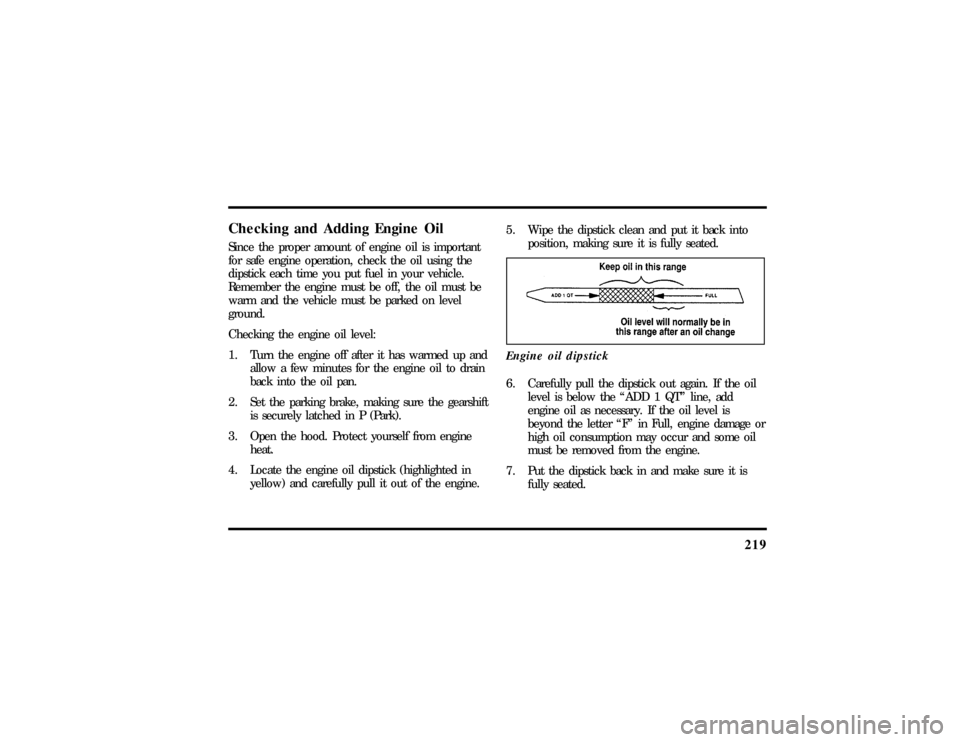
yellow) and carefully pull it out of the engine.5. Wipe the dipstick clean and put it back into
position, making sure it is fully seated.
Engine oil dipstick
6. Carefully pull the dipstick out again. If the oil
level is below the ªADD 1 QTº line, add
engine oil as necessary. If the oil level is
beyond the letter ªFº in Full, engine damage or
high oil consumption may occur and some oil
must be removed from the engine.
7. Put the dipstick back in and make sure it is
fully seated.
File:11fnmct.ex
Update:Mon Jun 17 13:54:56 1996
Page 247 of 305

245
q
English: MPG = (total miles)/(gallons used).
q
Metric: L/100K = (liters used) x 100/(total
kilometers)
Comparisons With Environmental
Protection Agency (EPA) and Transport
Canada (TC) Fuel Economy EstimatesEPA fuel economy figures are obtained from
laboratory tests under simulated road conditions and
may not reflect the actual conditions you experience
or your style of driving. The EPA fuel economy
estimate is not a guarantee that you will achieve
the fuel economy shown.
The following decrease fuel economy:q
Lack of regular, scheduled maintenance
q
Rapid acceleration and excessive speed
q
Driving with your foot on the brake
q
Sudden stops
q
Extended engine idling
q
Using speed control in hilly terrain
q
Extended use of the A/C, defroster, rear
window defroster and other accessories
q
Underinflated tires
q
Heavy loads
q
Aftermarket add-ons such as bike, ski or luggage
racks, bug deflectors, etc.
Self-Service PointersIf you choose to do your own fueling, you should
also perform a few simple maintenance routines.
This extra effort will save you additional money and
contribute to the driving efficiency of your vehicle.
The following procedures require only a tire gauge,
a rag, an oil can spout and windshield washer fluid.q
Check the engine oil at every refueling stop
q
Clean the windshield, outside mirrors and
headlights
File:11fnmct.ex
Update:Mon Jun 17 13:54:56 1996