Page 164 of 315
159
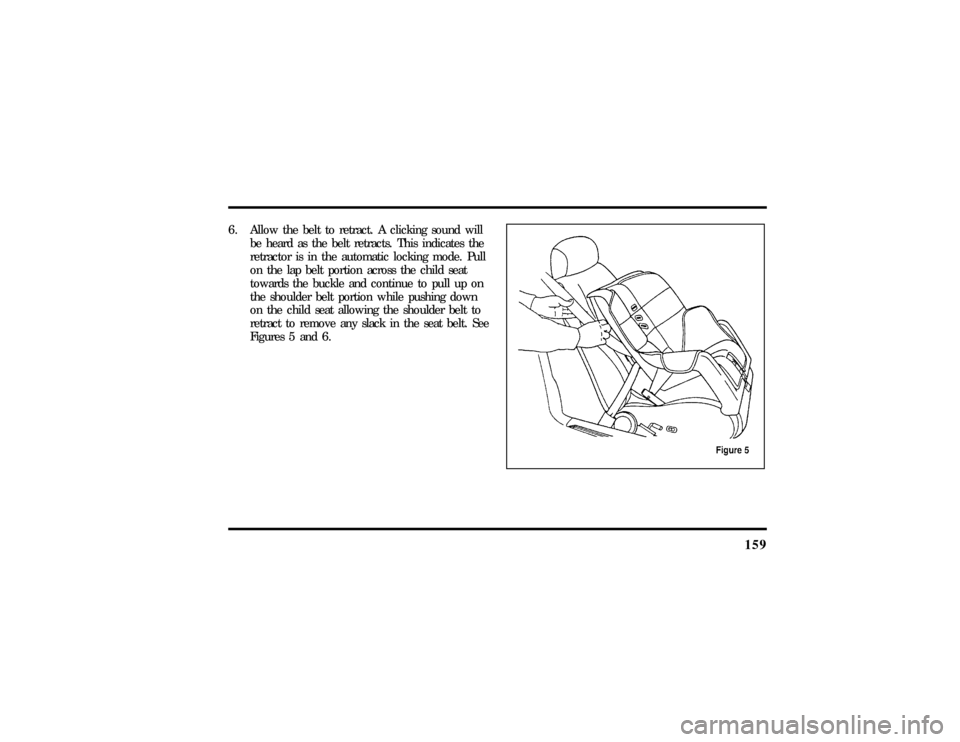
6. Allow the belt to retract. A clicking sound will
be heard as the belt retracts. This indicates the
retractor is in the automatic locking mode. Pull
on the lap belt portion across the child seat
towards the buckle and continue to pull up on
the shoulder belt portion while pushing down
on the child seat allowing the shoulder belt to
retract to remove any slack in the seat belt. See
Figures 5 and 6.
File:06fnss8.ex
Update:Wed Jun 19 15:04:39 1996
Page 167 of 315
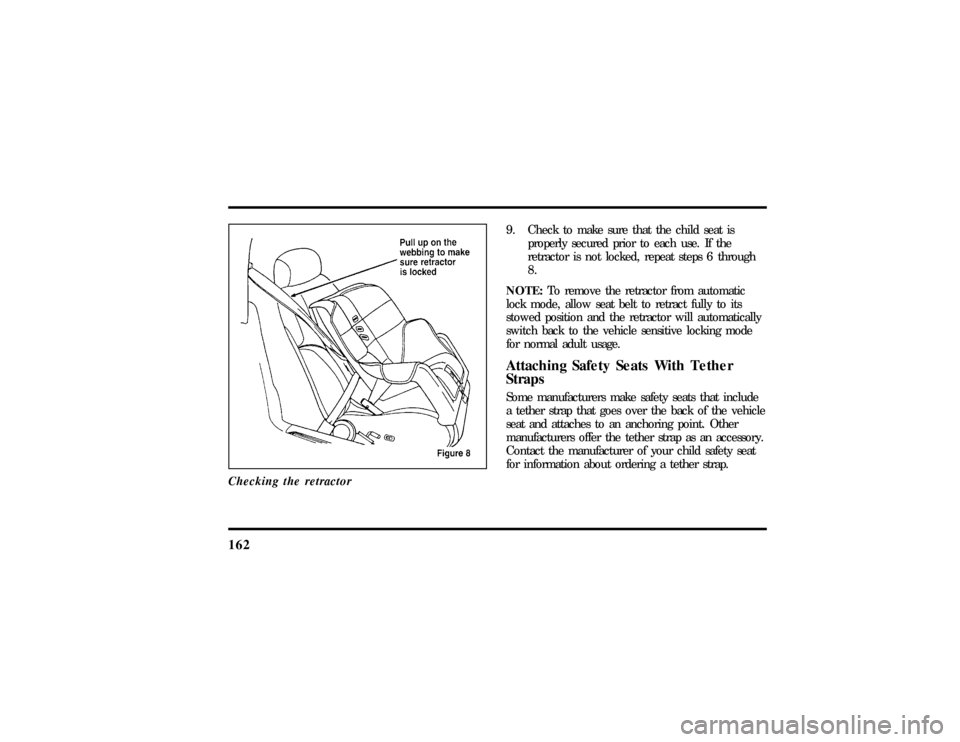
162Checking the retractor
9. Check to make sure that the child seat is
properly secured prior to each use. If the
retractor is not locked, repeat steps 6 through
8.
NOTE:To remove the retractor from automatic
lock mode, allow seat belt to retract fully to its
stowed position and the retractor will automatically
switch back to the vehicle sensitive locking mode
for normal adult usage.Attaching Safety Seats With Tether
StrapsSome manufacturers make safety seats that include
a tether strap that goes over the back of the vehicle
seat and attaches to an anchoring point. Other
manufacturers offer the tether strap as an accessory.
Contact the manufacturer of your child safety seat
for information about ordering a tether strap.
File:06fnss8.ex
Update:Wed Jun 19 15:04:39 1996
Page 190 of 315
185
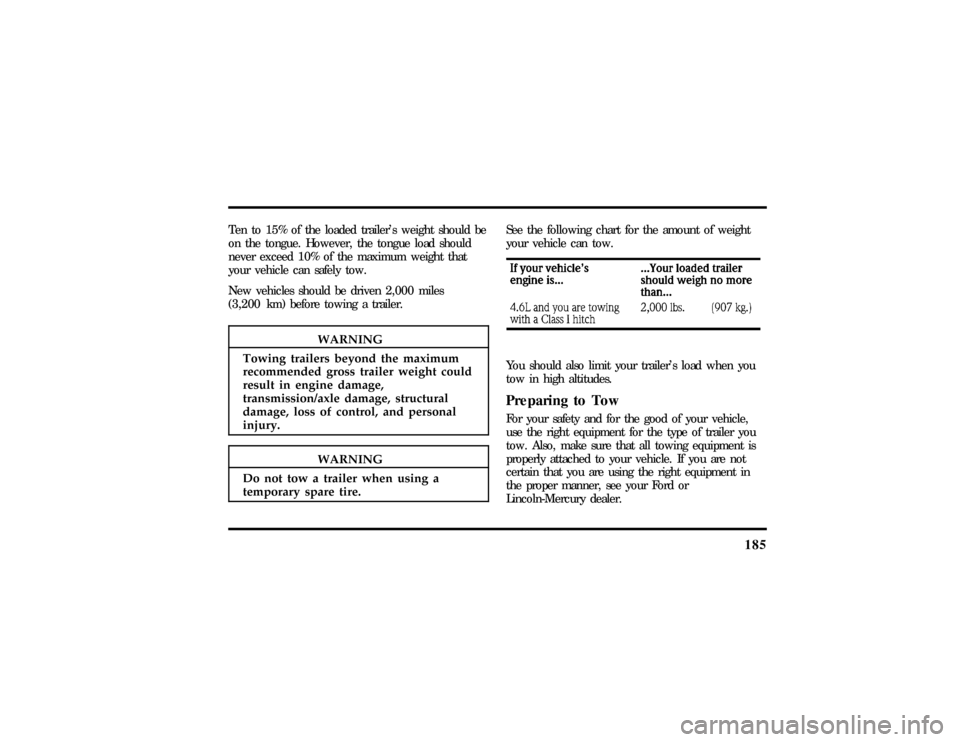
WARNING
Towingtrailer sbeyon dthemaximum
WARNING
Do no tto w atraile rwhe nusin ga
Yo ushoul dals olimi tyou rtrailer' sloa dwhe nyou
Page 191 of 315

186Do not use hitches that clamp onto your vehicle's
bumper. The bumper is not designed to bear the
load.
Always check the pressure in all your vehicle's tires
when preparing to tow (see inflation
recommendation on the tire label).Using the hitchYour vehicle uses aload carryinghitch. Because
this type of hitch places the tongue load of a trailer
on the rear wheels of your vehicle, you must
distribute the load in your trailer so that only 10 to
15% of the total weight of the trailer is on the
tongue.
Tie down the load so that it does not shift and
change the weight on the hitch. This will prevent
damage to your vehicle and make your vehicle
easier to handle.
Connecting the safety chainsAlways attach the trailer's safety chains to your
vehicle. They help protect your trailer if the hitch
breaks.
To connect the trailer's safety chains:
1. Cross the chains under the trailer tongue and
attach them to your vehicle's frame or hook
retainers. Never attach the safety chains to your
vehicle's bumper. The bumper is not designed
to bear the weight of a trailer.
2. Make sure that you leave enough slack in the
chains to allow you to turn corners.
If you use a rental trailer, follow the instructions
that the rental agency gives you.
File:09fngf8.ex
Update:Wed Jun 19 10:45:23 1996
Page 193 of 315
188If you tow in D (Overdrive) while riding through
hilly country, your vehicle may frequently shift
between Overdrive and Third gears. To prevent
your vehicle from shifting too much, press the
Transmission Control Switch located on the shift
lever. This will also give the engine more power
going up hills and better engine braking going down
hills.
If you use the speed control while you are towing
on very long, steep grades, the speed control may
shut off.
Servicing Your Vehicle If You TowIf you tow a trailer for a long distance, your vehicle
will need to be serviced more frequently than usual.
Refer to theMaintenance Schedulebooklet for
additional information.
File:09fngf8.ex
Update:Wed Jun 19 10:45:23 1996
Page 207 of 315
202When you drive with the temporary spare tire,
DO NOT:q
exceed 50 mph (80 km/h) under any
circumstances.
q
load your vehicle so that it is heavier than the
maximum vehicle load rating listed on the tire
decal.
q
tow a trailer.
q
use tire chains on this tire.
q
try to repair the temporary spare tire or remove
it from its wheel.
q
use the wheel for any other type of vehicle.
q
drive through an automatic car wash with this
tire. Because the temporary spare tire is smaller
than a conventional tire, it reduces the ground
clearance. Your vehicle may get caught in the
rails and it could be damaged.
Spare Tire LocationThe spare tire is stored under the carpet on the
floor of the trunk.
You will find additional instructions for the spare
tire on the warning label located on the wheel and
the jacking instructions located on the spare tire
cover.
File:10fner8.ex
Update:Thu Jun 20 14:27:22 1996
Page 218 of 315
213
After the vehicle is started, let it idle for a while to
let the engine ªrelearnº its idle conditions. Drive it
around for a while with all electrical accessories
turned off to let the battery recharge. Driveability
may be deteriorated slightly until all drive modes
are ªrelearned.ºYou may need to use a battery
charger to fully recharge the battery.
If you need to replace your battery, seeBatteryin
theMaintenance and Carechapter.
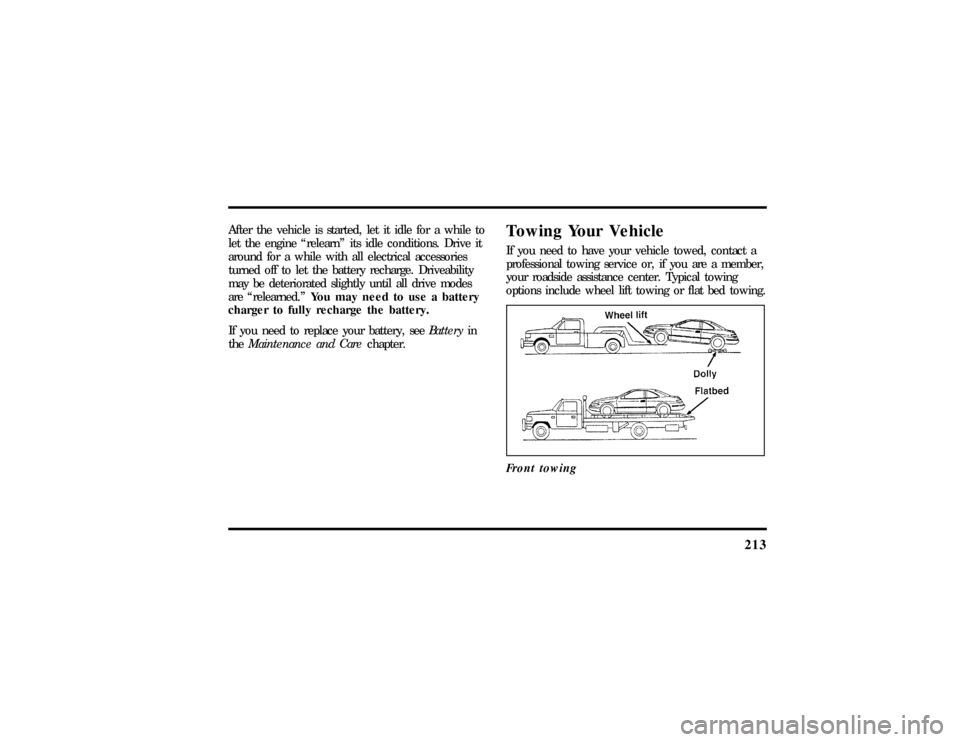
Towing Your VehicleIf you need to have your vehicle towed, contact a
professional towing service or, if you are a member,
your roadside assistance center. Typical towing
options include wheel lift towing or flat bed towing.
Front towing
File:10fner8.ex
Update:Thu Jun 20 14:27:22 1996
Page 219 of 315
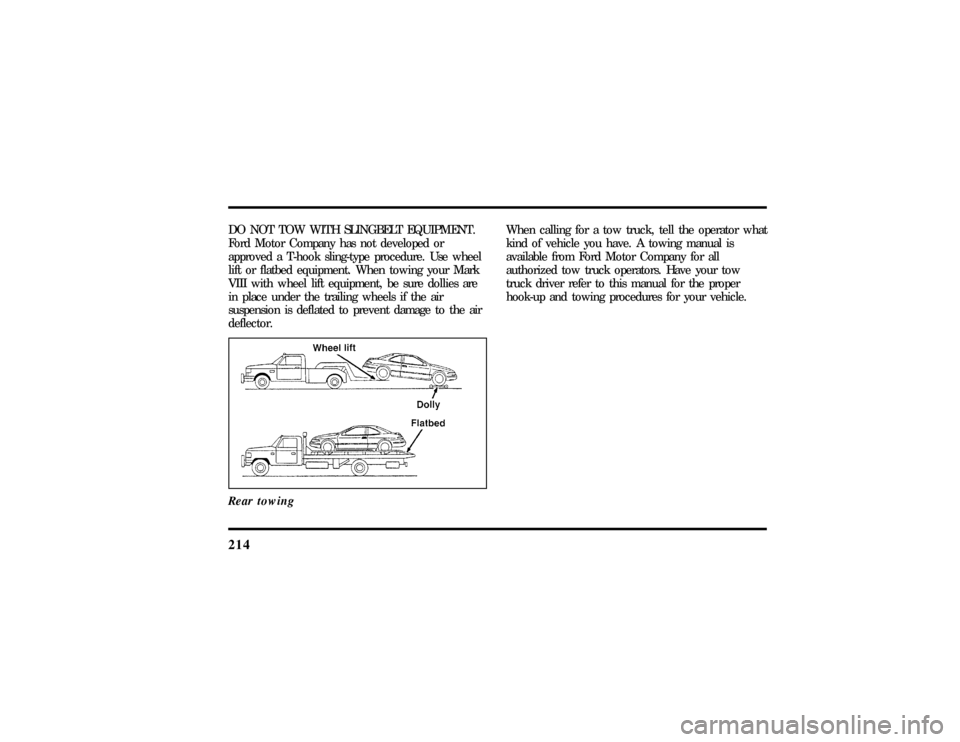
214DO NOT TOW WITH SLINGBELT EQUIPMENT.
Ford Motor Company has not developed or
approved a T-hook sling-type procedure. Use wheel
lift or flatbed equipment. When towing your Mark
VIII with wheel lift equipment, be sure dollies are
in place under the trailing wheels if the air
suspension is deflated to prevent damage to the air
deflector.
Rear towing
When calling for a tow truck, tell the operator what
kind of vehicle you have. A towing manual is
available from Ford Motor Company for all
authorized tow truck operators. Have your tow
truck driver refer to this manual for the proper
hook-up and towing procedures for your vehicle.
File:10fner8.ex
Update:Thu Jun 20 14:27:22 1996