Page 191 of 321

189
Driving While You TowBe especially careful when driving while you tow a
trailer. Never drive faster than 45 mph (70 km/h)
when you tow in hilly country on hot days. Also,
anticipate stops so that you can brake gradually.
Towing a trailer increases the load on the engine
and transaxle, particularly in hilly country and with
heavier trailers. Under these conditions you may
experience an excessive amount of shifting between
Overdrive and Third gears. Moving the shift selector
to D (Overdrive Lockout) will keep this from
happening and will provide better engine braking.
When driving in less hilly country or with a lighter
trailer load, you may move the gearshift selector
lever toj(Overdrive) without experiencing
excessive shifting.When driving down steep hills, you should put the
gearshift selector lever in the 1 (First) position to
shift the transaxle into second gear. This will
provide additional engine braking.
The automatic transaxle will automatically
downshift to the proper gear for driving up a grade.
If you use the speed control while you are towing
on very long, steep grades, the speed control may
shut off.
Servicing Your Vehicle If You TowIf you tow a trailer for a long distance, your vehicle
will need to be serviced more frequently than usual.
Refer to theMaintenance Schedulebooklet for
additional information.
File:09fngfc.ex
Update:Fri Sep 6 08:48:49 1996
Page 210 of 321
209
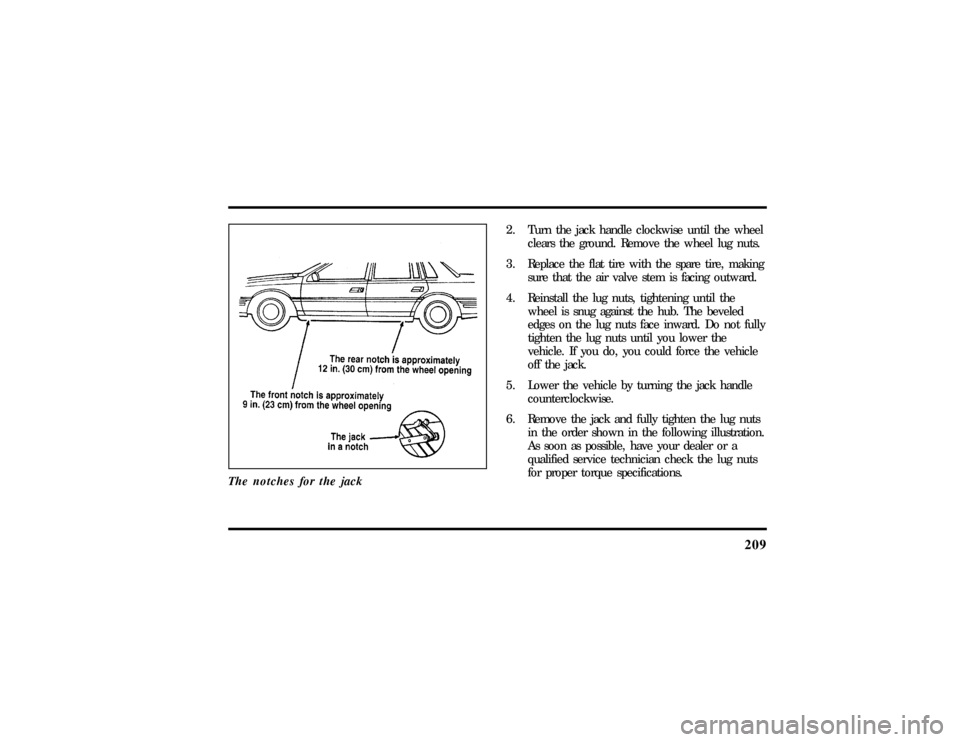
The notches for the jack
2. Turn the jack handle clockwise until the wheel
clears the ground. Remove the wheel lug nuts.
3. Replace the flat tire with the spare tire, making
sure that the air valve stem is facing outward.
4. Reinstall the lug nuts, tightening until the
wheel is snug against the hub. The beveled
edges on the lug nuts face inward. Do not fully
tighten the lug nuts until you lower the
vehicle. If you do, you could force the vehicle
off the jack.
5. Lower the vehicle by turning the jack handle
counterclockwise.
6. Remove the jack and fully tighten the lug nuts
in the order shown in the following illustration.
As soon as possible, have your dealer or a
qualified service technician check the lug nuts
for proper torque specifications.
File:10fnerc.ex
Update:Fri Sep 6 08:49:57 1996
Page 211 of 321
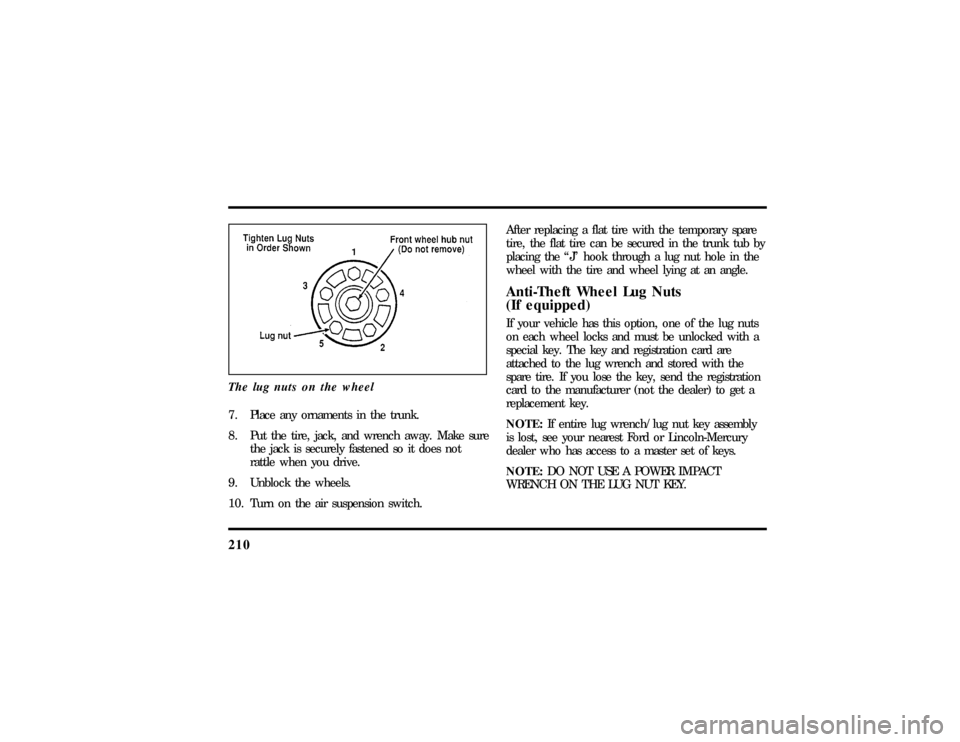
210The lug nuts on the wheel7. Place any ornaments in the trunk.
8. Put the tire, jack, and wrench away. Make sure
the jack is securely fastened so it does not
rattle when you drive.
9. Unblock the wheels.
10. Turn on the air suspension switch.After replacing a flat tire with the temporary spare
tire, the flat tire can be secured in the trunk tub by
placing the ªJº hook through a lug nut hole in the
wheel with the tire and wheel lying at an angle.
Anti-Theft Wheel Lug Nuts
(If equipped)If your vehicle has this option, one of the lug nuts
on each wheel locks and must be unlocked with a
special key. The key and registration card are
attached to the lug wrench and stored with the
spare tire. If you lose the key, send the registration
card to the manufacturer (not the dealer) to get a
replacement key.
NOTE:If entire lug wrench/lug nut key assembly
is lost, see your nearest Ford or Lincoln-Mercury
dealer who has access to a master set of keys.
NOTE:DO NOT USE A POWER IMPACT
WRENCH ON THE LUG NUT KEY.
File:10fnerc.ex
Update:Fri Sep 6 08:49:57 1996
Page 237 of 321

236q
Select maximum heater temperature and fan
speed settings. Position control to discharge air
at A/C vents in instrument panel.
q
Start engine and allow to idle. While engine is
idling, feel for hot air at A/C vents.
NOTE:IF AIR DISCHARGE REMAINS COOL AND
ENGINE TEMPERATURE GAUGE DOES NOT
MOVE,SHUT ENGINE OFF IMMEDIATELY.
This is an indication of low coolant level and/or air
pockets in coolant system. Allow engine to cool and
repeat the previous steps.
q
Allow to idle until normal operating temperature
is reached. Hot air should discharge from A/C
vents. The engine temperature gauge should
maintain a stabilized reading in the middle of
the ªNORMALº range and the lower radiator
hose should feel hot to the touch.
q
Shut off the engine and allow to cool down.
q
After the engine cools down, recheck the
engine coolant level. Fill reservoir to the
COLD-FULL level as required.
q
Check for leaks at the draincock, block plug
and vent plug.
q
Recheck the engine coolant level, using the
recommended procedure, after one or two
occasions of vehicle use. Fill to COLD-FULL
level as required.
File:11fnmcc.ex
Update:Fri Sep 6 08:51:16 1996
Page 264 of 321

263
3. At the back of the headlamp, pull back and up
slightly on the two right angle brackets to
release the headlamp assembly from the
vehicle.
4. Carefully pull the headlamp assembly away
from the vehicle to expose the back of the bulb
and wiring connector.
5. Remove the electrical connector from the bulb
by grasping the wire with a quick pull
rearward.
6. Remove the retaining ring by turning it 1/8 of
a turn to free it from the socket. Then slide the
ring off the plastic base of the bad bulb.Keep
the ring.You must use it again to hold the
new bulb in place.
7. Carefully remove the bulb assembly from its
socket by gently pulling it rearward without
turning.
Installing the headlamp bulb1. With the flat side of the bulb's plastic base
facing upward, insert the glass end of the bulb
into the socket. You may need to turn the bulb
left or right to line up the grooves in the plastic
base with the tabs in the socket. When the
grooves are aligned, push the bulb into the
socket until the plastic base contacts the rear of
the socket.
2. Slip the bulb retaining ring over the plastic base
until it contacts the rear of the socket. Lock
the ring into the socket by rotating it clockwise
until you feel a ªstop.º
3. Push the electrical connector into the rear of
the plastic base until it snaps, locking it into
position.
4. Carefully position the headlamp assembly onto
the vehicle making sure the alignment pins are
inserted into the proper holes.
File:11fnmcc.ex
Update:Fri Sep 6 08:51:16 1996
Page 265 of 321

2645. Hold the headlamp assembly snugly against the
vehicle and push down on the right angle
brackets to lock the lamp into position.
6. Install the plastic sight shield.
7. Turn the headlamps on and make sure that
they work properly. If the headlamp was
correctly aligned before you changed the bulb,
you should not need to align it again.Aiming HeadlampsYour vehicle is equipped with a Vehicle Headlamp
Aim Device (VHAD) on each headlamp body. Each
headlamp may be properly aimed in the horizontal
direction (left/right) and the vertical position
(up/down).NOTE:A non-zero bubble reading does not
necessarily indicate out-of-aim headlamps. If your
vehicle is not positioned on a level surface, the
slope will be included in the level indicator.
Therefore, vertical headlamp adjustment should be
performed only when beam direction appears to be
incorrect or a level surface can be verified.
Tools required: One 4mm socket and ratchet.
The Horizontal aim must be adjusted first.
NOTE:The following procedure assumes that the
vehicle's front structure is in factory alignment
condition. If the vehicle has been in an accident
requiring the front end of the vehicle to be
repaired, the horizontal indicator should be
recalibrated by the servicing facility.
File:11fnmcc.ex
Update:Fri Sep 6 08:51:16 1996
Page 304 of 321

306Index
A
ABS warning light (see Anti-lock
brake system)............ 11
Accessory position on the ignition.... 62
Accident damage............ 220
Air bag supplemental restraint system . . . 143
and child safety seats......... 149
description..........143, 145
driver air bag.........143, 145
indicator light............ 15
operation.............. 145
passenger air bag........... 145
service and information labels..... 145
tone generator............ 147
Air cleaner filter
location............... 224
specifications............ 271
Air conditioning, electronic automatic
temperature control system...... 45Air suspension
air leveling disabled warning,
message center........... 20
description............. 175
Alarm, activating remote personal..... 124
Aluminum wheels........... 250
Antenna, radio (see Electronic
sound system).......... 25,31
Antifreeze (see Engine coolant)...... 231
Anti-lock brake system (ABS)
description............. 171
noise................ 171
see also Brake............ 171
warning light............ 11
Anti-theft lug nuts and key........ 210
Anti-theft system
arming the system.......... 127
description..........126, 127
File:fnixc.ex
Update:Tue Sep 17 08:28:54 1996
Page 306 of 321

308
description............. 229
specifications............ 273
Brakes................ 171
adjustment............. 171
anti-lock.............. 171
anti-lock brake system (ABS)
warning light........... 11
applying the brakes.......... 171
brake warning light.......... 10
fluid, checking and adding....... 229
fluid, refill capacities......229, 272
fluid, specifications.......... 273
front disc.............. 171
if brakes do not grip well....... 171
master cylinder........... 229
new brake linings........... 5
noise.............171, 172
parking............... 172
power braking............ 171
servicing.............. 229
trailer............... 188
when storing your vehicle....... 276Break-in period.............. 5
Brights (high beams).......... 15
Bulbs, replacing............ 261
halogen............... 261
headlamps.............. 262
C
Canada, customer assistance....... 284
Canada, warranty information....... 4
Canadian Motor Vehicle Arbitration Plan
(CAMVAP).............. 285
Capacities for refilling fluids....... 272
Car seats for children
(see Child safety seats)........ 149
Cassette tape player (see Electronic sound
system)............... 32
Catalytic converter........... 258
CD player (see Electronic sound system) . . 35
Chains, tires.............. 250
Changing a tire............. 205
Charging system warning light...... 13
Childproof locks............ 103
File:fnixc.ex
Update:Tue Sep 17 08:28:54 1996