Page 179 of 321

177
Steering Your VehicleYour vehicle comes with power steering. Power
steering uses energy from the engine to help steer
your vehicle.
If the amount of effort needed to steer your vehicle
changes, check your steering effort selection in the
Message Center. If this is not the problem, have the
power steering system checked. If the power
steering system breaks down (or if the engine is
turned off), you can steer the vehicle manually but
it takes more effort.
The steering system in your vehicle is speed
sensitive. This means that the steering effort is light
for parking and heavier for highway driving.
However, if you have to swerve around an object
or another vehicle, your steering will have full
power assist.
Never hold the steering wheel to the extreme right
or left for more than five seconds if the engine is
running. This can damage the power steering pump.
Driving with an Automatic
Overdrive TransaxleYour automatic overdrive transaxle provides fully
automatic operation in eitherj(Overdrive) or D
(Drive). Driving with the shift selector inj
(Overdrive) gives the best fuel economy for normal
driving conditions. For manual control, start in 1
(First) and then shift manually.
Your vehicle is equipped with an Electronic
Powertrain Control Module that limits engine
and/or vehicle speeds with a cut-out mode to
promote durability.
File:09fngfc.ex
Update:Fri Sep 6 08:48:49 1996
Page 204 of 321
203
Checking and Replacing FusesIf you need to check a fuse, follow these steps:
1. Find the fuse panel underneath the instrument
panel to the left of the steering column.
Squeeze together the two areas indicated by
the arrows and pull down to remove the cover.
2. Find the fuse you want to check (fuses are
numbered on the fuse panel) and remove it
with the fuse pulling tool that is provided.
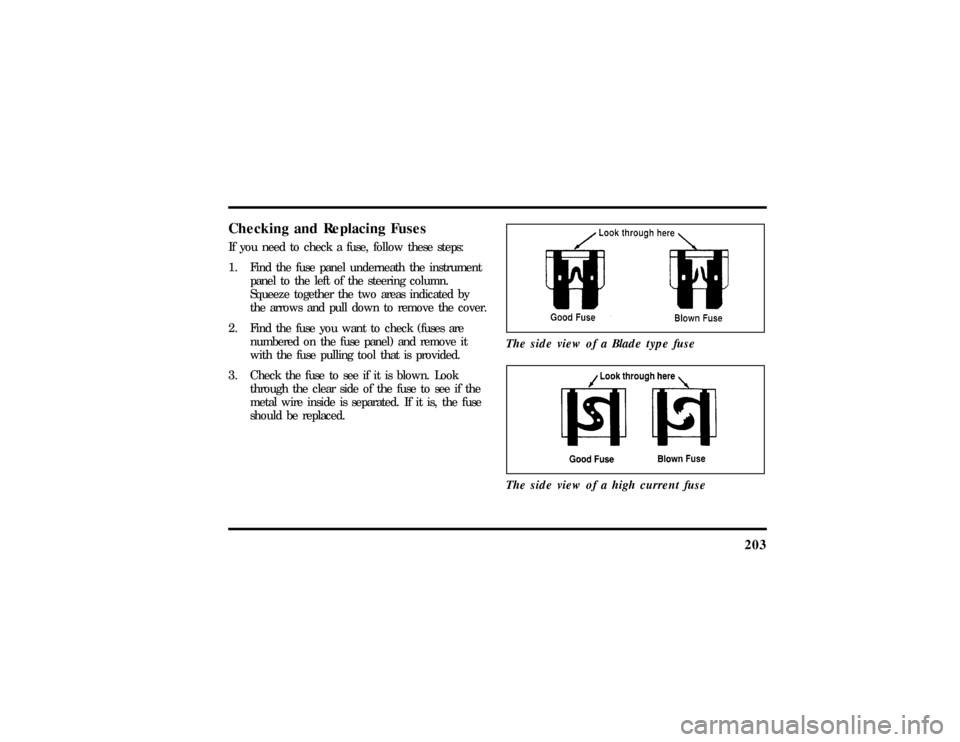
3. Check the fuse to see if it is blown. Look
through the clear side of the fuse to see if the
metal wire inside is separated. If it is, the fuse
should be replaced.The side view of a Blade type fuse
The side view of a high current fuse
File:10fnerc.ex
Update:Fri Sep 6 08:49:57 1996
Page 238 of 321
237
Power Steering FluidCheck the level of the power steering fluid at least
twice a year (i.e., every Spring and Fall).Checking and Adding Power Steering
Fluid1. Start the engine and let it run until the power
steering fluid reaches normal operating
temperature. The power steering fluid will be at
the right temperature when the engine coolant
temperature gauge in the instrument cluster is
near the center of the NORMAL operating
temperature range.2. While the engine idles, turn the steering wheel
back and forth several times. Make sure that
the cap assembly is installed at this time.
3. Turn the engine off and check the level on the
power steering reservoir.
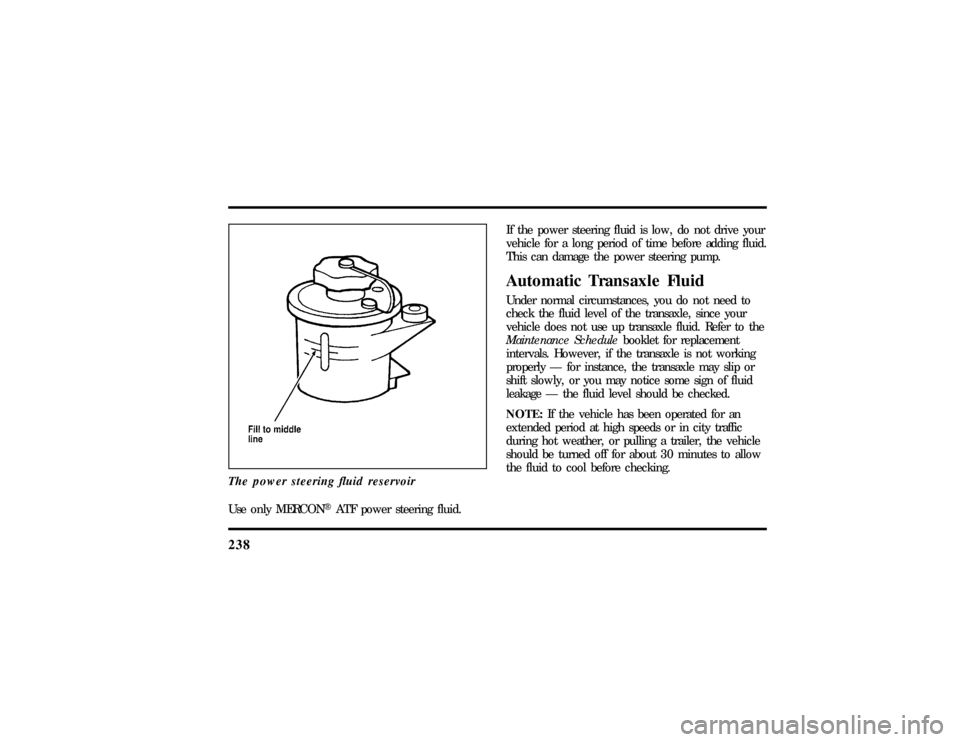
4. The fluid level is viewed through the sight
window on the power steering reservoir. If the
power steering fluid is below the middle line,
add fluid in small amounts, continuously
checking the level. Do not overfill.
File:11fnmcc.ex
Update:Fri Sep 6 08:51:16 1996
Page 239 of 321
238The power steering fluid reservoirUse only MERCONHATF power steering fluid.If the power steering fluid is low, do not drive your
vehicle for a long period of time before adding fluid.
This can damage the power steering pump.
Automatic Transaxle FluidUnder normal circumstances, you do not need to
check the fluid level of the transaxle, since your
vehicle does not use up transaxle fluid. Refer to the
Maintenance Schedulebooklet for replacement
intervals. However, if the transaxle is not working
properly Ð for instance, the transaxle may slip or
shift slowly, or you may notice some sign of fluid
leakage Ð the fluid level should be checked.
NOTE:If the vehicle has been operated for an
extended period at high speeds or in city traffic
during hot weather, or pulling a trailer, the vehicle
should be turned off for about 30 minutes to allow
the fluid to cool before checking.
File:11fnmcc.ex
Update:Fri Sep 6 08:51:16 1996
Page 308 of 321

310Clutch
fluid reservoir............ 229
specifications............ 273
Cold engine starting.......... 166
Combination lap and shoulder belts . 135, 137
Compact disc player (see Electronic sound
system)............... 35
Compact disc radio (see Electronic
sound system)............ 27
Console, description.......... 113
Controls, mirrors............ 92
Convenience kit in cargo area...... 206
Coolant (see Engine coolant)....... 231
checking and adding......... 231
preparing for storage......... 275
refill capacities............ 272
specifications............ 273
temperature gauge.......... 17
warnings.............. 231
Cooling fan.............. 221
Crankcase emission filter........ 271Customer Assistance Centre,
Ford of Canada............ 284
D
Daytime running light system...... 56
Defects, reporting............ 277
Dipstick................ 227
automatic transaxle fluid....238, 239
engine oil.............. 227
power steering fluid......... 237
Disabled vehicle (see Towing)...... 217
Dispute Settlement Board........ 280
Doors................. 103
lubricant specifications........ 273
Driving under special conditions
heavy load............. 183
towing a trailer........... 185
E
Electrical system, fuses......192, 203
Electronic sound system
antenna............... 31
tuning the radio........... 27
File:fnixc.ex
Update:Tue Sep 17 08:28:54 1996
Page 315 of 321

317
On-board diagnostic (OBD II) system . . . 260
Overdrive............... 181
Overseas offices............ 286
P
Panic alarm feature, remote
entry system............. 124
Parking brake............. 172
operation.............. 172
warning light............ 10
Parts (see Motorcraft Parts)....... 271
PCV valve, specifications........ 271
Phone, cellular............. 113
Power features
antenna............... 31
mirrors............... 92
moon roof.............. 91
seats................ 132
windows.............. 105
Power steering
dipstick............... 237
driving with power steering...... 177fluid, checking and adding....... 237
fluid, refill capacity.......... 272
fluid, specifications.......... 273
Prop rod, hood............. 223
R
Radio (see Electronic sound systems) . . . 25
Rear axle
lubricant specification......... 273
refill capacity............ 272
Rearview mirror............ 92
Rear window, washer reservoir...... 230
Refill capacities for fluids........ 272
Regulations, National Highway Traffic Safety
Administration............ 277
Remote entry system
arming and disarming the
anti-theft system.......... 124
locking/unlocking doors........ 123
opening the trunk.......... 123
panic alarm............. 124
File:fnixc.ex
Update:Tue Sep 17 08:28:54 1996
Page 317 of 321

319
Safety seats for children (continued)
in rear seat............. 149
tether anchorage hardware...... 160
Seat belts (see Safety restraints)..... 135
Seats................. 131
adjusting the seats, power....... 132
child safety seats........... 149
cleaning upholstery.......... 270
head restraints............ 131
Service concerns............ 279
Servicing your vehicle.......... 219
precautions when servicing...... 221
servicing when you tow........ 217
Shift positions (see Gearshift) . . . 178, 179
Shoulder and lap belts
(see Safety restraints)......135, 137
Shoulder belts
(see Safety restraints)......137, 138
Side mirrors.............. 92
adjusting.............. 110
heated............... 112
Sliding moon roof (see Moon roof).... 91Snow tires and chains.......... 250
Spare tire............... 205
changing the tire........205, 207
conventional spare.......... 206
finding the spare........... 206
removing the spare tire........ 206
storing the flat tire.......206, 208
temporary spare........... 205
Spark plugs, specifications........ 271
Specification chart, lubricants....... 273
Speed control
turning off............. 72
when towing a trailer......... 189
Speedometer.............. 17
Starting your vehicle
preparing to start your vehicle..... 165
starting a cold engine......... 166
starting after a collision........ 191
starting a warm engine........ 166
starting your vehicle if the battery
is disabled............. 211
Steering, power............ 177
File:fnixc.ex
Update:Tue Sep 17 08:28:54 1996
Page 318 of 321

320Steering wheel
horn................ 69
locking............... 62
tilting............... 70
Storage compartments, center console . . . 113
Storing your vehicle........... 274
Sunroof (moon roof).......... 91
Sun visor............... 94
Sunvisor................ 94
Supplemental air bag readiness light.... 15
Supplemental Restraint System (SRS) . . . 143
T
Tachometer.............. 17
mechanical cluster.......... 17
Tail lamps
bulb replacement........... 261
cleaning.............. 269
Temperature control (see Climate control) . 45
Tether anchor installation
(see Child restraints)......... 160
Tilt steering wheel........... 70Tires................. 246
changing.............. 205
checking the pressure......... 246
cleaning............... 270
inspection and maintenance...... 246
replacing.............. 248
rotating............... 247
snow tires and chains......... 250
spare tire.............. 206
storing your vehicle......... 276
tire grades............. 248
treadwear.............. 248
wear bands............. 248
Towing a trailer (see Trailer towing) . . . 185
Towing your vehicle.......... 217
using wheel dollies.......... 217
with a tow truck........... 217
Trailer towing............. 185
calculating maximum trailer weight . . . 185
safety chains............. 187
tips................ 189
trailer brakes............ 188
File:fnixc.ex
Update:Tue Sep 17 08:28:54 1996
Page:
< prev 1-8 9-16 17-24