Page 375 of 1600
BRAKES 5-47
DISASSEMBLY
Disassembly Steps
1. Dust seal
2. Screw
3. Reservoir ; fluid, brake
4. Grommet
5. Ring ; snap
6. Bolt ; stopper7. Gasket
8. Piston assembly ; primary and spring
9. Piston assembly ; secondary and spring
10. Cover ; fluid reservoir
11. Seal
12. Cylinder assembly ; brake, master
Page 376 of 1600
5-48 BRAKES
Important Operations
When disassembling, inspecting or reassembling the master
cylinder assembly, take care not to bring the parts into contact
with mineral oil or dust. Wash the piston cups only with brake
fluid. Do not use gasoline or other mineral-base cleaning
solvents.
5. Ring ; Snap
Remove the snap ring from the cylinder body with pushing in
the primary and secondary pistons.
6. Bolt ; Stopper
Push in the primary and secondary pistons and remove the
stopper bolt completery from the cylinder body, then remove
the primary and secondary piston assemblies.
8. Piston Assembly ; Primary and Spring
9. Piston Assembly ; Secondary and Spring
Don’t remove the spring from the piston.
Page 378 of 1600
5-50 BRAKES
Return Port
Check the return port for obstructions and if necessary, clean
with a tag wire.
Blow away foreign matter with compressed air.
Primary Piston
After reassembly, push in the primary piston to see that returns
smoothly.
Repeat the test two or three times to see that brake fluid is
forced out from the front and rear outlets.
Page 379 of 1600
BRAKES 5-51
REASSEMBLY
; Repair Kit
Reassembly Steps
1. Cylinder assembly ; brake, master
2. Piston assembly ; secondary and spring
3. Piston assembly ; primary and spring
4. Ring ; snap
5. Gasket
6. Bolt ; stopper
7. Grommet
8. Reservoir ; fluid, brake
9. Screw
10. Seal
11. Cover ; fluid reservoir
12. Dust seal
Important Operations
1. Cylinder Assembly ; Brake, Master
Lubricate the master cylinder bore with clean rubber
grease.(arrowed portion)
Page 382 of 1600
5-54 BRAKES
Important Operation - Removal
3. Brake Line
When handling, be careful not to spill brake fluid over the
painted surfaces, as damage to the paint finish will result.
Important Operation - Installation
8. Master Cylinder Assembly
Check the distance from the flange face of the vacuum servo
to the end of the push rod before installation of the master
cylinder.
Projection (A) mm(in)
18.0 - 18.2 (0.709 - 0.717)
If the measured distance deviates from the specified range,
make an adjustment with the lock nut
1 at the end of the push
rod.
Torque N
m(kgfm/lbft)
15 - 25 (1.5 - 2.5 / 11 - 18)
7. Vacuum Servo to Dash Panel and Pedal Mounting
Bracket
Torque N
m(kgfm/lbft)
22 - 31 (2.2 - 3.2 / 16 - 23)
Apply sealer to the dashboard fitting face.
3. Brake Line
Torque N
m(kgfm/lbft)
9 - 15 (0.9 - 1.5 / 6.5 - 11)
Page 395 of 1600
BRAKES 5-67
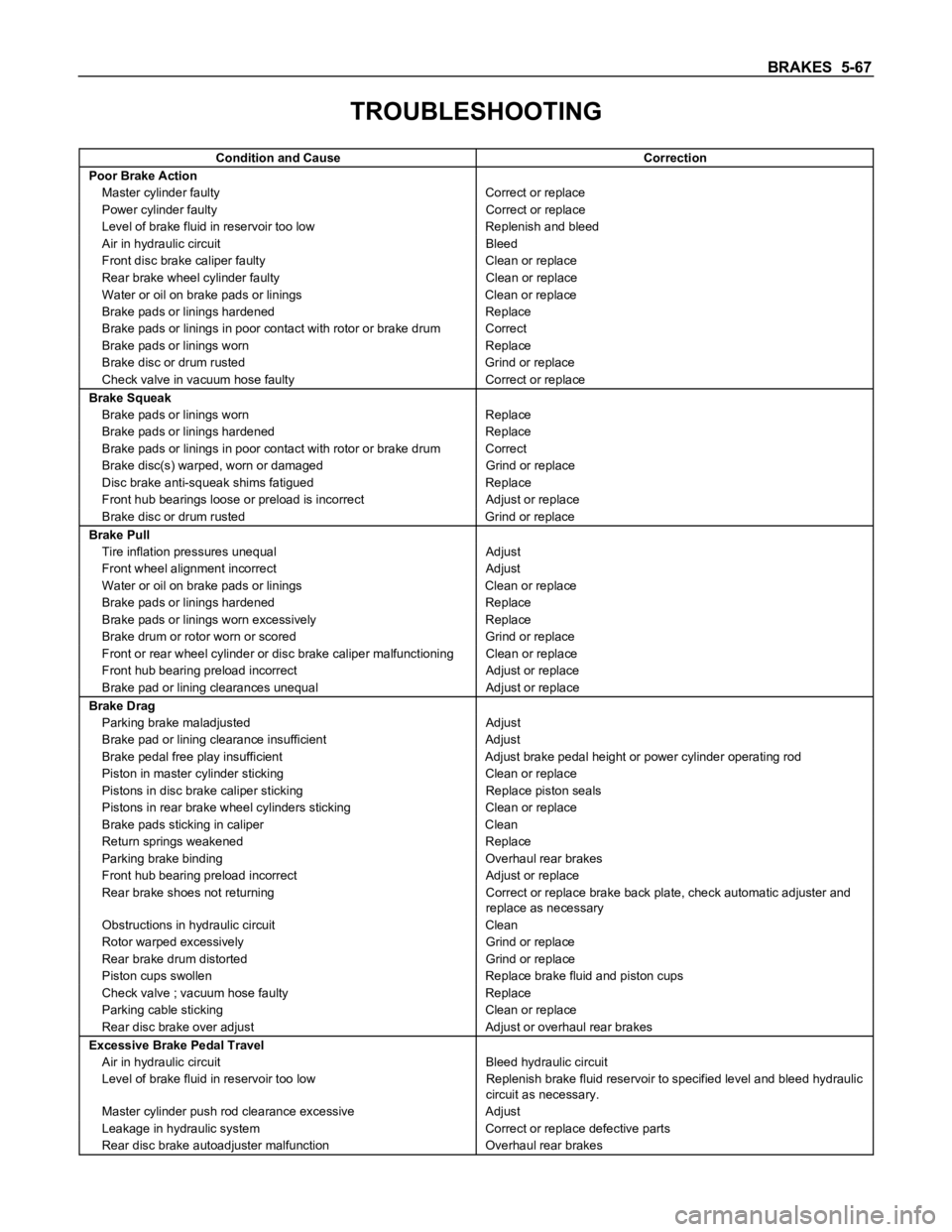
TROUBLESHOOTING
Condition and Cause Correction
Poor Brake Action
Master cylinder faulty Correct or replace
Power cylinder faulty Correct or replace
Level of brake fluid in reservoir too low Replenish and bleed
Air in hydraulic circuit Bleed
Front disc brake caliper faulty Clean or replace
Rear brake wheel cylinder faulty Clean or replace
Water or oil on brake pads or linings Clean or replace
Brake pads or linings hardened Replace
Brake pads or linings in poor contact with rotor or brake drum Correct
Brake pads or linings worn Replace
Brake disc or drum rusted Grind or replace
Check valve in vacuum hose faulty Correct or replace
Brake Squeak
Brake pads or linings worn Replace
Brake pads or linings hardened Replace
Brake pads or linings in poor contact with rotor or brake drum Correct
Brake disc(s) warped, worn or damaged Grind or replace
Disc brake anti-squeak shims fatigued Replace
Front hub bearings loose or preload is incorrect Adjust or replace
Brake disc or drum rusted Grind or replace
Brake Pull
Tire inflation pressures unequal Adjust
Front wheel alignment incorrect Adjust
Water or oil on brake pads or linings Clean or replace
Brake pads or linings hardened Replace
Brake pads or linings worn excessively Replace
Brake drum or rotor worn or scored Grind or replace
Front or rear wheel cylinder or disc brake caliper malfunctioning Clean or replace
Front hub bearing preload incorrect Adjust or replace
Brake pad or lining clearances unequal Adjust or replace
Brake Drag
Parking brake maladjusted Adjust
Brake pad or lining clearance insufficient Adjust
Brake pedal free play insufficient Adjust brake pedal height or power cylinder operating rod
Piston in master cylinder sticking Clean or replace
Pistons in disc brake caliper sticking Replace piston seals
Pistons in rear brake wheel cylinders sticking Clean or replace
Brake pads sticking in caliper Clean
Return springs weakened Replace
Parking brake binding Overhaul rear brakes
Front hub bearing preload incorrect Adjust or replace
Rear brake shoes not returning Correct or replace brake back plate, check automatic adjuster and
replace as necessary
Obstructions in hydraulic circuit Clean
Rotor warped excessively Grind or replace
Rear brake drum distorted Grind or replace
Piston cups swollen Replace brake fluid and piston cups
Check valve ; vacuum hose faulty Replace
Parking cable sticking Clean or replace
Rear disc brake over adjust Adjust or overhaul rear brakes
Excessive Brake Pedal Travel
Air in hydraulic circuit Bleed hydraulic circuit
Level of brake fluid in reservoir too low Replenish brake fluid reservoir to specified level and bleed hydraulic
circuit as necessary.
Master cylinder push rod clearance excessive Adjust
Leakage in hydraulic system Correct or replace defective parts
Rear disc brake autoadjuster malfunction Overhaul rear brakes
Page 544 of 1600
7C-4 CLUTCH
MASTER CYLINDER
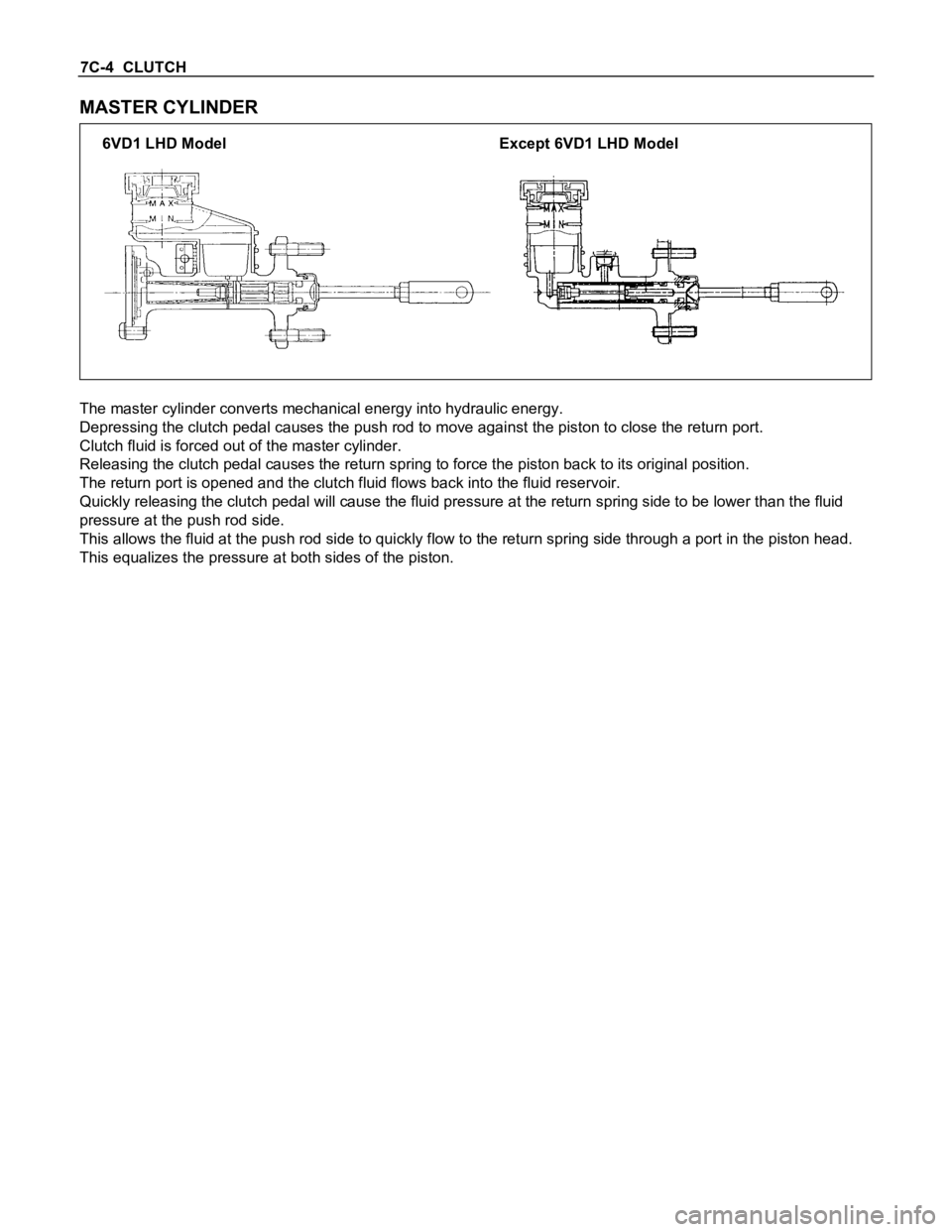
6VD1 LHD Model Except 6VD1 LHD Model
The master cylinder converts mechanical energy into hydraulic energy.
Depressing the clutch pedal causes the push rod to move against the piston to close the return port.
Clutch fluid is forced out of the master cylinder.
Releasing the clutch pedal causes the return spring to force the piston back to its original position.
The return port is opened and the clutch fluid flows back into the fluid reservoir.
Quickly releasing the clutch pedal will cause the fluid pressure at the return spring side to be lower than the fluid
pressure at the push rod side.
This allows the fluid at the push rod side to quickly flow to the return spring side through a port in the piston head.
This equalizes the pressure at both sides of the piston.
Page 545 of 1600
CLUTCH 7C-5
SLAVE CYLINDER
MUA Series
MSG Series
4J Engine Series
6VD1 Engine Series
The slave cylinder converts hydraulic energy into mechanical energy.
Hydraulic fluid supplied by the master cylinder moves the slave cylinder piston to actuate the shift fork.
The mechanical energy produced by the slave cylinder is directly proportional to the diameters of the master
cylinder and the slave cylinder.
A bleeder screw is provided to bleed the slave cylinder.