Page 165 of 241
Windshield Wipers
Check the condition of the wind-
shield wiper blades at least every six
months. Look for signs of cracking
in the rubber, or areas that are
getting hard. Replace the blades if
you find these signs, or they leave streaks and unwiped areas when
used.
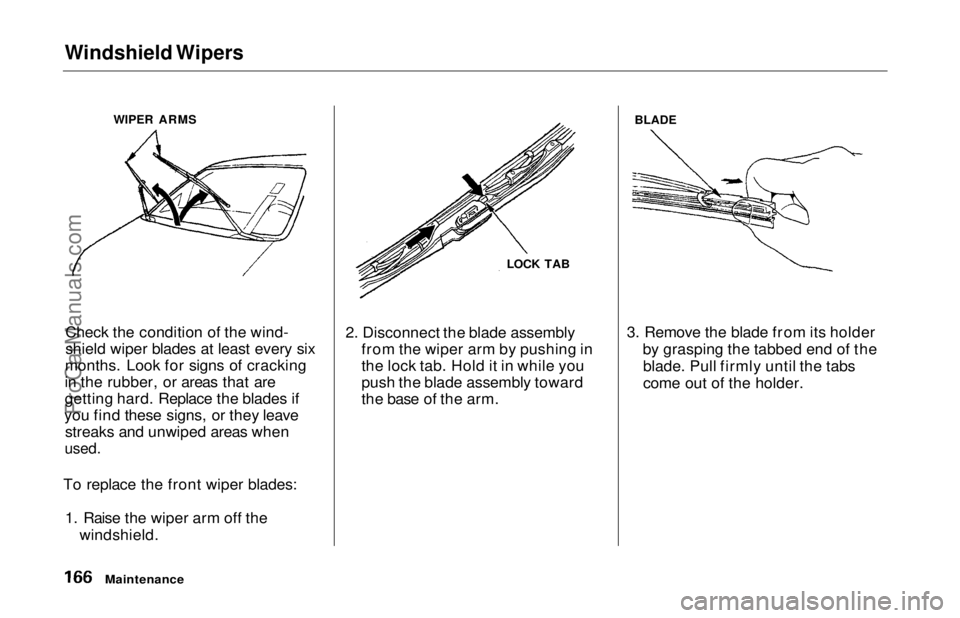
To replace the front wiper blades: 1. Raise the wiper arm off the windshield. 2. Disconnect the blade assembly
from the wiper arm by pushing in
the lock tab. Hold it in while you
push the blade assembly toward
the base of the arm. 3. Remove the blade from its holder
by grasping the tabbed end of theblade. Pull firmly until the tabs
come out of the holder.
Maintenance
WIPER ARMS
LOCK TABBLADEProCarManuals.comMain Menu Table of Contents s t
Page 166 of 241
Windshield Wipers
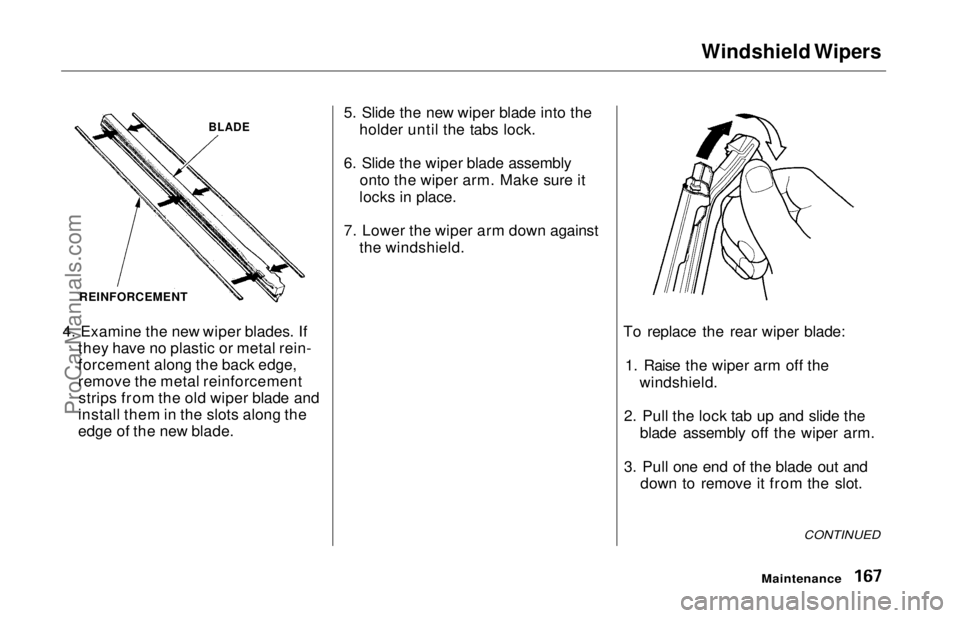
4. Examine the new wiper blades. If they have no plastic or metal rein-
forcement along the back edge,
remove the metal reinforcementstrips from the old wiper blade and
install them in the slots along the
edge of the new blade. 5. Slide the new wiper blade into the
holder until the tabs lock.
6. Slide the wiper blade assembly onto the wiper arm. Make sure it
locks in place.
7. Lower the wiper arm down against the windshield.
To replace the rear wiper blade:1. Raise the wiper arm off the windshield.
2. Pull the lock tab up and slide the blade assembly off the wiper arm.
3. Pull one end of the blade out and down to remove it from the slot.
CONTINUED
Maintenance
BLADE
REINFORCEMENTProCarManuals.comMain Menu Table of Contents s t
Page 167 of 241
Windshield Wipers
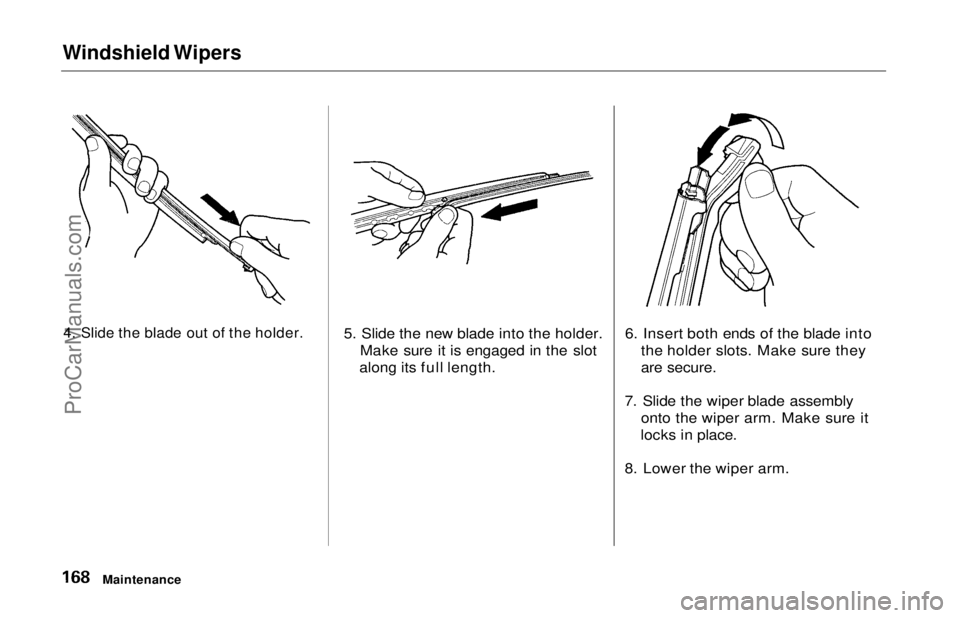
4. Slide the blade out of the holder.
5. Slide the new blade into the holder.
Make sure it is engaged in the slot
along its full length. 6. Insert both ends of the blade into
the holder slots. Make sure they
are secure.
7. Slide the wiper blade assembly onto the wiper arm. Make sure it
locks in place.
8. Lower the wiper arm.
MaintenanceProCarManuals.comMain Menu Table of Contents s t
Page 168 of 241
Air Conditioning System
Your car's air conditioning is a sealed system. Any major maintenance,
such as recharging, should be done
by a qualified technician. You can do a couple of things to make sure the
air conditioning works efficiently.
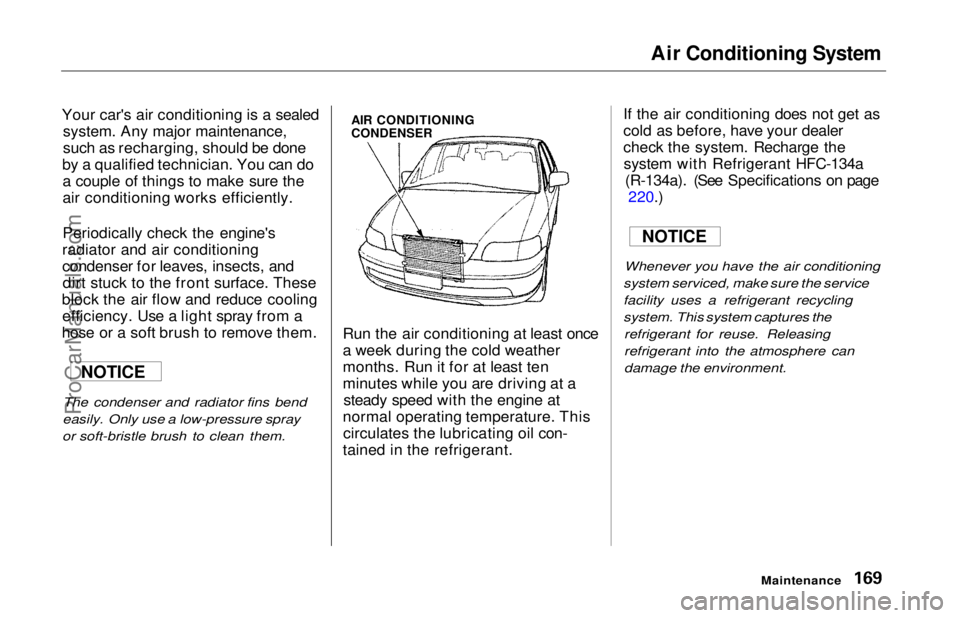
Periodically check the engine's
radiator and air conditioning
condenser for leaves, insects, and dirt stuck to the front surface. These
block the air flow and reduce cooling efficiency. Use a light spray from a
hose or a soft brush to remove them.
The condenser and radiator fins bend
easily. Only use a low-pressure spray
or soft-bristle brush to clean them.
Run the air conditioning at least once
a week during the cold weather
months. Run it for at least ten
minutes while you are driving at a
steady speed with the engine at
normal operating temperature. This circulates the lubricating oil con-
tained in the refrigerant. If the air conditioning does not get as
cold as before, have your dealer
check the system. Recharge the
system with Refrigerant HFC-134a (R-134a). (See Specifications on page 220.)
Whenever you have the air conditioning
system serviced, make sure the service
facility uses a refrigerant recycling
system. This system captures the refrigerant for reuse. Releasing
refrigerant into the atmosphere can
damage the environment.
Maintenance
AIR CONDITIONING
CONDENSER
NOTICE
NOTICEProCarManuals.comMain Menu Table of Contents s t
Page 169 of 241
Drive Belts, Timing Belt
Drive Belts
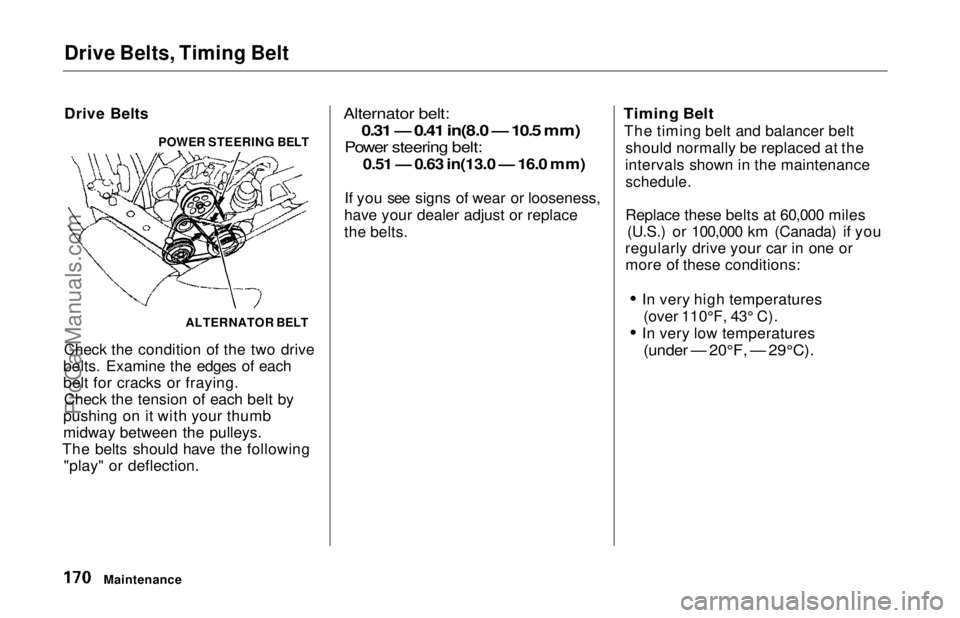
Check the condition of the two drive
belts. Examine the edges of each
belt for cracks or fraying. Check the tension of each belt by
pushing on it with your thumb
midway between the pulleys.
The belts should have the following "play" or deflection.
Alternator belt:
0.31 — 0.41 in(8.0 — 10.5 mm)
Power steering belt:
0.51 — 0.63 in(13.0 — 16.0 mm)
If you see signs of wear or looseness,
have your dealer adjust or replace
the belts.
Timing Belt
The timing belt and balancer belt should normally be replaced at the
intervals shown in the maintenance
schedule.
Replace these belts at 60,000 miles (U.S.) or 100,000 km (Canada) if you
regularly drive your car in one or more of these conditions:
In very high temperatures(over 110°F, 43° C).
In very low temperatures
(under — 20°F, — 29°C).
Maintenance POWER STEERING BELT
ALTERNATOR BELTProCarManuals.comMain Menu Table of Contents s t
Page 170 of 241

Tires
To safely operate your car, your tires must be the proper type and size, in
good condition with adequate tread, and correctly inflated. The following
pages give more detailed information on how and when to check air
pressure, how to inspect your tires
for damage and wear, and what to do
when your tires need to be replaced. Inflation
Keeping the tires properly inflated
provides the best combination of
handling, tread life and riding
comfort. Underinflated tires wear
unevenly, adversely affect handling
and fuel economy, and are more
likely to fail from being overheated. Overinflated tires can make your car
ride more harshly, are more prone to damage from road hazards, and wear
unevenly.
We recommend that you visually check your tires every day. If you
think a tire might be low, check it immediately with a tire gauge. Use a gauge to measure the air
pressure at least once a month. Even
tires that are in good condition may
lose one to two psi per month. Remember to check the spare tire at
the same time you check all the other tires.
Check the pressure in the tires when
they are cold. This means the car
has been parked for at least three
hours. If you have to drive the car
before checking the tire pressure,
the tires can still be considered "cold" if you drive less than 1 mile (1.6 km).
CONTINUED
Maintenance
Using tires that are excessively
worn or improperly inflated can
cause a crash in which you can be seriously hurt or killed.
Follow all instructions in this
owner's manual regarding tire
inflation and maintenance.ProCarManuals.comMain Menu Table of Contents s t
Page 171 of 241
Tires
If you check the pressure when the
tires are hot (the car has been driven several miles), you will see readings
4 to 6 psi (0.3 to 0.4 kgf/cm2, 30 to 40
kPa) higher than the cold reading.
This is normal. Do not let air out to match the specified cold pressure.
The tire will be underinflated.
You should get your own tire pressure gauge and use it whenever
you check your tire pressures. This
will make it easier for you to tell if a pressure loss is due to a tire problemand not due to a variation between
gauges.
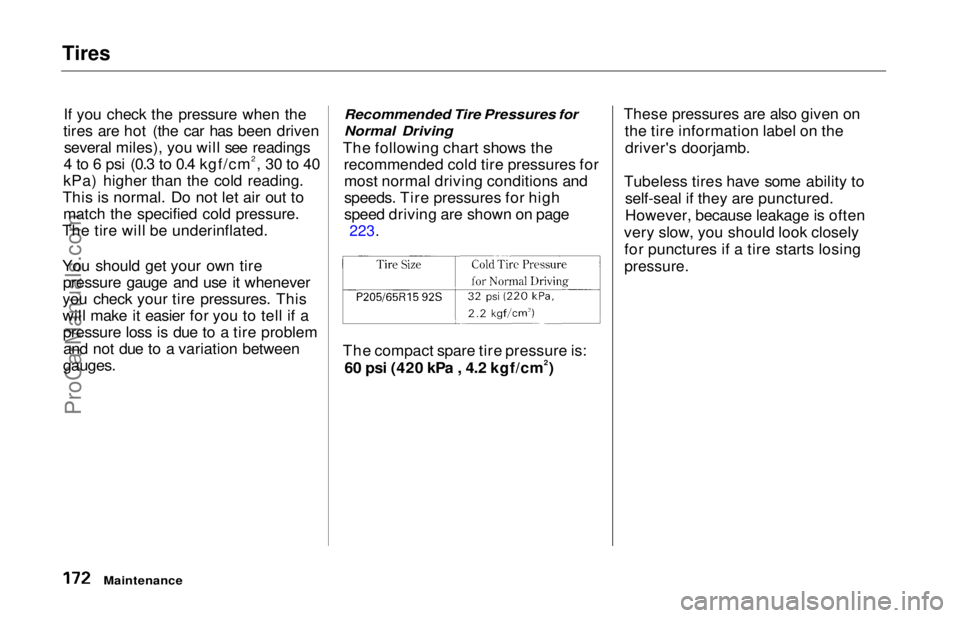
Recommended Tire Pressures for
Normal Driving
The following chart shows the recommended cold tire pressures formost normal driving conditions and
speeds. Tire pressures for high
speed driving are shown on page
223.
The compact spare tire pressure is: 60 psi (420 kPa , 4.2 kgf/cm2) These pressures are also given on
the tire information label on thedriver's doorjamb.
Tubeless tires have some ability to self-seal if they are punctured.
However, because leakage is often
very slow, you should look closely for punctures if a tire starts losing
pressure.
MaintenanceProCarManuals.comMain Menu Table of Contents s t
Page 172 of 241
Tires
Inspection
Every time you check inflation, you should also examine the tires for
damage, foreign objects, and wear.
You should look for:
Bumps or bulges in the tread or
side of the tire. Replace the tire if
you find either of these conditions.
Cuts, splits, or cracks in the side
of the tire. Replace the tire if you
can see fabric or cord.
Excessive tread wear.
INDICATOR LOCATION MARKS
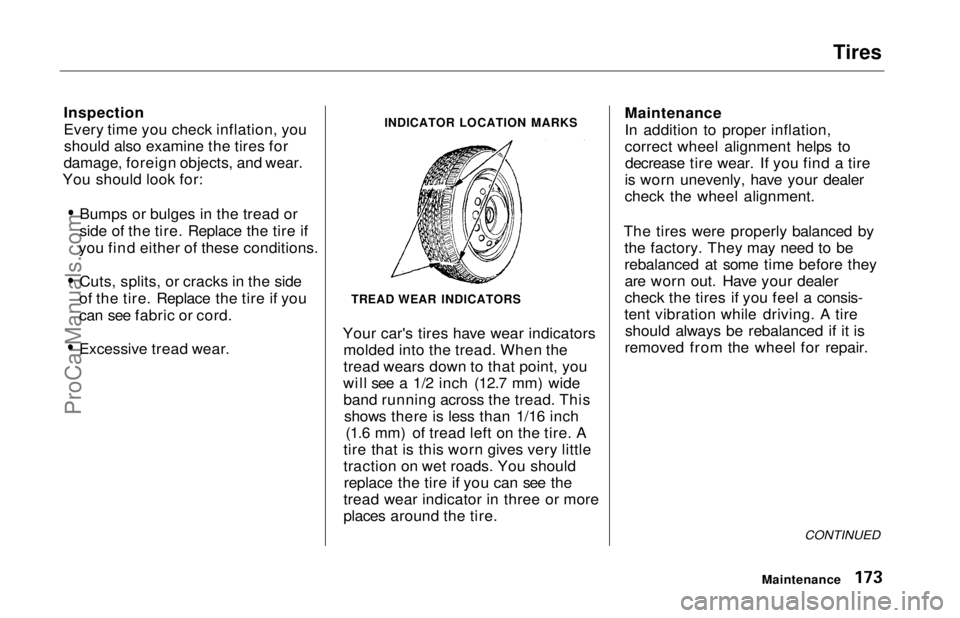
Your car's tires have wear indicators molded into the tread. When the
tread wears down to that point, you
will see a 1/2 inch (12.7 mm) wide band running across the tread. This shows there is less than 1/16 inch (1.6 mm) of tread left on the tire. A
tire that is this worn gives very little
traction on wet roads. You should replace the tire if you can see the
tread wear indicator in three or more
places around the tire. Maintenance
In addition to proper inflation,
correct wheel alignment helps to
decrease tire wear. If you find a tire
is worn unevenly, have your dealer
check the wheel alignment.
The tires were properly balanced by the factory. They may need to be
rebalanced at some time before theyare worn out. Have your dealer
check the tires if you feel a consis-
tent vibration while driving. A tire should always be rebalanced if it is
removed from the wheel for repair.
CONTINUED
Maintenance
TREAD WEAR INDICATORSProCarManuals.comMain Menu Table of Contents s t