1997 GMC SIERRA service
[x] Cancel search: servicePage 149 of 436
Have you recently changed brands of fuel?
If so, be sure to fuel your vehicle with quality fuel (see
“Fuel” in the Index). Poor fuel quality will cause your
engine not to run as efficiently as designed. You
may
notice this as stalling after start-up, stalling when you
put the vehicle into gear, misfiring, hesitation on
acceleration
or stumbling on acceleration. (These
conditions may go away once the engine is warmed up.)
This will be detected by the system and cause the light
to turn
on.
If you experience one or more of these conditions,
change the
fuel brand you use. It will require at least
one full tank
of the proper fuel to turn the light off.
If none of the above steps have made the light turn off,
have your dealer
or qualified service center check the
vehicle. Your dealer has the proper test equipment and
diagnostic tools
to fix any mechanical or electrical
problems that may have developed.
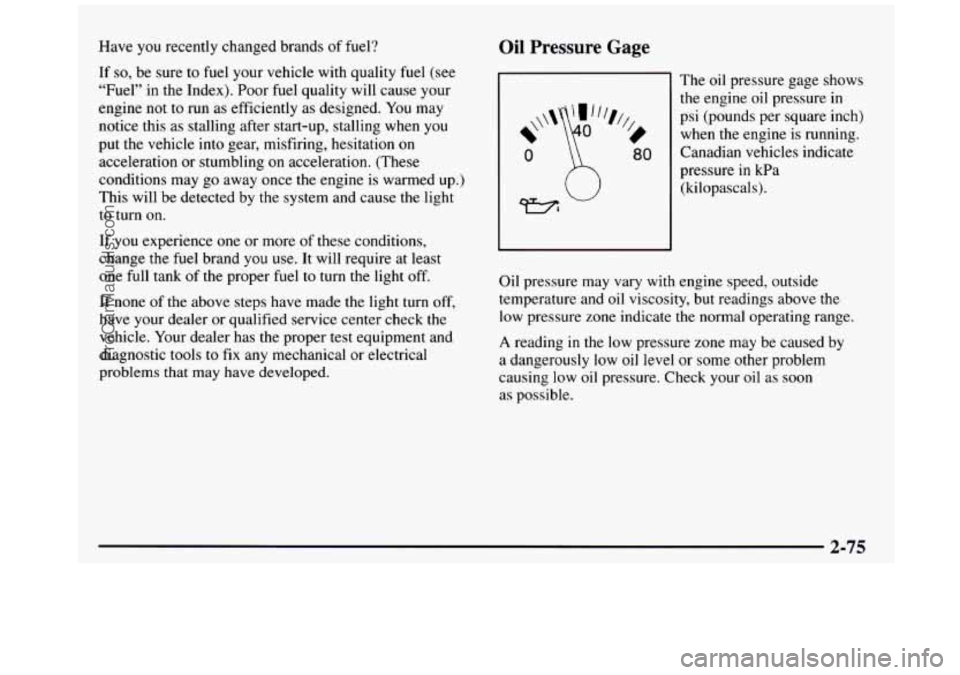
Oil Pressure Gage
The oil pressure gage shows
the engine oil pressure in
psi (pounds per square inch)
when the engine is running.
Canadian vehicles indicate
pressure in kPa
(kilopascals).
Oil pressure may vary
with engine speed, outside
temperature and oil viscosity, but readings above
the
low pressure zone indicate the normal operating range.
A reading in the low pressure zone may be caused by
a dangerously low oil level or some other problem
causing low oil pressure. Check your oil as soon
as possible.
2-75
ProCarManuals.com
Page 150 of 436
I !!i GL1U ION:
Don’t keep driving if the oil pressure is low. If
you do, your engine can become so hot that it
catches fire.
You or others could be burned.
Check your
oil as soon as possible and have your
vehicle serviced.
I NOTICE:
Damage to your engine from neglected oil
problems can be costly and is not covered by
your warranty.
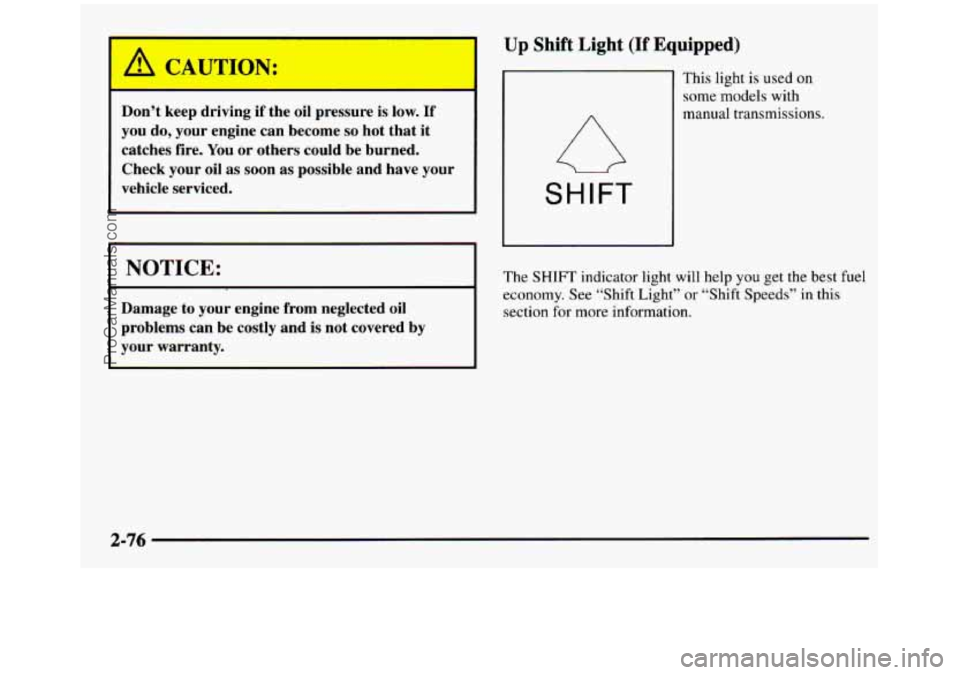
Up Shift Light (If Equipped)
This light is used on
some models with
manual transmissions,
SHIFT
The SHIFT’ indicator light will help you get the best fuel
economy. See “Shift Light”
or “Shift Speeds” in this
section for more information.
2-76
.. .
ProCarManuals.com
Page 151 of 436
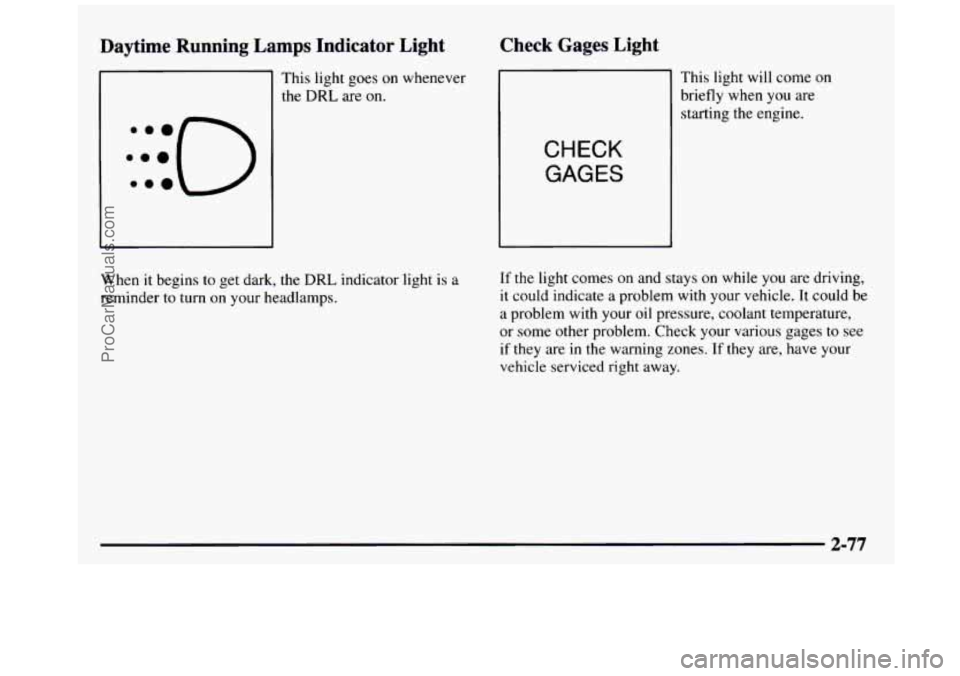
Daytime Running Lamps Indicator Light
:::O e..
This light goes on whenever
the DRL are
on.
Check Gages Light
I
CHECK
GAGES
This light will come on
briefly when
you are
starting the engine.
When it begins to get dark, the DRL indicator light is a
reminder
to turn on your headlamps.
If the light comes on and stays on while you are driving,
it could indicate a problem with your vehicle. It could be
a problem with your oil pressure, coolant temperature,
or some other problem. Check your various gages
to see
if they are
in the warning zones. If they are, have your
vehicle serviced right
away.
ProCarManuals.com
Page 178 of 436
The cassette tape player is able to detect a broken tape.
Some cleaning cassettes may appear as
a broken tape. If
the cleaning cassette is ejected immediately from the
tape player, follow these steps:
1. Turn the radio off.
2. Turn the ignition on.
3. Press and hold the TAPE-AUX button until the tape
4. Insert the cleaning cassette and the radio will turn on
5. Eject the tape after the tape player has been cleaned.
When the cleaning cassette has been ejected, the broken
tape detection feature is active again.
symbol
flashes.
in cassette mode.
After you clean the player, press and hold EJECT for
five seconds to reset the CLN indicator. The radio will
display
--- to show the indicator was reset.
Cassettes are subject to wear and the sound quality
may degrade over time. Always make sure the cassette
tape is in good condition before you have your tape
player serviced.
Care of Your Compact Discs
Handle discs carefully. Store them in their original cases
or other protective cases and away from direct sunlight
and dust. If the surface of a disc is soiled, dampen a
clean, soft cloth in a mild, neutral detergent solution and
clean
it, wiping from the center to the edge.
Be sure never to touch the signal surface when handling
discs. Pick up discs by grasping the outer edges or the
edge of the hole and the outer edge.
Fixed Mast Antenna
The fixed mast antenna can withstand most car washes
without being damaged.
If the mast should ever become
slightly bent, you can straighten it
out by hand. If the
mast is badly bent, as it might be by vandals, you should
replace
it.
Check every once in a while to be sure the mast is still
tightened
to the cowl.
3-26
ProCarManuals.com
Page 193 of 436
Before You Go Off-Roading
There are some things to do before you go out. For
example, be sure to have all necessary maintenance
and service work done. Check to make sure all
underbody shields
(if so equipped) are properly
attached. Be sure you
read all the information about
your four-wheel-drive vehicle in this manual.
Is there
enough fuel?
Is the spare tire fully inflated? Are the
fluid levels up where they should be? What are the local
laws that apply to off-roading where you’ll be driving?
If you don’t know, you should check
with law
enforcement people
in the area. Will you be on
someone’s private land?
If so, be sure to get the
necessary permission.
Loading Your Vehicle for Off-Road Driving
There are some important things to remember about
how to load your vehicle.
The heaviest things should be on the load floor and
forward
of your rear axle. Put heavier items as far
forward as you can.
Be sure the load is secured properly, so driving on
the off-road terrain doesn’t toss things around.
Cargo on the load floor piled higher than
the seatbacks can be thrown forward
during a sudden stop. You or your
passengers could be injured. Keep cargo
below the top of the seatbacks.
Unsecured cargo on the load floor can be
tossed about when driving over rough
terrain. You or your passengers can
be struck
by flying objects. Secure the
cargo properly.
Heavy loads on the roof raise the vehicle’s
center of gravity, making it more likely to
roll over. You can be seriously or fatally
injured
if the vehicle rolls over. Put heavy
loads inside the cargo area, not on the roof.
Keep cargo in the cargo area as far forward
and low
as possible.
You’ll find other important information
in this manual.
See “Vehicle Loading,” “Luggage Carrier” and “Tires”
in the Index.
ProCarManuals.com
Page 204 of 436
If the water isn’t too deep, then drive through it slowly.
At fast speeds, water splashes on your ignition system
and your vehicle can stall. Stalling can also occur
if you
get your tailpipe under water. And, as long as your
tailpipe is under water, you’ll never be able
to start your
engine. When you go through water, remember that when
your brakes get wet, it may
take you longer to stop.
ki CAU IN:
Driving through rushing water can be dangerous.
Deep water can sweep your vehicle downstream
and you and your passengers could drown.
If it’s
only shallow water, it can still wash away the
ground from under your tires, and
you could lose
traction and roll the vehicle
over. Don’t drive
through rushing water.
After Off-Road Driving
Remove any brush or debris that has collected on
the underbody, chassis or under the hood. These
accumulations can be
a fire hazard.
After operation
in mud or sand, have the brake linings
cleaned and checked. These substances can cause
glazing and
uneven braking. Check the body structure,
steering, suspension, wheels, tires and exhaust system
for damage. Also, check
the fuel lines and cooling
system for any leakage.
Your vehicle will require more frequent service due to
off-road use. Refer to the Maintenance Schedule for
additional information.
See “Driving Through Water”
in the Index for more
information on driving through water.
4-26
ProCarManuals.com
Page 212 of 436
When you want to leave the freeway, move to the proper
lane well in advance. If you miss your exit, do not,
under any circumstances,
stop and back up. Drive on
to the next exit.
The exit ramp can be curved, sometimes quite sharply.
The exit speed is usually posted.
Reduce your speed according to your speedometer, not
to your sense of motion. After driving for any distance
at higher speeds,
you may tend to think you are going
slower than you actually are.
Before Leaving on a Long Trip
Make sure you’re ready. Try to be well rested. If you
must
start when you’re not fresh -- such as after a day’s
work
-- don’t plan to make too many miles that first part
of the journey. Wear comfortable clothing and shoes you
can easily drive in.
Is your vehicle ready for a long trip?
If you keep it
serviced and maintained, it’s ready to go. If it needs
service, have
it done before starting out. Of course,
you’ll find experienced and able service experts in
GM
dealerships all across North America. They’ll be ready
and willing to help
if you need it.
Here are some things you can check before a trip:
0
0
0
0
a
Windshield Washer Fluid: Is the reservoir full?
Are all windows clean inside and outside?
Wiper Blades: Are they in good shape?
Fuel, Engine Oil, Other Fluids: Have you checked
all levels?
Lamps: Are they all working? Are the lenses clean?
Tires: They are vitally important to a safe,
trouble-free trip. Is the tread good enough for
long-distance driving? Are the tires all inflated to the
recommended pressure?
Weather Forecasts: What’s the weather outlook
along your route? Should you delay your trip a short
time to avoid
a major storm system?
Maps: Do you have up-to-date maps?
ProCarManuals.com
Page 213 of 436
Highway Hypnosis
Is there actually such a condition as “highway hypnosis”?
Or is it just plain falling asleep at the wheel? Call it
highway hypnosis, lack
of awareness, or whatever.
There is something about an easy stretch
of road with the
same scenery, along with the hum of the tires on the road,
the drone of the engine, and
the rush of the wind against
the vehicle that can make you sleepy. Don’t let it happen
to you! If it does, your vehicle can leave the road in
less
than a second, and you could crash and be injured.
What can you do about highway hypnosis? First, be
aware that it can happen.
Then here are some tips:
0
e
0
Make sure your vehicle is well ventilated, with a
comfortably cool interior.
Keep your eyes moving. Scan the road ahead
and
to the sides, Check your mirrors and your
instruments frequently.
If you get sleepy, pull off the road into
a rest, service
or parking area and take a nap, get some exercise, or
both. For safety, treat drowsiness
on the highway as
an emergency.
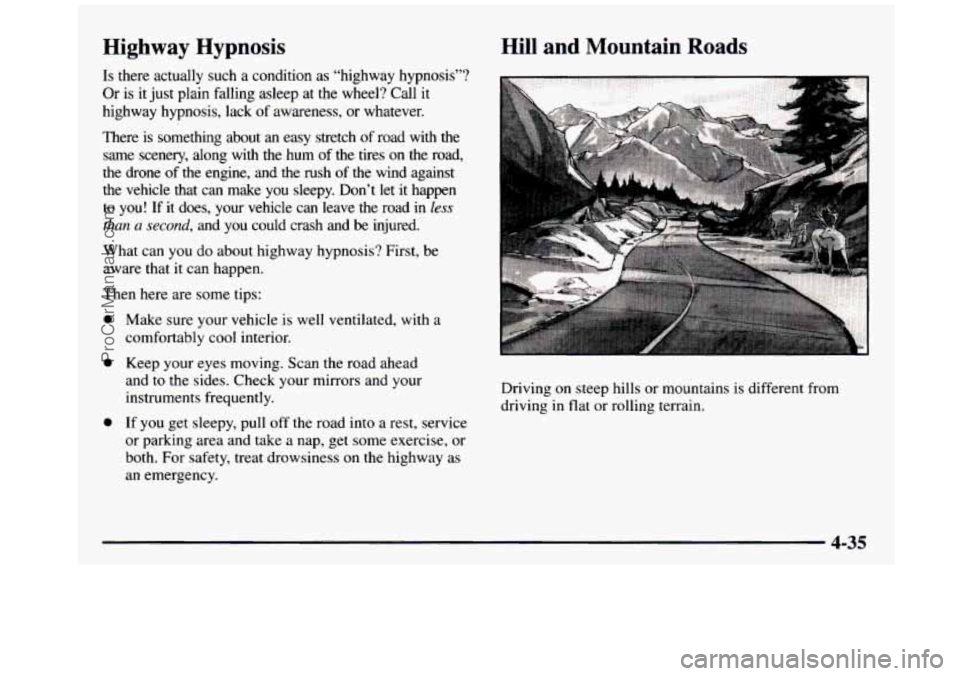
Hill and Mountain Roads
Driving on steep hills or mountains is different from
driving in flat or rolling terrain.
4-35
ProCarManuals.com