1997 GMC SIERRA mirror
[x] Cancel search: mirrorPage 75 of 436
Section 2 Features and Controls
-
Here you can learn about the many standard and optional features on your vehicle, and information on starting,
shifting and braking. Also explained
are the instrument panel and the warning systems that tell you if everything is
working properly
-- and what to do if you have a problem.
2- 1
2-3
2-4
2-5
2-7 2-9
2- 10
2-11
2- 13
2- 14
2- 15
2- 19
2-22
2-22
2-27
2-28
2-30
Keys
Tailgate
Third Door
Door Locks
Keyless Entry System
Theft
New Vehicle “Break-In” Ignition Positions
Starting Your Gasoline Engine
Engine Coolant Heater
Automatic Transmission Operation
Manual Transmission Operation
Locking Rear Axle
Four-wheel Drive
Parking Brake
Shifting Into PARK
(P) (Automatic
Transmission Models Only)
Shifting Out
of PARK (P)
(Automatic Transmission) 2-3
1
2-3 1
2-32
2-32
2-33
2-36
2-36
2-43 2-48
2-52
2-59
2-6
1
2-62
2-64 2-66 Parking
Your Vehicle (Manual
Transmission Models Only)
Parking Over Things That Burn
Engine Exhaust
Running Your Engine While You’re Parked
(Automatic Transmission)
Windows
Tilt Wheel
Turn SignalAUultifunction Lever
Lamps
Mirrors Storage Compartments
Ashtrays and Cigarette Lighter
Sun Visors
Instrument Panel
Instrument Panel Cluster
Warning Lights, Gages and Indicators
ProCarManuals.com
Page 122 of 436
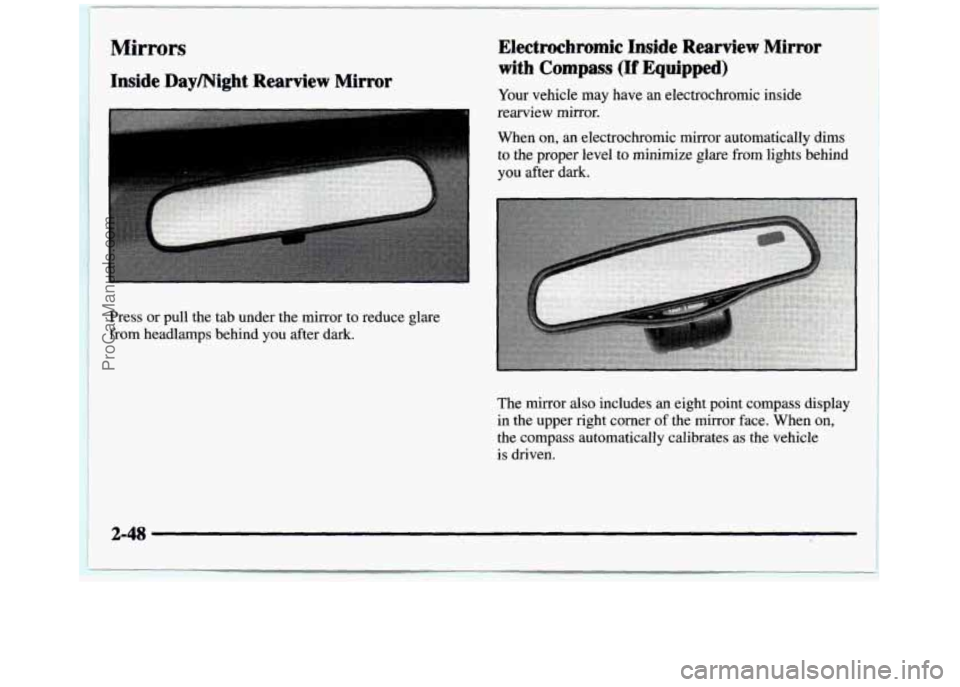
Mirrors
Inside Daymight Rearview Mirror
Press or pull the tab under the mirror to reduce glare
from headlamps behind you after dark.
Electrochromic Inside Rearview Mirror
with Compass (If Equipped)
Your vehicle may have an electrochromic inside
rearview mirror.
When on, an electrochromic mirror automatically dims to the proper level to minimize glare from lights behind
you after dark.
The mirror also includes
an eight point compass display
in the upper right corner of the mirror face. When
on,
the compass automatically calibrates as the vehicle
is driven'.
ProCarManuals.com
Page 123 of 436
Mirror Operation
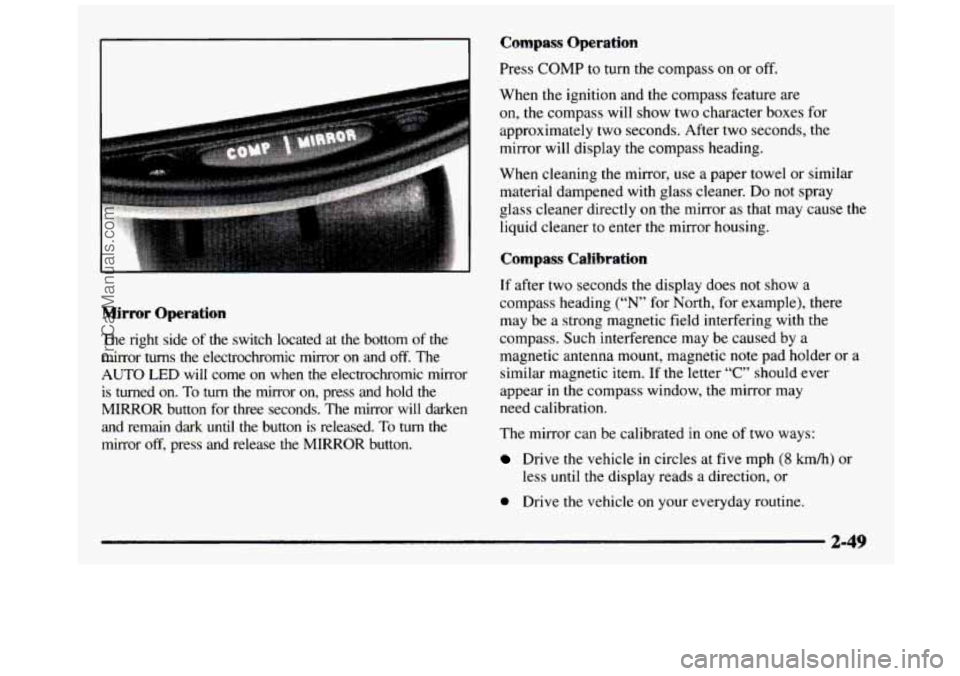
The right side of the switch located at the bottom of the mirror
turns the electrochromic mirror on and off. The
AUTO LED will come on when the electrochromic mirror
is turned
on. To turn the mirror on, press and hold the
MIRROR button for three seconds. The mirror will darken and remain dark
until the button is released. To turn the
mirror
off, press and release the MIRROR button.
Compass Operation
Press COMP to turn the compass on or off.
When the ignition and the compass feature are
on, the compass will show two character boxes for
approximately two seconds. After two seconds, the
mirror will display the compass heading.
When cleaning the mirror, use a paper towel
or similar
material dampened with glass cleaner.
Do not spray
glass cleaner directly on .the mirror as that may cause the
liquid cleaner to enter the mirror housing.
Compass Calibration
If after two seconds the display does not show a
compass heading (“N’ for North, for example), there
may be a strong magnetic field interfering with the
compass. Such interference may be caused by a
magnetic antenna mount, magnetic note pad holder
or a
similar magnetic item. If the letter “C” should ever
appear
in the compass window, the mirror may
need calibration.
The mirror can be calibrated
in one of two ways:
Drive the vehicle in circles at five mph (8 km/h) or
less
until the display reads a direction, or
0 Drive the vehicle on your everyday routine.
ProCarManuals.com
Page 124 of 436
Compass Variance
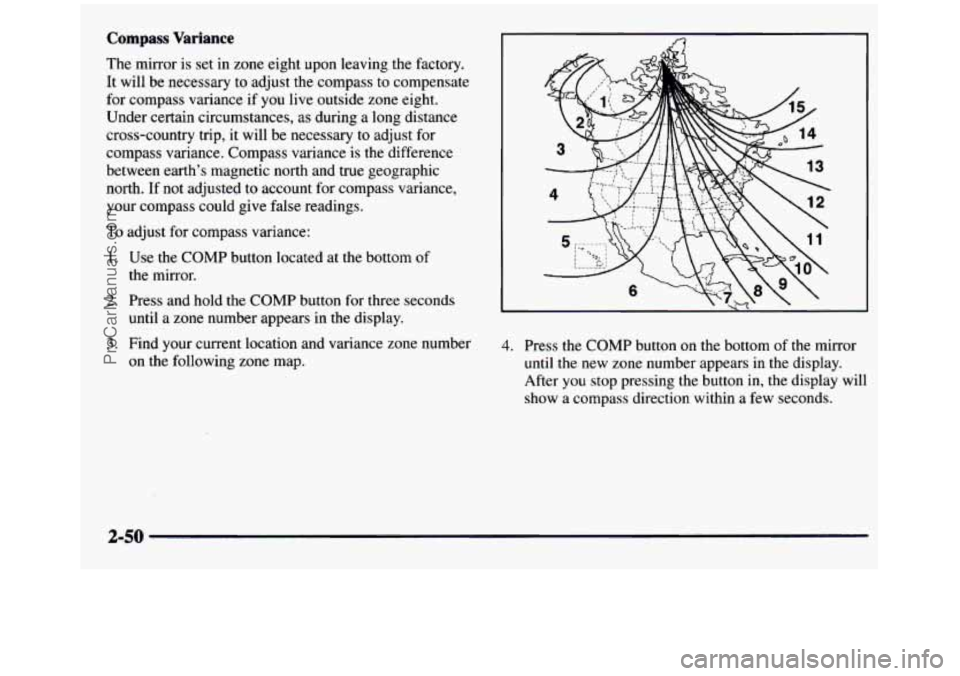
The mirror is set in zone eight upon leaving the factory.
It will be necessary to adjust the compass to compensate
for compass variance if you live outside zone eight.
Under certain circumstances, as during a long distance
cross-country trip,
it will be necessary to adjust for
compass variance. Compass variance is the difference
between earth’s magnetic north and true geographic
north. If not adjusted
to account for compass variance,
your compass could give false readings.
To adjust for compass variance:
1. Use the COMP button located at the bottom of
the mirror.
2. Press and hold the COMP button for three seconds
until a zone number appears in the display.
3. Find your current location and variance zone number
on the following zone map. 4. Press the COMP button on the bottom of the mirror
until the new zone number appears in the display. After you stop pressing the button in, the display will
show a compass direction within a few seconds.
2-50
ProCarManuals.com
Page 125 of 436
Outside Manual Adjust Mirror
Adjust your outside mirrors so you can just see the
side
of your vehicle and have a clear view of objects
behind
you. Some mirrors can be folded in to enter
narrow doorways.
Electric Outside Rearview Mirrors
(If Equipped)
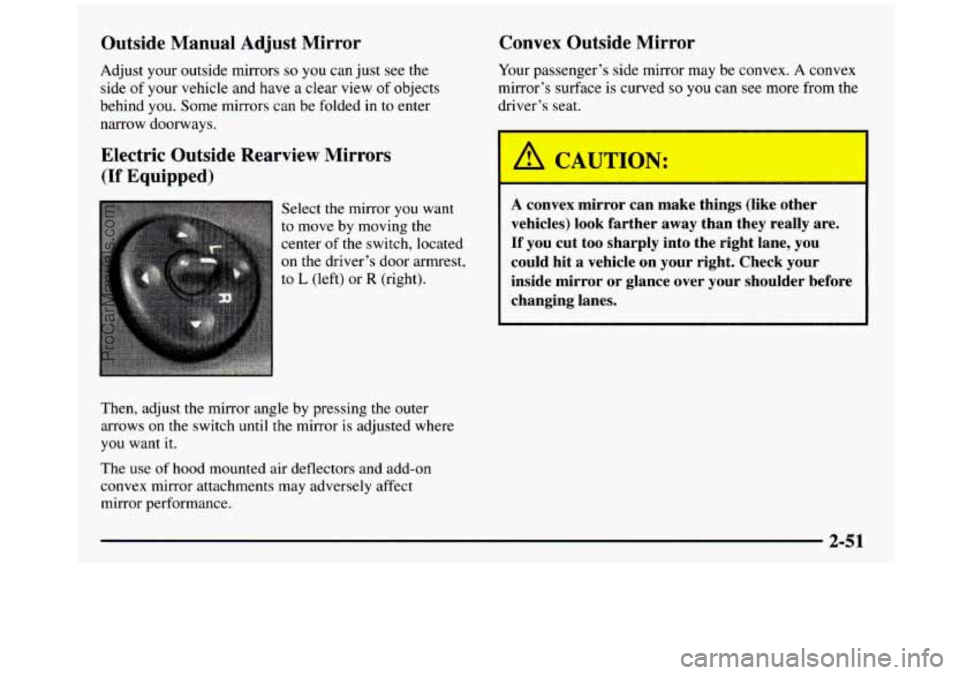
Select the mirror you want
to move by moving the
center
of the switch, located
on the driver’s door armrest,
to L (left) or
R (right).
Then, adjust the mirror angle by pressing the outer
arrows on the switch until the mirror is adjusted where
you want it.
The use
of hood mounted air deflectors and add-on
convex mirror attachments may adversely affect mirror performance.
Convex Outside Mirror
Your passenger’s side mirror may be convex. A convex
mirror’s surface
is curved so you can see more from the
driver’s seat.
A convex mirror can make things (like other
vehicles) look farther away than they really are.
If you cut too sharply into the right lane, you
could hit a vehicle on your right. Check your
inside mirror or glance over your shoulder before
changing lanes.
2-5 1
ProCarManuals.com
Page 135 of 436
Sun Visors Accessory Power Outlets
To block out glare, you can swing down the visors. You
can also swing them out to help block glare at the front
~
and side windows.
Your visor may have a strap to hold small items, such
as maps.
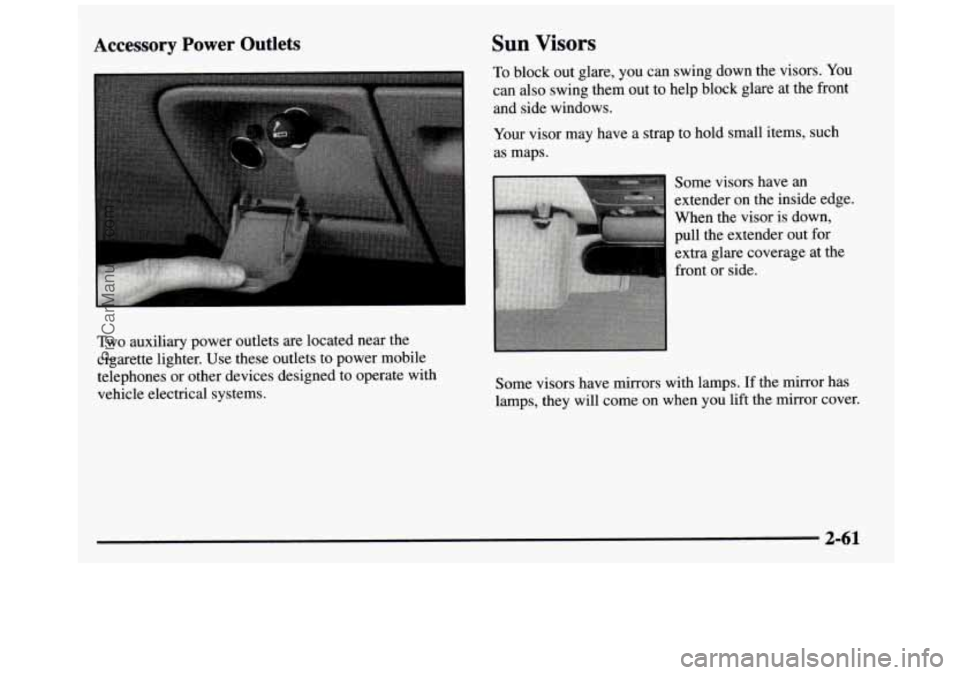
Some visors have
an
extender on the inside edge.
When the visor is down,
pull the extender out for
extra glare coverage at the
front or side.
Two auxiliary power outlets are located near the
cigarette lighter. Use these outlets to power mobile
telephones or other devices designed
to operate with
vehicle electrical systems. Some
visors have mirrors with lamps. If the mirror has
lamps, they will come on when you lift the mirror cover.
2-61
ProCarManuals.com
Page 191 of 436
If other cars are lined up to pass a slow vehicle, wait
your turn. But take care that someone
isn’t trying to
pass you as
you pull out to pass the slow vehicle.
Remember to glance over your shoulder and check
the blind spot.
Check your mirrors, glance over your shoulder and
start your left lane change signal before moving out
of the right lane to pass. When you are far enough
ahead of the passed vehicle to see its front
in your
inside mirror, activate your right lane change signal
and move back into the right lane. (Remember that
if
your right outside mirror is convex, the vehicle you
just passed may seem to be farther away from you
than
it really is.)
on two-lane roads. Reconsider before passing the
next vehicle.
Don’t overtake a slowly moving vehicle too rapidly.
Even though the brake lamps are not flashing,
it may
be slowing down or starting to turn.
following driver to get ahead of you. Perhaps you
can ease a little to the right.
0 Try not to pass more than one vehicle at a time
If you’re being passed, make it easy for the
Loss of Control
Let’s review what driving experts say about what
happens when
the three control systems (brakes, steering
and acceleration) don’t have enough friction where the
tires meet the road to do what the driver has asked.
In
any emergency, don’t give up. Keep trying to steer and
constantly seek
an escape route or area of less danger.
Skidding
In a skid, a driver can lose control of the vehicle.
Defensive drivers avoid most skids by taking reasonable
care suited to existing conditions, and by not
“overdriving” those conditions. But skids are always
possible.
The three types of skids correspond to your vehicle’s
three control systems. In
the braking skid, your wheels
aren’t rolling. In
the steering or cornering skid, too
much speed or steering
in a curve causes tires to slip and
lose cornering force. And
in the acceleration skid, too
much throttle causes the driving wheels to spin.
A cornering skid and an acceleration skid are best
handled by easing your foot off the accelerator pedal.
4-13
. ..
ProCarManuals.com
Page 192 of 436
If your vehicle starts to slide, ease your foot off the
accelerator pedal and quickly steer the way
you want the
vehicle to go. If you start steering quickly enough, your
vehicle may straighten out. Always be ready for
a
second skid if it occurs.
Of course, traction is reduced when water, snow, ice,
gravel or other material is on the road. For safety, you’ll
want to slow down and adjust your driving to these
conditions.
It is important to slow down on slippery
surfaces because stopping distance will be longer and
vehicle control more limited.
While driving on a surface with reduced traction, try
your best to avoid sudden steering, acceleration or
braking (including engine braking by shifting to a lower
gear). Any sudden changes could cause the tires to slide.
You may not realize the surface is slippery until your
vehicle is skidding.
Learn to recognize warning
clues
-- such as enough water, ice or packed snow on
the road to make a “mirrored surface”
-- and slow
down when you have any doubt.
Remember: Any anti-lock brake system (ABS) helps
avoid only the braking skid.
Driving Guidelines
Off-Road Driving with Your
Four-Wheel-Drive Vehicle
This off-road guide is for vehicles that have
four-wheel drive.
Also, see “Anti-Lock Brakes” in the Index.
If your vehicle doesn’t have four-wheel drive, you
shouldn’t drive off-road unless you’re
on a level,
solid surface.
Off-road dnving can be great fun. But
it does have
some definite hazards. The greatest of these is the
terrain itself.
“Off-roading” means you’ve left the great North
American road system behind. Traffic lanes aren’t
marked. Curves aren’t banked. There are no road signs.
Surfaces can be slippery, rough, uphill
or downhill. In
short, you’ve gone right back to nature.
Off-road driving involves some new skills. And that’s
why it’s very important that you read this guide. You’ll \
find many driving tips and suggestions. These will help
make your off-road driving safer and more enjoyable.
4-14
1
ProCarManuals.com