1997 GMC JIMMY air condition
[x] Cancel search: air conditionPage 243 of 410

Engine Fan Noise If a Tire Goes Flat
This vehicle has a clutched engine cooling fan. When
the clutch is engaged,
the fan spins faster to provide
more air to cool the engine.
In most everyday driving
conditions, the clutch
is not engaged. This improves
fuel economy and reduces
fan noise. Under heavy
vehicle loading, trailer towing and/or high outside
temperatures, the
fan speed increases when the clutch
engages.
So you may hear an increase in fan noise. This
is normal and should not be mistaken as the
transmission slipping
or making extra shifts. It is merely
the cooling system functioning properly. The fan will
slow down when additional cooling is not required and
the clutch disengages.
You
may also hear this fan noise when you start he
engine.
It will go away as the fan clutch disengages. It's
unusual
for a tire to "blow out" while you're driving,
especially
if you maintain your tires properly. If air goes
out of
a tire, it's muc11 more likely to leak out slowly.
But if you should ever have a "blowout." here are a few
tips about what
to expect and what to do:
If a front tire fails, the flat tire will create a drag that
pulls the vehicle toward that side. Take your foot off the
accelerator pedal and grip the steering wheel firmly.
Steer to ~naintain lane position, and then gently brake to
a stop well out of the traffic lane.
A rear blowout. particularly on a curve, acts much like a
skid and may require the same correction you'd use in a
skid. In any rear blowout, remove yo~~r foot from the
accelerator pedal. Get the c.ehicle under control
by
steering the way ~OLI want the vehicle to go. It may be
very bumpy
and noisy. but you can still steer. Gently
brake to
a stop -- well off the road if possible.
5-22
Page 260 of 410
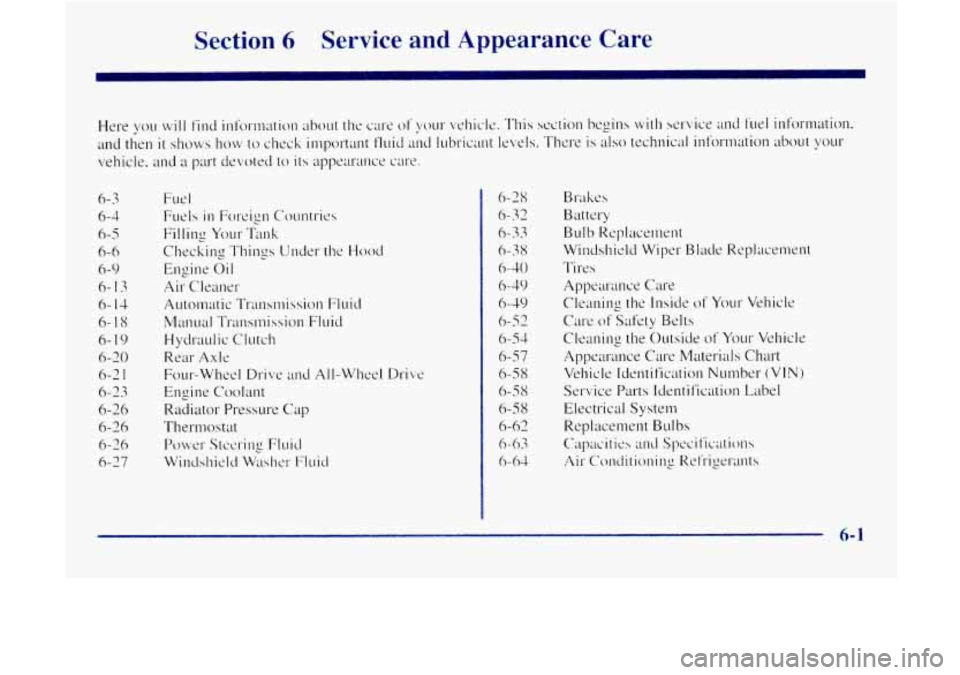
Section 6 Service and Appearance Care
6-3 6-4
6-5
6-6
6-9
6-13
6- 14
6- 1 8
6- 19
6-20
6-2
1
6-23
6-26
6-26 6-26
6-27
6-28
6-32
6-33
6-3
8
6-40
6-49
6-49
6-5 2
6-54
6-57
6-58
6-5 8
6-58
6-62
6-63
6-64 Brakes
Battery
Bulb
Replacement
Windshield Wiper Blade
Repl~tcenwnt
Tires Appemlnce Care
Cleaning
the Inside of Your Vehicle
Care of Safety Belts
Cleaning the Outside
of Your Vehicle
Appearance Care Materiuls
Chart
Vehicle Identification Number (VIN)
Service Parts Identification Label
Electrical System
Replacement Bulbs
Ci,plcities
and Specifications
Air Conditioning Refrigerants
Page 273 of 410

Automatic Transmission Fluid
Operating the engine with the air cleaner off can
cause you or others
to be burned. The air cleaner
not only cleans the air, it stops flame
if the engine
backfires.
If it isn't there, and the engine
backfires, you could be burned. Don't drive with
it
off, and be careful working on the engine with
the air cleaner
off.
I NOTICE:
If the air cleaner is off, a backfire can cause a
damaging engine fire. And, dirt can easily get
into your engine, which
will damage it. Always
have the air cleaner
in place when you're driving.
When to Check and Change
A good time to check your automatic transmission fluid
level is when the engine oil is changed.
Change both the fluid
and filter every 50.000 miles
(83 000 km) if the vehicle is mainly driven under one or
more of these conditions:
In heavy city traffic where the outside temperature
regularly reaches
90°F (32°C) or higher.
In hilly or mountainous terrain.
When doing frequent trailer towing.
Uses such as found in taxi. police or delivery service.
If you do not use your vehicle under any of these
conditions, the fluid and filter do not require changing.
See "Scheduled Maintenance Services"
in the Index.
6-14
Page 290 of 410

Brake Wear
Your vehicle has front disc brakes and rear drum brakes.
If you have the all-wheel drive option, your vehicle has
four-wheel disc brakes.
Disc brake pads have built-in wear indicators that make
a
high-pitched warning sound when the brake pads are worn
and new pads are needed.
The sound may come and go or
be heard all the time your vehicle is moving (except when
you are pushing on the brake pedal firmly).
I A CAUTION: I
The brake wear warning sound means that soon
your brakes won't
work well. That could lead to
an accident. When you hear the brake wear
warning
sound, have your vehicle serviced.
NOTICE:
Continuing to drive with worn-out brake pads
could result in costly brake repair.
Some driving conditions or climates may cause a brake
squeal when the brakes are first applied or lightly
applied. This does not mean something is wrong
with
your brakes.
Properly torqued wheel nuts are necessary to help
prevent brake pulsation. When tires are rotated, inspect
brake
pads for wear and evenly torque wheel nuts in the
proper sequence to
GM specifications.
Your rear
drum brakes don't have wear indicators,
but
if you ever hear a rear brake rubbing noise: have
the rear brake linings inspected. Also, the rear brake
drums should be removed and inspected each time the
tires are removed
for rotation or changing. When you
have the front brake pads replaced. have the rear brakes
inspected, too.
Brake linings should always be replaced as complete
axle sets.
See
"Brake System Inspection" in Section 7 of this manual
under
Part C "Periodic Maintenance Inspections."
6-31
Page 305 of 410

Traction -- A, B, C
The tmction grades, from highest to lowest. are A, B. and
C, and they represent the tire‘s ability to stop on wet
pavement
as measured under controlled conditions on
specified government test surfaces of asphalt and concrete.
A tire marked C may have poor traction perf’ormance.
Wxning: The traction grade assigned
to this tire is based
on braking (straight ahead) traction tests and does not
include cornering (tuning) traction.
Temperature -- A, B, C
The temperature grades are A (,the highest), B, and C.
representing the tire‘s resistance to the gencration of
heat and its ability to dissipate heat when tested undcr
controlled conditions
on a specified indoor laboratory
test wheel. Sustained high temperature can cause
the
material of the tire to degenerate and reduce tire life,
and excessive temperature can lead to sudden tire
failure. The grade
C corresponds to a level of
performance which all passenger car tires must meet
under the Federal Motor Vehicle
Safety Standard
No. 109. Grades B and A represent higher levels of
performance
on the laboratory test wheel than the
minimum required
by law.
Warnin?: Thc ten~perat~u-e pxde for this tire is
estnblishcd for a tire that is properly intlated and not
overloaded. Excessive speed. underinflation, or
excessive loading. either separatcly or in combination.
c;m ca~~se heat buildup
md possible tire failure.
Wheel Alignment and Tire Balance
The wheels on your vehicle were aligned and balanced
care1’uIly at the factory to give you the longest tire life
and best overdl performance.
lee1 Replacement
~epl~e ;my wheel that is bent. cracked, or badly rusted
01- corrocled. If wheel n~~ts keep coming loose. the wheel,
wheel bolts and wheel nuts should be 1-eplacec1.
If the
wheel leaks air, replace it (except some aluminum
wheels. which cm sometimes be repaired). See your
GM dcalcr if any of’ these conditions exist.
6-46
Page 315 of 410
Finish Damage
Any stone chips. fractures or deep scratches in the finish
should be repaired right away. Bare
metal will corrode
quickly and may develop into
a major repair expense.
Minor chips and scratches can be repaired with touch-up
materials available from your dealer or other service
outlets. Larger areas of finish damage can
be corrected
in your dealer’s body and paint shop.
Underbody Maintenance
Chemicals used for ice and snow removal and dust conh-01
can collect on the underbody. If these xe not removed,
accelerated corrosion (rust) can oxcur
on the underbody
parts such as fuel lines, frame, floor pan and exhaust system
even though they have corrosion protection.
At least every spring, flush these materials from the
underbody
with plain water. Clean any areas where mud
and other debris
can collect. Dirt packed in closed areas
of the frame should be loosened before being flushed.
Your dealer or an underbody car washing system can do
this for you.
Chemical Paint Spotting
Some weather and atmospheric conditions can create a
chemical fallout. Airborne pollutants can fall upon and
attack painted surfaces
on your vehicle. This damage
can take two
forms: blotchy, ringlet-shaped
discolorations, and small irregular dark spots etched into
the paint surface.
Although no defect
in the paintjob causes this, CM will
repair. at no charge to the owner. the surfaces of new
vehicles damaged by this fallout condition
within
I2 months or 12,000 miles (20 000 km) of purchase.
whichever occurs
first.
6-56
Page 323 of 410
Capacities (Approximate)
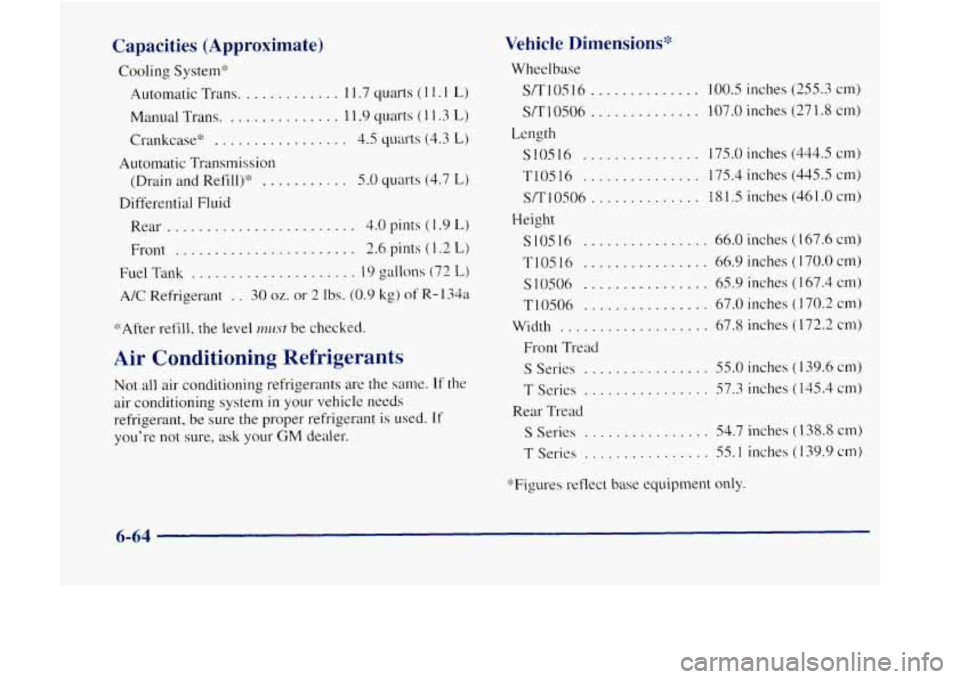
Cooling System"
Automatic Trans.
............ 1 1.7 quarts (
Manual Trans. .............. 1 1.9 quarts (
Crankcase"' ......... . . 4.5 quarts
Automatic Transmission
11.1 L)
1 I .3 L)
(4.3 L)
. . 5.0 quarts (4.7 L) (Drain and Refill)* .......
Differential Fluid
Rear ........................ 4.0 pints ( I .9 L)
Front ....................... 2.6 pints ( 1.2 L)
Fuel Tank ..................... IC) gallons (72 L)
A/C Refrigerant . . 30 oz. or 2 Ibs. (0.9 kg) of R- 1341
:%After refill. the level Inust be checked.
Air Conditioning Refrigerants
Not all air conditioning refrigerants are the same. If the
air conditioning system in your vehicle needs
refrigerant,
be sure the proper refrigerant is used. If
you're not sure, ask your GM dealer.
Vehicle Dimensions*
Wheelbase
S/TlOSIb
.............. 100.5 inches (255.3 cm)
S/T10506 .............. 107.0 inches (27 I .8 crn)
Length
S 105 I6 ............... 175.0 inches (444.5 cm)
TI0516 ............... 175.4 inches (445.5 cm)
S/T 1 OS06 .............. 18 1 .S inches (46 1 .O cm)
SI0516 .... ........ 66.0 inches (167.6 cm)
T 1 OS 16 ................ 66.9 inches ( 170.0 cm)
SI0506 ................ 65.9 inches (167.4 cm)
TI0506
................ 67.0 inches (170.2 cm)
Width ................... 67.8 inches (172.2 cm)
Front Tread
S Series ................ 55.0 inches ( 139.6 cm)
T Series ................ 57.3 inches (145.4 cm)
S Series ................ 54.7 inches ( 138.8 an)
T Series ................ 55.1 inches (139.9 cm)
Height
Rear Tread
'%Figures retlect base equipment only.
6-64
Page 325 of 410

KEEP ENGINE OIL
AT THE PROPER
LEVEL AND CHANGE AS
RECOMMENDED
Introduction
Your Vehicle and the Environment
Proper vehicle maintenance not only helps to keep your
vehicle
in good working condition, but also helps the
environment.
All recommended maintenance procedures
are important. Improper vehicle maintenance can even
affect the quality
of the air we breathe. Improper fluid
levels or the wrong tire inflation can increase the level
of emissions from your vehicle. To help protect our
environment. and to keep your vehicle
in good
condition, please maintain your vehicle properly.