1997 FORD RANGER light
[x] Cancel search: lightPage 132 of 361
![FORD RANGER 1997 2.G Owners Manual 130
*
[SS13070(R)01/96]
17-1/2 pica
art:0050088-A
Inflated passenger-side air bag
*
[SS13080(R)05/96]
RWARNING
The air bag will inflate only once. The system is
designed to function on a one-time-only](/manual-img/11/5332/w960_5332-131.png "FORD RANGER 1997 2.G Owners Manual 130
*
[SS13070(R)01/96]
17-1/2 pica
art:0050088-A
Inflated passenger-side air bag
*
[SS13080(R)05/96]
RWARNING
The air bag will inflate only once. The system is
designed to function on a one-time-only")
130
*
[SS13070(R)01/96]
17-1/2 pica
art:0050088-A
Inflated passenger-side air bag
*
[SS13080(R)05/96]
RWARNING
The air bag will inflate only once. The system is
designed to function on a one-time-only basis. If the air
bag is inflated, THE AIR BAG WILL NOT FUNCTION
AGAIN AND MUST BE REPLACED IMMEDIATELY. If
the air bag is not replaced, this will increase the risk of
injury in a subsequent collision.
*
[SS13090(R)05/96]
To ensure that the air bag system will operate as intended in a
crash, the system is equipped with a diagnostic module, which
controls a readiness lamp and a warning tone. The diagnostic
module monitors its own circuits, the air bag electrical system,
the air bag readiness light, the air bag power and the air bag
inflators.
File:06unssr.ex
Update:Fri Mar 21 09:43:41 1997
Page 133 of 361
![FORD RANGER 1997 2.G Owners Manual Seating and Safety Restraints
131
%*
[SS13100(R)05/96]
A problem with the system is indicated by one or more of the
following:
*
[SS13125(R)05/96]
n
the readiness light will either flash or stay illum](/manual-img/11/5332/w960_5332-132.png "FORD RANGER 1997 2.G Owners Manual Seating and Safety Restraints
131
%*
[SS13100(R)05/96]
A problem with the system is indicated by one or more of the
following:
*
[SS13125(R)05/96]
n
the readiness light will either flash or stay illum")
Seating and Safety Restraints
131
%*
[SS13100(R)05/96]
A problem with the system is indicated by one or more of the
following:
*
[SS13125(R)05/96]
n
the readiness light will either flash or stay illuminated,
*
[SS13150(R)05/96]
n
or it will not illuminate immediately after ignition is turned
on,
*
[SS13175(R)05/96]
n
or a group of five beeps will be heard. The tone pattern will
repeat periodically until the problem and light are repaired.
*
[SS13225(R)01/96]
If any of these things happen, have the air bag system serviced
at your Ford or Lincoln-Mercury dealer immediately. Unless
serviced, the air bag supplemental restraint system may not
function properly in the event of a collision.
*
[SS13300(R)05/96]
RWARNING
Do not attempt to service, repair, or modify the Air Bag
Supplemental Restraint System or its fuses. See your
Ford or Lincoln-Mercury dealer.
%*
[SS13680(R)05/96]
Disposal of air bags and air bag equipped vehicles
*
[SS13700(R)05/96]
For disposal of air bags or air bag equipped vehicles, see your
local Ford or Lincoln-Mercury dealer. Air bagsMUSTbe
disposed of by qualified personnel.
%*
[SS14300(R)01/96]
Safety Restraints for Children
*
[SS14400(R)01/96]
In the U.S. and Canada, you are required by law to use safety
restraints for children. If small children ride in your vehicle Ð
this generally includes children who are four years old or
younger and who weigh 40 pounds (18 kg) or less Ð you must
put them in safety seats that are made specially for children.
Safety belts alone do not provide maximum protection for these
children. Check your local and state laws for specific
requirements.
File:06unssr.ex
Update:Fri Mar 21 09:43:41 1997
Page 149 of 361
![FORD RANGER 1997 2.G Owners Manual 148
%*
[TO06200(R)01/96]
Starting Your Engine
*
[TO06300(R)01/96]
To start your engine:
*
[TO06400(R)01/96]1.
Follow the steps underPreparing to Start Your Vehicleat the
beginning of this section.
*
[](/manual-img/11/5332/w960_5332-148.png "FORD RANGER 1997 2.G Owners Manual 148
%*
[TO06200(R)01/96]
Starting Your Engine
*
[TO06300(R)01/96]
To start your engine:
*
[TO06400(R)01/96]1.
Follow the steps underPreparing to Start Your Vehicleat the
beginning of this section.
*
[")
148
%*
[TO06200(R)01/96]
Starting Your Engine
*
[TO06300(R)01/96]
To start your engine:
*
[TO06400(R)01/96]1.
Follow the steps underPreparing to Start Your Vehicleat the
beginning of this section.
*
[TO06425(R)01/96]2.
Turn the ignition key to the ON position.
*
[TO06451(R)01/96]3.
DO NOT depress the accelerator pedal when starting your
engine. DO NOT use the accelerator while the vehicle is
parked.
*
[TO06475(R)01/96]4.
Turn the key to the START position (cranking) until the
engine starts. Allow the key to return to the ON position
after the engine has started.
*
[TO06501(R)01/96]
If you have difficulty in turning the key, rotate the steering
wheel slightly because it may be binding.
%*
[TO06510(R)01/96]
For a cold engine:
*
[TO06515(R)01/96]
n
At temperatures10ÊF (-12ÊC) andbelow:If the engine does
not start infifteen (15) secondson the first try, turn the key
to OFF, wait approximately ten (10) seconds so you do not
flood the engine, then try again.
*
[TO06520(R)01/96]
n
At temperaturesabove10ÊF(-12ÊC):If the engine does not
start infive (5) secondson the first try, turn the key to OFF,
wait approximately ten (10) seconds so you do not flood the
engine, then try again.
%*
[TO06521(R)01/96]
For a warm engine:
*
[TO06522(R)01/96]
n
Do not hold the key in the START position for more than
five (5) secondsat a time. If the engine does not start within
five (5) seconds on the first try, turn the key to the OFF
position. Wait a few seconds after the starter stops, then try
again.
*
[TO06575(R)01/96]
Whenever you start your vehicle, release the key as soon as the
engine starts. Excessive cranking could damage the starter.
File:08untor.ex
Update:Thu Mar 20 08:53:27 1997
Page 156 of 361
![FORD RANGER 1997 2.G Owners Manual 155
Driving
%*
[GF00100(R)05/96]
Brakes
*
[GF00200(R)01/96]
Front Disc Brakes
*
[GF00210(R)01/96]
The front disc brakes are self-adjusting. They do not require
service other than periodic inspection f](/manual-img/11/5332/w960_5332-155.png "FORD RANGER 1997 2.G Owners Manual 155
Driving
%*
[GF00100(R)05/96]
Brakes
*
[GF00200(R)01/96]
Front Disc Brakes
*
[GF00210(R)01/96]
The front disc brakes are self-adjusting. They do not require
service other than periodic inspection f")
155
Driving
%*
[GF00100(R)05/96]
Brakes
*
[GF00200(R)01/96]
Front Disc Brakes
*
[GF00210(R)01/96]
The front disc brakes are self-adjusting. They do not require
service other than periodic inspection for pad wear.
*
[GF00270(R)03/96]
Rear Drum Brakes
*
[GF00274(R)03/96]
The rear drum brakes are self-adjusting. Automatic adjustment
occurs when the brakes are applied while ªbacking up.º If
normal operation does not include much backing, adjust the
brakes when they seem ªlow,º using the procedure underIf
Brakes Do Not Grip Well or Pedal is ªLowºin this chapter.
*
[GF00300(R)01/96]
Hydraulic Power Brakes
[GF00310(R)01/96]
The hydraulic brake system is made up of two independent
hydraulic circuits. One hydraulic circuit supplies fluid to the
front disc brakes and the other hydraulic circuit supplies fluid
to the rear drum or disc brakes. These two circuits are supplied
by a common hydraulic brake fluid reservoir, with a fluid level
sensor.
[GF01010( ALL)03/97]
Occasional brake noise is normal and does not indicate a
performance concern with the vehicle's brake system. In normal
operation, automotive brake systems may emit occasional or
intermittent squeal or groan noises when the brakes are applied.
Such noises are usually heard during the first few brake
applications in the morning; however, they may be heard at any
time while braking and can be aggravated by environmental
conditions such as cold, heat, moisture, road dust, salt or mud.
If a ªmetal-to-metalº or ªcontinuous grindingº sound is present
while braking, the brake linings may be worn-out and should be
inspected by a qualified service technician.
*
[GF00312(R)01/96]
The brake light in the instrument cluster will light for low brake
fluid in the common brake fluid reservoir.
File:09ungfr.ex
Update:Thu Mar 20 08:55:24 1997
Page 164 of 361
![FORD RANGER 1997 2.G Owners Manual Driving
163
[GF00900(R)05/96]
Automatic Transmission Operation
(4R44E/5R55E)
[GF08715(R)05/96]
If your vehicle is equipped with an automatic transmission, it
will be either a four speed overdrive tran](/manual-img/11/5332/w960_5332-163.png "FORD RANGER 1997 2.G Owners Manual Driving
163
[GF00900(R)05/96]
Automatic Transmission Operation
(4R44E/5R55E)
[GF08715(R)05/96]
If your vehicle is equipped with an automatic transmission, it
will be either a four speed overdrive tran")
Driving
163
[GF00900(R)05/96]
Automatic Transmission Operation
(4R44E/5R55E)
[GF08715(R)05/96]
If your vehicle is equipped with an automatic transmission, it
will be either a four speed overdrive transmission (4R44E) or a
five speed overdrive transmission (5R55E). All 2.3L and 3.0L
engines use the 4R44E transmission, while all 4.0L engines use
the 5R55E transmission. Both transmission types have a lockup
torque converter. Transmission operation is controlled by the
Powertrain Control Module (PCM).
*
[GF08720(R)01/96]
The PCM will automatically adjust transmission operation to
make up for varying conditions. Several sensors located on the
engine and transmission such as throttle position, engine speed,
vehicle speed and transmission temperature are used by the
PCM to shift the transmission into a higher or lower gear when
required for the best performance and fuel economy. For
example, you may notice that the transmission will upshift to a
higher gear more quickly when the vehicle has not reached
normal operating temperature.
*
[GF08730(R)01/96]
The PCM also controls the transmission's Torque Converter
Clutch (TCC) to further raise vehicle performance and fuel
economy. The TCC will engage when the transmission operating
temperature and other conditions determined by the PCM have
been met. Engagement of the clutch may be noted as a decrease
in engine speed.
[GF08740(R)05/96]
To help in troubleshooting, the PCM continually performs
self-tests on the electronic control system and, if any faults are
detected, stores them in memory. The Transmission Control
Indicator Light (TCIL) (O/D OFF), which is located on the
instrument cluster, may flash steadily if a malfunction has been
detected. If the TCIL is flashing, contact your Ford dealer as
soon as possible. If this condition persists, damage to the
transmission could occur.
File:09ungfr.ex
Update:Thu Mar 20 08:55:24 1997
Page 169 of 361
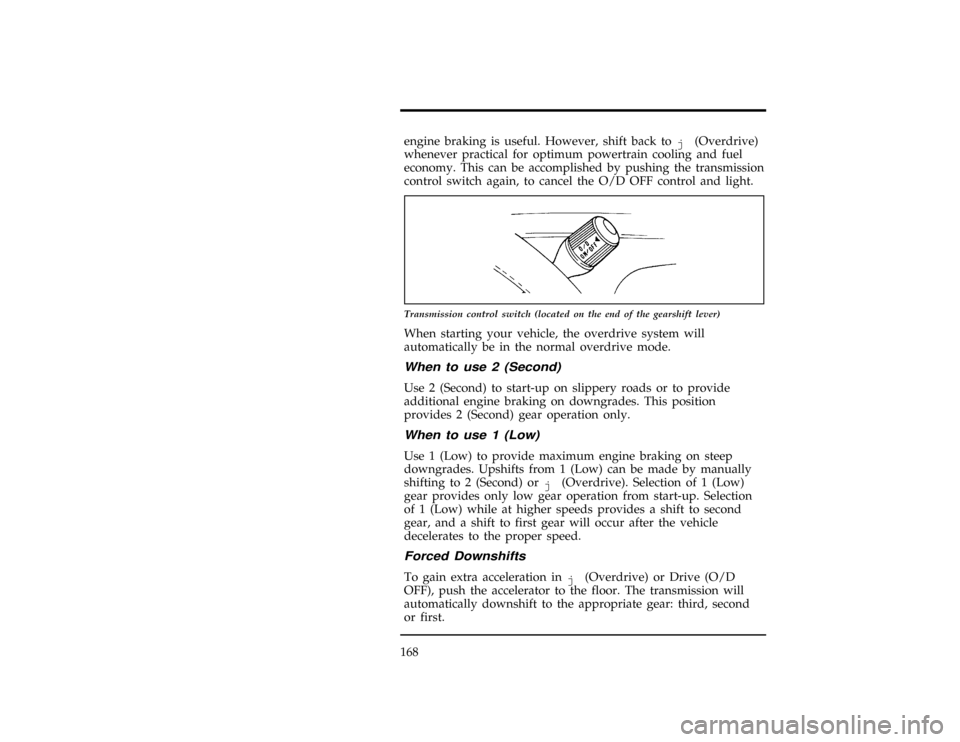
168engine braking is useful. However, shift back to
j(Overdrive)
whenever practical for optimum powertrain cooling and fuel
economy. This can be accomplished by pushing the transmission
control switch again, to cancel the O/D OFF control and light.
[GF09850(R)01/96]
quarter page
art:0021255-A
Transmission control switch (located on the end of the gearshift lever)
*
[GF09950(R)01/96]
When starting your vehicle, the overdrive system will
automatically be in the normal overdrive mode.
*
[GF10100(R)05/96]
When to use 2 (Second)
*
[GF10200(R)05/96]
Use 2 (Second) to start-up on slippery roads or to provide
additional engine braking on downgrades. This position
provides 2 (Second) gear operation only.
*
[GF10300(R)05/96]
When to use 1 (Low)
*
[GF10400(R)05/96]
Use 1 (Low) to provide maximum engine braking on steep
downgrades. Upshifts from 1 (Low) can be made by manually
shifting to 2 (Second) or
j(Overdrive). Selection of 1 (Low)
gear provides only low gear operation from start-up. Selection
of 1 (Low) while at higher speeds provides a shift to second
gear, and a shift to first gear will occur after the vehicle
decelerates to the proper speed.
*
[GF10402(R)05/96]
Forced Downshifts
*
[GF10404(R)05/96]
To gain extra acceleration in
j(Overdrive) or Drive (O/D
OFF), push the accelerator to the floor. The transmission will
automatically downshift to the appropriate gear: third, second
or first.
File:09ungfr.ex
Update:Thu Mar 20 08:55:24 1997
Page 170 of 361
![FORD RANGER 1997 2.G Owners Manual Driving
169
[GF10410(R)05/96]
Driving (5R55E Transmission)
%*
[GF10419(R)05/96]
When to use
j(Overdrive)
*
[GF10420(R)05/96]
This is the normal driving position. As the vehicle picks up
speed, automat](/manual-img/11/5332/w960_5332-169.png "FORD RANGER 1997 2.G Owners Manual Driving
169
[GF10410(R)05/96]
Driving (5R55E Transmission)
%*
[GF10419(R)05/96]
When to use
j(Overdrive)
*
[GF10420(R)05/96]
This is the normal driving position. As the vehicle picks up
speed, automat")
Driving
169
[GF10410(R)05/96]
Driving (5R55E Transmission)
%*
[GF10419(R)05/96]
When to use
j(Overdrive)
*
[GF10420(R)05/96]
This is the normal driving position. As the vehicle picks up
speed, automatic upshifts to second, third, fourth and fifth gears
will occur when
j(Overdrive) is chosen on the selector and
the transmission control switch has not been pressed. The
transmission will shift into the correct gear when the right
speed is achieved, for the accelerator pedal position you have
chosen.
*
[GF10429(R)05/96]
When to use Drive
[GF10430(R)05/96]
You will note there is not a drive position on your gearshift
indicator. However, you will find a transmission control switch
labeled OD ON/OFF located on the end of the gearshift lever.
With overdrive canceled and the OD ON/OFF illuminated, the
transmission will operate in gears one through four. This is
useful if you experience frequent downshift/upshift conditions,
when operating a heavy load or in hilly terrain, or if additional
engine braking is useful. However, shift back to
j(Overdrive)
whenever practical for optimum powertrain cooling and fuel
economy. This can be accomplished by pushing the transmission
control switch again, to cancel the OVERDRIVE OFF control and
light.
*
[GF10435(R)05/96]
When to use 2 (Second)
*
[GF10440(R)05/96]
With the gearshift in the 2 (Second) position, more engine
braking is provided. Use the 2 (Second) position to drive up
moderately steep grades, to start up slippery roads, or to
provide moderate engine braking on downgrades. DO NOT GO
FASTER THAN 55 mph (88 km/h) IN THIS GEARSHIFT
POSITION.
File:09ungfr.ex
Update:Thu Mar 20 08:55:24 1997
Page 177 of 361
![FORD RANGER 1997 2.G Owners Manual 176
[GF16190(R)05/96]
Four-wheel drive operation (4x4 HIGH or 4x4 LOW) on dry
pavement is not recommended. Operating the vehicle in
four-wheel drive on dry pavement will increase noise, vibration,
tir](/manual-img/11/5332/w960_5332-176.png "FORD RANGER 1997 2.G Owners Manual 176
[GF16190(R)05/96]
Four-wheel drive operation (4x4 HIGH or 4x4 LOW) on dry
pavement is not recommended. Operating the vehicle in
four-wheel drive on dry pavement will increase noise, vibration,
tir")
176
[GF16190(R)05/96]
Four-wheel drive operation (4x4 HIGH or 4x4 LOW) on dry
pavement is not recommended. Operating the vehicle in
four-wheel drive on dry pavement will increase noise, vibration,
tire wear, decrease fuel economy, and make four-wheel drive
disengagement difficult for the transfer case.
[GF16200(R)05/96]
Electric shift system indicator lights
[GF16210(R)05/96]
A 4WD indicator light and a 4WD LOW indicator light are
located in the instrument cluster. If either light flashes, take
your vehicle in for service.
[GF16220(R)05/96]
n
Two-Wheel Drive mode Ð Neither the 4WD nor the 4WD
LOW lights are lit.
[GF16230(R)05/96]
n
4WD High Ð Only the 4WD light is lit.
[GF16240(R)05/96]
n
4WD LOW mode Ð Both the 4WD and 4WD LOW lights
are lit.
[GF16250(R)05/96]
To shift from Two-Wheel Drive to 4WD High:
[GF16260(R)05/96]
To shift into 4WD High rotate the 4WD switch located on the
instrument panel to 4x4 High. This shift can be done at a stop
or at speeds up to 55 miles per hour (88 km/h). When the
vehicle is driven, the automatic locking hubs will engage. If the
vehicle is stopped while in 4WD and the vehicle direction is
reversed from the previous direction, the automatic locking hubs
will momentarily disengage and re-engage. The automatic
locking hubs may click as they automatically engage in the new
direction.
File:09ungfr.ex
Update:Thu Mar 20 08:55:24 1997