Page 139 of 219
Fuses
Position Amps Description
7 15 Parking and tail lamps
8 30 Headlamps
9 15 Daytime running lamps and fog lamps
10 25 Auxiliary power point
11 - Not used
12 - Not used
13 - Not used
14 60/20 4WABS/rear anti-lock brake
15 50 Air suspension compressor
16 40 Trailer tow battery charge and stop/turn lamps
17 30 4WD transfer case shift motor and clutch
18 30 Driver power seat
19 20 Fuel pump
20 50 Instrument panel fuse panel ignition switch feed
21 50 Instrument panel fuse panel ignition switch feed
22 50 I/P fuse panel battery feed
23 40 I/P blower
24 30 PCM power
25 30 Power windows
26 - Not used
27 - Not used
28 30 Trailer tow electronic brake
29 - Not used
Diodes
Position Description
1 Rear ABS diode
2 PCM diode
Roadside emergencies
140
Page 142 of 219
Tire change procedure
1. Park on a level surface.
2. Activate the hazard flashers.
3. Set the parking brake.
4. Place the gearshift in P (Park)
(automatic transmission) or R
(Reverse) (manual transmission).
For 4WD vehicles equipped with
Lever-operated transfer case, make
sure that the lever is not in the N
(Neutral) position.
5. Block the diagonally opposite
wheel.
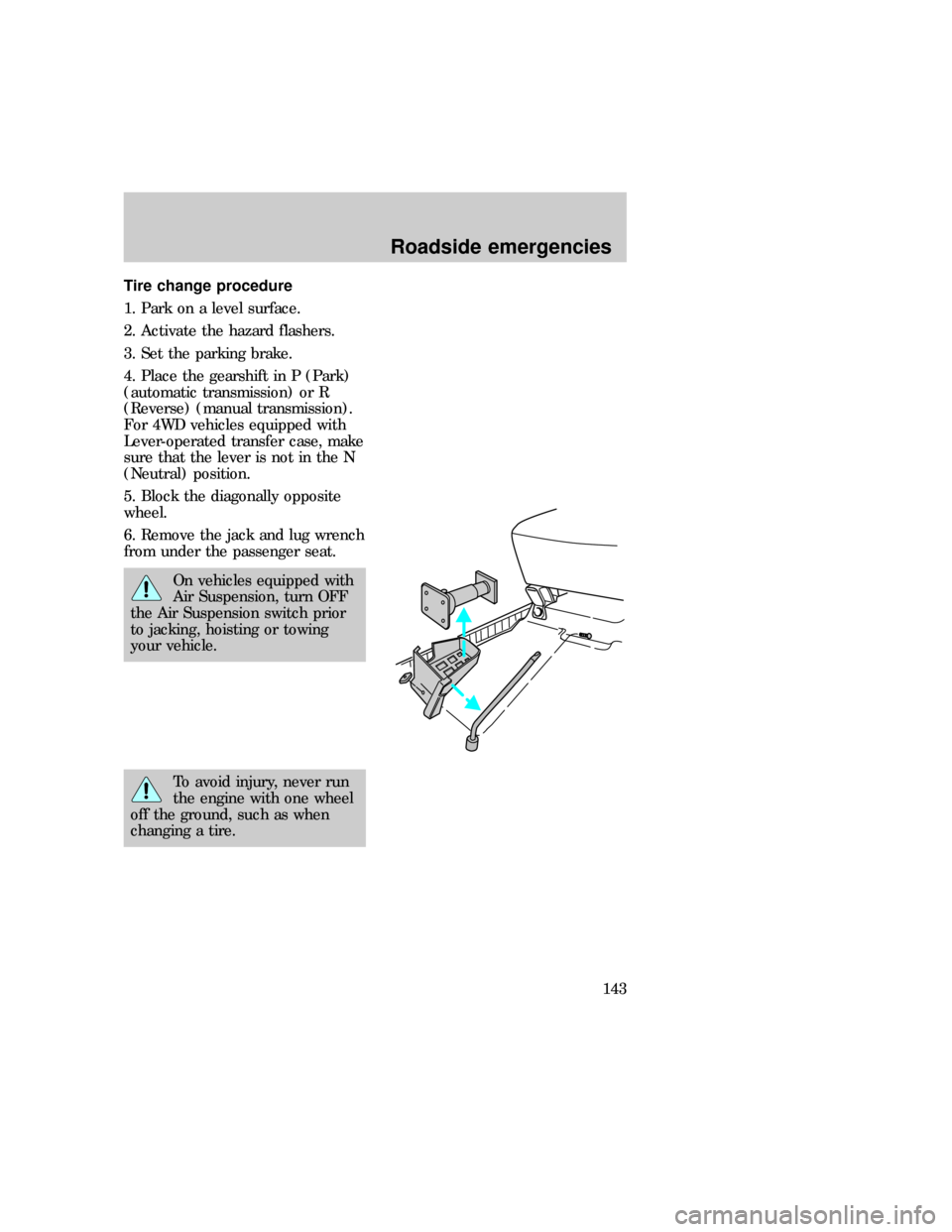
6. Remove the jack and lug wrench
from under the passenger seat.
On vehicles equipped with
Air Suspension, turn OFF
the Air Suspension switch prior
to jacking, hoisting or towing
your vehicle.
To avoid injury, never run
the engine with one wheel
off the ground, such as when
changing a tire.
f12_removing_spare
Roadside emergencies
143
Page 144 of 219
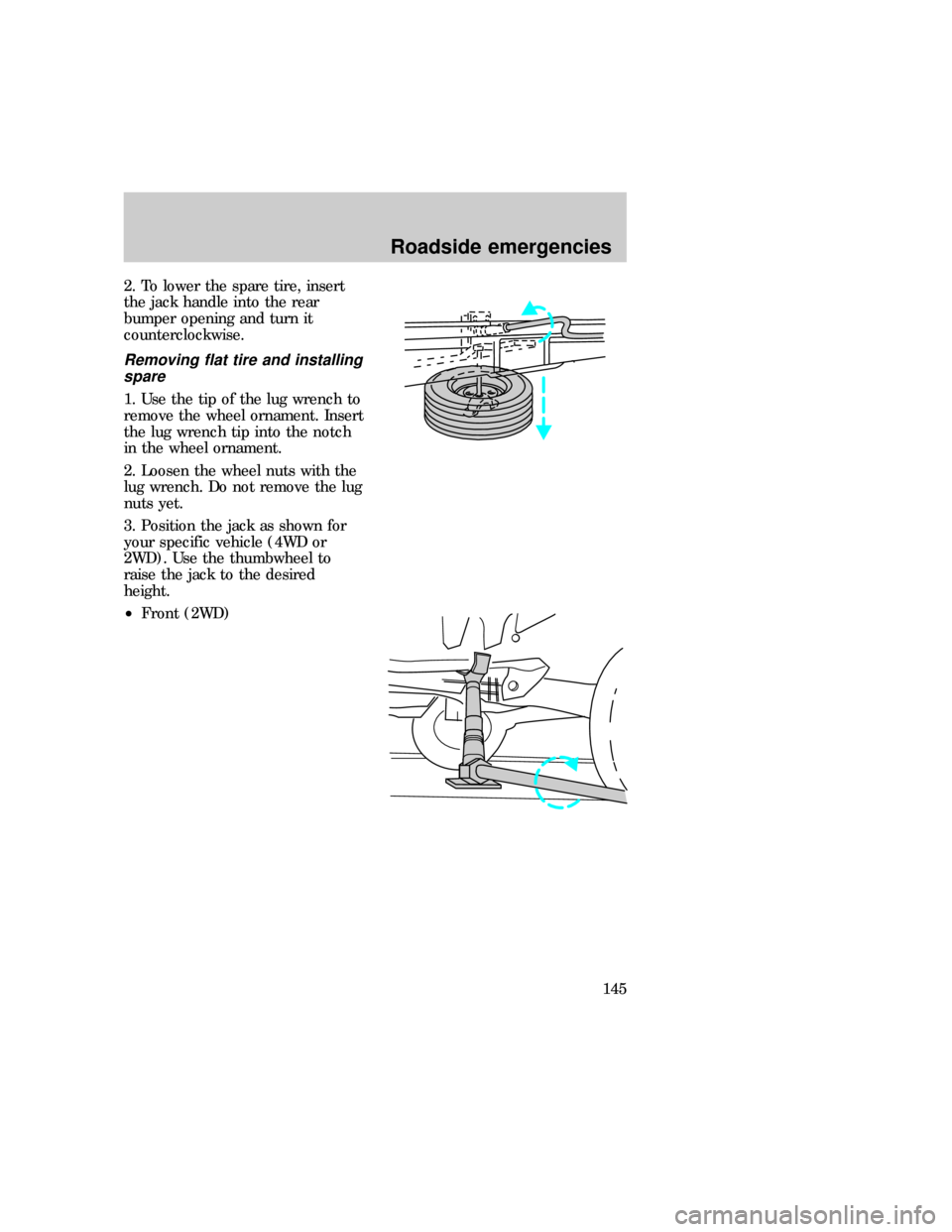
2. To lower the spare tire, insert
the jack handle into the rear
bumper opening and turn it
counterclockwise.
Removing flat tire and installing
spare
1. Use the tip of the lug wrench to
remove the wheel ornament. Insert
the lug wrench tip into the notch
in the wheel ornament.
2. Loosen the wheel nuts with the
lug wrench. Do not remove the lug
nuts yet.
3. Position the jack as shown for
your specific vehicle (4WD or
2WD). Use the thumbwheel to
raise the jack to the desired
height.
²Front (2WD)
f12_removing_flat
Roadside emergencies
145
Page 147 of 219
9. To stow the flat tire, lay the tire
on the ground with the inboard
side facing up. Install the retainer
through the wheel center and slide
the wheel under the vehicle. Turn
the spare handle clockwise until
the tire is raised to its original
position underneath the vehicle.
The spare handle ratchets when
the tire is raised to the stowed
position. It will not allow you to
overtighten.
10. Unblock the wheel.
11. Stow the jacking equipment
under the passenger seat and stow
the jack handle in the engine
compartment.
12. As soon as possible, tighten the
wheel nuts with a torque wrench
to 115±165 Nm (85±115 lb-ft).
JUMP STARTING YOUR
VEHICLE
The gases around the
battery can explode if
exposed to flames, sparks, or lit
cigarettes. An explosion could
result in injury or vehicle
damage.
Do not push-start your
vehicle. You could damage
the catalytic converter. For
further information, seeJumper
Cablesin the Index.
com_jump-starting.01
Roadside emergencies
148
Page 151 of 219

2. Maximum speed is 56 km/h (35
mph).
3. Maximum distance is 80 km (50
miles).
If a distance of 80 km (50 miles)
or a speed of 56 km/h (35 mph)
must be exceeded, you must
disconnect the rear driveshaft.
With the rear driveshaft
disconnected, the maximum speed
is 88 km/h (55 mph) and there are
no mileage restrictions.
See your dealer for help with
disconnecting the driveshaft.
4WD ± Lever operated transfer
case (manual and automatic
transmissions)
1. Place transmission in P (Park).
2. Shift the transfer case to N
(Neutral).
3. Lockout the center disconnect
by capping off one of the front
axle vacuum motor lines. See your
Ford dealer for assistance.
4. Vehicle speed should not exceed
88 km/h (55 mph) and there are
no mileage restrictions.
4WD ± Electronic shift transfer
case
1. Place transmission in N
(Neutral).
2. Shift the transfer case to 2H
(2WD high).
3. Lockout the center disconnect
by capping off one of the front
axle vacuum motor lines. See your
dealer for assistance.
Roadside emergencies
152
Page 154 of 219

could get caught in moving
parts. Take precautions with
long hair.
²Do not work on a vehicle with
the engine running in an
enclosed space, unless you are
sure you have enough
ventilation.
²Keep all lit cigarettes, open
flames and other lit material
away from the battery and all
fuel related parts.
If you disconnect the battery, the
engine must ªrelearnº its idle
conditions before your vehicle will
drive properly, as explained in
Batteryin this chapter.
Working with the engine off
²Automatic transmission
1. Set the parking brake fully and
ensure the gearshift is securely
latched in P (Park).
2. Turn off the engine and remove
the key.
3. Block the wheels to prevent the
vehicle from moving unexpectedly.
²Manual transmission
1. Set the parking brake, depress
the clutch and place the gearshift
in 1 (First).
2. Turn off the engine and remove
the key.
3. Block the wheels to prevent the
vehicle from moving unexpectedly.
Working with the engine on
²Automatic transmission
com_working_off.02
com_working_on.02
Maintenance and care
155
Page 155 of 219
1. Set the parking brake fully and
ensure the gearshift is securely
latched in P (Park).
2. Block the wheels to prevent the
vehicle from moving unexpectedly.
Do not start your engine
with the air cleaner
removed and do not remove it
while the engine is running.
²Manual transmission
1. Set the parking brake, depress
the clutch and place the gearshift
in 1 (First).
2. Block the wheels to prevent the
vehicle from moving unexpectedly.
f12_opening_hood
Maintenance and care
156
Page 167 of 219

If you must remove the coolant
recovery cap, follow these steps to
avoid personal injury:
1. Before you remove the cap, turn
the engine off and let it cool.
2. When the engine is cool, wrap a
thick cloth around the cap. Slowly
turn cap counterclockwise to the
first stop.
3. Step back while the pressure
releases.
4. When you are sure that all the
pressure has been released, use
the cloth to press the cap down,
turn it counterclockwise and
remove it.
Use Ford Premium Cooling System
Fluid E2FZ-19549±AA (in Canada,
Motorcraft CXC-8±B) or an
equivalent premium engine coolant
that meets Ford Specification
ESE-M97B44±A. Ford Premium
Engine Coolant is an optimized
formula that will protect all metals
and rubber elastomers used in
Ford cooling systems for 4 years or
80,000 km (50,000 miles).
Do not use alcohol or methanol
antifreeze or any engine coolants
mixed with alcohol or methanol
antifreeze. Do not use
supplemental coolant additives in
your vehicle. These additives may
harm your engine cooling system.
The use of an improper coolant
may void the warranty of your
vehicle's engine cooling system.
f12_recycled_coolant
Maintenance and care
168